You’re not paranoid about data breaches. You’re behind if you’re not worried.
Let me be blunt: the way we casually throw patient info into phones, emails, shared drives, and random apps is insane. And yes, as a student, resident, or early-career doc, you’re the one who’s going to lie awake thinking, “Did I just violate HIPAA and ruin my career because I saved that patient note in my Google Drive?”
You’re not alone. I’ve heard this exact whisper outside team rooms:
“I took a picture of the whiteboard for my notes… do I have to delete it now?”
“I emailed myself the H&P to work on at home… is that illegal?”
“I have a spreadsheet of cases for my log… what if I get audited?”
Let’s walk through this like someone who is actually scared of getting burned. Because you’re right to be cautious.
The Harsh Truth: Almost Everything You Want to Store Is Risky
Here’s the ugly starting point:
If you’re asking “How much patient info can I safely store?”, the correct default is “Way less than you think.”
Most of what we casually want to keep—full notes, screenshots, pictures of the monitor, labeled case logs—is not safely storable on your personal devices or in your favorite cloud tools.
HIPAA doesn’t care that you’re “just a student” or “only using initials.”
Let me draw a line in the sand:
If it has anything that can reasonably identify a patient, you should assume:
- You cannot store it on your personal phone, laptop, or personal cloud
- You cannot email it to your Gmail, Outlook.com, or random personal account
- You cannot save it in Notion, Evernote, Apple Notes, or Google Docs under your personal login
Unless your institution has specifically approved that platform for PHI and given you a work-controlled account, it’s a no.
And “PHI” (Protected Health Information) is broader than your brain wants it to be.
What counts as identifiable?
You probably know the obvious ones: name, MRN, date of birth.
But HIPAA’s “18 identifiers” list is brutal. If anything in your notes directly links to a person or makes it “reasonably possible” to identify them, it’s PHI.
That includes:
- Dates (admission date, discharge date, procedure date, birthdate) when tied to clinical info
- Contact info (phone, email, address, zip code)
- ID numbers (MRN, encounter number, device serial number)
- Photos where the patient, their face, tattoos, or room number are visible
- Biometric stuff (fingerprints, voice recordings)
- Even rare diseases or wild combinations of details in a small community that make someone “obviously that guy”
So that “HIV-positive 45-year-old cardiologist from our own hospital” in your reflective essay? Yeah. Closer to identifiable than you think.
How Much Can I Safely Store? The Real Answer: Almost Zero PHI, Lots of De‑identified Stuff
Here’s the core thing you actually care about:
“How much actual patient info can I keep on my own devices and still sleep at night?”
You want a mental rule you can apply at 2 a.m. when you’re exhausted.
Let’s split it very cleanly:
| Type of Information | Usually OK to Store Personally? |
|---|---|
| Full notes with name/MRN/dates | No |
| Photos of patients or monitors | No |
| Case logs with MRN or dates | No |
| De-identified summaries (no dates, no IDs) | Yes, usually |
| Lessons learned / patterns / teaching points | Yes |
| Raw research data with identifiers | No, unless on approved system |
What’s usually not safe to store on your own devices
- Full H&Ps, discharge summaries, consult notes
- Screenshots from the EHR with any visible patient data
- Photos taken in patient rooms (even “just the monitor”)
- Personal case logs with MRNs, exact dates, or room numbers
- Clinic lists, rounding lists, handoff documents
- Copies of imaging, ECGs, or labs with names, dates, or IDs
These belong only:
- In the hospital’s EHR
- On institution-approved, encrypted systems
- Under institutional accounts, not your random personal cloud
What you can safely store — as long as you do it properly de-identified
You can keep:
- Clinical pearls: “For elderly AFib patients with CKD, consider X instead of Y”
- Fully de-identified case summaries: “Middle-aged patient with uncontrolled diabetes develops X…” (no names, no MRN, no exact dates, no unique personal detail)
- Reflections that don’t tie to a particular, recognizable person
- Patterns you’ve noticed: “3 patients in a week had delayed diagnosis of spinal epidural abscess because…”
The absolute golden rule:
If someone from your hospital could read your saved material and immediately say, “Oh, that’s Mrs. Johnson in 8B,” you’ve failed at de-identification.
The Nightmare Scenarios You’re Afraid Of (And How They Actually Play Out)
Let’s confront the scary stuff you’re imagining in the shower.
Scenario 1: “I saved a rounding list on my phone. Am I done?”
This is incredibly common. Resident prints list. You snap a photo “just for today.” Then you forget.
Is this technically a HIPAA problem if your phone isn’t encrypted and it gets stolen? Yes.
Is every single person who’s done this immediately reported to the board? No.
But here’s the pattern I’ve seen:
- One small mistake is usually handled with counseling, documentation, maybe retraining
- Repeated sloppiness or obvious negligence? That’s when careers actually get damaged
Still, why gamble? At minimum:
- Turn on full device encryption
- Use a strong passcode or biometrics
- Delete those photos immediately and empty your “Recently Deleted” folder
Scenario 2: “I emailed myself a note from my hospital email to Gmail”
Confession: lots of people do this before they know better. Doesn’t make it fine.
If PHI was in that email, yes, it’s a potential HIPAA issue. Personal Gmail is not a HIPAA-compliant system for PHI unless you have a special business setup (you don’t).
If this happened:
- Don’t panic and start mass-deleting everything and hiding it. That looks worse if it ever comes up.
- Talk to someone you trust in your program, or your institution’s privacy office if you feel safe doing that.
- Going forward: treat personal email as absolutely off-limits for patient data. Period.
Scenario 3: “I have a case log spreadsheet with MRNs and dates on my laptop”
This one horrifies me because case logs are expected in many fields (surgery, anesthesia, EM), and no one properly explains how to do them safely.
Storing raw MRNs and dates on an unencrypted personal device? That’s a real problem if it gets stolen or hacked.
The safer way:
- Use institution-approved logging tools if they exist (ACGME case log systems, etc.)
- If you must track on your own: use anonymous case IDs that only link back inside the hospital (e.g., you keep the “decoder” inside a secure system at work, not your home laptop)
And if you already have a spreadsheet with identifiers? Encrypt the file or folder at a minimum, then talk to your program about migrating that data to a safer system.
The Future: It’s Getting Better And Worse At The Same Time
Everyone likes to say “the future of healthcare is digital.” They don’t mention the part where it also means “the future of healthcare is a constant low-grade panic about data leaks.”
Here’s where we really are:
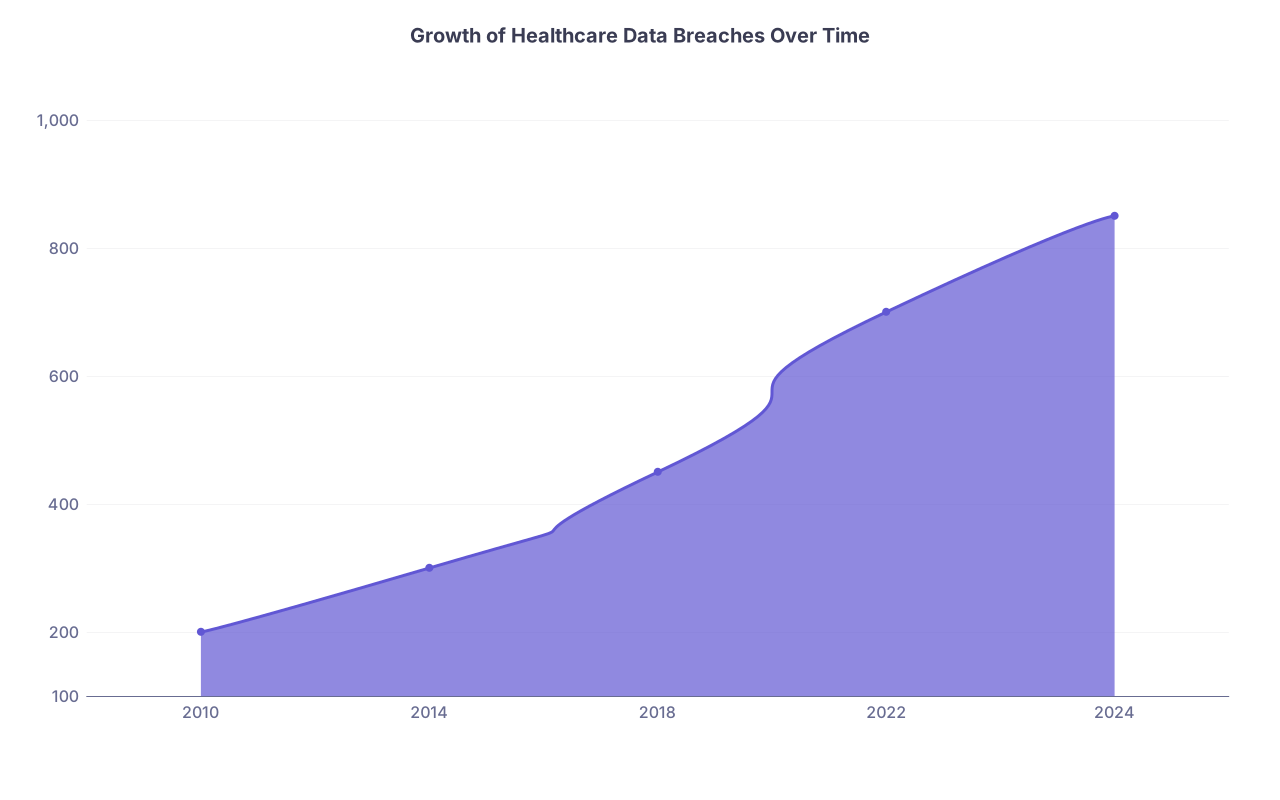
| Category | Value |
|---|---|
| 2010 | 200 |
| 2014 | 300 |
| 2018 | 450 |
| 2022 | 700 |
| 2024 | 850 |
Breaches are going up. Attackers love hospitals. Ransomware is everywhere. You’re right to feel like you’re walking on thin ice.
But at the same time, institutions are finally waking up and doing at least some things right:
- More hospitals are giving encrypted, managed devices to residents
- More systems are moving to secure messaging apps instead of random texting
- There’s more training (even if it’s soul-killing mandatory modules)
You’ll see more:
- EHR-integrated case logs so you don’t have to roll your own
- Approved, HIPAA-compliant mobile apps that can store and sync data safely
- Automated auditing and alerts when someone downloads or exports too much data
So weirdly, the safest move for your career is also kind of boring:
Use only what your institution gives you and approves. Don’t be the creative one trying to “optimize” with ten cute third-party productivity apps.
A Simple Mental Checklist Before You Store Anything
You don’t need to memorize HIPAA law. You need a 10-second gut check.

| Step | Description |
|---|---|
| Step 1 | Want to save info |
| Step 2 | Probably safe if de identified |
| Step 3 | Save in approved system |
| Step 4 | Do not store |
| Step 5 | Follow local policy |
| Step 6 | Any identifiers? |
| Step 7 | Approved system? |
Ask yourself:
- Does this contain any patient identifier or combination of details that could reasonably point to a specific human? If yes → treat as PHI.
- Is the storage location explicitly approved by my institution for PHI?
- Hospital EHR? Yes.
- Official secure messaging app from the hospital? Usually yes.
- Personal iCloud/Google Drive/Dropbox/Notion/Apple Notes? No.
- If I lost my phone or laptop today and it was all over the news tomorrow, would I be able to say, “Everything with patient info was encrypted, on approved systems, and password protected”?
If the answer feels even slightly like “uhhh maybe”… don’t store it.
What About Research and “De-identified” Data?
Research is its own minefield.
There’s this dangerous assumption:
“If I remove names and MRNs, it’s de-identified, so I can do whatever I want with it.”
Not true.
You have:
- Fully de-identified data (no way back to a patient)
- Coded data (identifiers removed but a key exists somewhere)
- Limited data sets (some identifiers like dates and zip codes remain, under special agreements)
And your Institutional Review Board (IRB) decides what you can do with each, where it can be stored, and who can access it. Not you.

If you’re working with any dataset that:
- Came from the EHR
- Contains dates, visit details, or anything not obviously generic
…you treat it like regulated data unless your IRB or data security office explicitly told you otherwise.
Do not:
- Sync your research data to your personal Google Drive
- Email full datasets to your personal email
- Store them on random USB sticks rolling around in your bag
Use:
- Institution-provided secure drives or virtual desktops
- Encrypted, access-controlled research storage your IT actually knows about
Again: boring is safe.
How to Learn From Patients Without Hoarding Their Data
Here’s the real tension: you actually need to learn from your patients. You want to remember that weird case. You want to grow.
You just don’t need their raw data to do that.
A practical way to do it safely:
- After your shift, sit down with a notebook (paper or digital) that has zero patient identifiers.
- Ask yourself: What did I learn clinically? What pattern did I see?What did I miss initially?
- Write that down. Something like:
“Patient with subacute back pain + urinary retention + fever → consider spinal epidural abscess even if neuro exam looks okay at first.”
Don’t write:
“Mr. H., 62-year-old at St. Mary’s, came in on 1/3/26 with back pain, ended up with epidural abscess.” That’s not learning; that’s identifiable gossip dressed up as reflection.
You can build an entire personal knowledge system around:
- Patterns
- Decision points
- Red flags
- Management strategies
…without ever storing something that would blow up your life if it leaked.
FAQ (Exactly 4 Questions)
1. Is it ever okay to store any PHI on my personal phone or laptop?
Only if:
- Your institution explicitly allows it, and
- Your device is encrypted and meets their security standards, and
- You’re using an institution-approved app or method (like a managed secure messaging app)
If none of those are true, assume the answer is no.
2. Are patient initials or room numbers “safe enough” for my notes?
No. Initials + clinical details are still identifying in context. Room numbers absolutely are when combined with details. If you’re storing anything on your own device, drop initials, MRNs, room numbers, exact dates, or anything that ties back to a specific person.
3. What if I’ve already saved PHI in my personal email or cloud?
Step one: stop making it worse. Don’t send more.
Step two: delete what you can, including from trash/recycle.
Step three: strongly consider talking to your institution’s privacy or compliance office, especially if it’s substantial. One-time honest mistakes usually lead to education, not execution. Repeated or hidden issues cause real trouble.
4. Can I use real patient stories in personal statements, essays, or talks?
Yes, but only if they’re truly de-identified and respectfully altered:
- Remove or change ages, dates, occupations, locations, and non-essential details
- Don’t use ultra-rare conditions in a tiny community where people will instantly know who you mean
- Focus on your growth and reflection, not their biography
If there’s any doubt that someone could recognize themselves or a friend, change more details.
Key takeaways:
You can store almost unlimited lessons from patients—but almost zero raw patient data on your personal systems. When in doubt, assume it’s PHI and don’t save it anywhere that isn’t explicitly approved. And if something feels even a little sketchy security-wise, trust that feeling. It’s usually right.