It’s 10:47 p.m. You’re on your medicine sub-I. Everyone else is “finishing notes,” which seems to mean hammering away at an EHR that looks like it was designed in 1998 by someone who hated humans. You just spent 15 minutes trying to order Tylenol, accidentally opened 7 pop-up windows, and you’re one click away from tossing the mouse across the workroom.
And the thought hits you:
“If this is what medicine is now—EHR hell, mandatory ‘wellness’ apps, AI tools I don’t trust—am I signing up for a lifetime of being a glorified data-entry clerk? What if I hate all this tech? Can I actually have a sustainable career, or am I just setting myself up for burnout?”
I’ve heard that exact panic, word-for-word, from more than one student. I’ve felt versions of it myself watching attendings spend more face time with Epic than with patients. Let me say the loud part clearly:
You can hate the EHR and still have a sustainable career.
But you can’t pretend the tech doesn’t exist. You have to be strategic about how you relate to it, which paths you choose, and how you protect yourself from becoming tech collateral damage.
Let’s unpack this in a not-sugar-coated way.
Are You Doomed If You Hate the EHR?
Short answer: no. Longer, more honest answer: it depends what you mean by “hate.”
If “I hate the EHR” for you means:
- “It feels clunky and slows me down.”
- “I feel stupid every time I use it.”
- “I resent that it takes me away from patients.”
That’s…normal. Borderline healthy. Most doctors don’t love the EHR. They tolerate it, optimize around it, and then forget about it when they’re actually in the room with the patient.
If “I hate the EHR” means:
- “Interacting with it makes me feel rage every day.”
- “I’d rather quit medicine than spend my life clicking boxes.”
- “Any new tech rollout spikes my anxiety for weeks.”
Then we’re in different territory. Not doomed, but you’ll need to be more deliberate about:
- The specialty you choose
- The practice setting you end up in
- How you set up your workflow and protections
Because here’s the reality: you’re not going to find a mainstream, employed US physician job in 2026 that doesn’t touch an EHR. Even that older private practice doc who “still uses paper charts”? I guarantee they’re dealing with some sort of electronic billing, e-prescribing, portals, or quality reporting.
So the fantasy of “pure, tech-free medicine” is dead. But the fantasy of “I can shape my career to minimize what I hate and maximize what I care about” is very much alive.
How Much Tech Different Careers Actually Use (Not the Brochure Version)
Let me be blunt: not all specialties are equal when it comes to EHR and tech load. Some are soul-sucking from a click perspective. Others are surprisingly tolerable.
| Specialty | EHR Burden | New Tech Exposure | Documentation Intensity |
|---|---|---|---|
| Outpatient IM/FM | Very High | High | Very High |
| Hospitalist IM | High | Moderate | High |
| Radiology | Moderate | Very High | Moderate |
| Psychiatry | Moderate | Moderate | Moderate |
| Pathology | Moderate | High | High (but structured) |
| EM | High | Moderate | High |
This is rough, but the pattern holds.
Primary care outpatient? You’re basically married to the EHR. Panels of 1800–2500 patients, quality metrics, portals, refill requests, prior auths, inbox messages at all hours. Every “convenience” tool for the system gets dumped on outpatient first.
Hospital medicine? Still heavy EHR, but more team-based. You’re documenting a lot, but you often have scribes, residents, NPs, or templated workflows. The day is chunked into rounds, admissions, discharges. It’s intense, but more bounded.
EM? EHR is everywhere but your day is sprints, not marathons. Also usually more standardized templates, and you’re not doing long-term portal message battles.
Radiology/pathology? Tech heavy for sure, but in a different way. You live inside specialized software, often with better design than standard EHRs. AI tools will hit these fields hard, but often as assistive rather than “farm you for clicks.”
Psychiatry? This is one of the common escape hatches for people who care deeply about the conversation, the relationship, and want less tech noise. Outpatient psych has portals and notes, yes, but the actual in-room time often feels the least “EHR-driven” compared to, say, primary care.
The point: if EHR/tech drains you in a way that feels existential, you don’t have to walk into the most EHR-heavy specialties and call that your only option.
Ways People Quietly Minimize EHR Misery (That Students Rarely Hear About)
The system isn’t going to come to you, apologize, and say “we’re going to fix the EHR so you’re happy now.” That’s not happening.
What actually happens is this quiet, almost underground set of adaptions by people who want to stay in medicine without losing their minds.
1. Choosing settings with lower tech chaos
Same specialty, wildly different tech experience. I’ve seen:
- A community hospitalist with scribes, decent templates, and admin who actually listens to feedback → charting mostly done by end of shift, rare after-hours work.
- A big-name academic center hospitalist drowning in clicks, 15 different “quality initiatives,” and 80+ unread inbox items after every weekend off.
Or:
- A small private psych practice where the doc picked a simple, clean EHR and still writes notes that actually sound like English.
- A huge system psych department where dot phrases and checkboxes rule and the portal messages never stop.
You can actively look for:
- Smaller groups or private practices that picked their tech intentionally
- Places that explicitly offer scribes or team documentation support
- Groups that advertise “no after-hours inbox work” or protected admin time
2. Getting ruthlessly good at “just enough” documentation
This part is uncomfortable for a lot of anxious med students because we’re trained to over-document to prove we’re smart and thorough. The attendings who survive long-term? They’re almost always:
- Clear on what actually needs to be documented
- Fast, not fancy
- Totally uninterested in writing a novel when a single, clean sentence will do
They’re not reckless. They’re efficient. They’ve internalized that the EHR is not a diary, it’s a legal/communication/billing tool. So they deal with it at that level. No more.
You can learn this. From:
- Senior residents who leave on time
- Attendings whose notes are short but always pass audits
- People who clearly have a life outside work
These are the ones to copy. Not the martyr PGY-2 at 10 p.m. writing four-page SOAP notes for an uncomplicated CHF exacerbation.
What About AI, Virtual Care, Wearables…Is It Just Going to Get Worse?
Here’s where the “future of healthcare” stuff either spikes your anxiety or gives you some tiny sliver of hope.
You’ve probably heard a version of: “AI is coming for your job,” “EHRs will only get more complex,” “Soon you’ll be managing a swarm of devices, portals, and algorithms.”
Some of that is true. A lot of it is lazy tech-bro extrapolation.
Here’s what I actually think is going to happen if you’re practicing for the next 20–30 years:
- The amount of tech will increase. That’s not optional.
- The direct clicking you have to do may actually go down over time, if the system is even half rational.
Why? Because tech that pushes doctors to the edge of burnout is bad business. Hiring more scribes, integrating ambient documentation, letting AI pre-draft notes and orders—those things save money if they keep you from quitting.
We’re already seeing some of this:
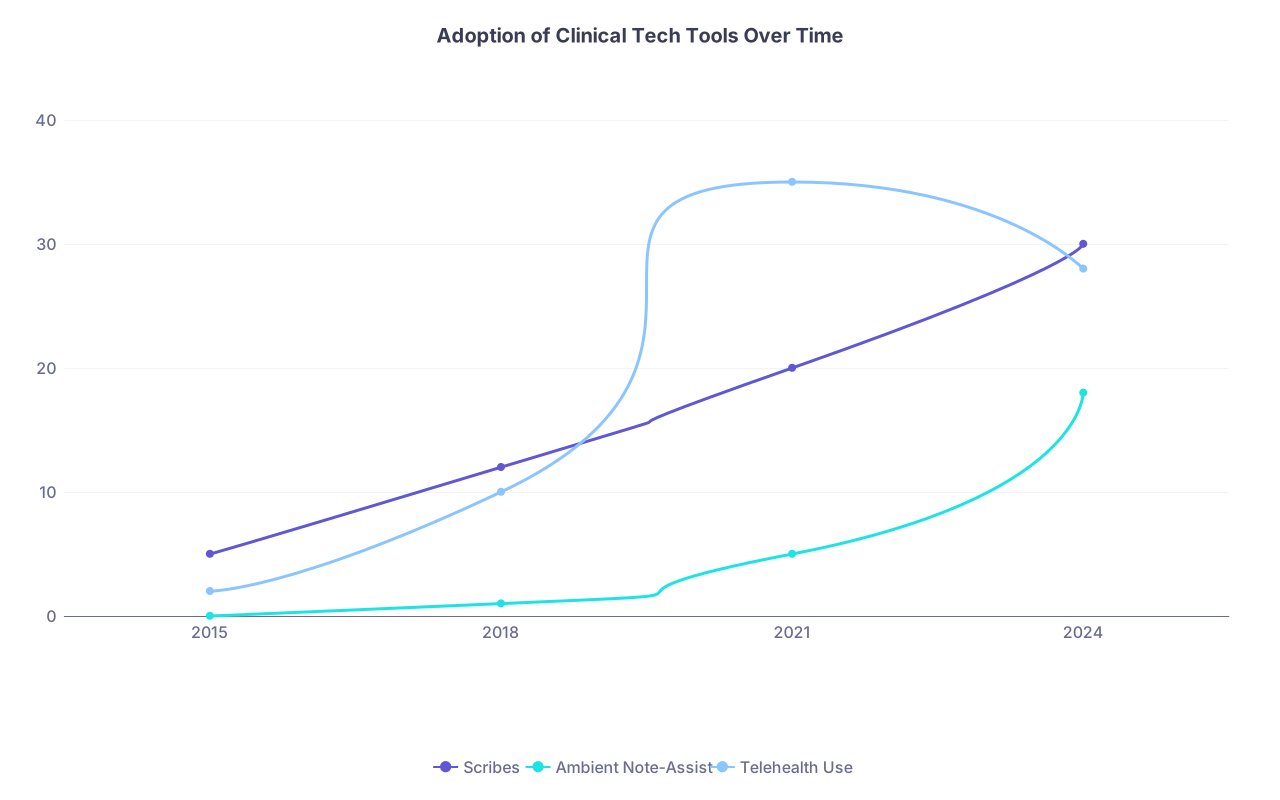
| Category | Scribes | Ambient Note-Assist | Telehealth Use |
|---|---|---|---|
| 2015 | 5 | 0 | 2 |
| 2018 | 12 | 1 | 10 |
| 2021 | 20 | 5 | 35 |
| 2024 | 30 | 18 | 28 |
These numbers aren’t exact, but the pattern is real: more tools that buffer you from raw clicking, not fewer.
Will every hospital implement this perfectly? Absolutely not. Some will use AI like duct tape over a crumbling wall. Others will integrate it well and actually make your day smoother.
But the idea that the future is “same EHR hell, multiplied by 10 forever” isn’t accurate. The direction of travel is messy, but it’s toward:
- Less typing every single word yourself
- More reviewing and editing suggested content
- More team-based documentation support
If you can tolerate interacting with tech, even if you don’t love it, the future may actually be better from a workload standpoint.
But What If Tech Just…Scares You?
Let me guess: you’re that person who:
- Needed way longer than your classmates to feel OK with Epic
- Feels your heart race when a new system goes live
- Worries you’ll “mess something up” with one wrong click and hurt a patient
You’re not alone. A lot of very good clinicians feel exactly that way. They just don’t say it out loud because medicine punishes vulnerability.
There are a few things you can do proactively:
Practice tech in low-stakes environments.
Not just the EHR. Any unfamiliar app or tool: play with it when there’s nothing serious at stake. People who are comfortable with tech aren’t smarter; they’ve just racked up way more low-risk reps.Ask for shadow time specifically for workflows.
When you’re on rotations, ask residents/attendings: “Can you walk me through exactly how you structure your charting from start to finish on a typical day?” Watch where they click, what they don’t do, what they ignore.Learn the handful of shortcuts that matter.
Not 80 features. The 5–10 highest-yield macros, dot phrases, or templates. This moves you from “tech-chaotic” to “minimally competent” faster than you think.Accept that you will never be the “superuser” and that’s fine.
Every department has the EHR wizard who loves customizing flowsheets. You don’t have to be that person. You just have to not be the person losing an hour to a password reset every week.
Career Shapes That Fit “I Hate Tech but I Love Medicine”
If your core question is, “Can I actually practice and enjoy the human side of medicine without the EHR eating my soul?”—some career shapes tend to work better.
Some examples I’ve seen work in real life:
Outpatient psychiatry with carefully chosen EHR.
Solo or small group practice, simple software, longer visits, less checkbox insanity, more patient interaction. The tech is there but it’s not the main event.Lifestyle specialties in small private groups.
Allergy/immunology, rheum, derm, GI in certain models. Often can afford scribes, and the income supports paying real support staff rather than dumping everything on the doc.Direct primary care / concierge practices.
Not a magic fix, but panels are smaller, visit lengths longer, and the practice often picks an EHR optimally…because they’re the ones suffering otherwise.Inpatient-only jobs with well-supported workflows.
Some hospitalist or intensivist groups have figured out smoothing their operational ship. You still work with tech a lot, but it’s more structured and team-based.Non-clinical or hybrid clinical roles.
If you get farther along and decide 100% clinical isn’t for you, there are ways to shift: medical education, administrative, consulting, informatics, etc. Those are still “tech” adjacent but less on-the-clock EHR clicking.
None of these erase tech. But they change the relationship you have with it—from “EHR as my main job” to “EHR as annoying but manageable background noise.”
Hard Truths You Probably Already Suspect
Let me not gaslight you: some stuff about this really does suck.
- You will spend a painful chunk of your day staring at screens.
- There will be stupid pop-ups, meaningless metrics, and redundant clicks.
- Administrators will sometimes implement tech you didn’t ask for, then tell you it’s for “wellness.”
And yes, tech can absolutely contribute to burnout. I’m not going to pretend otherwise. I’ve watched residents in tears at midnight, still charting. I’ve seen attendings re-write entire notes because a new template broke.
But here’s the other side:
- Lots of physicians are still genuinely satisfied with their careers despite the tech.
- Your future relationship with the EHR is not fixed at “how it feels as an M3.” You will get faster, more selective, more ruthless.
- You have far more control over your final practice environment than med school makes it seem—once you’re past training and the Match.
The worst-case scenario your brain is spinning—“I’ll be miserable, trapped forever in EHR hell with no escape”—is not how this usually plays out.
What actually happens for most people:
- Intern year: You feel like the EHR is your enemy.
- End of residency: You don’t like it, but you’re competent and can work around its nonsense.
- Early attending years: You structure your life and job choices to blunt the worst parts.
- Mid-career: You’ve either found a tolerable set-up or you pivoted (job change, practice change, role change).
So…Can You Still Have a Sustainable Career?
If you’re waiting for me to say, “You’ll never be bothered by tech again,” I can’t. That would be a lie.
Here’s what I can say, and I mean this:
- Hating the EHR does not disqualify you from having a good, long, sustainable career in medicine.
- Trying to pretend tech isn’t part of the job absolutely will make you miserable.
- Being intentional—about specialty, practice setting, your own workflow, and your boundaries—changes everything.
You don’t need to become a cheerleader for “the future of healthcare.” You just need to become competent enough with the tools that they fade into the background so you can focus on the part you actually came here for: the patients, the thinking, the impact.

| Step | Description |
|---|---|
| Step 1 | Hate EHR and new tech |
| Step 2 | Target lower burden specialties |
| Step 3 | Consider hybrid/nonclinical roles |
| Step 4 | Choose supportive practice settings |
| Step 5 | Optimize workflow and shortcuts |
| Step 6 | Build sustainable career |
| Step 7 | Explore education, admin, consulting |
| Step 8 | Willing to tolerate some tech? |

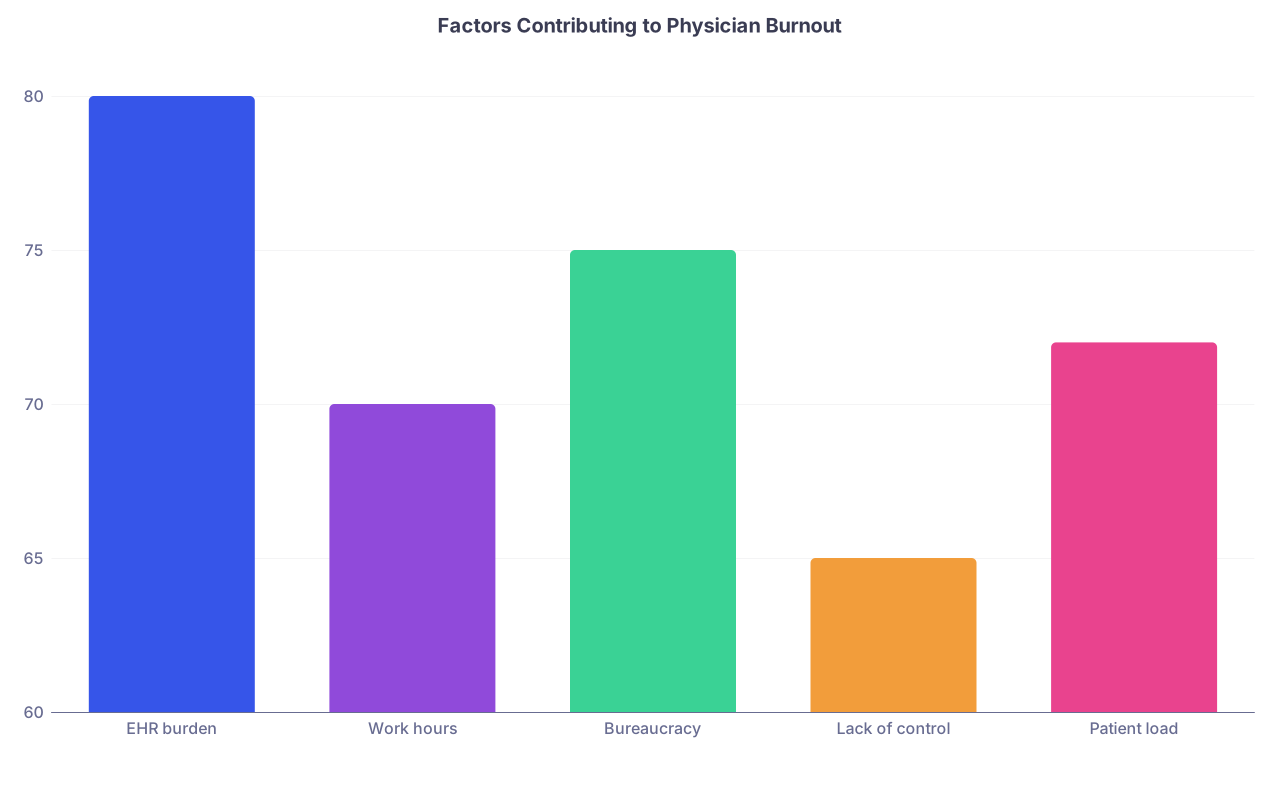
| Category | Value |
|---|---|
| EHR burden | 80 |
| Work hours | 70 |
| Bureaucracy | 75 |
| Lack of control | 65 |
| Patient load | 72 |

| Step | Description |
|---|---|
| Step 1 | Pre-clinic dot phrases ready |
| Step 2 | See patient |
| Step 3 | Talk and examine |
| Step 4 | Enter key orders |
| Step 5 | Quick note using templates |
| Step 6 | Inbox batch processing block |
| Step 7 | Leave with charts mostly done |
Here’s your next step, and I mean literal next step, not some vague “reflect on your values” thing:
Open a blank document and write down three columns:
- “Parts of tech/EHR that I truly can’t stand”
- “Parts that are annoying but tolerable”
- “Parts that might actually be helpful if someone set them up right”
Force yourself to fill each column with at least three items. That exercise will do two things:
- It will separate “this is unbearable” from “this is just new and clunky right now.”
- It will give you something concrete to bring to a resident, attending, or mentor and say, “Given this list, what specialties or practice types would you steer me toward or away from?”
Do that tonight. Ten minutes. No perfection. Just honesty on paper. Then you’re not just spiraling about the future of healthcare in your head—you’re actually starting to shape the version of it you can live with.