It’s late January of your M2 year. You just bombed a UWorld block, your group chat is panicking about Step, and a friend casually mentions their “AI sepsis prediction project that might turn into a publication.” You look at your CV and realize: you’ve got some shadowing, some research, some volunteering… but nothing that screams you understand where healthcare is going.
This is where tech projects can make or break how you look to residency programs.
Let’s walk it from pre-med through M4. At each stage: what kind of tech work actually helps your Match chances, what’s overkill, and when you’re frankly too late for certain moves.
Big Picture: How Tech Projects Actually Hit Your Match
Before we go timeline, you need the frame.
Programs don’t care that you “like technology.” They care about:
- Evidence you can complete projects and work on a team
- Alignment with specialty culture (radiology, derm, EM, anesthesia, IM, etc.)
- Outputs they can understand quickly:
- Abstracts, posters, pubs
- Concrete deliverables (app used in clinic, QI dashboard, workflow tool)
- Skills that map to their own projects (informatics, data, AI, workflow design)
The mistake I see all the time: people start something cool at the wrong time. They don’t finish it. Or they finish it after it would have actually influenced interviews.
So think of tech projects as high-yield electives for your CV. They only matter if:
- The project is finished or has a visible output by ERAS submission
- It’s clearly relevant to medicine or healthcare delivery
- You can explain what you did in 60 seconds without sounding like you’re reading from a startup pitch deck
Now the timeline.
Pre-Med (Freshman to Senior Year): Build Tools, Not Just Buzzwords
At this point you should not be chasing a “founder” title. You should be building muscles: data, basic coding, and understanding healthcare problems.
Freshman–Sophomore Year: Skill Acquisition > Fancy Projects
Focus:
- Learn basic coding (Python or R; not both deeply)
- Get comfortable with data, not just GPA
- Observe real clinical workflows if you can
Good moves:
- Take a CS/intro programming course
- Take statistics and maybe an intro data science class
- Play with simple healthcare-related projects:
- Script to clean and visualize CDC or CMS data
- Simple web app that calculates risk scores (e.g., CHA₂DS₂-VASc)
- Automation for student org signups or scheduling
Avoid:
- “AI to revolutionize surgery” with no idea how an OR works
- Massive side projects that tank your grades
Junior Year: First Real Tech-Health Outputs
At this point you should have one or two visible things you can link or show.
Aim for:
- Joining a professor’s health-data or informatics project
- Helping build:
- A simple research database
- A survey tool
- A small analytics pipeline for an ongoing study
Deliverables that matter:
- Your name on a poster / abstract using code you wrote
- A GitHub repo where your contribution is crystal clear
- A simple web tool or script that’s actually used by a lab or clinic
This is also the year to decide how “tech-heavy” you want your narrative to be. If you might aim for:
- Radiology
- Anesthesiology
- EM
- IM with informatics
- Neurology
- Pathology
… then tech work will age well for you.
Senior Year / Gap Year: Translation to “Pre-Med Narrative”
Now you’re writing personal statements and talking in interviews.
At this point you should:
- Have 1–3 tech-related bullets on your CV that are:
- Specific (“Developed Python script to preprocess 10k ECG traces for ML model”)
- Outcome-oriented (“Used dashboard to reduce clinic no-show rates by 5%”)
Don’t pitch yourself as:
- A future software engineer who happens to apply to medical school
- Someone more excited about startups than patient care
You’re selling: “I understand how care is delivered now and where it’s going, and I have just enough technical literacy to be dangerous in a good way.”
M1: Light Touch, High Leverage
You just started school. Everyone’s pretending they aren’t stressed. You absolutely do not need a startup this year.
At this point you should prioritize: adjusting to med school and passing everything comfortably.
M1 Fall: Minimum Viable Tech Identity
Good moves:
- Show up to your school’s:
- Informatics interest group
- AI in medicine club
- QI/innovation meetings
- Identify 1–2 faculty plugged into tech:
- Chief medical information officer
- Radiology AI person
- EM doc who built an EHR tool
Tiny, realistic project types:
- Simple survey-based QI project built on REDCap or Qualtrics
- Helping clean data for an ongoing AI or EHR study
- Building a simple spreadsheet-based tracking tool for a student clinic
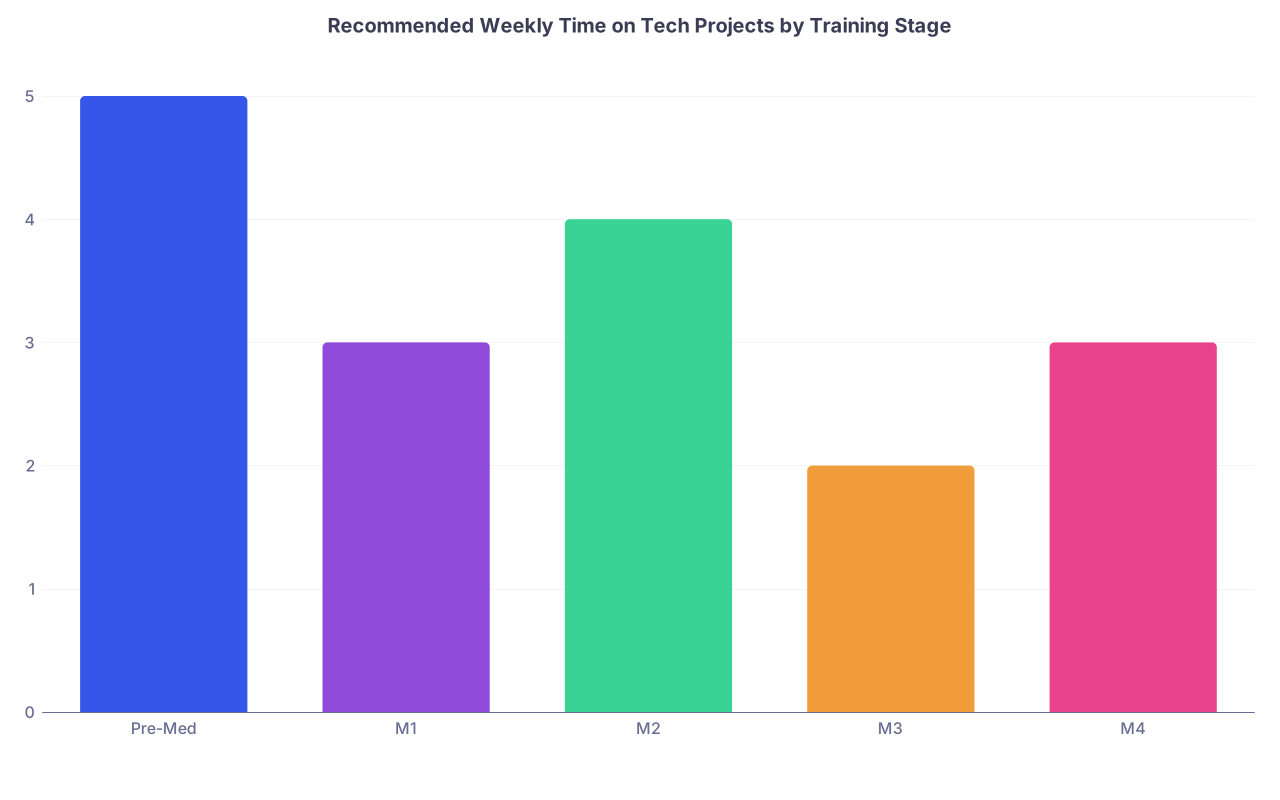
Time cap: 2–3 hours/week maximum.
If your grades slip, that’s your sign to pause. A 3.0 with “cool tech stuff” is not a better match profile than a 3.7 with zero tech.
M1 Spring: One Concrete Deliverable
By the end of M1 you should have one of these:
- Abstract submitted to a local/regional conference
- Internal poster day presentation
- Named role on a digital health or QI project with:
- Clear problem
- Defined scope
- Timeline that ends before or by early M3
| Category | Value |
|---|---|
| Pre-Med | 5 |
| M1 | 3 |
| M2 | 4 |
| M3 | 2 |
| M4 | 3 |
M2: The Sweet Spot for Starting Serious Tech Work
This is where timing starts to matter a lot.
Your Step/Level exam typically hits end of M2 / start of M3. ERAS goes in fall of M4. That gives you a ~18–24 month window from M2 start to “this project is on my application.”
M2 Fall: Pick 1–2 Medium Projects That Can Finish
At this point you should choose:
- One primary research / tech project
- Optional one very small side tool or QI idea
Ideal project scope:
- Start: Aug–Oct M2
- Active work: 4–6 months
- Output: Abstract / poster / internal tool ready by late M3
Examples that work:
- Radiology: help develop and validate a simple ML model for triaging CT head reports (you handle data cleaning and basic stats)
- EM: build an automated dashboard for ED wait times and LWBS (left without being seen) patients
- IM: EHR-based sepsis alert refinement with chart review + logistic regression
Red flags:
- Huge, multi-center AI project where your contribution is murky
- Starting a digital health “company” during Anki season
Target time: 4–5 hours/week, with planned full stop 1–2 months before you start dedicated exam study.
M2 Spring: Lock It In Before Dedicated
You’re shifting toward Step/Level focus.
By the time you hit dedicated study, you should have:
Primary tech project:
- Data mostly collected or code mostly written
- Draft abstract in progress or submitted
- Clear understanding of your role for any remaining tasks
A short, honest description for your future ERAS:
- “Co-developed and implemented ED wait-time dashboard using Python and SQL; used for daily operational huddle.”
Then you shelve anything new. Do not start extra projects. From this point until you’re through boards, your job is score and sanity.
M3: Clinical Year – Convert Projects into Stories, Not Time Sinks
Third year is about clerkship performance. That’s still the single biggest thing for most programs.
At this point you should treat tech projects like side-quests, not the main storyline.
Early M3: Light Maintenance, No New Grand Plans
You’re figuring out pimp questions, notes, and staying awake post-call. That’s enough.
Good approach:
- Commit to:
- Max 1 ongoing project
- 1–2 hours/week average, often in bursts between rotations
- Push that project to:
- Abstract presentation
- Pre-print if your group does that
- Internal demo if it’s a tool
If a PI approaches you with something huge:
You say, “I’d love to help in a limited, clearly defined way.” Or you say no. I’ve watched too many M3s tank shelf scores trying to be part-time data scientists.
Late M3: Now You Think Like ERAS
By the last 3–4 months of M3 you should:
- Decide on a specialty (or top 2)
- Decide how you want to frame your tech work for that field
At this point you should have:
- 1–3 tech/innovation entries that are:
- Completed or clearly near-complete
- Mapped to your chosen field:
Examples:
- EM applicant: “Built triage tool and ED dashboard, interested in operations and ED throughput.”
- Radiology applicant: “Worked on image analysis project; interested in AI augmentation of radiology workflow.”
- IM applicant: “Helped design inpatient handoff tool; interested in hospital medicine and informatics.”
What you do not need:
- To publish in NEJM
- To launch an app nationwide
- To have a startup with paying customers
You need a coherent narrative and some finished things.
M4: You’re Out of Time for Big New Projects (But Not for Smart Packaging)
(See also: Avoid These Privacy Mistakes When Using AI Tools for Studying for tips.)
This is the part people underestimate. By the time you’re M4, the window is mostly about presentation, not new builds.
Let’s go month-by-month.
M4 April–June (Pre-ERAS Opening): Final Outputs Only
At this point you should:
Finish:
- Any abstracts already in the pipeline
- Any manuscripts you’re realistically going to submit before September
- Any simple tool you can demo or at least screenshot
Clean up:
- GitHub (if you’ll link it verbally, make sure it’s not a half-broken mess)
- Project documentation enough that you can walk someone through in 2–3 minutes
No new major tech projects. If something comes your way now, it’s either incredibly lightweight or it’s post-Match career fodder, not application fodder.
ERAS Season (June–September): Positioning Your Tech Work
ERAS typically opens for editing in June, submission mid–September.
At this point you should:
- Translate each project into:
- Problem
- Your role
- Outcome/impact
Example ERAS entry:
- Collaborated with EM attending and IT analyst to design real-time ED operations dashboard (Python, SQL, Tableau)
- Integrated EHR data feeds and created visualizations for patient flow and LWBS rates
- Dashboard adopted for daily ED huddles; associated with 12% relative reduction in LWBS over 6 months
You’re making it:
- Clinically understandable
- Outcome-oriented
- Clear that you weren’t just “the idea person”
Avoid buzzword salad like: “Led AI-driven synergy for disruptive digital transformation.”
(Related: How Attendings Actually Use AI During Rounds)
Interview Season (Oct–Jan M4): Use Projects as Convnersation Gravity
This is where tech projects actually cash out.
Your goals during interviews:
- Use tech work to:
- Signal you can contribute to their QI/informatics projects
- Anchor answers to “Tell me about a time you…” questions
- Show you think about systems, not just single patients
At this point you should be able to answer quickly:
- What was the problem?
- What exactly did you build/do?
- What didn’t work?
- What did you learn that will matter as a resident?
If you’re going into a specialty that’s tech-heavy (radiology, path, EM, anesthesia, IM-hospitalist), expect some attendings to really dig into details. Do not oversell your skills.
Which Tech Projects Actually Move the Needle?
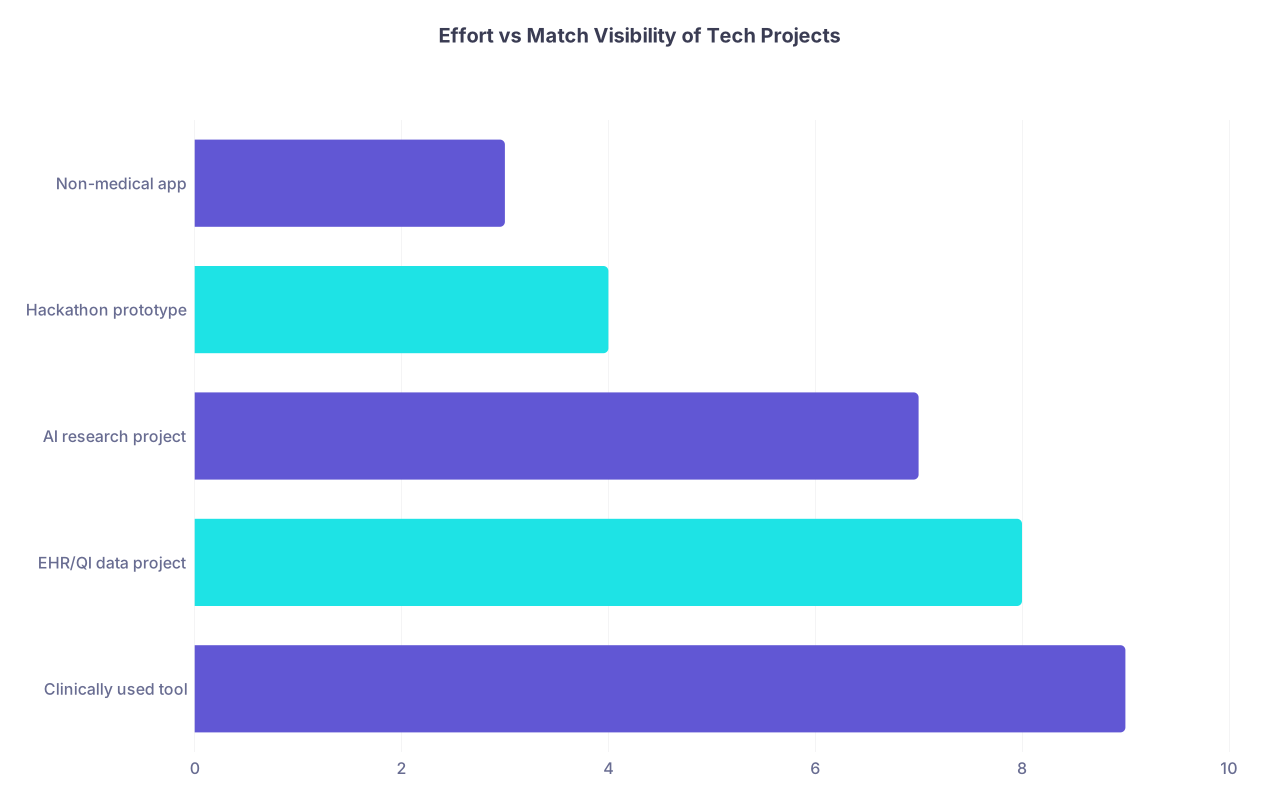
Here’s the uncomfortable truth: not all tech work is equal in the eyes of programs.
| Project Type | Match Impact | Comment |
|---|---|---|
| Clinically used workflow tool | High | Shows real-world impact |
| EHR data / QI with outcome | High | Very legible to clinicians |
| AI/ML with patient-level data | Medium-High | Great if you understand details |
| Generic hackathon prototypes | Low-Medium | OK as early experience |
| Non-medical app or game | Low | Only helps if tightly framed |
Rule of thumb:
- If a clinician can say “Oh, I’d actually use that” → strong
- If it’s a cool toy with no real users → okay, but not a centerpiece
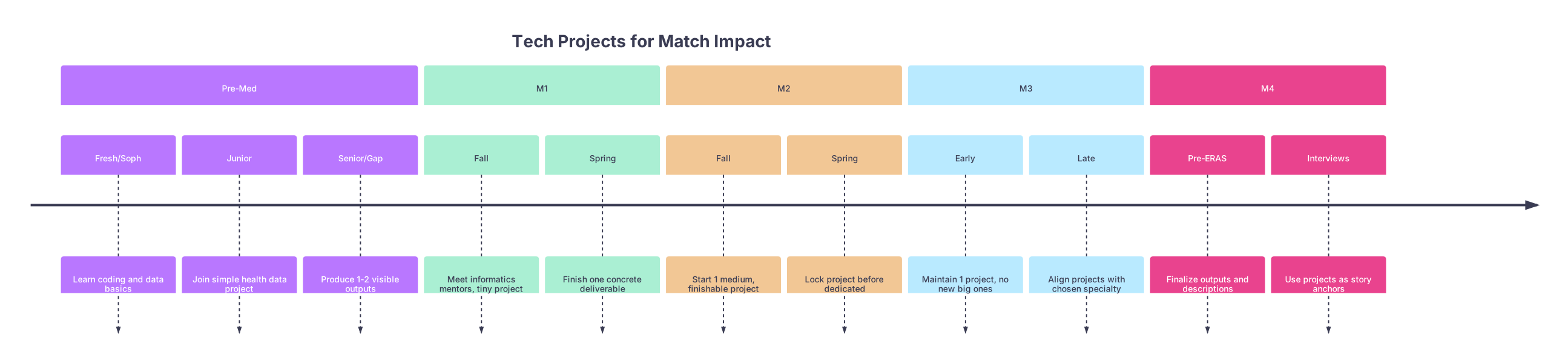
Rough Timeline Overview (Pre-Med → M4)
Let me compress it into a single pass.
| Period | Event |
|---|---|
| Pre-Med - Fresh/Soph | Learn coding and data basics |
| Pre-Med - Junior | Join simple health data project |
| Pre-Med - Senior/Gap | Produce 1-2 visible outputs |
| M1 - Fall | Meet informatics mentors, tiny project |
| M1 - Spring | Finish one concrete deliverable |
| M2 - Fall | Start 1 medium, finishable project |
| M2 - Spring | Lock project before dedicated |
| M3 - Early | Maintain 1 project, no new big ones |
| M3 - Late | Align projects with chosen specialty |
| M4 - Pre-ERAS | Finalize outputs and descriptions |
| M4 - Interviews | Use projects as story anchors |
How Much Is Enough? Avoiding the “I’m Basically a Startup” Trap
You don’t need five tech projects. You need a coherent pattern.
By ERAS, a strong but realistic profile might look like:
- 1–2 clinically used or piloted tools OR
- 1 AI/ML or EHR-based research project with:
- Abstract, poster, maybe early manuscript
- 1 early/basic project from pre-med or M1 that shows continuity of interest
What’s overkill (and suspicious):
- 6–8 “projects” where your actual contribution is unclear
- Grandiose entrepreneurship claims with zero adoption or validation
- A tone that suggests you’d rather be at a startup than on night float
Programs are reading between the lines: will this person:
- Show up on time
- Take care of patients
- Finish the boring parts of QI projects
Tech is a bonus. Not a replacement.
Common Bad Timing Scenarios (And What To Do)
Scenario 1: Late M3, No Tech Projects, Tech-Heavy Specialty
You’re thinking radiology or EM, it’s May of M3, and you have nothing remotely technical.
At this point you should:
- Skip big builds
- Aim for:
- Joining a small, well-scoped retrospective data project with an aggressive timeline
- A simple QI project that has digital components (even a smart spreadsheet with macros)
Focus on one project you can honestly list and discuss. Quality over volume.
Scenario 2: M2 Wants to “Take a Year Off to Build a Startup”
99% of the time: bad idea purely for Match optimization.
Better sequence:
- Finish M2
- Crush boards
- Start startup-ish work as a structured research/innovation year with clear mentors, metrics, and a plan to publish results or at least produce tangible outputs.
If your idea is truly fundable and you’re okay pushing Match back, that’s a life decision, not a CV optimization move.
Scenario 3: Strong CS Background, Now M1/M2 Med Student
You wrote production code before med school. That can be gold or a trap.
At this point you should:
- Be very selective. Don’t default to building “big software platforms.”
- Target:
- 1–2 clinically anchored tools, ideally with:
- A champion attending
- Plan for small pilot and measurement
- 1–2 clinically anchored tools, ideally with:
Talk on interviews like a clinician who can code, not a coder who wandered into medicine.
Visual: Project Effort vs Match Visibility
| Category | Value |
|---|---|
| Clinically used tool | 9 |
| EHR/QI data project | 8 |
| AI research project | 7 |
| Hackathon prototype | 4 |
| Non-medical app | 3 |
FAQ (Exactly 3 Questions)
1. If I can’t code, is it still worth doing “tech” projects?
Yes, but redefine “tech.” Workflow redesign, EHR template optimization, handoff tools, and QI dashboards often involve tech but don’t require you to write every line of code. You can partner with IT, analysts, or CS students. What matters is that you understand the clinical problem, help design the solution, and can articulate your role.
2. How do I list these projects on ERAS if they aren’t published?
Treat them like QI or leadership activities. Use one entry per substantial project, and describe problem, your role, and outcome: adoption, measured change, or at least a completed pilot. If there’s no paper, that’s fine. “Implemented tool used daily in clinic” often impresses more than “Manuscript in preparation” that never appears.
3. Which specialties care most about tech backgrounds?
Radiology, EM, anesthesia, IM (especially hospitalist and cards), neurology, and pathology tend to be the most obviously appreciative. But every specialty has pockets of informatics and innovation. Even in fields like OB/GYN or pediatrics, a well-done EHR, telehealth, or QI-automation project can stand out. The key is aligning your tech story with the actual problems in that specialty.
Key points to walk away with:
- The high-yield window to start serious tech projects is late M1 through early M2; the high-yield window to finish them is late M2 through M3.
- One or two well-finished, clinically grounded projects beat a dozen vague “AI” or startup claims every time.
- By M4, stop building new things and focus on packaging: sharp ERAS entries and clear, honest stories you can own in interviews.