Automation is going to change call schedules more than any new duty-hours rule ever did. The question is whether it will make your life better or just compress more work into fewer hours.
Here’s the answer you’re actually looking for: over the next 10–20 years, automation will absolutely reshape nights, weekends, and off-hours coverage. But it will not eliminate call. It will change who is needed, when, and for what, and it will hit different specialties very differently.
Let’s break it down like someone who’s actually stared at a call pager at 3:17 a.m. and asked, “Why am I getting called for this?”
The 4 Big Ways Automation Will Reshape Call
Forget the hype. For call schedules and work hours, automation really bites in four places:
- Triage and first-response
- Routine orders and “nuisance” pages
- Monitoring and early-warning
- Scheduling and staffing optimization
1. Triage and First-Response Will Shift Off Your Plate
Right now, nights are clogged with low-acuity noise.
Nurse calls: “BP 88/55, asymptomatic, what do you want to do?” Family calls: “Mom seems more confused than usual.” Post-op calls: “Patient has mild pain overnight, can they take one more oxycodone?”
Automation is already starting to chew on this and will only get more aggressive:
- AI-driven nurse call triage systems that suggest next steps or auto-approve protocols
- Chatbot-assist for patient calls (“I had surgery yesterday, is this normal?”)
- Protocol engines attached to vitals, labs, and meds that propose responses
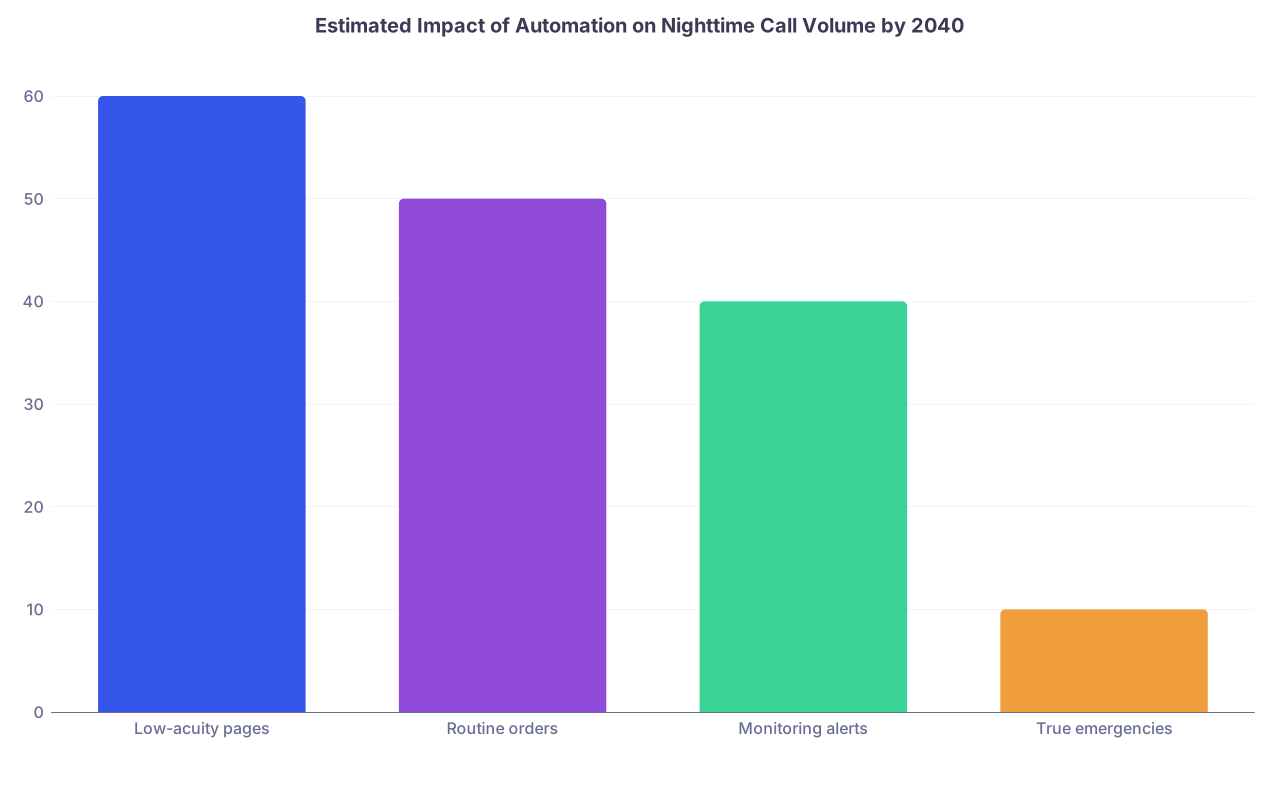
| Category | Value |
|---|---|
| Low-acuity pages | 60 |
| Routine orders | 50 |
| Monitoring alerts | 40 |
| True emergencies | 10 |
This does not mean no one is on call. It means:
- Fewer interruptions for trivial or predictable issues
- More time spent on actual decisions and real emergencies
- A rising expectation that when the system does wake you, you respond fast and decisively
The low-complexity stuff gets filtered. The cognitive-heavy, risk-bearing decisions stay yours.
2. Routine Orders and “Nuisance” Pages Will Largely Vanish
A lot of your after-hours misery is busywork, not medicine:
- Renewing a home med the EMR already knows they take
- Clarifying obvious PRN pain meds
- Replacing electrolytes when the lab result screams “give KCl”
Automation will progressively handle:
- Med renewals based on rules, with auto-approval unless flagged
- Protocolized pain/nausea/sleep regimens that don’t require paging
- Electrolyte, insulin, and fluid replacement via closed-loop or semi-closed-loop systems
- Standard post-op order sets that anticipate 90% of needs
Here’s the pattern I’ve already seen in early-adopter systems:
- Early stage: “AI suggestions” for orders that you quickly click “Accept”
- Middle stage: Automatic execution within defined protocols; you get notified, not paged for permission
- Late stage: Only outliers or high-risk exceptions page a human
Net effect on your life: calls become rarer but heavier. When your phone goes off at 2 a.m., it’s far more likely to be real.
Will Automation Actually Cut Work Hours?
Now to the question everybody really cares about: do your hours get better?
Short version: automation will make hours more flexible and less chaotic, but only reduce total hours if payment and staffing models change alongside it. Technology alone doesn’t magically produce humane schedules.
Here’s what actually changes.
1. Fewer In-House Bodies, More High-Level Coverage
With better monitoring, triage, and automation, many hospitals will:
- Reduce the number of in-house residents/hospitalists overnight
- Use regional or system-wide “virtual” coverage for some tasks
- Expect one physician to safely oversee more patients because the floor is pre-filtered
So you get:
- More “home call” or hybrid models for some specialties
- Intensivists or hospitalists covering multiple facilities virtually plus one in-house extender
- On-call radiologists/neurologists/surgeons awakened less often but responsible for larger catchment areas
Your hours on the schedule may drop a bit. Your responsibility per hour will go up.
2. Smarter, Less Sadistic Scheduling
The first real “win” from automation won’t be clinical AI; it will be scheduling AI.
We already have primitive scheduling software. What’s coming is:
- Algorithms that incorporate duty hours, rest requirements, circadian science, and preferences
- Automatic swapping and optimization to avoid strings of brutal nights
- Load-balancing based on actual page volume and case complexity, not just “bodies on the grid”
| Feature | Typical Today | With Advanced Automation |
|---|---|---|
| Night distribution | Manual, arbitrary | Algorithmic, fairness-based |
| Fatigue / circadian protection | Minimal | Modeled and enforced |
| Real page-volume data used | Rarely | Core input to assignments |
| Short-notice coverage | Ad hoc texts/emails | Automated matching and alerts |
| Preference handling | Informal, political | Transparent rule-based system |
This is the kind of change you’ll actually feel day to day: fewer “why am I doing 7 nights in 10 days?” moments.
How Different Specialties Will Feel It
Not everyone gets the same future. Some specialties get massive relief; some barely move.
Hospitalists and Internal Medicine
They probably gain the most in terms of quality of call.
Expect:
- Automated triage that filters most vitals-only pages and protocolized adjustments
- AI note summarization so cross-cover is less blind at 2 a.m.
- Fewer total pages per night but each one matters more
Work hours? Maybe slightly fewer, but more realistic is this: nights become less of a chaotic interruption-fest and more of a manageable, focused shift.
Emergency Medicine
ED docs will not be “replaced” by automation. But:
- Front-end triage bots and symptom-checkers will pre-sort lower acuity
- Wait times for non-urgent care might be mitigated by virtual care options
- Decision-support for imaging, labs, and risk scores will get embedded in the workflow
Nights and weekends will still be busy. Trauma, STEMIs, sepsis, overdoses, and psych crises aren’t going away. What might change is that fewer trivial visits land at 3 a.m., or they’re rerouted to virtual care.
Hours? I expect EM shifts to be more efficiently packed, not shorter. Same 8–12-hour shifts, slightly lower “nonsense density.”
Surgery and Procedural Specialties
This one’s tricky.
Automation will not scrub in and do your emergent lap appy anytime soon. But it will:
- Make post-op management at night much smoother (pain control, nausea, fluids, early warning)
- Reduce the number of overnight calls about routine post-op questions
- Enable better prediction and smoothing of elective caseloads (less day-to-day chaos)
Call burden shifts:
- Fewer calls for minor issues
- Similar or slightly reduced emergent cases
- More structured, predictable nights overall
But if hospitals see “we can run more late/evening cases safely,” you know what happens. Automation savings get converted into more production.
Radiology and Pathology
These are early winners.
Radiology in particular is already leaning on AI:
- First-pass reads on common studies for triage (e.g., positive head CT for bleed flagged immediately)
- Worklist prioritization based on acuity detected by algorithms
- Potential partial auto-reads for straightforward cases, leaving only complex ones for humans
Night call for radiology may:
- Involve fewer mundane normal CTs and X-rays
- Focus on high-acuity, ambiguous, or interventional-related imaging
- Support more centralized night float models (one team covering many hospitals with AI pre-screen)
Pathology: not much “call,” but frozen sections and urgent reads get faster and more precise with AI help. After-hours demands may drop further.
Psychiatry
Psych’s call structure is already shifting with telepsychiatry.
Add automation:
- AI-assisted risk assessments layered onto histories and EHR data
- Chatbot-based low-acuity support and monitoring between visits
- Early-warning systems for relapse or suicide risk that trigger outreach before crisis
On-call psychiatrists will still be needed for:
- Complex risk decisions
- Involuntary holds
- Medication decisions with serious side-effect implications
But volume of “routine” after-hours touchpoints could drop. More virtual, fewer physical in-hospital nights.
The Dark Side: How This Can Go Wrong
Let me be blunt: automation doesn’t automatically help clinicians. It helps whoever controls the budget and the metrics. If that’s misaligned with you, the tech can make things worse.
Here are the failure modes:
Productivity Creep
“The AI took away all those nuisance pages—great! You can safely cover 40% more patients overnight.”
You feel just as hammered, just with different types of calls.Always-On Expectations
Faster triage and smarter alerts lead admins to think you should be instantly reachable since “the system has done 90% of the work for you.”
Real rest time erodes as micro-interruptions become constant.Alert Overload 2.0
Badly tuned automation throws “smart” alerts at you all night, each supposedly high priority. You become the final filter for a flood of algorithmic anxiety.De-Skilling and Over-Reliance
If junior clinicians always have AI suggestions, they can lean too hard on them. Then when something breaks, they’re less prepared to operate independently—especially at night.
So yes, automation can reduce call misery. Or it can mutate it into a more intense, more abstract form. The difference is governance, regulation, and clinician control over implementation.
Realistic Long-Term Picture (10–20 Years)
Projecting out a couple decades, here’s the likely steady state.
What Call Looks Like
- Fewer total pages per night; pages you get are higher risk and more complex
- More hybrid models: one in-house clinician + off-site backup + strong automation
- Some specialties (radiology, neurology, psychiatry) doing a lot of call virtually
- AI-driven scheduling that’s actually semi-rational; fewer brutal sequences by default
What Work Hours Look Like
- Slightly shorter or similar total hours for most; modest improvements, not miracles
- More flexible distribution: combination of in-person, remote, async review
- Stronger formal rest periods mandated by systems that can verify you’re overworked (because they track everything)

| Step | Description |
|---|---|
| Step 1 | Event occurs |
| Step 2 | Automated triage |
| Step 3 | Protocol auto-executed |
| Step 4 | AI recommends actions |
| Step 5 | Immediate human alert |
| Step 6 | Clinician reviews and approves |
| Step 7 | Orders placed and logged |
The pager still exists in spirit, but many pings never reach you. They get absorbed by protocols, low-level automation, and triage layers.
What You Should Actually Plan For (as a Trainee or Young Attending)
If you’re thinking about your career, here’s the actionable part:
- Choose specialties where automation is a tool, not your competition. Anything that relies on context, hands-on procedures, and complex discussion with patients stays very human.
- Learn to work with decision-support, not fight it. Senior clinicians who can oversee automated systems and push back when needed will be valuable.
- Pay attention to who controls scheduling and metrics where you work. A place that weaponizes automation to extract more hours is a place to leave.
Automation is coming for the stupid parts of call first. That’s a good thing. Just make sure no one turns those freed-up brain cells into another “productivity target.”
FAQ: Automation, Call Schedules, and Work Hours
1. Will automation ever eliminate night call completely?
No. Nighttime emergencies, deteriorations, and urgent decisions are not going away. Automation will reduce the volume and change the nature of call, but there will always be a need for humans to make judgment calls, especially when things are ambiguous or going sideways.
2. Are residents likely to see better hours because of automation?
Residents will probably see better quality of nights before they see fewer total hours. Expect fewer dumb pages, smoother protocols, and more consistent schedules. But unless accreditation bodies and hospitals rewrite duty-hour and staffing assumptions, automation alone will not suddenly cut residency from 80 hours to 40.
3. Which specialties are most likely to benefit from automated call triage?
Hospital medicine, internal medicine, pediatrics, and some surgical services will get the biggest improvements from triage and protocol automation—because they currently absorb a huge amount of low-acuity overnight noise. Radiology also benefits heavily from AI pre-screening that filters and prioritizes cases.
4. Will automation make it easier to work part-time or flex schedules?
Yes, over time. Once call coverage and patient monitoring become more virtual and algorithmically supported, it’s easier to create fractional coverage roles, cross-site pools, and flexible night-shift structures. The barrier here is mostly institutional culture and HR policy, not technology.
5. Could automation make burnout worse instead of better?
Absolutely. If hospitals use automation purely to increase patient volume per clinician or to justify thinning overnight staffing, individuals can feel more responsible and more stressed, not less. Good implementation reduces cognitive load and interruptions; bad implementation turns you into an air-traffic controller for algorithms.
6. What skills should I build now to stay relevant in an automated future?
Get good at complex decision-making, communication, and managing uncertainty. Learn how to interpret and question algorithmic recommendations. Take opportunities to sit on informatics, quality, or scheduling committees to understand how these tools are adopted. People who can both practice medicine and shape how automation is used will have a lot of leverage.
Key points:
Automation will shrink the dumb parts of call—nuisance pages, rote orders, and chaotic scheduling—but it will not erase nights and weekends. Your hours may not drop dramatically, but your nights should become fewer, more predictable, and more meaningful if the tech is implemented with clinicians, not just budgets, in mind.