
Can I safely paste “de‑identified” patient cases into ChatGPT-type tools—or am I kidding myself?
Short answer: You might be able to do it safely, but most people who think their cases are “de‑identified” are not actually meeting a legal or practical safety bar. And yes, you can get yourself and your institution into very real trouble.
Let me walk you through a clear framework so you can stop guessing.
1. The core problem: your definition of “de‑identified” is probably wrong
Most clinicians mean “I removed the name and MRN” when they say “de‑identified.”
Legally and operationally, that is nowhere near enough.
There are two main standards you need to understand (assuming a HIPAA context, e.g., US):
| Method | Who Does It | Flexibility | Typical Use Case |
|---|---|---|---|
| Safe Harbor | Anyone following list | Low | Quick internal data sharing |
| Expert Determination | Qualified statistician | Higher | Research, large data releases |
Safe Harbor (the one most people quote)
To meet HIPAA Safe Harbor de-identification, you must remove 18 specific identifiers about the patient, relatives, employers, or household members. Not just names and dates of birth. Things like:
- Names
- Geographic subdivisions smaller than a state (with some limited ZIP code exceptions)
- All elements of dates (except year) directly related to an individual (DOB, admission, discharge, death)
- Telephone, fax, email, SSN, MRN, account numbers, etc.
- Full-face photos or comparable images
- Any other unique identifying number, characteristic, or code
And you must have no actual knowledge that the remaining information can be used to identify the individual.
Two problems:
- Clinical vignettes almost always contain rare features, sequences of events, or combinations that could re-identify a patient, especially in small communities or rare diseases.
- LLM prompts are often short—so you cram in the unusual details. Those details make the case more identifiable.
If you are describing “the only 22-year-old with metastatic colon cancer in this rural county who delivered last week after emergency surgery,” that’s not really de-identifed in any meaningful sense, even if you removed the name.
Expert Determination (the one almost nobody really has)
The other path: a qualified expert uses accepted statistical methods to determine that the risk of re-identification is “very small,” and documents it.
If your “expert” is you eyeballing the text and saying, “Eh, looks fine,” that does not count.
So before you worry about the AI platform, check whether what you are pasting would pass either of these tests. Most one-off clinical narratives will not.
2. The AI platform matters more than you think
Even if your data were perfectly de-identified, you still have to care about where you’re sending it and how that system handles it.
There are three common scenarios:
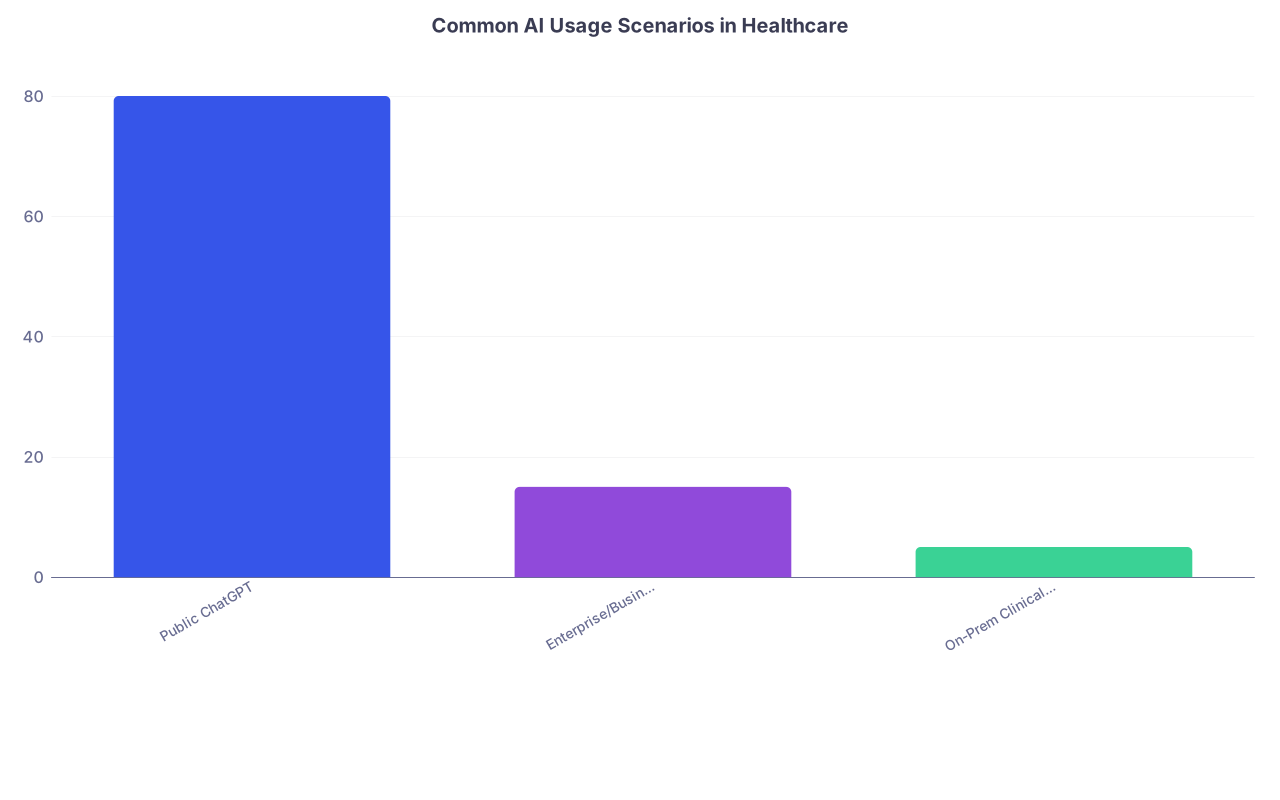
| Category | Value |
|---|---|
| Public ChatGPT | 80 |
| Enterprise/Business AI | 15 |
| On-Prem Clinical AI | 5 |
(Think of these numbers as rough proportions of current usage, not formal stats.)
1) Public, consumer-grade tools (e.g., free ChatGPT on the open web)
- Typically not HIPAA-compliant
- Not under a Business Associate Agreement (BAA) with your institution
- Content may be used to improve models, unless you explicitly opt out (and even then, check the exact terms and geography)
From a risk perspective:
For actual patient data, including “sort-of” de-identified cases, this is usually not acceptable under most institutional policies. Many hospital compliance teams are crystal clear: do not put clinical information into non-BAA tools. Full stop.
2) Enterprise or “for work” versions (e.g., ChatGPT Enterprise, Azure OpenAI, etc.)
These platforms may:
- Offer a BAA
- Commit not to use your data to train public models
- Provide audit logs, data retention controls, SSO, etc.
Now you’re at least in negotiable territory.
But this does not automatically make everything you do “safe.” Your institution still has to:
- Actually sign the BAA
- Configure the environment correctly
- Write and enforce policies for acceptable use
If your hospital has an approved “secure AI” platform, you might be able to use de-identified or even limited PHI there, with guardrails. But this must be explicitly endorsed by legal/compliance, not you freelancing.
3) On-prem or tightly integrated clinical AI
These are systems:
- Hosted inside your institution’s environment, or
- Fully integrated into your EHR under existing HIPAA controls
These can be designed to process PHI safely, like EHR-integrated note summarizers. Here, you’re not “pasting cases into ChatGPT,” you’re using a tool your organization has already vetted.
For the article you’re reading now, I’ll assume you’re asking about #1 or #2.
3. A practical decision framework: can I use this or not?
Here’s the blunt version.

| Step | Description |
|---|---|
| Step 1 | Want to use ChatGPT type tool |
| Step 2 | Do not use with any patient info |
| Step 3 | Use only in approved PHI workflows |
| Step 4 | May use with guardrails |
| Step 5 | Institution AI Policy exists |
| Step 6 | Tool approved with BAA |
| Step 7 | Case truly de-identified per HIPAA or policy |
Let’s translate that flowchart into words you can act on.
Step 1: Check your institution’s policy
If your hospital or practice has any policy on generative AI, it probably says one of:
- “No patient information, period.”
- “Only use institution-approved tools listed here.”
- “PHI allowed only in [specific] systems.”
If the rule is “no patient information,” that includes “I removed the name.” Don’t play games with semantics. They’re trying to keep you and themselves out of hot water.
Step 2: Is the tool under a BAA and on the “approved” list?
If not, stop. You’re not the one who gets to decide that public tools are “basically safe.”
If yes, the question is: is this an environment explicitly designated as okay for de-identified cases or even PHI? Many enterprise AI platforms will have specific guidance: “Avoid PHI,” or “PHI allowed with these controls.”
Step 3: Be honest about the case details
Ask yourself:
- Could someone familiar with my hospital, city, or specialty plausibly guess who this is?
- Is this case rare, locally newsworthy, or highly distinctive?
- Would my patient recognize themselves if they saw this writeup?
If the answer to any of those is yes, assume this is not truly de-identified, especially for consumer tools.
4. Safe-ish use cases vs. obvious bad ideas
Let’s separate low-risk from high-risk behavior.

Lower-risk scenarios (still check policy)
These are usually defensible if done in an approved or at least non-PHI environment:
Asking about generic medical knowledge:
“What are the causes of nephrotic-range proteinuria in a young adult?”Creating educational vignettes that are composites or clearly fictional, not traceable to any individual patient
Having the AI improve wording of something that includes zero clinical details: emails, policies, draft patient education (with no cases included)
Summarizing already de-identified research text where a proper de-identification process has been done upstream
Here, you’re essentially treating the AI like a smarter PubMed filter or Grammarly, not a clinical data processor.
High-risk scenarios (do not do this in public tools)
- Copy-pasting EMR notes or consults, even if you “quickly remove the name”
- Including rare diagnoses, exact dates, hospital names, small-town references, or anything locally unique
- Sharing imaging descriptions that clearly mark a specific event (e.g., “CT head after high-profile crash on [date]”)
- Asking AI to “summarize this complicated patient history” by dumping chart text
A useful mental shortcut:
If a hospital privacy officer saw the exact text you pasted, would you want to be in that meeting? If not, don’t paste it.
5. How to actually make a case safer if you must use AI
Sometimes you’re in an educational context, research design, or quality improvement work, and you really want AI’s help with a case narrative. Here’s how to reduce (not eliminate) risk.
| Step | Impact on Risk | Difficulty |
|---|---|---|
| Remove direct identifiers | High | Easy |
| Shift or blur dates | High | Moderate |
| Generalize locations | Medium | Easy |
| Alter non-essential facts | Medium | Moderate |
| Use composite patients | Very High | Hard |
1. Remove all 18 HIPAA identifiers—and then some
Not just names and dates. Remove:
- Hospital name, unit, city
- Exact occupations (“the only pediatric neurosurgeon in town”)
- Exact ages for extreme ages (e.g., “a 104-year-old” → “a centenarian”)
2. Shift dates and sequences
Instead of:
“On 4/2/2024, the patient presented after 3 days of vomiting. Admitted 4/2, discharged 4/7…”
Try:
“In early spring, the patient presented after several days of vomiting. Hospitalized for about a week…”
Maintain clinical logic but break the real-world traceability.
3. Generalize unique features that don’t affect your question
If the point is the diagnostic dilemma, you don’t need to preserve the exact hometown, employer, or headline-making cause of injury.
- “After a widely reported bus accident” → “after a major accident”
- “Only cardiologist in a rural town of 1,200” → “physician in a small community”
4. Consider composites
For teaching or brainstorming, make a case that’s a blend of several real patients, with some made-up details filling in gaps. At that point, you’re functionally in fictional territory, which is much safer.
6. Where this is headed: the future of AI and patient data
We’re not staying in this awkward “just don’t do it” phase forever. The direction of travel is pretty clear.
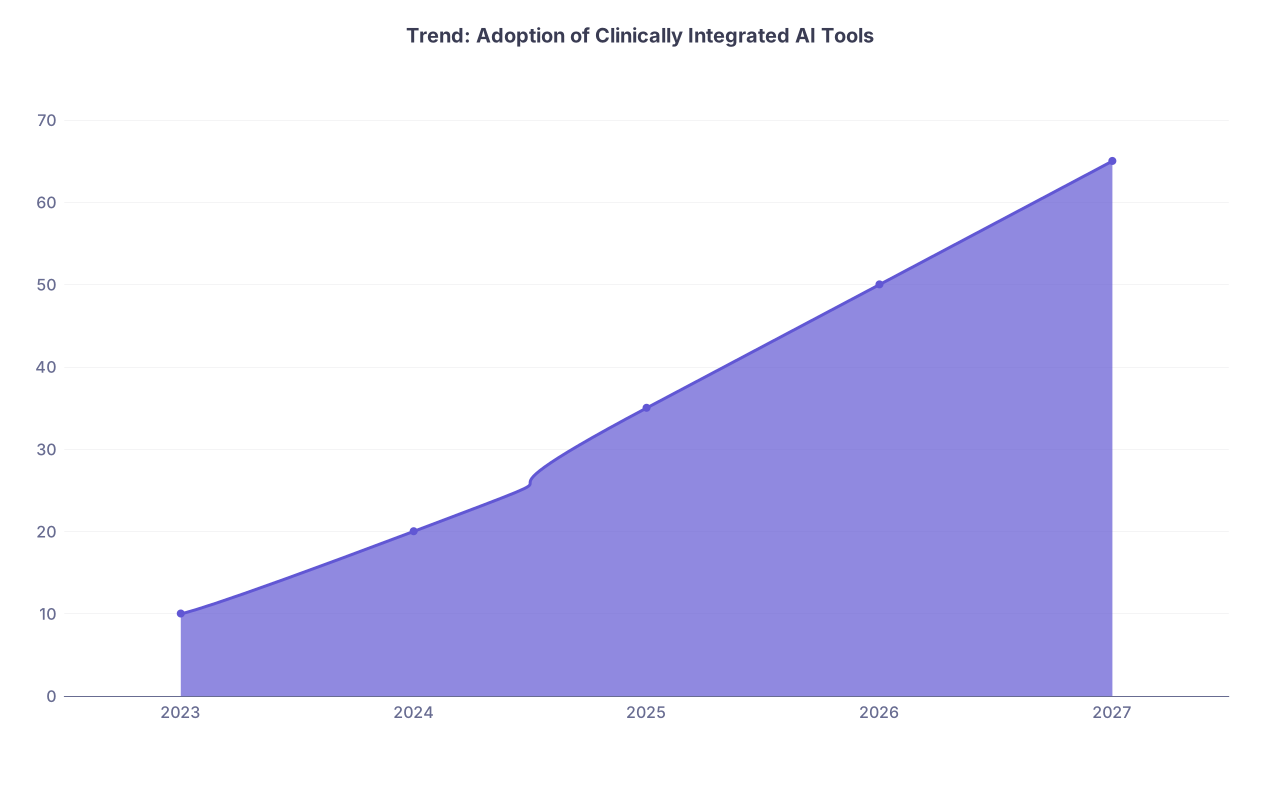
| Category | Value |
|---|---|
| 2023 | 10 |
| 2024 | 20 |
| 2025 | 35 |
| 2026 | 50 |
| 2027 | 65 |
Hospitals and health systems are:
- Signing BAAs with major AI providers
- Standing up internal, firewalled LLMs trained on their own data
- Integrating AI directly into EHR systems for notes, coding, and patient messaging
That will eventually mean:
- You won’t paste text into a random web page
- You’ll click “Ask AI” inside Epic/Cerner or your PACS
- PHI will stay inside the health system’s controlled environment
The grey zone we’re in—people quietly pasting cases into public tools—is a symptom of the gap between what clinicians need and what IT/compliance can currently offer.
The future of healthcare will normalize AI assistance, but inside the walls, under real governance. Not in your personal browser tab.
7. Concrete recommendations you can follow today
Let me condense this into actual behavior you can adopt tomorrow.
- Do not paste any patient-related text into public, non-approved AI tools if it came from the chart or could reasonably be tied back to a specific person.
- Use AI freely for:
- Medical knowledge questions
- Drafting protocols, teaching slides, generic content
- Fictional or clearly composite case examples
- If your institution offers an approved, BAA-covered AI system:
- Learn the exact rules: PHI allowed or only de-identified?
- Stick to those rules rigidly. “Everyone else does it” is not a defense when compliance calls.
- When in doubt, treat “de-identified” like radiation exposure: minimize dose and frequency. If you’re arguing with yourself about whether it’s safe, that’s a sign to stop.
FAQ (7 questions)
1. If I remove the patient’s name and MRN, is that enough to call it de-identified?
No. Removing name and MRN is the bare minimum, not de-identification. HIPAA’s Safe Harbor list has 18 categories of identifiers, and even if you remove them, you still must not have actual knowledge that remaining details could re-identify someone. Most real-world clinical vignettes don’t meet that standard.
2. Can I use ChatGPT to help write case reports for publication?
You can use AI to polish language, structure sections, or suggest phrasing, but you should not paste raw, identifiable chart text into a public model. If your institution has a secure, approved AI environment with a BAA, you may be able to work with more detailed data there, but only under your IRB/publisher/institution’s rules. And you must disclose AI use according to journal policy.
3. What about student teaching? Can I have ChatGPT help generate teaching cases based on real patients?
The safest path is to create composite or fictional cases first—offline—and then ask AI to refine or expand them. Do not feed real, specific case narratives with unique details into consumer tools. Your role as an educator doesn’t give you special privacy exemptions.
4. Are ChatGPT Enterprise or “for work” versions automatically HIPAA-compliant?
No. They can be configured to be HIPAA-aligned and may offer BAAs, but compliance depends on the specific contract, configuration, and how you use them. Your hospital has to formally sign and approve that environment. You as an individual cannot decide “this is fine” based solely on marketing materials.
5. Could a model ever “leak” my patient’s case to another user?
Modern providers claim strong controls, and most prompt content is not directly retrievable by other users. But two real risks remain: (1) training data reuse, if your data is used to improve public models, and (2) future vulnerabilities, misconfigurations, or policy changes. Legally, if you send PHI to a non-BAA system and it leaks, you’re still exposed.
6. If my institution has no AI policy yet, what should I do?
Default to conservative behavior: do not send any clinical narratives, even “de-identified,” to public tools. Use them only for general knowledge, writing help, and clearly fictional or composite scenarios. And push your institution (politely) to develop an AI policy and consider an approved, secure platform.
7. Is there any scenario where it’s clearly safe to use ChatGPT-type tools with patient-related content?
Yes: when the content has gone through formal de-identification (Safe Harbor or Expert Determination) or is synthetic/composite, and you’re not including rare, revealing constellations of details. Also, when you use institution-approved, BAA-covered tools that explicitly permit PHI for defined workflows. Outside those lanes, you’re guessing—and that’s a bad compliance strategy.
Key points to remember:
- Your casual idea of “de-identified” is almost never enough for public AI tools.
- The platform, contract (BAA), and institutional policy matter just as much as the text you paste.
- Until you have a clearly approved, secure AI environment, keep real patient cases out of general-purpose chatbots.