This article is for educational purposes only. It is not financial advice, not legal advice, and not tax advice. Figures vary by individual circumstances, so consult a qualified professional before acting.
The Morning Everything Changed
You built the whole year around it. The research fellowship at that lab you'd been courting since sophomore year. The NIH summer program with the PI who seemed genuinely excited about your project. The global health rotation you'd been logistics-planning for eight months. The clinical coordinator position that checked every box on your advisory dean's wish list.
Then the email arrived at 7:43 AM on a Tuesday.
"We regret to inform you that due to [budget restructuring / unforeseen circumstances / changes in program leadership / visa complications], we are unable to move forward with your placement this cycle."
I've watched this happen to more applicants than I can count. A funded research fellowship evaporates when the PI's grant doesn't renew. A international program suspends operations after a political shift. A family health emergency makes the cross-country relocation you'd planned suddenly impossible. A visa delay kills a research position abroad two weeks before your start date.
Your first reaction? Total free-fall. That gap year was load-bearing in your application narrative. It was the clinical experience that made you competitive. The research that would close the productivity gap. The thing you'd explain in every interview when they asked what you'd been doing since graduation.
Here's what I want you to hear: the raw panic you're feeling right now is appropriate, but the catastrophe narrative is wrong.
This is a detour. Not a dead end.
The match cycle clock feels ruthless when your plans disintegrate. I've sat with applicants who called me convinced they'd need to sit out a whole cycle, who six weeks later were in positions that actually served them better than the original plan. The difference between those who recovered and those who didn't wasn't luck or connections. It was what they did in the first 72 hours.
And I'm going to walk you through exactly what that looks like.
The First 48 Hours: Contain the Damage
Breathe first. I mean that literally.
When your plans collapse, your nervous system floods you with the same chemicals that prepare you for physical danger. Your prefrontal cortex, the part that makes strategic decisions, goes partially offline. That's not a metaphor. That's neurobiology.
So step one: do not send any emails in the first 24 hours. Not to the program that just rejected you. Not to your advisor. Not to the connected mentor you're suddenly desperate to impress. Write them if you need to. Save them as drafts. Send nothing.
I've watched applicants torch relationships in the first hours after a setback by sending emotionally-charged messages that made them look unstable or entitled. One student I worked with sent a seven-paragraph email to a program director blaming "systemic bias" for his fellowship cancellation. It was actually a budget cut. That PD never replied to him again, and he'd been a potential letter writer.
Once you're thinking clearly, get precise about what actually happened. Not the emotional story. The facts.
What specifically fell through? A named fellowship? A research position? A clinical opportunity? A whole category of plan?
Why did it fall through? Funding? Administrative failure? Your decision? Someone else's? Get honest about this because it determines what you tell the next person you talk to.
Where are you in the application cycle? Did this happen in March before the cycle opened? In June when you were already submitting? In August when you were completing secondary applications? The timing changes your options dramatically.
Now: make the list. Three to five people who might actually help. Program directors who know you. Mentors from previous research experiences. Your premed advisor. Alumni from your school who are now in positions of influence. Anyone who's ever said "let me know if you need anything" and meant it.
When you reach out, and wait until day two or three, keep it brief, honest, and forward-looking. Try something like:
"Dr. Chen, I'm reaching out because the research fellowship I'd planned for this year was cancelled due to funding cuts. I'm currently reassessing my options and would value any guidance you might have. I'm particularly interested in [2-3 specific areas] and would be grateful to hear your perspective on productive directions. Thank you for your time."
Notice what that message does: it states the problem without melodrama, shows you're already moving, and asks for guidance rather than a favor. You're not asking them to fix this. You're asking them to help you think.
That distinction matters.
Your Actual Options: The Recovery Menu
You have four real paths forward. None of them are perfect. All of them are viable. Let me walk you through them honestly.
Option A: Pivot the gap year
Same timeframe, different activities. Your original plan was a research fellowship? Look for clinical research coordinator positions at nearby academic medical centers. Planned to do global health work abroad? Local public health departments, community health centers, and refugee health programs need people. Had a scribe position lined up that fell through? Other scribe companies are perpetually hiring.
This option works best when you have more than three months before you'd need to apply. It keeps your gap year intact but redirects the energy.
Option B: Compress the timeline
If the collapse happens early enough, say, January or February before the application cycle, ask yourself whether you actually need the gap year at all. I've seen applicants who planned gap years because everyone told them to, not because their applications genuinely needed more time. If your stats are competitive, your clinical experience is solid, and the gap year was more about "what everyone does" than about filling genuine holes, applying this cycle might be your best move.
Option C: Restructure completely
This is the hardest option to stomach, but sometimes it's the right one. If your gap year was meant to fix specific application weaknesses, a low GPA, minimal clinical hours, no research experience, a single year of scrambling might not solve the problem anyway. A structured post-bacc program, an additional year of coursework, or a formal research master's might serve you better than a hastily assembled gap year.
Option D: Emergency gap year
This is the "find something productive fast" option. Not prestigious. Not carefully curated. Just real. A hospital scribe position. A medical assistant job at a clinic that's understaffed. A part-time research assistantship with a postdoc who needs help. A public health initiative that needs data entry support.
Here's the truth most advisors won't tell you: an emergency gap year that gives you genuine clinical exposure and patient interaction will serve your application better than a prestigious research fellowship that falls apart six weeks in and leaves you with nothing.
The question isn't which option sounds best on paper. It's which option you can actually execute given your timeline, your resources, and your specific application gaps. Be honest with yourself about all three.
The Fast-Track Fix: Finding New Opportunities in Weeks
The medical education establishment talks about gap years like they're carefully planned architectural features. In reality, most successful gap years are assembled in a rush with whatever materials are lying around.
Here's where to look when you need something real, fast.
Hospital scribe positions remain the most accessible entry into clinical work. Companies like ScribeAmerica, Aquity, and local hospital-based programs hire continuously, train quickly, and get you into patient encounters within weeks. The pay is mediocre. The hours are brutal. The clinical exposure is genuine. I've known applicants whose scribe experiences generated the most compelling stories in their personal statements.
Clinical research coordinator roles at academic medical centers are more competitive but surprisingly accessible if you're willing to email the right people. Department administrators, individual PIs, and research nurses all know when they're understaffed. A concise, specific email expressing interest, backed by any prior research experience, can open doors that formal applications won't.
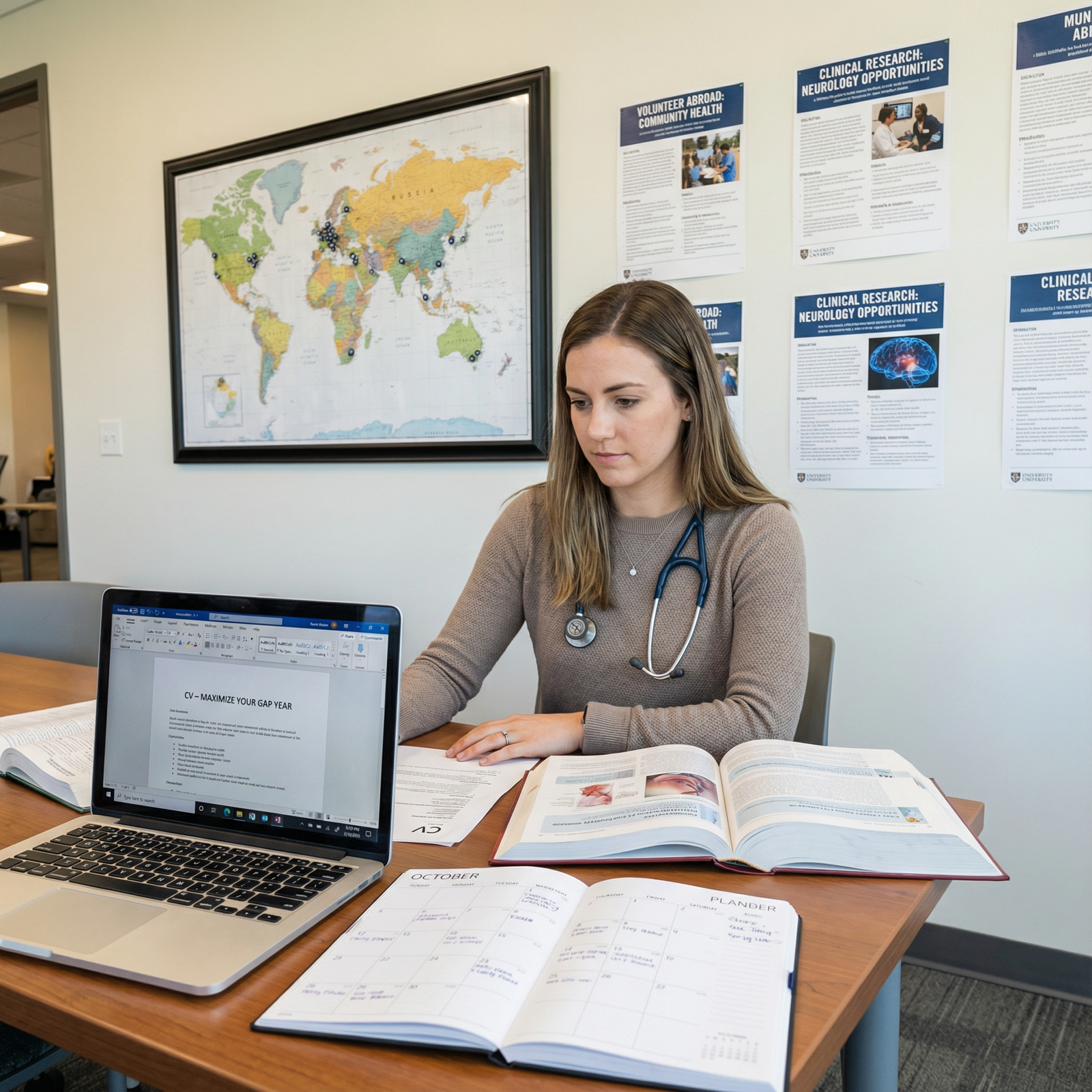
Public health initiatives don't always appear on formal application radars. County health departments, state public health labs, community health worker programs, and nonprofit organizations running health education campaigns all need capable people. These positions won't give you clinical exposure in the traditional sense, but they'll give you population health perspective that many applicants lack.
Leverage existing connections aggressively. Your undergraduate research mentor. The PI who wrote your letter. Your advisor's colleague who runs a lab at the medical school. Your friend's older sibling who's now an attending. Email them directly. Be honest about your situation. Ask what they'd do.
The "emergency gap year" doesn't need to be impressive. It needs to be productive. Three months of genuine patient interaction beats six months of nothing. A research assistantship that produces data beats a fellowship that exists only in your deleted emails.
How do you frame this on your application? Straightforwardly. You planned one path, circumstances changed, you adapted, you found something valuable. That narrative shows programs exactly what they want to see in a resident: someone who handles disruption without falling apart.
Making This Work for Your Application
Here's the paradox most applicants don't understand: the gap year that collapses and gets rebuilt often produces a stronger application than the one that goes exactly as planned.
Programs don't want smooth sailing. They want evidence that you can handle the chaos that residency will throw at you. A gap year that required adaptability, initiative, and problem-solving demonstrates those qualities more authentically than a curated experience that never encountered friction.
What do residency programs actually want to see when they look at your gap year? Growth. Clinical exposure. Maturity. Initiative. The capacity to turn obstacles into opportunities. They're not scoring you on whether your gap year matches some ideal template. They're reading for evidence that you used your time deliberately and learned something real.
When you address the gap in your personal statement, own the narrative. Don't hide what happened. Don't apologize for it. Frame it as what it actually was: a real-world test of exactly the qualities that make someone a good resident.
In interviews, when someone asks about your gap year, tell the honest story. "I'd planned a research fellowship that lost funding. I spent two weeks scrambling, reached out to three former mentors, and ended up working as a clinical coordinator at a community health center. That experience taught me more about patient care than I would have learned in the lab." That's not making excuses. That's demonstrating exactly the kind of resilience that programs want.
The story of overcoming obstacles is almost always more compelling than the story of everything going according to plan. Use that.
What To Do This Week
Stop deliberating. Start moving. Here's the actual schedule.
Monday: Process the disappointment. Talk to someone you trust. Then sit down with your application materials and identify exactly what this gap year was supposed to accomplish. Clinical hours? Research productivity? Community involvement? Name the gaps.
Tuesday-Wednesday: Build your contact list. Five to ten people who might help. Email three of them. Not all ten. You want quality conversations, not a spam blast that makes you look desperate.
Thursday-Friday: Research concrete options. Hospital scribe applications. Clinical research coordinator postings. Public health volunteer opportunities. Local clinics that might need help. Identify two or three that seem realistic and genuinely useful.
<chart-data-api config='{"type":"hbar","title":"One-Week Recovery Action Timeline","labels":["Monday: Process","Tuesday: Contact","Wednesday: Contact","Thursday: Identify","Friday: Pursue","Weekend: Decide"],"values":[1,2,3,4,5,6],"yAxisLabel":"Day"}">
Weekend: Make a decision. Pick one primary path forward and one backup. Commit to the primary path for at least six weeks before reconsidering. Endless deliberation will cost you more time than a slightly imperfect choice.
Set yourself a hard deadline. If you don't have something lined up within four weeks of your original plan collapsing, that's a problem. Not because you've failed, but because momentum matters. The longer you sit in the uncertainty, the harder it gets to move.
Summary: This Is a Detour, Not a Dead End
Every physician I know has a story about a plan that fell apart. The fellowship that got cut. The research project that collapsed when the PI left. The rotation that got canceled three days before it started. The gap year that wasn't supposed to happen but did.
The skills you're developing right now, assessing a crisis, reaching out for help, finding alternatives under pressure, adapting without falling apart, those are the same skills that get you through residency. You're not losing time. You're building the capacity that the next stage of your career will demand.
You have more control than it feels like today. The options I outlined are real. The timeline I suggested works. The narrative framework I gave you will hold up in interviews.
But none of that matters if you don't take the first step.
Send one email today. Not five. One. To the person most likely to respond. Start the momentum. The rest follows from there.

Key Takeaways:
- Gap year plans collapse more often than anyone admits, this situation is more recoverable than it feels
- The first 48 hours belong to assessment and outreach, not permanent decisions
- Your recovery options include pivoting, compressing, restructuring, or finding emergency opportunities
- Handling this crisis well can actually strengthen your application narrative
- Taking immediate concrete action matters more than finding the perfect solution