

What do you say when the program director looks up from your ERAS, pauses on your missing year, and asks: “So… what were you doing between July 2023 and July 2024?”
You get about 30 seconds to either reassure them—or quietly kill your chances.
Let me be blunt: badly explaining a gap year is one of the fastest ways to turn a neutral application into a liability. The gap year itself usually is not the problem. Your story is. Or the lack of one.
I have heard versions of all of these in interviews and debriefs:
- “They sounded aimless.”
- “I still don’t really know what they did that year.”
- “It felt like they were hiding something.”
- “They said they were burned out and needed time off… I do not want that on my call schedule.”
You are not going to get a second chance to fix a botched explanation. So let’s walk through the most common mistakes people make when talking about a pre‑residency gap year—and how to avoid setting off every alarm in the room.
The First Big Mistake: Acting Like the Gap Year Is No Big Deal
If you treat your gap year like a throwaway line—“Oh yeah, I just took some time off, nothing major”—you are already in trouble.
Programs notice gaps. They highlight them on applicant review sheets. They talk about them behind closed doors. Not because they hate gap years, but because gaps raise specific questions:
- Are you reliable?
- Can you handle sustained work without disappearing?
- Are you running away from something?
- Are you going to burn out on them?
The red-flag answer sounds like this:
“Oh, that year? I just kind of took some time to figure things out, did some traveling, spent time with family. Nothing too specific.”
That “nothing too specific” is exactly the problem. Vague + casual = “I have something to hide” in their minds.
Better instinct: own the gap. Give it structure. You do not need a heroic narrative, but you must show that you understand why they care and that your time had purpose, even if the year was messy.
Red Flag #1: Over-Sharing Personal Chaos
Some of you had brutal years. Family illness, mental health crises, academic failures, relationship implosions. You are human. Programs know that.
What hurts you is not the reality. It is how you present it.
The risky answer:
“Honestly, I was really burned out and depressed after failing Step 1. I just couldn’t function for several months. My relationship ended, I moved back home, and it took me a long time to get motivated again. I saw a therapist, tried some meds, it was rough for a while.”
Is any of that immoral? No. Does it make some PDs nervous about your ability to handle 80-hour weeks, night float, and sick patients without collapsing? Absolutely.
The mistake here:
- Too much raw detail.
- Centering your loss of function rather than your recovery and current stability.
- Leaving them unsure you are ready now.
You do not lie. But you also do not hand them a narrative of instability with no clear resolution.
A safer structure if your gap involved serious personal struggle:
- Name the category at a high level (family health issue, personal health, academic difficulty).
- Briefly acknowledge the impact.
- Spend the majority of your time on:
- What you did to address it.
- What structures you have in place now.
- What you learned that will help you as a resident.
If 80% of your answer lives in “I was struggling” and 20% in “here is how I am functioning now,” you have it backwards.
Red Flag #2: Sounding Aimless or Drifting
Program directors hate the sense that someone just floated for a year.
The red-flag version:
“I was kind of exploring different options. I tried some shadowing, did a bit of research, did some travel, spent time thinking about what specialty I wanted. I didn’t really have a set plan; I just wanted to see what felt right.”
To you, that might sound honest and thoughtful. To them, it sounds like:
- Lack of direction.
- Lack of follow-through.
- Possible difficulty committing.
What they want to hear is that even if your year started messy, you imposed structure on it.
You avoid this mistake by always being able to answer, clearly and specifically, these questions:
- “What were your primary commitments that year?”
- “What did a typical week look like?”
- “What concrete outcomes came from that year?”
If you cannot answer those without rambling or hand-waving, they will fill in the blanks—and not in your favor.
Red Flag #3: Pure Vacation Year With No Professional Thread
This one is common and deadly.
You worked hard. You felt exhausted. You finally had a year with no exams. So you backpacked across Europe. Lived at home. Traveled. Enjoyed life.
All fine for your soul. Deadly if it is the only thing you can say in an interview.
The dangerous answer:
“Yeah, I realized I might not get much time off once I start residency, so I decided to take a year to travel, see the world, and recharge.”
If you say this and nothing else, you just told a PD:
- You prioritized leisure over professional development for an entire year.
- You may underestimate the workload and sacrifice of residency.
- You had an opportunity to grow and did not take it.
You can absolutely have travel in your narrative. But not as the main event. You need a spine—clinical work, research, teaching, caregiving, something that ties to medicine and shows growth.
Think of it this way: if they write one line about your gap year in the rank meeting, what would you want it to say? If the line is “Took a year to travel,” that is a problem.
Red Flag #4: Blaming, Bitterness, or Victim Mode
Nothing tanks an interview faster than a candidate who uses their gap year explanation to air grievances.
I have heard answers like:
“My school wasn’t supportive after I failed that exam.”
“The administration really messed up our schedule, and I ended up delayed.”
“The dean was unfair, so I had to take time off to sort things out.”
What they hear:
- You externalize blame.
- You may be difficult to supervise.
- You may handle conflict by complaining rather than adapting.
The moment your answer starts sounding like a grievance committee letter, you lose them.
If institutional problems contributed to your gap, you can mention them, but do it surgically:
- Brief.
- Factual.
- Immediately followed by what you did in response and what you control now.
If the main emotional tone of your explanation is resentment, they will picture you resenting them when their schedule or policies are not perfect. And they are rarely perfect.
Red Flag #5: Downplaying Board or Academic Problems
Trying to “soften” a failure by almost pretending it did not matter is another classic error.
Example:
“I took a year to better align my Step preparation with my learning style. I just needed more time for personal growth.”
They can see the transcript. They see the fail. Dancing around it makes them suspicious.
Bad signs in your answer:
- Euphemisms instead of plain language.
- No specific description of how your approach changed.
- No clear evidence that the problem is now fixed.
Here is how you raise red flags even while technically telling the truth:
“I just needed more time to find study strategies that work for me. I’m confident I’ve learned how I study best now.”
Why they hate this:
- “More time” is not a strategy.
- “Strategies that work for me” is vague.
- Anyone can say “I’m confident.”
If your gap year was driven by academic or board issues, avoiding specificity is the mistake. They want to know:
- Precisely what went wrong (at a high level).
- Specifically what you changed (schedule, resources, support).
- Concrete results (improved score, passed on first retry, better clerkship performance).
You do not have to self-flagellate. But you cannot hand them a platitude and expect them to feel reassured.
Red Flag #6: Making the Gap Year Sound Like a Backup Plan to Residency
Some students essentially advertise that medicine was their plan B for that year.
The problematic answer:
“I really wanted to pursue my start-up full-time and see if it would take off. When it didn’t, I decided to re-focus on residency applications.”
Or:
“I spent the year exploring non-clinical careers like consulting and pharma, because I wasn’t sure medicine was the right fit anymore.”
What they hear:
- You are not fully committed to practicing medicine.
- You may jump ship to industry at the first opportunity.
- Training you is a risky long-term investment.
Again, there is a way to talk about exploring other fields without implying that clinical medicine is a consolation prize. The mistake is centering your answer on “I wasn’t sure I wanted to do this at all.”
If your gap year involved non-clinical work, you must thread it back to skills and insights that make you a better resident now—not advertise it as your preferred alternative.
Red Flag #7: Incoherent Timeline or Obvious Gaps Inside the Gap
This one is surprisingly common and extremely avoidable.
You say you worked as a clinical research coordinator from August to March. Then… nothing until the next July. If they ask, and the story shifts or sounds fuzzy, you look dishonest or disorganized.
Typical red-flag moment:
“From August to May I… sorry, I think it was more like July to February? But then I had some family stuff and travel… well, it was a mix of things.”
If your own timeline sounds like a blur, the PD assumes either you are hiding something or you really did nothing. Neither helps.
At minimum, before interview season, you should be able to lay out your year like this:
- Months.
- Main activity.
- Hours / commitment level.
- Any gaps inside the gap and why.
You do not need to narrate every detail, but if they probe, your story should sound like you actually lived it, not like you invented it on the drive over.
Red Flag #8: Over-Polished, Obviously Scripted “Personal Growth” Monologue
The opposite mistake of rambling chaos is the over-rehearsed TED-talk answer.
You know the type:
“This gap year was a transformative journey that allowed me to align my personal values with my professional calling, cultivating resilience, empathy, and a growth mindset.”
That sounds like ChatGPT swallowed an AMCAS guide. And PDs are tired of it.
Problems:
- Too abstract. No tangible activities or outcomes.
- Too polished. Sounds memorized, not lived.
- No sense of how your program will concretely benefit from this “growth.”
Red flags appear when you sound like you are performing a “gap year answer” rather than talking about your actual life.
You fix this by anchoring everything to specifics:
- Specific role: “Full-time medical assistant in a community clinic.”
- Specific struggle: “Balancing two part-time jobs and evening Step prep.”
- Specific growth: “I learned to manage high volumes of work while staying present with patients who had very limited resources.”
If your answer could be copy-pasted into any applicant’s mouth, you have gone too generic.
What Programs Are Actually Looking For (Translated)
To avoid mistakes, you need to know what the other side wants. Here is the honest version of what most PDs are trying to assess when they ask about your gap year:
| Underlying Question | What Raises Red Flags |
|---|---|
| Are you reliable and stable? | Vague, chaotic, or contradictory story |
| Can you handle residency stress? | Emphasis on burnout without recovery plan |
| Are you committed to this specialty? | Talk of “exploring other options instead” |
| Did you grow in ways that help us? | Pure vacation / no professional thread |
| Are you honest but appropriately boundaried? | Over-sharing intimate personal details |
They are not looking for perfection. They are looking for:
- Coherent story.
- Evidence of maturity.
- Signs the problem (if any) is addressed.
- A trajectory that points forward, not stuck in the past.
Your job is to give them just enough truth, structure, and reassurance to check those boxes—without spilling your entire therapy log.
How to Talk About “Messy” Gap Years Without Sinking Yourself
Not all gap years are tidy research fellowships. Many are patchwork: family illness, odd jobs, studying, a failed exam, some travel.
You do not need a flawless year. You need a coherent narrative.
Here is a simple structure that helps you avoid the most common mistakes:
One-sentence summary.
“I took a structured gap year focused on X and Y after [reason].”Concrete activities (2–3 pillars, not a laundry list).
Clinical work, research, caregiving, teaching, exam prep, etc.Challenge → Response → Result.
If your gap was triggered by a problem (exam failure, health, family), frame it:- “The challenge was…”
- “I addressed it by…”
- “As a result, I’m now… [concrete outcome].”
Tie to residency.
One or two sentences linking your experience to skills or traits that will show up on the wards.
You avoid red flags by not centering the pain, not centering the vacation, and not centering the blame. You center the response and the outcome.
Specific Phrases That Should Make You Stop and Reword
If any of these phrases are in your current answer, you probably need to rethink it:
- “I just needed a break from medicine.”
- “I wasn’t really doing anything too specific.”
- “I kind of drifted for a while.”
- “The school / administration really screwed me over.”
- “I realized I wasn’t sure if I wanted to be a doctor.”
- “I was pretty non-functional for a long time.”
- “I mainly used the year to travel and relax.”
- “It was just a personal year; not much to talk about.”
All of these plant doubt. Even if they are emotionally true, you must translate them into language that a residency selection committee can work with.
Quick Comparison: Safer vs. Problematic Framing

Here is what I mean by framing mistakes. Notice how both versions describe essentially the same year, but one raises far fewer red flags.
| Version | How They Describe the Same Year |
|---|---|
| Problematic | “I was burned out, so I took time off to travel and think.” |
| Safer | “After completing my core clerkships, I took a planned year to focus on personal health, structured Step prep, and working part-time in a clinic. I also had the opportunity to travel briefly before starting full-time work.” |
| Problematic | “I failed Step 2 and needed more time. I just hadn’t studied enough.” |
| Safer | “I did not pass Step 2 on my first attempt. I realized my approach—cramming alone, no schedule—was not effective. During my gap year I created a structured plan, enrolled in a review course, and met weekly with a study group. I passed on my next attempt and have applied the same structure to my clinical work.” |
Same facts. Different risk profile.
Timing and Consistency: Two Underestimated Pitfalls
There is another trap: your written and spoken stories do not match.
Program directors have ERAS, MSPE, personal statements, sometimes dean’s letters with their own spin. If your interview explanation feels like a completely different version, they start wondering which one is closer to the truth.
Common inconsistencies that raise eyebrows:
Personal statement: “I took a year to care for a sick family member.”
Interview: “I mainly used the year to explore different hobbies and figure out my interests.”MSPE: “Student took a leave of absence for academic reasons.”
Interview: “It was mostly for personal reasons and travel.”
They will notice. No, you will not talk your way out of this with charm.
Before interviews start, sit down with your ERAS, MSPE, and any email explanations you have sent. Map out a single version of what happened—truthful, consistent, appropriately bounded. That is the version you stick to.
A Quick Reality Check: How Often Do Gap Years Actually Sink You?
Not as often as you fear—if you avoid these self-inflicted wounds.
Here is the rough reality many PDs see each cycle:
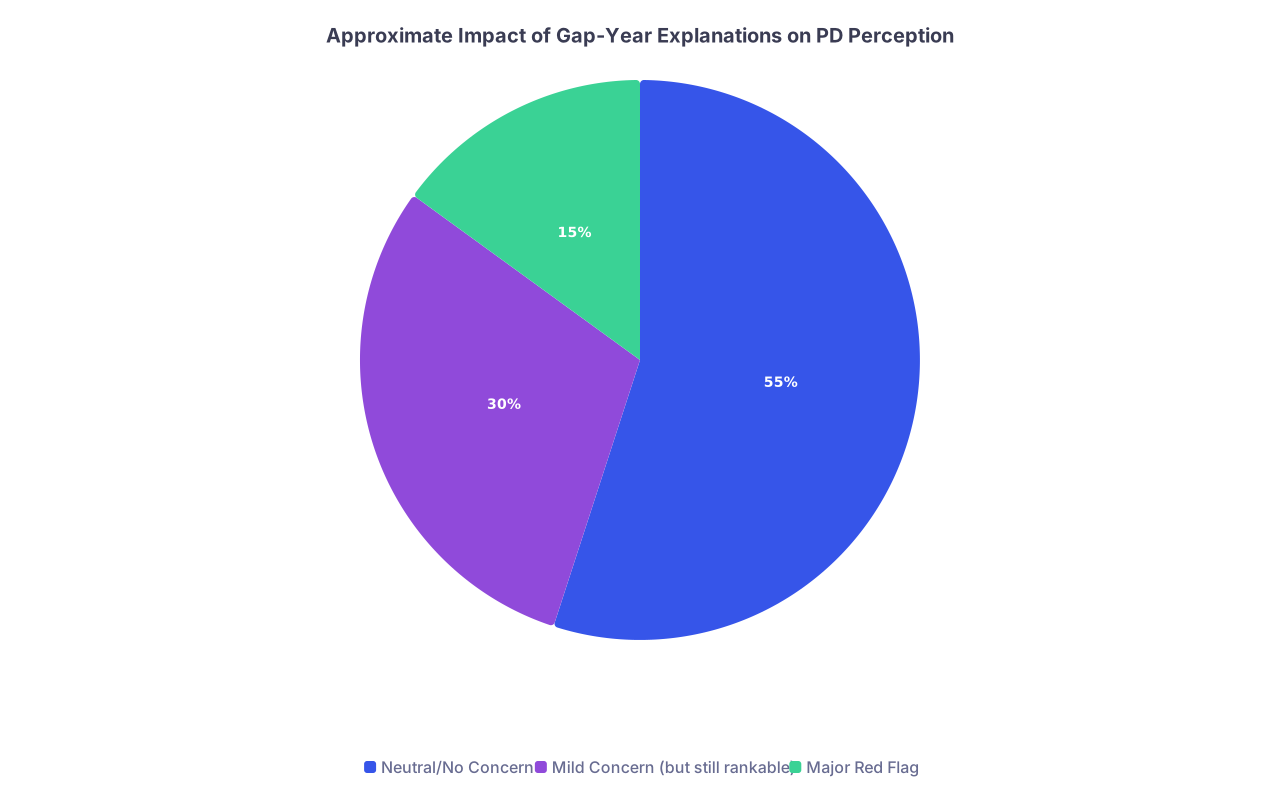
| Category | Value |
|---|---|
| Neutral/No Concern | 55 |
| Mild Concern (but still rankable) | 30 |
| Major Red Flag | 15 |
Most gap years end up neutral. Some raise mild concern that can be offset by strong performance elsewhere. A minority become “do not rank” triggers—almost always because of how the story is told, not the bare fact of the gap.
Your goal is not to make them love your gap year. Your goal is to keep it out of the “major red flag” slice.
Practice Without Turning Into a Robot
You should rehearse this answer. Out loud. Multiple times. But there is a line between prepared and scripted.
One useful way to practice without sounding fake:

| Step | Description |
|---|---|
| Step 1 | Write Bullet Points |
| Step 2 | Practice Out Loud Alone |
| Step 3 | Record Yourself Once |
| Step 4 | Revise for Clarity |
| Step 5 | Practice With Friend or Advisor |
| Step 6 | Trim Jargon and Over-Polish |
| Step 7 | Use Flexible Outline, Not Memorized Script |
If your answer requires you to memorize exact sentences, it is too complicated. If you can hit the same key points in slightly different words each time, you are in the safe zone.
The One Question You Must Be Ready For
At some point, directly or indirectly, you will get this:
“Why should I be confident that what led to your gap year will not recur during residency?”
If your answer to that is vague, defensive, or optimistic fluff, you are in danger.
Your answer must contain three elements, very clearly:
What specifically changed.
Schedule, support system, mental health treatment, study method, living situation.Evidence it is working now.
Recent performance, passing scores, sustained work, letters commenting on reliability.How you will handle future stress.
Concrete strategies, not “I’ll just work harder.”
If you skip any of those three, they will fill in the blank with doubt.
One Last Mistake: Pretending the Gap Year Did Not Change You
You are not interviewing to prove that the gap year meant nothing. That you are the same applicant, just older. That misses the opportunity and feels oddly flat.
At least once in your explanation, you should be able to articulate in plain language:
- One thing you understand now that you did not then.
- One habit or structure you plan to carry into residency.
- One specific way your program will feel the benefit of that year.
If you cannot do that, your gap year sounds like lost time. And that is how they will treat it.

Key Takeaways
- The gap year itself is rarely fatal; how you explain it is. Vagueness, blame, over-sharing, and pure vacation narratives are what hurt you.
- Your story must be coherent, specific, and forward-looking: clear activities, clear response to any problems, clear evidence you are stable and ready now.
- Align your written and spoken explanations, practice a flexible but consistent answer, and always be ready to answer the real underlying question: “Why should we trust you with our patients and our schedule now?”


