

The Hidden Risk of Unstructured Moonlighting in Your Gap Year
The fastest way to torch your residency chances in a gap year is unstructured moonlighting that “seems fine at the time.”
Everyone talks about the money. The freedom. The “I’ll just moonlight, stack cash, and apply stronger next cycle” plan. What most people do not see until it’s too late is how chaotic, poorly planned moonlighting during your pre-residency gap can quietly sabotage your Match more effectively than a bad Step score.
I’ve watched smart, capable graduates walk into an avoidable mess: malpractice issues, red-flag CV gaps, program directors questioning their judgment, and a year that was supposed to “strengthen the application” turning into one long explanation tour.
If you’re even thinking about moonlighting in your gap year before residency, you need to understand where people screw this up.
Let’s walk through the traps you actually need to worry about—not the theoretical ones your school handouts vaguely mention.
Mistake #1: Treating Moonlighting Like a Side Gig, Not a Regulated Medical Practice
If you remember nothing else, remember this: once you’re billing for patient care, you’re not “just helping out.” You’re practicing medicine. And the system will judge you accordingly.
Unstructured moonlighting usually looks like this:
- A friend or senior says, “We always need someone to cover nights; easy money.”
- A locums agency tells you, “Licensing is simple, credentialing is fast, tons of shifts available.”
- You think, “I’ll just do some urgent care, maybe a small ED, it’s fine.”
The mistakes start when you forget the rules changed the moment you stepped out of supervised training.
Here’s what people consistently underestimate:
Licensing and scope
Using a limited license meant for training to do unsanctioned moonlighting? That’s a career-ruining mistake.
Practicing outside the scope of your license or in a state where you’re not properly licensed is not a slap-on-the-wrist issue; it’s reportable, and residency programs will find out if it blows up.Supervision fantasy
Gap-year moonlighting is often unsupervised or minimally supervised. No attending to co-sign your mess. No safety net. If you’re fresh out of med school, that’s a big jump from “PGY-1 under watch” to “you’re the final word at 3 a.m.”Credentialing shortcuts
Unstructured gigs sometimes mean sloppy onboarding: “We’ll get your paperwork in; just start next week.”
That’s how you end up:- Unclear on your privileges
- Unclear who covers you for malpractice
- Unclear what support is available when something goes wrong
You know who doesn’t like unclear? State medical boards. Hospital credentialing. And residency program directors reading between the lines of your ERAS.
If you want to moonlight safely, you need the mindset of a fully responsible clinician, not a student picking up a side hustle. Most people don’t make that shift quickly enough.
Mistake #2: Letting Moonlighting Wreck Your Residency Narrative
Program directors don’t hate moonlighting. They hate unexplained, unfocused, or chaotic choices.
Your gap year is not just a 12-month paycheck. It’s part of your professional story. Unstructured moonlighting writes a very specific story if you’re not careful, and it often sounds like this:
- “I chased money instead of building my clinical skills deliberately.”
- “I didn’t have mentors helping me think long-term.”
- “I wasn’t selective about my clinical environment.”
- “I didn’t plan enough to avoid random job-hopping.”
You need to be brutally honest: if someone looked at your ERAS and only knew what’s on paper, what would they assume?
| Moonlighting Pattern | Common Negative Interpretation |
|---|---|
| Multiple short-term urgent care jobs | Unstable, chasing cash, no commitment |
| Heavy night shifts only | Burned out, hiding daytime performance |
| No concurrent academic activity | Not engaged in growth or improvement |
| Unexplained 3–4 month work gaps | Reliability concerns, possible termination |
The silent mistake? You assume you’ll “just explain it in interviews.” But you only get to explain if they invite you.
If your gap year:
- Has no coherent structure
- Is not clearly aligned with your target specialty
- Looks like random moonlighting filling time
…then you’ve made their job easy. They move on to someone whose file tells a cleaner story.
You can absolutely moonlight in a gap year and still look strong—if there’s structure:
- Defined clinical scope
- Consistent practice environment
- Clearly documented responsibilities
- Parallel work (research, QA, teaching, board prep) that shows growth
Unstructured = red flag. Structured = potentially a plus.
Mistake #3: Ignoring Documentation and Malpractice Exposure
This is the risk everyone claims to “know,” then half-ignore in practice.
Sloppy moonlighting setups often mean:
- Vague malpractice coverage
- Unclear tail coverage if you leave
- No one walking you through the implications of your documentation habits
You want the nightmare scenario? It looks like this:
You work a string of urgent care shifts for a private group. You’re charting fast. Templates, autopopulated normal exams, minimal detail. You leave after 8 months. Two years later, a letter arrives: malpractice claim. The complaint quotes your own note—with canned phrases that don’t match the actual context.
Now imagine:
- You’re already a resident or fellowship applicant
- This triggers credentialing reviews, maybe board notification
- You’re scrambling to produce proof of coverage from a group that barely exists anymore
All because you treated charting like a formality.
Unstructured moonlighting is where documentation discipline often collapses. No academic oversight. No structured feedback. No one auditing charts regularly. That freedom feels good—until it doesn’t.
At minimum, before you accept any moonlighting role in a gap year, you should have clear answers to:
- Who provides malpractice coverage?
- What are the limits? Is tail coverage included if I leave?
- Are there any procedures or settings not covered that I might be pushed to do anyway?
- Who reviews and co-signs (if anyone) my notes?
If those questions make the practice owner uncomfortable, that’s your sign to walk away.
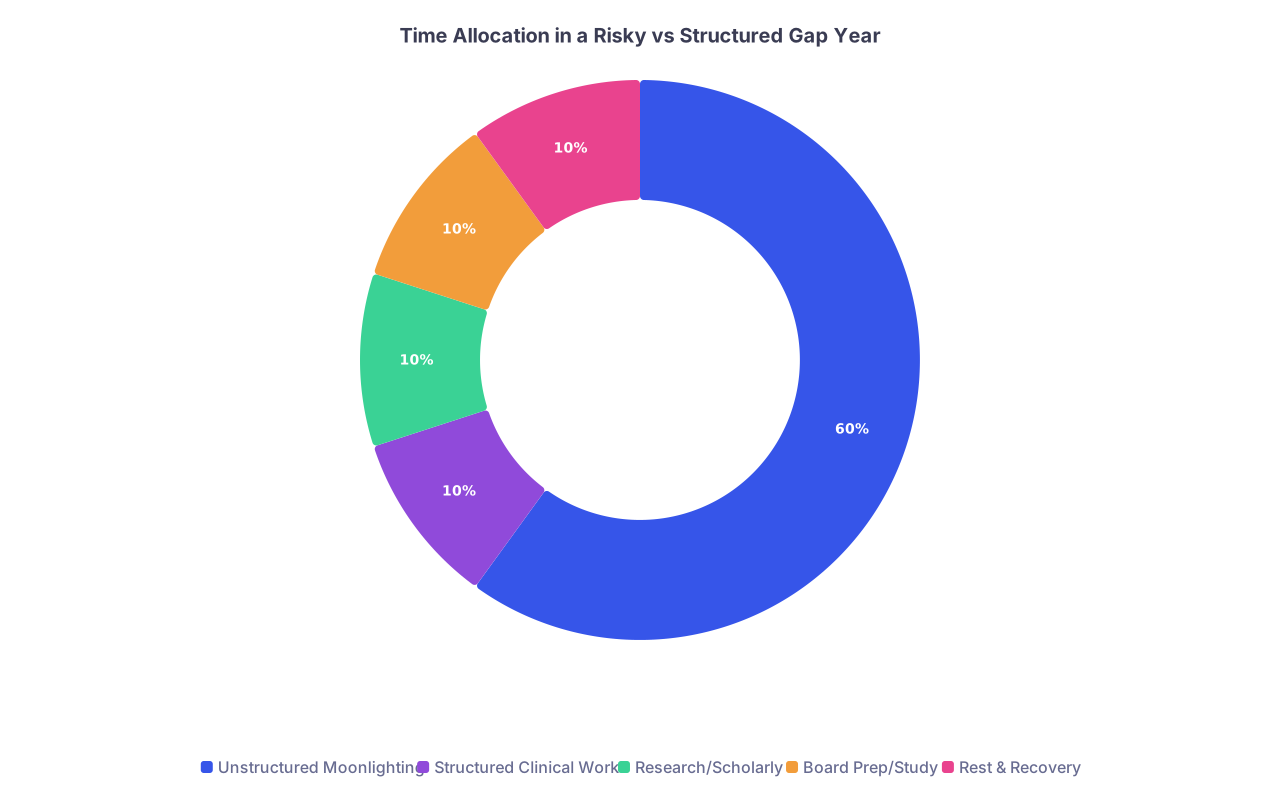
| Category | Value |
|---|---|
| Unstructured Moonlighting | 60 |
| Structured Clinical Work | 10 |
| Research/Scholarly | 10 |
| Board Prep/Study | 10 |
| Rest & Recovery | 10 |
Mistake #4: Letting Your Clinical Skills Decay in the Wrong Direction
Yes, you read that right. You can be “busy clinically” and still be getting worse for residency.
Think about it. If you’re matching into internal medicine, but you spend a year in:
- Retail clinics with 90% minor URIs and back-to-work notes
- Cash-based urgent care focusing on quick turnaround
- Settings with no real continuity, no complex management, no feedback
You’re not practicing the skills you’ll need. You’re reinforcing:
- Cutting corners in history-taking
- Over-reliance on quick imaging and labs
- Minimal longitudinal thinking
I’ve seen applicants show up for PGY-1 orientations after a “busy clinical year” and they’re rusty on:
- Inpatient medicine flow
- Guideline-based chronic disease management
- How to call consults appropriately
- Evidence-based decision making beyond “rule out the catastrophe, send home”
Because they spent a year playing urgent-care whack-a-mole.
Worse: many unstructured moonlighting gigs have very little feedback. No one says, “Hey, why did you give this? Why not that?” You lose the learning curve and keep only the habits.
If you want to moonlight and not sabotage your clinical growth:
- Choose settings that overlap with your target specialty’s bread and butter
- Make sure there’s at least some feedback or mentorship
- Periodically review your own charts with a critical eye
- Stay engaged with actual learning—guidelines, question banks, conferences
Gap-year moonlighting can be clinically valuable. But random, isolated, poorly chosen gigs usually are not.
Mistake #5: Underestimating How Burnout Bleeds into Your Applications
Another hidden risk: the emotional and physical cost.
Unstructured gigs are often:
- Nights and weekends
- Long stretches of shifts when “they’re desperate for coverage”
- Understaffed environments leaning on the locums person to absorb chaos
Now combine that with:
- ERAS writing
- Letters of recommendation follow-up
- Interview prep and travel
- Board studying or retakes
You can burn through your reserves fast. And residency programs can smell it on you.
A PGY-1 committee member once said to me after an interview day:
“Two of them looked like zombies. You could tell they’ve been grinding shifts nonstop. I don’t want someone already fried before July 1.”
That’s the part people forget. You’re not just trying to survive the year. You’re auditioning for a career. If your gap year leaves you:
- Exhausted
- Cynical about patients
- Detached or robotic in interviews
…your moonlighting “income” came at a huge hidden cost.
Build hard limits:
- Cap your weekly hours
- Block out protected periods for interviews and application work
- Take real time off (not just “days I didn’t have a shift”) to reset
A gap year that leaves you half-burned-out is not a “productive” year, no matter what your bank account says.

| Step | Description |
|---|---|
| Step 1 | Decide on Gap Year |
| Step 2 | Research/Scholarly Focus |
| Step 3 | Consider Moonlighting |
| Step 4 | High Risk: Reassess Jobs |
| Step 5 | Select Aligned Clinical Sites |
| Step 6 | Clarify License & Malpractice |
| Step 7 | Set Hour Limits & Protected Time |
| Step 8 | Maintain Academic Growth |
| Step 9 | Apply to Residency Stronger |
| Step 10 | Primary Goal? |
| Step 11 | Structured Plan? |
Mistake #6: Creating Red-Flag Gaps and Question Marks on Your CV
Program directors are trained to read what you did not write.
Unstructured moonlighting often leaves:
- Gaps when a job ended abruptly
- Vague descriptions like “clinical work in various settings”
- No formal titles or roles, especially in small private clinics
- No references who are known to academic medicine
That translates as:
- “Did they get fired?”
- “Did something happen there they don’t want to describe?”
- “Who can vouch for their professionalism?”
I’ve watched rank list meetings where someone scrolls through an application and says:
“What’s this 7-month job that just says ‘physician, locums’? No details. Pass.”
If you’re going to moonlight, you need to structure it on paper as well as in real life:
- Define clear job titles and locations
- Keep a log of shifts and responsibilities
- Identify at least one supervisor or colleague who can speak to your work
- Make sure your timeline is tight—no unexplained months floating around
You can absolutely say, “Gap year: moonlighting physician at X facility, focused on Y patient population, working Z hours per week, supervised by Dr. A.”
That sounds intentional. Safe. Responsible.
Compare that to “locums/urgent care, various locations” dropped into your CV like filler. One gets you questions. The other gets you filtered out.

Mistake #7: Misreading How Different Specialties View Gap-Year Moonlighting
Not every specialty reads moonlighting the same way. If you ignore this, you can accidentally step into a cultural mismatch.
Here’s the reality:
Competitive specialties (Derm, Ortho, Plastics, ENT, Rad Onc)
They want to see:- Research
- Strong letters from names they recognize
- Academic engagement
A year that’s heavily clinical moonlighting with minimal academic activity often reads as: “Checked out of the game.”
Medicine-heavy specialties (IM, EM, FM, Peds, Psych)
They’re more open to clinically focused gap years if they look structured, safe, and relevant.
But:- EM doesn’t want to see you doing sketchy low-resources solo-coverage ED work with no attending back-up as a newbie
- IM doesn’t want you spending 12 months in a setting where you never manage chronic disease or inpatient issues
Procedural fields (Gen Surg, OB/GYN, Anesthesia)
If you’re not doing procedure-related work, you’d better be:- Doing meaningful research
- Getting OR exposure with proper supervision
Random urgent care shifts? That doesn’t scream “future surgeon” unless paired with something stronger.
If your target specialty is highly academic, pure moonlighting with no scholarly work is almost always a mistake. You can still work—but stack something else on top: a research project, QI work with publishable output, teaching, exam preparation with tangible results (Step 3, for example).
Unstructured moonlighting without regard to specialty expectations basically says: “I didn’t bother to understand your world.”
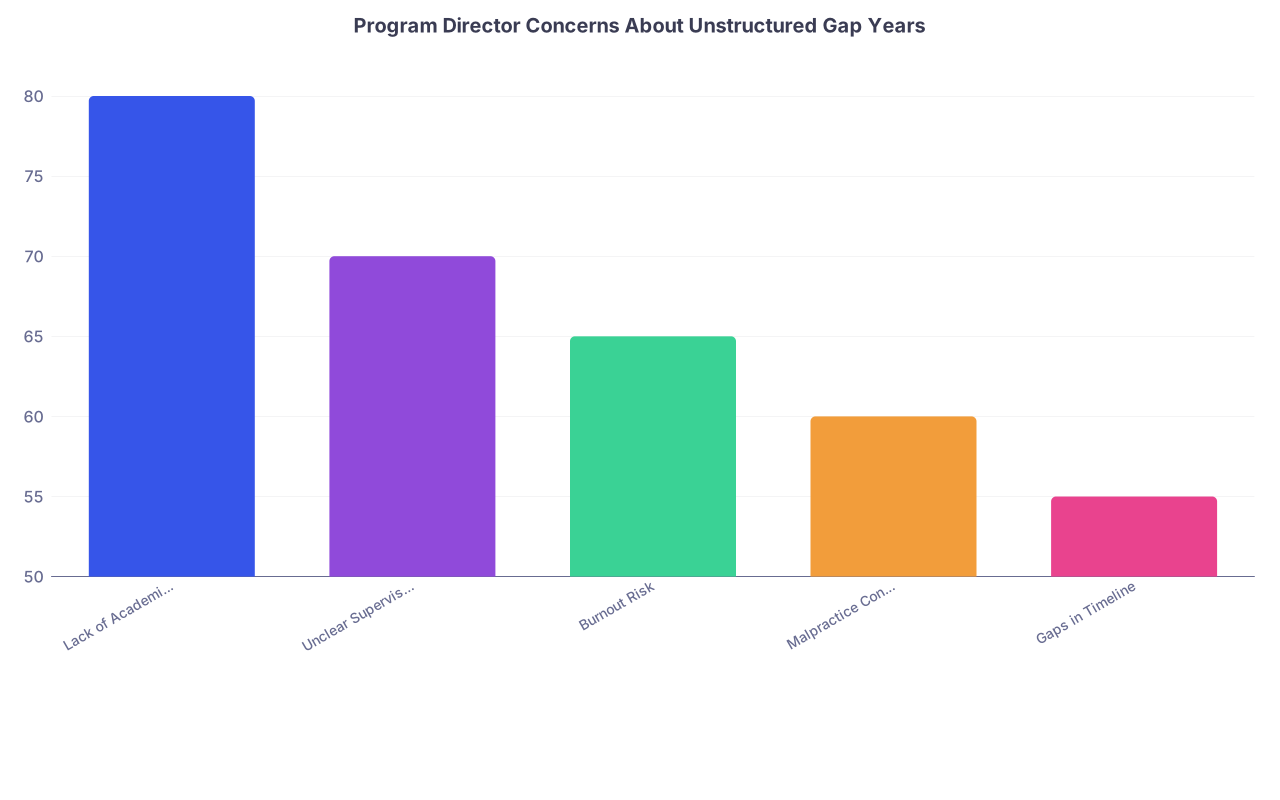
| Category | Value |
|---|---|
| Lack of Academic Activity | 80 |
| Unclear Supervision | 70 |
| Burnout Risk | 65 |
| Malpractice Concerns | 60 |
| Gaps in Timeline | 55 |
Mistake #8: Saying “Yes” Before You Ask the Ugly Questions
The riskiest moonlighting offers are often the ones that sound most appealing up front:
- “You can start next week.”
- “We pay above market; we’re desperate for help.”
- “You’ll be the only provider overnight—great autonomy.”
If you accept before interrogating the details, you’re gambling with your future license and Match prospects.
Here are the questions people are afraid to ask—but absolutely should:
- Who exactly supervises me? Are they on-site, on-call, or just “available if needed”?
- What’s the backup plan if something goes wrong—crashing patient, agitated psych, pediatric emergency?
- Am I expected to do procedures I’m not trained for? (Laceration repair is one thing; chest tubes solo at 2 a.m. in a rural ED is another.)
- Have previous moonlighters had issues? Why did the last person leave?
- Can I see the malpractice policy before I sign?
If the answers are vague, defensive, or rushed, walk. Do not be the person who says, “It’ll be fine” and discovers in 18 months that their “it’ll be fine” gig is now part of a legal proceeding.
This isn’t paranoia. It’s how you keep your career clean.

Mistake #9: Failing to Build Any Structure Around the Year
The core problem isn’t moonlighting. It’s unstructured moonlighting.
A structured, safe, defensible gap year might look like:
- 2–3 days per week of clinically relevant, supervised work at a reputable site
- 1–2 days committed to research, QI, or a defined project with deliverables
- Protected time for:
- Exam prep (if needed)
- Application writing
- Sleep, exercise, and a genuine life
Unstructured moonlighting? That’s:
- Taking anything offered
- No schedule discipline
- No long-term plan for how this year will read on your CV
- No “end product” beyond money and anecdotes
Here’s the harsh truth: if you can’t structure one year of your professional life intentionally, residency programs will question how you’ll manage the chaos of PGY-1.

The Bottom Line: Use Moonlighting, Don’t Let It Use You
You can absolutely work in your gap year and come out stronger for the Match. But if you stumble into unstructured moonlighting thinking it’s “just paid experience,” you’re walking into avoidable trouble.
Keep these points welded into your brain:
- Unstructured moonlighting is practicing medicine without a net—if you don’t nail licensing, supervision, and malpractice, you’re gambling with your future.
- Your gap year tells a story; random, cash-chasing shifts with no academic or structured clinical growth make you look unfocused and risky.
- A smart gap year is intentional: structured clinical work aligned with your specialty, clear documentation and supervision, plus ongoing academic or professional development.
Do not let a year meant to “help your application” become the thing you spend the next five explaining away.


