

The way most applicants describe gap-year telemedicine work on their CVs is lazy and undersells the experience.
Let me break this down specifically: if you spend a year doing telemedicine scribing, remote triage, or virtual care coordination, you can frame it as low-level clerical work…or as high-yield clinical systems experience that programs actually care about. The work itself is often the same. The difference is documentation, billing literacy, and how you present it.
You are in the “Gap Year Before Residency / Residency Match and Applications” zone. That means two overlapping priorities:
- Do not screw yourself with sloppy documentation or billing ignorance.
- Extract maximum CV value from what you are already doing.
We will hit both.
1. The Telemedicine Gap Year Landscape: What You Are Actually Doing
Most gap-year telemedicine roles for pre-residents fall into a few buckets:
| Role Type | Typical Title | Clinical Exposure Level |
|---|---|---|
| Remote scribe | Telemedicine Scribe | High |
| Virtual MA / care coordinator | Remote Medical Assistant | Moderate |
| Triage / patient navigator | Virtual Care Navigator | Moderate |
| Research + telehealth hybrid | Telehealth Research Assistant | Variable |
| Nonclinical operations | Telemedicine Operations Assistant | Low |
You may be:
- Live-charting for a virtual urgent care physician.
- Pre-charting charts (HPI, PMH, meds, allergies) before tele-visits.
- Managing inbound patient messages, refills, and result communication.
- Working in a digital clinic (e.g., weight loss, dermatology, behavioral health).
- Doing asynchronous chart review (e-visits, portal questionnaires).
Programs know these roles exist now. I have heard PDs at mid-sized IM programs say verbatim: “I would rather see a structured telehealth job than ‘studying for Step’ as the only thing listed.”
So your job is not to justify “telemedicine” as legitimate. It already is. Your job is to show:
- You did real clinical work, not call-center customer service.
- You understand documentation standards and clinical reasoning.
- You learned billing and systems realities, not just typing speed.
2. Documentation: How Not to Sabotage Yourself (and Your Attending)
Telemedicine documentation is not casual. It is discoverable in court, audited for billing, and judged by your future colleagues. Sloppy notes in telehealth are just as bad as sloppy inpatient notes. Sometimes worse, because the whole encounter hinges on what is written.
Core elements that must be in every telemedicine note
If you remember nothing else, remember this list. For each encounter, your documentation should clearly include:
- Modality: audio-only vs audio-video.
- Location of patient and provider (state at minimum, often needed for licensure).
- Consent for telehealth (and limitations explained).
- Chief complaint, HPI, ROS, PMH/PSH, meds, allergies as appropriate.
- Physical exam adapted to telehealth: what you actually assessed remotely.
- Clinical reasoning: differential and rationale, not just “Dx: sinusitis.”
- Plan with safety netting: return precautions, in-person escalation triggers.
If you are a scribe or MA, you are not independently deciding the content. But you are setting up structure and making it easier or harder for the clinician to do it correctly.
The dangerous mistake: copying in canned smart phrases with no idea what they imply. For example, documenting “no respiratory distress” in a video visit where the patient’s camera was off. Or pre-populating a complete 10-system ROS for a 3-minute phone call.
That is how future deposition transcripts get ugly.
Telehealth-specific documentation traps
Here is where gap-year folks often get it wrong.
Not specifying limitations of the exam.
If the camera quality is poor, or you could not inspect the oropharynx, say that. E.g., “Limited visual exam due to low-resolution video; unable to assess tympanic membranes or pharynx directly.” That sentence can save a malpractice case.Unrealistic exams documented by template.
I have reviewed charts where a remote derm visit listed “Normal cardiopulmonary exam” with no stethoscope and no audio quality good enough to judge respiratory effort. If your template auto-checks these, you should be the one flagging: “This default needs to be adjusted for telehealth.”Unclear triage / escalation criteria.
The plan should not just say “Follow up as needed.” For virtual care, it must include concrete “If X, go to ED; if Y, in-person in 24–48 hours.” Vagueness is dangerous.Licensure and location mismatch.
You might be sitting in Colorado, your attending licensed in New York, and the patient physically located in New Jersey. The only thing that matters legally is that the clinician is licensed where the patient is. The note should reflect that location. If your workflows are loose about recording patient location, that is a compliance risk.Over-reliance on “telemedicine boilerplate.”
The EMR may have a telemedicine macro. Fine. But when that macro says “Risks and benefits discussed, patient verbalized understanding,” and the entire “discussion” was 80 seconds, that can look dishonest.
How to build good documentation habits in this year
You want to walk away from your gap year being able to say, truthfully:
- “I became fluent in telehealth documentation standards.”
- “I helped refine templates to be clinically and legally appropriate.”
- “I understand how documentation flows into billing and compliance.”
Concrete ways to get there:
- Ask your supervising clinician directly: “Can you show me a model telehealth note for [common complaint] that you are proud of?” Then pattern-match.
- Keep a personal list of “telehealth documentation pitfalls” you have seen and mentally correct them.
- If your role allows, propose small changes to macros (removing obviously inapplicable exam findings, for instance).
- Learn the basics of E/M documentation requirements for telehealth (time vs MDM, key elements).
You will never be the one signing the notes in this role. But your fingerprints will be all over them. Act like that matters.
3. Billing in Telemedicine: What You Actually Need to Understand
Most gap-year applicants hand-wave billing: “I don’t bill; the physician handles that.” That is naïve. If you want to impress a PD or an interviewer who runs ambulatory clinics, show that you understand the basics of telehealth billing and its friction points.
I will keep this at a practical level.
Time-based vs MDM-based billing
In telemedicine, many encounters are billed based on time, especially when counseling dominates. Others are billed based on medical decision making (MDM) just like office visits.
You should know how these two models differ:
- Time-based: total time spent on the day of the encounter, including documentation and review, falls into a CPT range. E.g., 99442 vs 99443 for telephone E/M.
- MDM-based: complexity of problems, data reviewed, and risk of management.
Why you care: documentation must support whichever method is used.
- If your clinic bills by time, documenting “Total time: 19 minutes (chart review 4 min, patient interaction 10 min, documentation 5 min)” is not fluff. It is the difference between under- and appropriately-coded visits.
- If your clinic uses MDM, your note must clearly show complexity: number/severity of problems, data sources, and risk, not just “URI symptoms; Rx: azithro.”
Common telehealth codes and modifiers (high-level)
You are not coding, but drop these words intelligently in interviews and you sound like someone who actually worked.
- Phone E/M: 99441–99443 (audio-only MD/NP)
- Virtual check-in: G2012 (very brief communication)
- E-visits: 99421–99423 (patient-initiated online visits)
- Standard office E/M codes (99202–99215) used for video telehealth when payers allow parity.
Telehealth often uses specific modifiers and POS (place of service) codes. You do not need to memorize them, but you should know they exist:
- Modifiers like 95 or GT were common for telehealth.
- POS 02 or 10 in some payers for telehealth services.
If in your gap year you learn which codes your clinic uses and how documentation supports them, that is gold on your CV and in your “activity description” or ERAS experiences section.
Billing and documentation misalignment: where things fail
Real-world problems I have seen:
- Clinician checks a code for high-complexity MDM, but note reads like a simple sniffles visit with no justification.
- Visit billed as time-based, but total time not documented anywhere.
- Audio-only calls billed as audio-video telehealth due to lazy templates.
- Patient physically in an out-of-coverage region; telehealth claim denied because location not documented properly.
As a gap-year telemedicine worker, you can either sleepwalk through this…or notice the patterns and walk away saying: “I worked closely with clinicians and our billing team to make sure documentation appropriately supported telehealth E/M coding; I developed a working understanding of time-based vs MDM-based billing in virtual care.”
That sentence in an interview will absolutely differentiate you from 90 percent of other gap-year applicants.
4. How to Frame Telemedicine Work on Your CV and in ERAS
This is the part almost everyone gets wrong. They write:
“Telemedicine scribe – documented visits for physicians.”
That is dead on the page. It could be a high-school job.
You want to present:
- Scope.
- Complexity.
- Systems exposure.
- Clinical reasoning adjacency.
- Telehealth-specific skills.
Step 1: Title and organization
Use a title that is honest but not infantilizing.
Bad: “Telemedicine assistant (remote job)”
Better: “Telemedicine Clinical Scribe” or “Remote Clinical Documentation Specialist – Virtual Primary Care”
For ERAS “Experience Type,” this is typically “Paid Employment – Not Medical/Clinical Research” or “Paid Employment – Medical/Clinical” depending on duties. If you had direct patient interaction (triage calls, patient messages) under supervision, lean toward clinical employment.
Step 2: One-line role summary
You want a concise opener that sets context:
“Full-time remote clinical scribe supporting high-volume telemedicine urgent care practice (20–30 video visits per shift) for board-certified EM physicians licensed in multi-state practice.”
That one line tells the reviewer: volume, telemedicine, acuity, and who you worked with.
Step 3: Bullet content that actually matters
Now the meat. Limit to 3–6 bullets. Focus on:
- Documentation.
- Clinical reasoning exposure.
- Telehealth systems.
- Quality/billing awareness.
- Any leadership or process improvement.
Examples (adapt; do not copy verbatim everywhere):
- “Prepared and live-documented telehealth visits, structuring HPIs, ROS, and telehealth-appropriate physical exams for >2,000 adult and pediatric encounters across urgent care and primary care.”
- “Learned and applied telehealth documentation standards, including modality, location, consent, and limitations of remote exam; collaborated with attendings to refine EMR templates to better reflect what can be assessed virtually.”
- “Observed and documented clinical reasoning in telemedicine for undifferentiated complaints (e.g., chest pain, abdominal pain, shortness of breath), with particular emphasis on criteria for in-person vs ED escalation.”
- “Coordinated with billing team to ensure documentation supported E/M codes for telehealth; developed working knowledge of time-based vs MDM-based coding for remote encounters.”
- “Managed patient messaging, refill requests, and lab result communications under physician protocols, prioritizing safety-netting and follow-up plans for virtual care.”
Notice what is not there: fluff about “providing compassionate care” unless you had real patient-facing contact. Keep it concrete.
Step 4: Quantify and stratify
Programs like numbers because numbers imply reality:
- “Supported ~25–35 video visits per 8-hour shift.”
- “Documented >1,500 telehealth visits over 9 months.”
- “Managed inbox for a panel of ~1,200 primary care patients.”
Differentiate:
- Was it mostly low-acuity dermatology? Say that.
- Was it multi-state urgent care with real decision points? Say that.
Step 5: Map it to your target specialty
If you are applying to IM, FM, EM, psych, peds, or even neurology, telemedicine maps fairly directly. Cardiology or GI? Still fine if it was adult medicine–oriented.
In your personal statement or supplemental essays, you can do something like:
- “My gap-year telemedicine work forced me to think concretely about what can and cannot be safely managed virtually. Watching attendings articulate their thresholds for ED referral versus home management sharpened my own sense of risk tolerance and clinical uncertainty—skills I will bring into internal medicine training.”
You are not claiming you practiced medicine. You are claiming exposure to how real clinicians think in constrained environments. That is acceptable and compelling.
5. Red Flags and Pitfalls: What Programs Worry About with Telemedicine Jobs
Let me be honest: telemedicine gap years can raise concerns if framed badly.
Here is what PDs worry about when they see “telemedicine”:
- Low-responsibility “call center” masked as clinical.
- High-volume mill clinics practicing questionable medicine.
- You were just typing; no real clinical thinking exposure.
- You hid academic weakness behind remote gig work.
You defuse those by:
Making the work sound structured and supervised.
“Worked closely with 4 attending internists” sounds safer than “independent virtual clinic assistant.”Showing you understand limitations of telehealth.
Overstating what can be done virtually makes you sound naïve or reckless.Not pretending you were functioning as a physician.
If your description reads like you were diagnosing and prescribing, you will trigger red flags about professionalism and insight.Clarifying continuity, not chaos.
A coherent, long-term role (9–12 months) with the same group looks good. Three short stints at random telehealth startups looks more like gig-hopping.
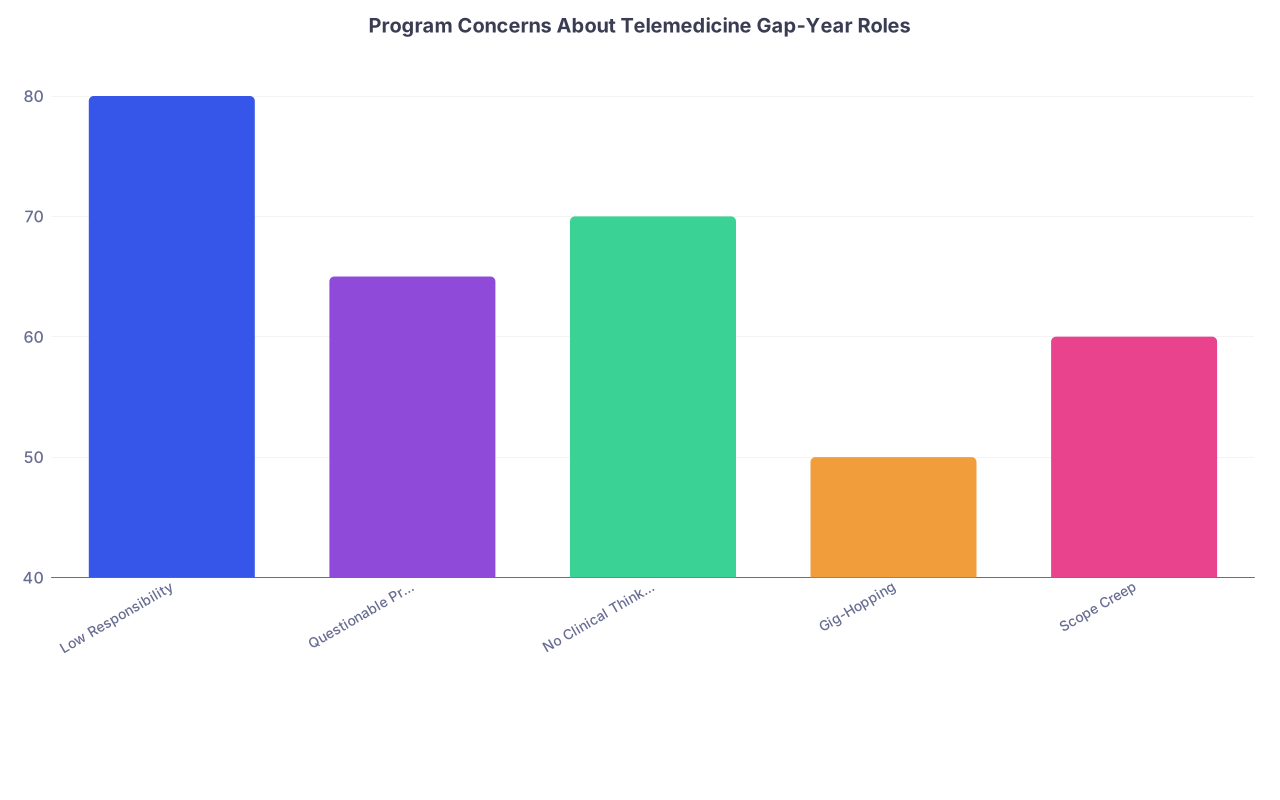
| Category | Value |
|---|---|
| Low Responsibility | 80 |
| Questionable Practice | 65 |
| No Clinical Thinking | 70 |
| Gig-Hopping | 50 |
| Scope Creep | 60 |
The fix is mostly in how you document and frame your work, not in the work itself.
6. Using Telemedicine Experience Strategically in Interviews and Essays
You can use this gap year as a serious asset if you talk about it intelligently.
Angles that play well in interviews
Systems and efficiency.
“Seeing telemedicine workflows up close showed me how small changes in documentation templates or pre-visit data collection can make the difference between a rushed, unsafe visit and a focused, high-yield one. I am interested in bringing that systems lens into residency clinic.”Equity and access.
“I saw how telehealth improved access for patients with transportation barriers, but also how connectivity issues and digital literacy gaps limited care. It made me appreciate the residents who patiently coached patients through technology while still providing safe care.”Clinical uncertainty and safety netting.
“Telemedicine forced very explicit safety-netting. I watched attendings say, ‘If your pain localizes here, or if fevers persist beyond 48 hours, you go to ED. Do not wait.’ That discipline in explaining uncertainty is something I want to emulate.”Learning from repetition.
“After documenting hundreds of telehealth URIs or UTI visits, you start to see consistent red flags that pushed attendings to change course. That pattern recognition—what made someone uneasy—taught me more than any textbook differential.”
A quick structure for a strong “telemedicine story”
Keep it tight:
- Concrete encounter (e.g., borderline chest pain / COVID triage / suicidal ideation on video).
- What you observed in how the attending handled limitations.
- What systems or documentation constraints shaped the visit.
- How that recalibrated your understanding of outpatient medicine.
You do not need drama. You need insight.
7. Practical Moves During the Year to Maximize Value
If you are already in the job or about to start, here is how to make the most of it.

| Step | Description |
|---|---|
| Step 1 | Start Telemed Job |
| Step 2 | Learn EMR + Templates |
| Step 3 | Understand Telehealth Documentation |
| Step 4 | Shadow Billing/Coding Workflow |
| Step 5 | Track Volume & Case Mix |
| Step 6 | Contribute to Small Process Improvement |
| Step 7 | Extract Stories for ERAS & Interviews |
Key steps:
- Ask if you can sit in on a brief training with the billing team. Even 30 minutes of “how we bill telehealth” will put you ahead of most peers.
- Keep a simple log (not PHI, obviously) of how many visits you support, typical complaints, and what surprised you clinically. This becomes raw material for ERAS entries and essays.
- Volunteer for small process projects: cleaning up a template, building a quick-reference intake checklist, standardizing telehealth ROS for common complaints.
- Request short, focused feedback from attendings: “Is there anything in my documentation structure that makes your notes harder or easier to complete?”
By March–May in the application cycle, you want to have:
- Clear metrics (volume, responsibilities).
- One or two meaningful process improvements you actually did.
- A supervisor who knows your name well enough to write a specific letter if needed.
8. How This Plays with The Rest of Your Application
Telemedicine alone will not rescue a weak Step 2 or a spotty transcript. But it can:
- Explain a “gap” year without research.
- Show maturity and understanding of real-world outpatient medicine.
- Support an interest in primary care, hospitalists, EM, psych, or telehealth-adjacent specialties.
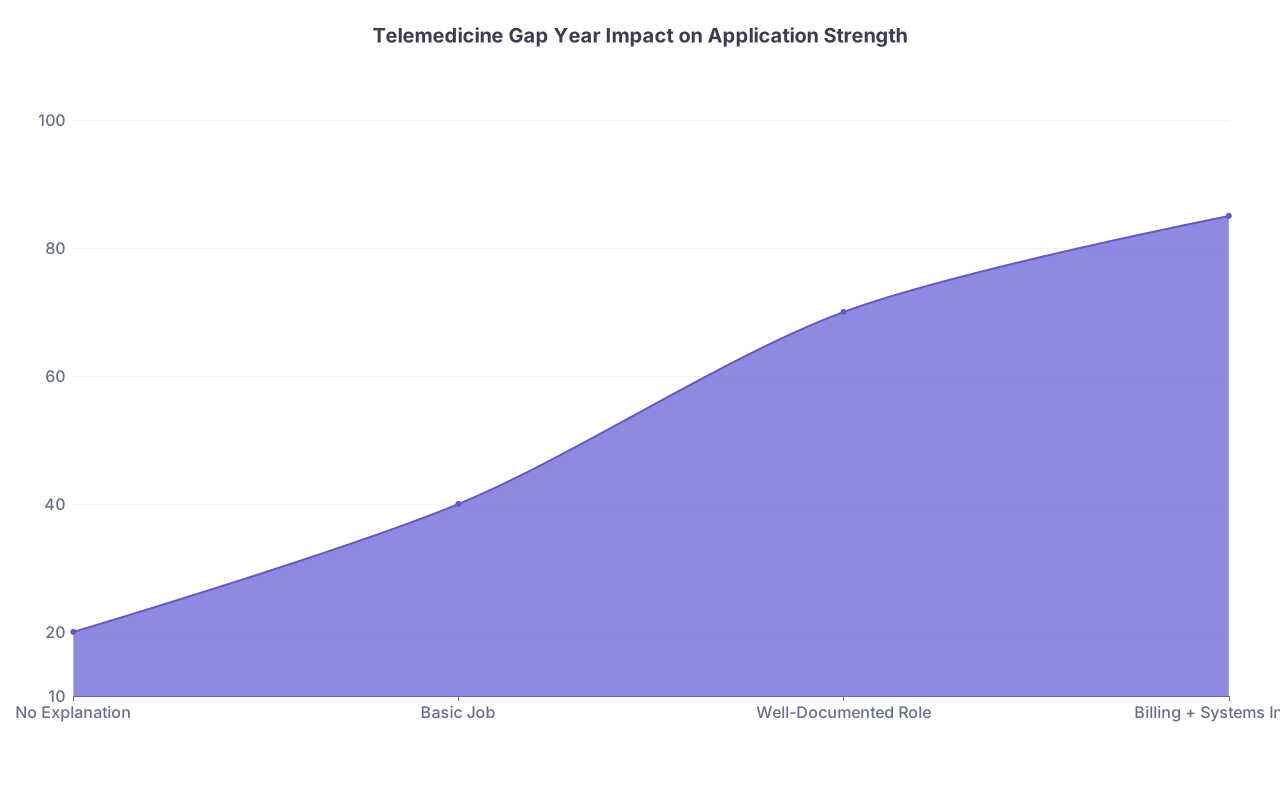
| Category | Value |
|---|---|
| No Explanation | 20 |
| Basic Job | 40 |
| Well-Documented Role | 70 |
| Billing + Systems Insight | 85 |
If your academic profile is middle-of-the-road but you can speak sharply about documentation, billing, and the constraints of telehealth, you come across as someone who has actually seen how medicine runs—not just how it is tested.
Not glamorous. But compelling.
FAQ (Exactly 6 Questions)
1. Does telemedicine scribe work “count” as clinical experience for residency programs?
Yes, when it is linked directly to real patient encounters and clinical documentation. Programs increasingly recognize telehealth as a core part of modern outpatient care. If your work was embedded in live visits, with direct exposure to HPI, exam, and plan for real patients, it absolutely counts. What does not count is generic customer service call-center work that is only tangentially related to care.
2. Should I ask for a letter of recommendation from my telemedicine job?
If you worked closely with one or two physicians who actually know your work habits, documentation quality, and professionalism, then yes, a letter can be very useful. It will carry the most weight in primary care, IM, FM, EM, psych, or peds applications. If your interaction with physicians was minimal or purely transactional (“we never talked; I just typed”), forcing a letter is a mistake. Go for depth, not novelty.
3. How do I avoid overrepresenting my role and getting accused of “scope creep”?
Draw a hard line in how you describe your work: do not say you “diagnosed,” “treated,” or “managed” patients. Use language like “documented,” “supported,” “coordinated,” “prepared,” and “observed decision-making.” Make it explicitly clear that all clinical decisions were made by supervising physicians or APPs. Interviewers are very sensitive to pre-resident applicants who blur this boundary.
4. Is it a problem if my telemedicine job was with a high-volume, direct-to-consumer platform?
It can raise eyebrows if the platform has a reputation for pill-mill behavior (e.g., overly liberal stimulant or opioid prescribing). If that is your situation, you should focus on what you personally learned about the risks and limitations of such models, and avoid sounding like you endorse questionable practices. If the clinical standards were solid, frame the volume as a chance to see a wide range of presentations and triage decisions.
5. How detailed should I get about billing and coding in my ERAS entry?
Keep it concise but concrete. One bullet along the lines of “Collaborated with clinicians and billing staff to ensure telehealth documentation supported appropriate E/M coding; gained working knowledge of time-based vs MDM-based billing for virtual encounters” is enough. You do not need to list CPT codes. Save deeper billing stories for interviews, where you can read the room and expand if the interviewer cares.
6. What if my telemedicine role was mostly patient messaging and refills, not live video visits?
You can still frame it well. Emphasize longitudinal care coordination, safe refill protocols, standard lab monitoring, and clear written safety-netting for patients. Describe how you triaged messages, routed urgent concerns appropriately, and observed how physicians handled abnormal results or new concerning symptoms via asynchronous communication. It is somewhat less “dramatic” than live visits, but it shows continuity-of-care experience that many programs value.
Key takeaways:
First, treat telemedicine documentation as real clinical documentation; learn the standards and avoid template-driven nonsense. Second, understand at least the basics of how telehealth visits are billed so your documentation and interview stories sound grounded in reality. Third, frame your gap-year role on the CV and in ERAS as structured, supervised clinical systems exposure—quantified, specific, and clearly within your scope—so programs see an asset, not a placeholder job.


