

Most gap year “clinical educator” jobs are wasted opportunities—because they look like generic service work instead of deliberate academic grooming.
Let me show you how to structure yours so program directors see “future faculty,” not “took a year off and floated around.”
1. The Core Mindset: You Are Building an Academic Product
The mistake I see over and over: people treat a gap‑year clinical educator job like another line on the CV. “2025–2026: Clinical educator, XYZ Hospital. Taught medical students on wards.”
That is meaningless. Every program gets dozens of those lines.
You are not filling time. You are building an academic product across four dimensions:
- Teaching portfolio
- Curriculum / systems impact
- Scholarship and dissemination
- Professional narrative and letters
If your gap year does not give you concrete wins in at least three of those four, then you structured it poorly.
Think of PDs at places like UW, UCSF, or Mayo reading your file. They are asking:
- Did this person do more than just “be helpful”?
- Did they work at the level of a junior faculty member?
- Would I trust them with our medical students or residents on day one?
- Did anyone invest in them enough to write a detailed, academic‑style letter?
Your job is to make “yes” the only rational answer.
2. Choosing and Negotiating the Role: Do Not Just Take What Is Offered
Do not just grab the first “clinical educator” or “teaching fellow” position you see and call it good. You need structure and explicit responsibilities that you can later convert into bullets, projects, and letters.
A. What a Strong Gap Year Clinical Educator Role Looks Like
You are aiming for something that, on paper, looks suspiciously like junior faculty:
- A defined teaching load (sessions per week, courses, rotations)
- Named responsibilities (“course co‑director,” “clerkship assistant director,” “simulation lead,” “OSCE coordinator”)
- A faculty mentor specifically for education
- Protected non‑clinical time for curriculum/scholarly work
- A clear evaluation pathway (evaluation forms, trainee feedback, annual review)
This is worlds apart from “I precepted students in clinic sometimes.”
| Aspect | Weak Role Description | Strong Role Description |
|---|---|---|
| Job title | Clinical assistant / tutor | Clinical teaching fellow / educator |
| Teaching | Ad hoc bedside teaching | Scheduled sessions + assigned courses/rotations |
| Responsibilities | “Help with students” | Named projects (OSCEs, simulation, morning report) |
| Mentorship | Informal, inconsistent | Assigned faculty mentor, regular meetings |
| Scholarship | None or vague | At least one planned scholarly output |
You can find these roles under titles like:
- “Clinical Teaching Fellow” (common in the UK, some US places)
- “Medical Education Fellow”
- “Clinical Instructor / Clinical Educator”
- “Junior Faculty in Medical Education”
- “Simulation Fellow”
- “Pre-clinical Teaching Fellow” (for anatomy, path, phys)
B. How to Negotiate the Structure (Before You Sign Anything)
You do not need to be demanding. You do need to be specific.
When you are offered or discussing a role, ask explicitly:
- “What are the recurring teaching activities you would expect me to own?”
- “Is there a specific course, clerkship, or simulation activity I can be officially tied to?”
- “Who would serve as my primary education mentor, and how often can we meet?”
- “Is there scope for me to develop or revise a teaching tool, small curriculum, or assessment?”
- “Would you support me presenting any education work at a conference or submitting a brief report?”
If they answer those questions vaguely, that is a warning sign. Academic programs like seeing you in environments where expectations are clear and you are held to a faculty‑level standard.
3. Designing Your Teaching Portfolio: From “I Taught” to “Here Is Evidence”
A “teaching portfolio” sounds formal and distant. It is not. It is simply organized proof that you are serious about education.
A. What You Want to Have at the End of the Year
By the time ERAS opens, you should be able to pull out:
- A one‑page teaching summary: types of teaching, lean numbers, highlights
- A list of specific sessions / courses you taught, with your role clearly defined
- Representative student evaluations (anonymized, of course)
- One or two teaching materials you created or heavily revised
- If available: any teaching awards / nominations or positive comments aggregated
This is not overkill. The people who match into solid academic programs often have some version of this.
B. Make Your Teaching Quantifiable
Do not rely on fuzzy language like “taught often” or “frequent educator.”
From day one, track:
- Number of small‑group sessions (e.g., 28 small groups of 8–10 students)
- Types of teaching: bedside, small group, lectures, simulation, OSCE prep, skills labs
- Levels of learners: pre‑clinical, clerkship, sub‑interns, PA students, NP students
- Formal roles: “co‑led the M3 Internal Medicine Clerkship orientation session monthly”
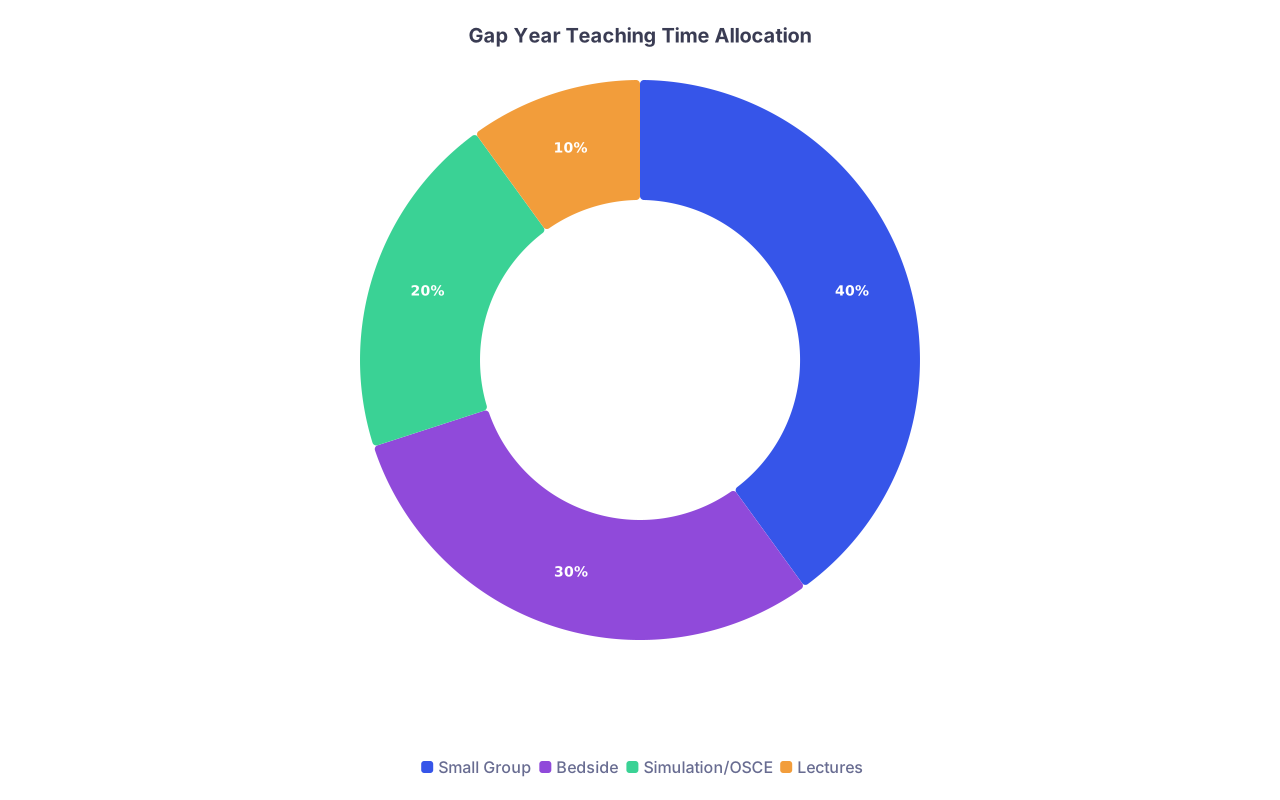
| Category | Value |
|---|---|
| Small Group | 40 |
| Bedside | 30 |
| Simulation/OSCE | 20 |
| Lectures | 10 |
On your CV and ERAS, you can then write:
- “Facilitated 32 small‑group clinical reasoning sessions for 1st–3rd year medical students (6–10 students per group).”
- “Led weekly bedside teaching rounds for 3rd‑year clerks (approx. 120 hours over the academic year).”
- “Served as primary instructor for 6 standardized‑patient OSCE prep sessions (avg. 20 students per session).”
Those numbers signal seriousness.
C. Collect and Organize Evaluations
You want hard evidence that learners valued your teaching.
Steps:
- Clarify early how students evaluate you. Is there a standard form? Can you be added as a named instructor in the evaluation system?
- Ask the clerkship director or education office to ensure you are listed correctly for evaluations. Most forget this unless you push.
- At mid‑year and end‑of‑year, ask for an anonymized summary of your teaching evaluations. Not individual comments tied to names, but the aggregate.
You are looking for:
- Quantitative ratings (e.g., “4.6/5 on overall teaching effectiveness, n=45”)
- Representative comments that highlight your strengths: clarity, organization, feedback, approachability, clinical reasoning
Those can feed:
- Your CV bullets: “Received mean rating 4.7/5 (n=52) on overall teaching effectiveness as small‑group facilitator.”
- Letters: your mentor can quote those numbers and specific themes.
- Interview talking points.
D. Build a Small but Polished Set of Teaching Artifacts
You want 2–3 things that, if a PD asked, you could show with pride:
- A structured case you designed for clinical reasoning
- A short set of slides for a recurring talk (e.g., “Approach to AKI for M3 students”)
- A skills checklist for OSCE or procedure teaching
- A feedback form or template you developed
These do two things:
- Demonstrate that you moved beyond “showing up and talking.”
- Make it easier to write any education scholarship you decide to pursue.
4. Curriculum, Systems, and “Impact” Work: How to Look Like a Junior Faculty Member
Teaching hours are necessary. Impact is what separates you.
You want at least one project that fits the pattern:
- Identified a need
- Designed or modified something
- Implemented
- Evaluated somehow
- Shared locally or beyond
A. Types of High‑Yield Projects
A few that work very well in applications:
- OSCE enhancement: redesigned checklists, added a new case, streamlined scoring
- Simulation curriculum: built or refined a simulation scenario with debriefing guide
- Clerkship orientation: created a structured orientation packet or workshop
- Feedback improvement: implemented a new feedback form or framework for residents to use with students
- Assessment alignment: mapped clerkship activities to NBME / shelf content and adjusted teaching sessions
- Self‑directed learning modules: short online modules or case banks for rotating students
Notice all of these are tangible and definable.
B. Keep the Project Scalable
Do not propose a multi‑year longitudinal curriculum if you are there for 10–12 months and have no staff.
A realistic gap‑year project:
- Scope: 1–3 sessions, 1 rotation, or one course component
- Timeline: 3–6 months from conception to implementation
- Data: basic pre/post surveys, utilization data, or learner feedback
For example:
- “Developed a 2‑session simulation curriculum on acute chest pain for 3rd‑year clerks; collected pre/post confidence ratings and satisfaction scores.”
That one line on your CV reads very differently than “helped teach simulations.”
C. Make Sure Someone Senior Co‑Owns It
You want a faculty member’s name next to yours. Always.
- Approach a clerkship director: “I noticed students struggle with X. Could I work with you on a small project to improve Y?”
- Suggest specific deliverables and a simple evaluation plan.
- Make it easy for them. You do the heavy lifting; they provide oversight, institutional memory, and legitimacy.
At the end, they can:
- Present the project in your letter as “our” work with you as the main driver.
- Help you submit it to a regional or national education meeting (e.g., COMSEP, SGIM, APDIM, AAMC).
5. Turn Work into Scholarship: You Need Something Citable
The academic programs that care about “clinical educator” pipeline will scan your application for some evidence that you understand dissemination: posters, workshops, short papers.
You do not need a NEJM article. But you do need something.
A. Identify What From Your Job is “Publishable”
The easiest paths:
- Innovation abstracts / posters on med‑ed projects
- Workshop proposals for regional or national conferences
- Brief curricular innovation reports in med‑ed journals
- Online resources with DOIs (e.g., MedEdPORTAL)
What translates well:
- A new or revised curriculum with any evaluation data
- A structured feedback tool with pilot results
- A simulation case that fills a clear gap
- A clerkship scheduling or orientation fix with measurable benefits
B. Timeline Reality Check
You have about 10–12 months.
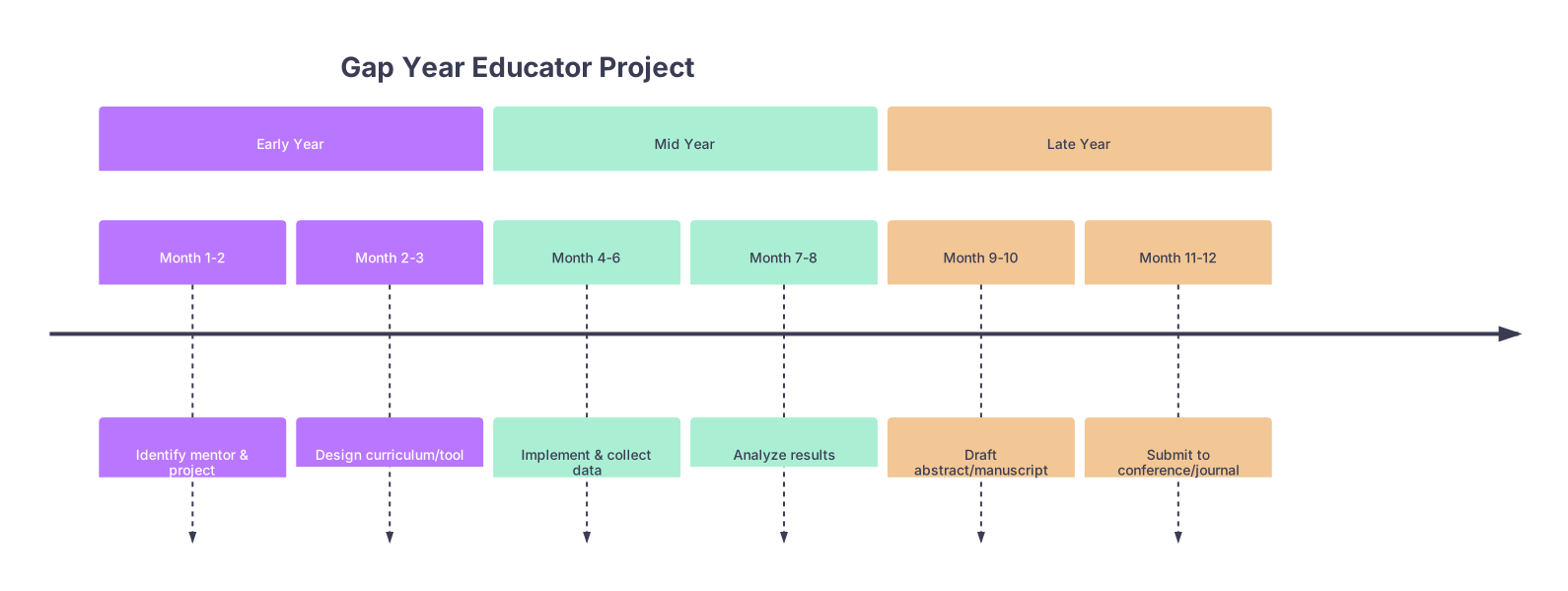
| Period | Event |
|---|---|
| Early Year - Month 1-2 | Identify mentor & project |
| Early Year - Month 2-3 | Design curriculum/tool |
| Mid Year - Month 4-6 | Implement & collect data |
| Mid Year - Month 7-8 | Analyze results |
| Late Year - Month 9-10 | Draft abstract/manuscript |
| Late Year - Month 11-12 | Submit to conference/journal |
The realistic goal: by ERAS submission you either have:
- An accepted abstract/poster OR
- A submitted manuscript/workshop with documentation OR
- At minimum, a complete project with prepared abstract/manuscript in progress mentioned in your LOR
Mention it clearly:
- “Co‑authored accepted abstract on clerkship simulation curriculum (to be presented at SGIM 2026).”
- “First author, curricular innovation manuscript under review at MedEdPORTAL.”
That is the type of line that instantly marks you as “education‑serious.”
6. Build the Right Relationships and Letters: Your Hidden Currency
I have seen weaker CVs match very strong programs purely on the back of two things:
- A clear academic direction
- Exceptional, detailed letters from serious educators
Your gap year is a machine for generating those letters if you use it correctly.
A. Pick at Least Two Core Mentors
You want two different people to know your work well:
- A day‑to‑day teaching supervisor (e.g., course director, simulation director, clerkship director)
- A more senior “education person” (e.g., Vice Chair for Education, Assistant Dean for UME/GME, residency APD)
Meet with them with intent:
- Month 1–2: introductory meeting — clarify your goals (residency, interest in clinician‑educator path), ask for advice, ask if they are willing to mentor
- Monthly or every other month: brief updates with specific asks (feedback on a session, project design, where to present, who else to meet)
- Mid‑year: explicit conversation — “I hope to apply for residency this fall; can we discuss if you would feel comfortable writing a detailed letter when the time comes?”
- Late year: sit down with CV, personal statement draft, and a one‑page summary of your work with them
B. Make Their Job Easy When Letter Time Comes
Hand them:
- Your updated CV
- A one‑paragraph blurb on your residency target and intended career path
- Bullet points of work you did with them: teaching, projects, leadership, any metrics
- A short list of key themes you hope they can address (e.g., teaching effectiveness, professionalism, independence, initiative)
Good letters talk about:
- Specific teaching episodes (“She independently ran the M3 case conference when I had to step out…”)
- Trainee feedback quotes or metrics
- How you compare to other educators at your level (“Top 5% of junior teachers I have worked with”)
- Your potential as future faculty (“I would recruit him back to our department without hesitation”)
You cannot write the letter for them, but you can hand them enough material that they want to.
C. Seek Titles and Roles That Signal Trust
If there is an opportunity to attach your name to a micro‑leadership role, take it. Even modest.
Examples:
- “Co‑lead, M3 Case‑Based Learning Series”
- “Junior Facilitator Coordinator for OSCEs”
- “Assistant pre‑clinical lab director for anatomy tutorials”
This is not about ego. It is about having a title a PD recognizes as “not just extra hands.”
7. Documenting and Presenting It in Your Application
Structuring the role well is useless if you bury it in generic CV language.
You need to thread it through:
- Your ERAS “Experience” section
- “Publications/Presentations”
- Personal statement
- Supplemental ERAS (if applicable)
- Interview talking points
A. ERAS Experience Entry: Do the Heavy Lifting Here
Title: be precise.
Bad: “Clinical Educator”
Better: “Clinical Teaching Fellow, Internal Medicine Clerkship”
Or: “Medical Education Fellow, Department of Emergency Medicine”
Description: 3–6 bullets, concrete and outcome‑oriented. For example:
- “Facilitated 32 small‑group clinical reasoning sessions for 1st–3rd year medical students (6–10 students per group).”
- “Led weekly bedside teaching rounds for 3rd‑year clerks (approx. 120 hours of supervised and independent teaching).”
- “Co‑developed and implemented a 2‑session simulation curriculum on acute chest pain; collected pre/post learner confidence data (n=48).”
- “Received mean rating 4.7/5 on overall teaching effectiveness (aggregated student evaluations, n=52).”
- “Co‑authored accepted education abstract for [Conference name], focusing on OSCE checklist redesign.”
You are telling a coherent story: volume + quality + impact + scholarship.
B. Publications and Presentations: Make Education Visible
Everything gets listed. You are not “too junior” to include this.
Examples:
- Doe J, You A, Smith B. “A Simulation Curriculum for Acute Chest Pain in Clerkship Students.” Regional SGIM Meeting, 2026. Poster.
- You A, Doe J. “Redesigning Internal Medicine Clerkship OSCE Checklists.” Submitted to MedEdPORTAL, 2026. Manuscript under review.
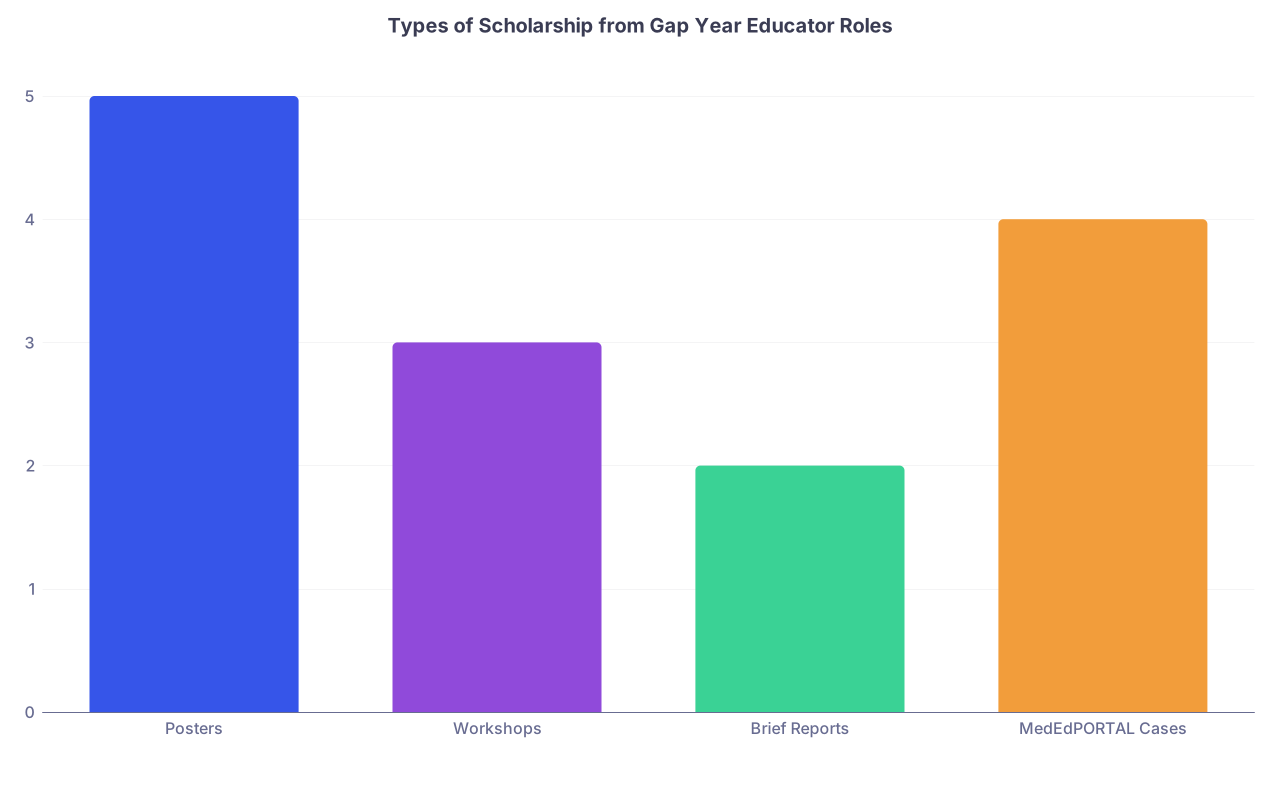
| Category | Value |
|---|---|
| Posters | 5 |
| Workshops | 3 |
| Brief Reports | 2 |
| MedEdPORTAL Cases | 4 |
C. Personal Statement: Use It to Frame, Not to List
You do not need to regurgitate your CV. You do need to explain the why.
One tight paragraph can:
- Explain your deliberate choice of a teaching‑heavy gap year
- Highlight one vignette that shows your growth as an educator
- Link that to your desire to be a clinician‑educator / residency teacher
Example skeleton:
- “I chose to spend a year as a Clinical Teaching Fellow in Internal Medicine at X because…”
- “Early in the year, I realized…” (short anecdote: perhaps a struggling student you helped with reasoning)
- “Working with our clerkship director on [project] taught me…”
- “This experience confirmed that I want my residency to be a place where I can continue teaching and shaping learners while deepening my own clinical skills.”
Do not write 3 paragraphs of “I love teaching.” Show it in 8–10 tight sentences with concrete reference points.
D. Interviews: Have 3–4 Go‑To Stories Ready
Program directors will ask some version of:
- “Tell me about your gap year.”
- “What did you do as a clinical educator?”
- “How did that experience prepare you for residency?”
- “What did you learn from teaching?”
Have ready:
- A “scope” story: describe your teaching and responsibilities in 30–40 seconds with numbers.
- A “challenge” story: student who struggled, curriculum that initially failed, how you adjusted.
- An “impact” story: specific change you helped implement and its effect.
- A “reflection” story: how teaching reshaped your approach to patient care or learning.
You should sound like someone who has been on the other side of the table—thinking about learning objectives, assessments, and feedback, not just “helping explain things.”
8. Common Pitfalls That Make a Gap Year Look Weak
I have watched people squander strong jobs. Do not repeat this.
A. Over‑servicing, Under‑documenting
You say yes to every small-group, every extra session, every last‑minute substitution. But:
- You track nothing.
- You collect no evaluations.
- You do not attach your name to any specific piece of curriculum.
End result: you worked like a resident, but your application looks like you floated.
Fix: from week one, keep a simple spreadsheet and ask explicitly about evaluations and project ownership.
B. No Mentor, No Project
You stay “busy” but do not build anything that outlives you.
Programs read that as: high energy, low direction. Fine for a service job, less impressive for an academic trajectory.
Fix: within the first 4–6 weeks, lock in:
- One project
- One mentor who knows about it
C. Disconnect from Your Target Specialty
You want to match into neurology but take a year in pre‑clinical anatomy teaching with zero neuro angle. Not fatal, but suboptimal.
Ideally:
- Align the educator role with your target specialty (e.g., medicine, peds, EM, surgery)
- Or at least carve out blocks that clearly link (neuro cases in clinical reasoning, neuro OSCE stations, neuro simulation episodes)
If that is impossible, be ready with a clear explanation and tie‑back in your statement and interviews.
D. Letting the Role Turn into a Pure Service Job
Some departments see “gap year educator” and think “cheap labor.”
Signs:
- You are constantly pulled into coverage of random tasks unrelated to teaching.
- No one cares if your project moves forward.
- Meetings about education get canceled but service needs do not.
You will not fix the institutional culture alone, but you can protect some time:
- Politely but firmly block off 2–4 hours per week for project and reflection time.
- Involve your mentor: “I want to make sure we hit our target for [project]; can you help protect some time?”
- Be willing to say “I can help with X, but I am already committed to Y teaching sessions and Z project deadlines.”
9. Quick Example: What “Done Right” Looks Like on Paper
Let me pull this together into a realistic snapshot.
“Clinical Teaching Fellow, Department of Internal Medicine, University Hospital (2025–2026)”
- Facilitated 30+ small‑group clinical reasoning sessions for 2nd–3rd year medical students (6–10 learners/session).
- Led weekly bedside teaching rounds on the general medicine ward (~100 hours), focusing on history‑taking, physical exam, and oral presentations.
- Co‑developed a 2‑session simulation curriculum on acute decompensated heart failure for 3rd-year clerks; implemented pilot with 48 students and collected pre/post confidence data (significant improvement in self‑reported comfort managing hypotension and dyspnea).
- Redesigned OSCE checklists for the Internal Medicine clerkship to streamline scoring and emphasize clinical reasoning; served as examiner for 4 OSCE days per year.
- Received mean rating 4.7/5 on overall teaching effectiveness (aggregated student evaluations, n=52), with repeated comments on clarity of explanations and high‑quality feedback.
- Co‑authored abstract on simulation curriculum accepted for presentation at the regional SGIM meeting (2026); first‑author curricular innovation manuscript under review at MedEdPORTAL.
Pair that with:
- A letter from the clerkship director describing you as “functioning at the level of a junior faculty member.”
- A short personal statement paragraph tying this to your plan to be a clinician‑educator.
- Interview stories that line up with these bullets.
Academic programs will pay attention.
FAQs
1. Do I need a formal “fellowship” title, or is any teaching‑heavy job enough?
A fancy title helps but is not mandatory. What matters more is: clear teaching responsibilities, documented evaluations, a defined project, and strong mentorship. A job called “Clinical Assistant” can impress if you structure it like a junior faculty role. Conversely, a “Medical Education Fellowship” with no real teaching or scholarship behind it will disappoint. PDs read beyond titles very quickly.
2. How many hours per week should I be teaching for this to be meaningful?
There is no magic number, but as a rule of thumb, aim for at least 4–8 hours per week of direct teaching (small group, bedside, simulation, lab) during active blocks, with additional time for prep, feedback, and project work. The key is consistency and responsibility. Ten hours one month and nothing for three months looks weaker than 4–6 hours steadily over the year with a named role in a course or clerkship.
3. What if my institution does not support education scholarship or conference travel?
Then you have to be more strategic. Focus on: (1) building a very strong teaching portfolio with clear metrics and evaluations; (2) completing at least one local project with clear outcomes; (3) getting exceptional letters that explicitly describe your impact. You can still draft abstracts or manuscripts and list them as “in preparation” if your mentor agrees. Not ideal, but better than ignoring scholarship entirely.
4. Will taking a gap year in education hurt me if I am applying to a very research‑heavy academic program?
Not if you present it correctly. Many research‑heavy programs still need residents who can teach well and lead educational initiatives. Your job is to show that: (1) you did not de‑skill clinically (keep some patient care, moonlighting, or clinical exposure if possible); (2) your educator year sharpened your reasoning and communication; and (3) you still value and understand research, even if the gap year focus was education. Some of the strongest academic clinician‑educators I know took a year like this and then did a research‑oriented fellowship later.
Key points:
- Do not “just teach.” Build a structured teaching portfolio with numbers, evaluations, and artifacts.
- Own at least one education project with clear impact and, ideally, some form of scholarship.
- Engineer the year to produce high‑quality, detailed letters that describe you functioning at a junior faculty level.


