

Last year a prelim medicine resident showed me his CV over coffee. Eleven publications from his “research gap year.” On paper he looked unstoppable. Then his name came up in our rank meeting—and he was a hard no from two different faculty. Why? Because everybody in that room could tell, within 30 seconds, that those 11 papers did not mean what he wanted them to mean.
Let me walk you through what actually happens when program directors and faculty look at your gap year publications. Because the way students talk about “getting pubs” is miles away from how those lines get interpreted in a rank meeting.
How PDs Actually Look at Your Publications
Program directors are not counting your publications like baseball cards. They’re scanning them for signal. Strength. Authenticity. Fit.
They care about:
- What the publications say about you
- How they match your stated interests
- Whether they show real work vs. CV theater
They do not care about:
- Sheer number, if the quality is junk
- Your ability to get your name buried on an 18‑author case series you barely touched
- Whether you “hit” some arbitrary number you heard on Reddit
Here’s what you do not see: your ERAS printout on a projector in a conference room, with 10–20 faculty paging through PDFs or scrolling on a laptop, while your name is one of 40 up for discussion in that hour. That’s the environment in which your “gap year research” is being judged.
The conversation sounds like:
“Anybody work with this person?”
“These publications look… thin.”
“All case reports and letters—no sustained project.”
“Yeah, I’m not convinced.”
Or, much more rarely:
“This is the candidate who did the sepsis outcomes work with Dr. X, right?”
“Yeah—first author in Chest during her gap year.”
“She presented that at ATS, I remember her. Strong.”
Same number of lines on the CV. Very different reaction.
The Two Questions Every Gap Year Publication Has To Answer
Every single publication from your gap year is basically on the hook for two questions in the mind of a PD or faculty reviewer:
- Does this show intellectual ownership and real contribution, or did you just hang around a busy lab and let your name be stapled on at the end?
- Does this demonstrate trajectory toward the kind of resident or academic doctor you claim you want to be?
If the answer to both is “yes,” the publication matters. If the answer to both is “no,” it’s decoration.
And there’s a nasty middle ground: when the answer is “no” but you proudly treat it like it’s “yes.” That’s when you look naive—or worse, disingenuous.
Let’s break down the types of gap year work and how they actually land.
Not All Publications Are Created Equal
1. First-Author, Cohesive Work in a Relevant Area
This is the gold standard. Not because of prestige points, but because it screams ownership.
Example:
You take a gap year between M3 and M4 to work in critical care outcomes at a big academic center. You design or heavily drive a retrospective cohort study, clean the data, run analyses with a biostatistician, draft the manuscript, respond to reviewer comments. You end up first author in a solid mid‑tier specialty journal. Maybe a second related abstract or secondary analysis spins off.
To PDs, this says:
- You can actually complete a project
- You can deal with the unglamorous grind of research (data cleaning, IRB, re‑revising)
- Your academic interests match the specialty you’re applying into
On a rank call, someone will say:
“They actually led that project, I know the PI. That’s real.”
That’s the line you want spoken when your name is on the board.
2. Middle-Author Work in a High-Functioning Group
Middle‑author does not automatically mean “fake” or “low value.” But it needs context.
Example:
You spend your gap year in a cardiology imaging lab. There are big prospective registries, plenty of ongoing manuscripts. Your name ends up 4th or 5th on two papers in Circulation and JACC. You did the image adjudication, some data extraction, maybe part of a methods section.
To PDs, this can be meaningful if:
- You can clearly tell the story of your role on interview day
- Your mentor vouches for you in letters: “She did the heavy lifting on data acquisition and quality control.”
- The work is thematically consistent with your stated interests
But here’s the catch. If your ERAS looks like:
“10 publications – all 4th–10th author on miscellaneous topics, no clear thread, no first‑author anything”
The vibe shifts from “team player in a productive lab” to “body in the room who got added to author lists.”
Faculty sense that immediately.
3. Case Reports, Letters, and Low-Tier Journals
Now we’re in the danger zone.
Are case reports and letters always useless? No. I’ve seen beautifully done case reports become talking points that helped a borderline candidate stand out.
But here’s what a lot of students do: they spend a gap year churning out low‑impact case reports in questionable journals, or filler letters that required minimal effort, then brag about “10+ publications.”
From the PD side, the questions become:
- Did you need a full gap year for this?
- Why is there almost nothing substantive—no cohesive project, no first‑author original research?
- Was this student avoiding real work or unable to get into a functioning research group?
A handful of case reports tied to a theme (say, rare complications in transplant patients) can supplement a strong portfolio. A CV made almost entirely of predatory open‑access case series and one‑paragraph letters looks like CV inflation.
4. Review Articles and “Invited” Pieces
Review articles are tricky. Students love them because they feel more controllable: read a lot, organize, write. But faculty read them with a raised eyebrow.
Good scenario:
You work with a known expert in your specialty of interest. The PI is asked to contribute a narrative review to a reputable journal and hands the first draft to you. You spend months reading primary papers, synthesizing, building figures, drafting. Your attending edits heavily, your name goes first or second. Topic clearly tied to your specialty.
This can look quite good—especially in fields like heme/onc, cards, pulm/crit where reviews actually get read.
Bad scenario:
You cold‑email someone who lets you crank out an “update on disease X” for a no‑name journal nobody reads, clearly just to help pad student CVs. You do one of these every other month, purely to hit volume.
On a real faculty’s screen, that pattern looks hollow.
What PDs Actually Notice: The Pattern, Not the Count
Program directors don’t sit with a tally counter marking “pub #1… pub #2…” They scan the list and ask:
- Is there a coherent story here?
- Does this level of productivity feel plausible for a student?
- Does the timeline of activity make sense?
Here’s how that plays out in practice.
| Pattern on CV | Typical PD Interpretation |
|---|---|
| 2–4 first-author projects in 1–2 related areas | Serious, focused, high ownership |
| 1 meaningful project + a few smaller side pieces | Balanced, believable productivity |
| 10+ low-quality case reports/letters in 1 year | CV padding, shallow engagement |
| Many middle-author pubs but weak letter/description | Possibly peripheral involvement |
| Nothing substantial despite “full research year” | Poor environment or low initiative |
You know what actually impresses faculty? A believable arc: MS2 or MS3 summer project → early poster → gap year deep dive → resulting first‑author paper → M4 presentation, all thematically coherent.
That tells us you can stick with something longer than a semester. You followed it through the inevitable wall when the data got messy or the first journal rejected you.
The Gap Year Trap: Volume Over Substance
The worst‑kept secret in academic medicine is that a lot of “research gap years” at certain institutions are paper mills. High‑volume, low‑ownership, low‑impact output.
Students fall into three common traps:
Treating the gap year like a publication factory
They say, “I need at least 10 pubs to match derm/rads/ortho,” then chase anything that offers a PubMed ID. They bounce from case report to letter with no throughline and no depth.Overestimating how carefully PDs read
They assume nobody will notice that half their papers are in barely indexed journals or that they were author #12 on a series. Faculty notice. Quickly.Underestimating how much the interview will expose
They write up “prospective observational study of X” on ERAS, but on interview day they can’t explain the study design, primary outcome, or limitations. You can watch the interviewer’s face change in real time.
You do not want to be in that third category.
How PDs Use Your Publications When Ranking You
Let me show you where publications actually come into play in a rank discussion.
Rough structure of what we care about:
- Can you do the work? (evaluations, letters, Step, clerkship performance)
- Are you safe and reliable? (professionalism, no red flags)
- Are you someone we want in our culture? (interview impressions, interpersonal skills)
- Do you fit our mission? (academic, community, research, underserved)
Publications live mostly in that last bucket, with some spillover into “can you complete long-term projects.”
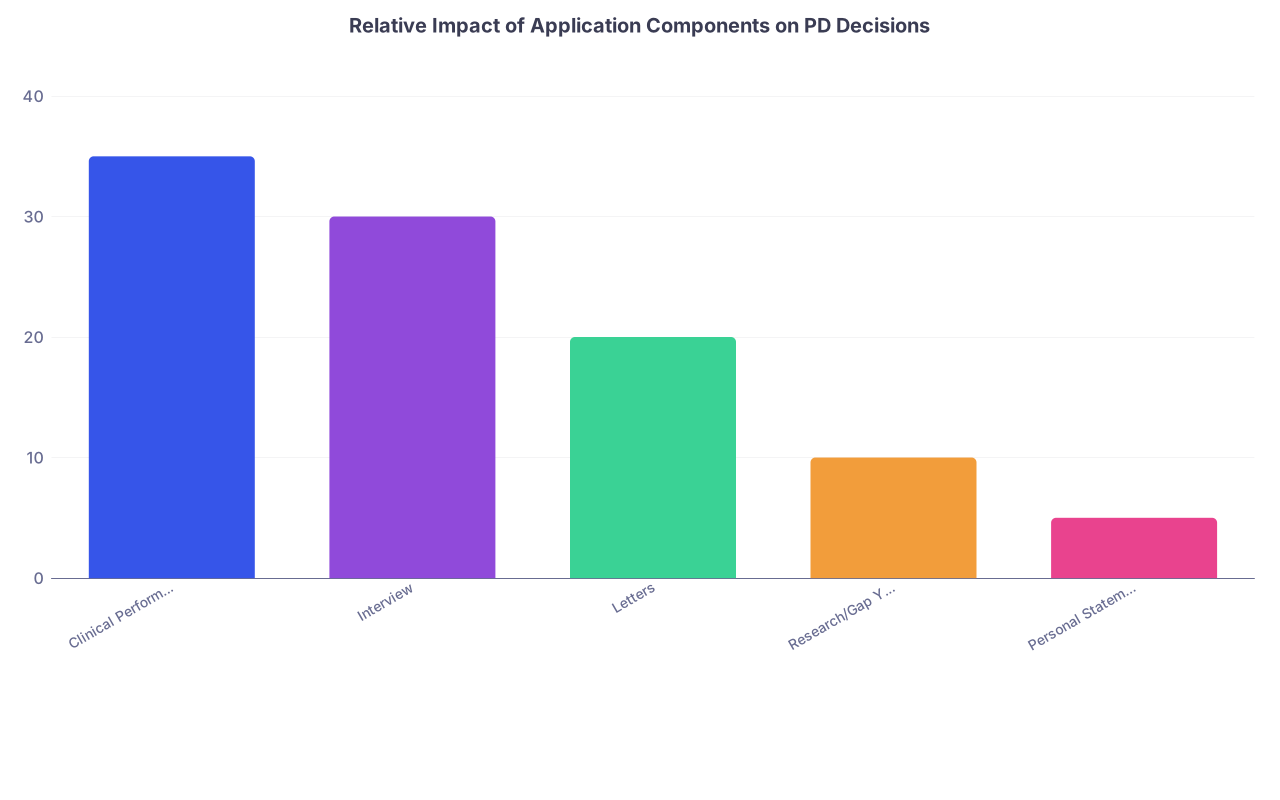
Here’s the quiet truth: a strong personality fit and solid clinical performance can absolutely outrank an extra three papers. I’ve seen mid‑tier research candidates outrank “research monsters” because everyone liked working with them more and trusted them on the wards.
Where publications do break ties is among highly competitive applicants. When we’re comparing:
- Two similar Step scores
- Both from solid schools
- Both with decent letters
And one has clear, focused, meaningful research that aligns with our department’s interests, and the other has generic or fluff CV content—that’s where your gap year work can move the needle.
| Category | Value |
|---|---|
| Clinical Performance | 35 |
| Interview | 30 |
| Letters | 20 |
| Research/Gap Year Pubs | 10 |
| Personal Statement | 5 |
When Gap Year Publications Actually Hurt You
Yes, they can hurt you. Not in the sense of “we will reject you because you have publications,” but in the sense of undermining your credibility.
Faculty get wary when they see:
- A full‑time research year with almost nothing concrete to show for it
- A massive list of low‑quality work that looks implausible for one person
- A mismatch between your claimed interest and your entire research history
- A glaring gap between “PI’s glowing reputation” and “underwhelming output + weak letters”
And they absolutely talk about it.
Examples I’ve personally seen torpedo someone:
- Applicant with “18 publications in one year,” almost all in tiny predatory journals, unable to explain impact factor or peer review process when asked. Came off as padding and naivety.
- Gap year in a genuinely elite research group, but zero first‑author anything and a lukewarm letter. The implicit message: “They were in the room but not driving the work.” Red flag for initiative.
- Candidate loudly branding themselves as “future surgeon‑scientist” with a research year—but all work was administrative quality‑improvement with no real stats, no hypothesis, no rigor. Faculty saw through the mismatch.
If your publications make us question your judgment or honesty, you’d have been better off with fewer, stronger pieces.
Designing a Gap Year That Produces Publications PDs Respect
If you haven’t started yet—or you’re early—here’s how to structure a year that yields work people actually value.
Anchor Yourself To One Serious Project
You want one anchor project that is clearly yours. That usually means:
- You are first or second author
- You can explain the rationale, design, stats, limitations
- Your mentor would back you up if we emailed them tomorrow
If you walk into an interview and can talk deeply about that project for 15 minutes, you’re already ahead of most.
Add a Reasonable Number of Side Outputs
Then, maybe you supplement with:
- One or two case reports genuinely tied to your clinical area
- A review or perspective piece with someone established
- A poster or oral presentation at a real conference
This looks like an engaged, productive year—not like a desperate numbers game.

| Step | Description |
|---|---|
| Step 1 | Start Gap Year |
| Step 2 | Join Active Research Group |
| Step 3 | Define 1 Anchor Project |
| Step 4 | Data Collection & Analysis |
| Step 5 | Manuscript Draft & Submission |
| Step 6 | Small Side Projects Aligned with Theme |
| Step 7 | Conference Abstracts & Presentations |
| Step 8 | Strong Letter from Mentor |
| Step 9 | ERAS Application with Coherent Story |
Align With Your Target Specialty
If you’re going into neurology but all your research is in plastic surgery wound healing, the story better be tight. Sometimes it is (people switch interests legitimately). But if your entire gap year was in a specialty you didn’t even apply to, be ready for skeptical questions.
PDs like to see:
- Internal medicine applicant → outcomes, QI, or clinical trials in IM subfields
- Surgery applicant → surgical outcomes, techniques, or basic science tied to surgery
- Radiology applicant → imaging studies, AI, workflow
- Derm applicant → derm trials, basic or translational derm
Does it have to be perfectly matched? No. But alignment makes your whole application feel intentional.
Care About Where the Work Goes
Students pretend journals are all the same as long as they’re “PubMed indexed.” Faculty know better.
Nobody expects you to drop a first‑author NEJM paper out of your gap year. But there’s a world of difference between:
- Solid subspecialty journals with proper peer review
- Reputable society journals
- Questionable “pay to publish” venues with zero actual filtering
You do not need to obsess over impact factor, but if all your work landed in journals nobody in the field has heard of, that’s noted.
What To Say About Your Gap Year on Interview Day
This is where the whole thing lives or dies.
The strongest candidates can:
- Explain why they took a gap year in clear, adult language
- Walk through their main project’s hypothesis, design, and findings without sounding rehearsed
- Acknowledge challenges: IRB delays, negative results, rejections
- Reflect on what they learned about themselves and their career goals
The ones who implode:
- Oversell minor contributions (“I led this multi‑center trial” when they really screened charts)
- Can’t answer basic questions about sample size, primary outcome, or limitations
- React defensively when asked about weaker aspects of the year
If you treat your gap year like a learning experience rather than a vanity metric, you come across as grounded. Faculty like that more than the polished “research superstar” act that falls apart under gentle probing.
Quick Reality Check: Who Actually Needs a Research Gap Year?
Since you’re here, let me say the quiet part out loud.
A research gap year makes sense when:
- You are aiming at highly competitive specialties and your current CV is thin
- You genuinely enjoy research and see it as part of your long‑term career
- You’re at a school with weaker research infrastructure and need external cred
It makes less sense when:
- You already have a couple of solid projects and are applying to less research‑heavy programs
- You hate research but feel pressured to do it anyway “for derm” or “for ortho” (this shows)
- You’re using it purely to avoid graduation or because everyone around you “seems to be doing it”
PDs can smell the difference between “I took a gap year because I care about this work” and “I took a gap year because I panicked.”
FAQs
1. Is it better to have one strong first‑author paper or several smaller things?
If I have to pick, one truly substantial first‑author project wins. Especially if you can talk about it intelligently and it’s in your target field. Several smaller things can help, but not if they’re low‑quality and scattershot. Depth over shallow breadth.
2. Do PDs actually recognize journal names and care about impact factor?
Yes, at least in their own fields. A pulm/crit PD knows which journals are serious and which are CV-padding factories. They may not sit there quoting impact factors, but reputationally they know what’s meaningful. You do not need only top‑tier journals, but a pattern of only obscure venues raises eyebrows.
3. What if my gap year did not produce any publications by ERAS time?
That can be okay if: you have submitted manuscripts, you can clearly describe the projects, and your mentor’s letter reflects that legitimate work is in progress. Many real projects take more than a year to publish. What we do not like is a “research year” with no clear projects, no submissions, and a vague story.
4. Can case reports ever be enough on their own?
For most competitive programs and specialties, no. A handful of well‑done case reports can complement your application and give you stories to tell, but they rarely substitute for at least one substantive project. If your entire gap year output is case reports, expect skeptical looks from serious academic programs.
If you remember nothing else, remember this: PDs are not impressed by the raw number of citations under your name. They’re impressed by evidence that you can take ownership of real work, see it through, and tell an honest, coherent story about why it mattered and what it taught you. Design your gap year—and your publications—around that, and you’ll be on the right side of the conference room conversation.


