

It’s July 5th. Your classmates just started intern orientation. You’re in a “gap year.”
On your calendar:
- 40 hours/week research
- 2 part-time clinical jobs
- Dedicated Step 2 CK “re-take” study blocks
- Weekly volunteering
- Two committees
- Shadowing
- And you just agreed to help someone write a review paper “that won’t be much work.”
You told yourself this was your comeback year. The year you’d fix your application, transform it, and match “for sure this time.”
Instead, you’re already behind on your research project, canceling shifts, half-studying at midnight, and fielding passive-aggressive emails from your PI. Your ERAS personal statement is still a blank document named “PS_draft_FINAL_real_this_time.docx”.
Let me be direct:
You are about to waste your gap year by trying to do everything. And it will backfire. Hard.
This is one of the most common, most damaging mistakes I see in applicants taking a year (or more) before residency. Not laziness. Not lack of effort. The opposite: frantic, scattered, unsustainable over-commitment.
Let’s walk through the traps so you do not become the cautionary tale your classmates whisper about.
The Core Problem: Your Gap Year Is Not a Redemption Circus
A gap year before residency feels like your “last shot.”
- You failed Step 1 once.
- Or you applied and didn’t match.
- Or you want to switch from FM to Derm or Ortho.
- Or your CV feels light and you’re convinced everyone else has 19 publications and a letter from the Surgeon General.
So you do what anxious, driven people do: you try to fix everything at once.
You say yes to:
- Every research offer
- Every shadowing invitation
- Every “quick” quality improvement project
- Extra tutoring, moonlighting, scribing
- Volunteer roles “just to fill the gap”
You think a packed calendar = a strong application.
That’s the lie.
Program directors don’t want chaos. They want signal. Coherent, focused, believable growth. When your year looks like a frantic buffet plate—piled with everything, nothing finished, no theme—that screams a few things you don’t want associated with your name:
- Poor judgment
- Poor follow-through
- Poor self-awareness
The harsh truth:
Overstuffing your gap year can make you look worse than if you’d done less.
The 7 Big Ways an Overstuffed Gap Year Blows Up Your Application
1. You End Up With Half-Finished Everything and Nothing Impressive
The most common pattern I see:
Started 3 research projects →
- One stalled after IRB
- One where you’re “third author” and your name never makes it to submission
- One presented as a poster… in March, after ERAS is already in
-
- None consistently, nothing meaningful enough to talk about for 5 minutes in an interview
“Studying Step 2 all year” →
- But scoring the same on UWorld self-assessments because your brain is fried and your time is chopped into 90-minute chunks scattered between obligations
Program directors don’t give you points for attempted volume. They care about completed, high-quality, or at least clearly progressing work.
Here’s the comparison that applicants routinely get wrong:
| Approach | Typical Result by ERAS Submission |
|---|---|
| Overstuffed | 3–5 ongoing projects, 0–1 complete outputs, vague experiences |
| Focused | 1–2 major projects, 1–3 concrete outputs (poster, manuscript, strong letter) |
| Overstuffed | Generic, scattered ERAS entries with weak stories |
| Focused | Clear narrative, specific impact examples |
| Overstuffed | Minimal improvement on Step scores or clinical skills |
| Focused | Measurable improvement in 1–2 key weaknesses |
One strong letter from a PI who saw you carry a project across the finish line beats ten lines of “assisted with data collection” and “helped with chart review.”
Don’t chase count. Chase completion.
2. Your Step Score (or Clinical Performance) Stays Flat Because You’re Fried
If you’re in a gap year before residency, there’s usually at least one academic or exam-based issue on the table:
- Low or failed Step score
- Weak clerkship evaluations
- Limited US clinical experience (IMGs especially)
You think: “I can do research AND fix my Step 2 score AND moonlight AND…”
No. You probably cannot. Not at the level that moves the needle.
Real talk:
To raise a Step 2 CK score from 215 to 240+, you’re not sprinkling in questions “when you can.” That takes:
- Consistent, protected time
- Deep focus (not 30-minute sprints between clinic and lab)
- Sleep that’s not stolen from 2–5 AM
Overstuffing your schedule usually leads to:
- Fragmented studying
- Constant fatigue
- Panic-review the last 3–4 weeks before the exam
- Score jump of 3–5 points instead of the 15–20 you needed
And on paper, your application says:
- “Took gap year to improve application”
- Step 2: barely changed
That mismatch looks bad. Program directors notice.
If your exam profile is a problem, the mistake is trying to fix it while stacking everything else. Sometimes the smartest use of a gap year is boring:
- Strong Step/COMLEX focus for a few months
- One solid clinical/research role the rest of the time
Simple does not mean weak. Simple often reads as controlled and intentional.
3. You Look Disorganized and Unreliable to the People Whose Letters You Need
Here’s what overstuffed looks like from the attending/PI side:
- You show up late to clinic because your other job ran over
- You ghost a weekly research meeting “just this once”
- Deadlines slip: “I’ll send it tonight” becomes next week
- Drafts are rushed, sloppy, or half-done
- You cancel volunteer shifts last-minute
They might not yell. But they remember.
When it’s time to write a letter, here’s what you lose:
- “Exceptionally reliable”
- “Always followed through”
- “Could trust them with independent tasks”
And you gain phrases like:
- “With some supervision”
- “When given clear structure”
- “Growing in time management”
Death by faint praise.
Overstuffing your gap year doesn’t just make you tired. It directly undermines the two things you actually need from mentors:
- Strong, enthusiastic letters
- Someone willing to pick up the phone and advocate for you
They will not do that for the person who constantly bit off more than they could chew.
4. Your Story Becomes Incoherent and Unbelievable
During residency interviews for people who took a gap year, you will be asked variants of:
- “Tell me about how you used your gap year.”
- “What did you focus on improving?”
- “What changed between your last application and now?”
If your year is overstuffed, your answer often sounds like this:
“I did some research in cardiology, and also orthopedics, and helped with a QI project in the ED, and I also volunteered at a free clinic and did some shadowing and worked as a scribe and studied for Step 2 and Step 3…”
That’s not a story. That’s noise.
Now compare that to a focused narrative:
“I knew two things hurt me last cycle: my Step 2 CK score and limited US clinical experience. So I structured my year around those. I spent the first 4 months with a very structured study plan and improved my score from 222 to 242. In parallel, I worked 3 days a week as a clinical research coordinator in pulmonary/critical care, which gave me both hands-on ICU exposure and led to a poster at ATS. By the end of the year, I also had a strong letter from the ICU director, who saw me consistently on rounds.”
Which sounds like someone you’d trust as an intern?
Too many mini-activities make your year look like panic, not strategy.
5. You Quietly Burn Out Before You Even Start Residency
I’ve watched this play out more times than I’d like:
- They didn’t match or had to take a year.
- They load that year with 70–80 hours/week of “self-improvement.”
- By January, they’re emotionally done.
- By ERAS submission, they’re jaded and resentful.
- By Match Day, they’re just numb.
Then they start intern year already tired, already cynical, already running on fumes.
The mistake is thinking this year has to be punishment. Some sort of productivity purgatory to atone for your past scores or failures. That mindset breeds:
- Overcommitting
- Self-flagellation
- Zero rest, zero joy
You are not a machine. A well-used gap year includes:
- Some rest
- Some life
- Some perspective
If you grind yourself flat just to list a few more entries on ERAS, you miss the point. Programs can absolutely tell when someone is brittle and exhausted—even if your CV looks “busy.” They’re not excited to match the person who’s already burned out before day one.
6. You Chase Name-Dropping Instead of Real Mentorship
Overstuffed gap years often come with desperate networking:
- “I’m doing a tiny project with Dr. Famous at Big Name Hospital!”
- “I helped on a paper with three departments!”
- “I volunteered with a national organization!”
On paper it sounds impressive. In reality:
- None of these people know you well
- No one sees you regularly enough to meaningfully advocate for you
- The “projects” move at a glacial pace
- You’re a replaceable warm body on email threads
Programs don’t care that you were on 7 projects with 12 attendings. They care that:
- Someone with judgment and credibility can say, “I would absolutely hire this person; they work like a good resident.”
That usually comes from:
- 1–2 real mentors
- Longitudinal work
- Depth, not breadth
The overstuffing mistake is confusing contact with connection. You spread yourself so thin across big-name people that none of them see the best version of you.
7. You Ignore the Specialty Reality and Overcorrect in the Wrong Direction
Gap years are common in competitive specialties: derm, ortho, plastics, ENT, neurosurgery, IR, etc. Here’s where people absolutely lose the plot.
They think:
“I didn’t match ortho because I only had 1 publication. So this year I’ll crank out 5.”
Then they:
- Take any ortho-adjacent project they can get
- Neglect to address their low Step 2 score or weak away rotation feedback
- Ignore that their letters were mediocre
Programs in competitive fields are tired of the “CV maxing without insight” crowd. They know what they’re looking at.
If your fundamental problem was:
- Poor clinical performance
- Unprofessionalism concerns
- Weak communication skills
- Bad fit on rotations
Throwing 10 papers at the problem while you’re juggling five other commitments does nothing. In fact, it annoys people in interviews when your story is:
“I’m very passionate about orthopedics; I spent my year doing 7 research projects.”
And they read your old MSPE saying “needs to improve receptiveness to feedback” and “difficulty working in teams.”
The mistake is using overstuffed activity lists to avoid facing the uncomfortable root issue. A good gap year is surgical. Directed. Uncomfortable in a productive way.
What a Non-Stupid Gap Year Actually Looks Like
Let me show you what a sane, effective gap year could be, depending on your main problem.
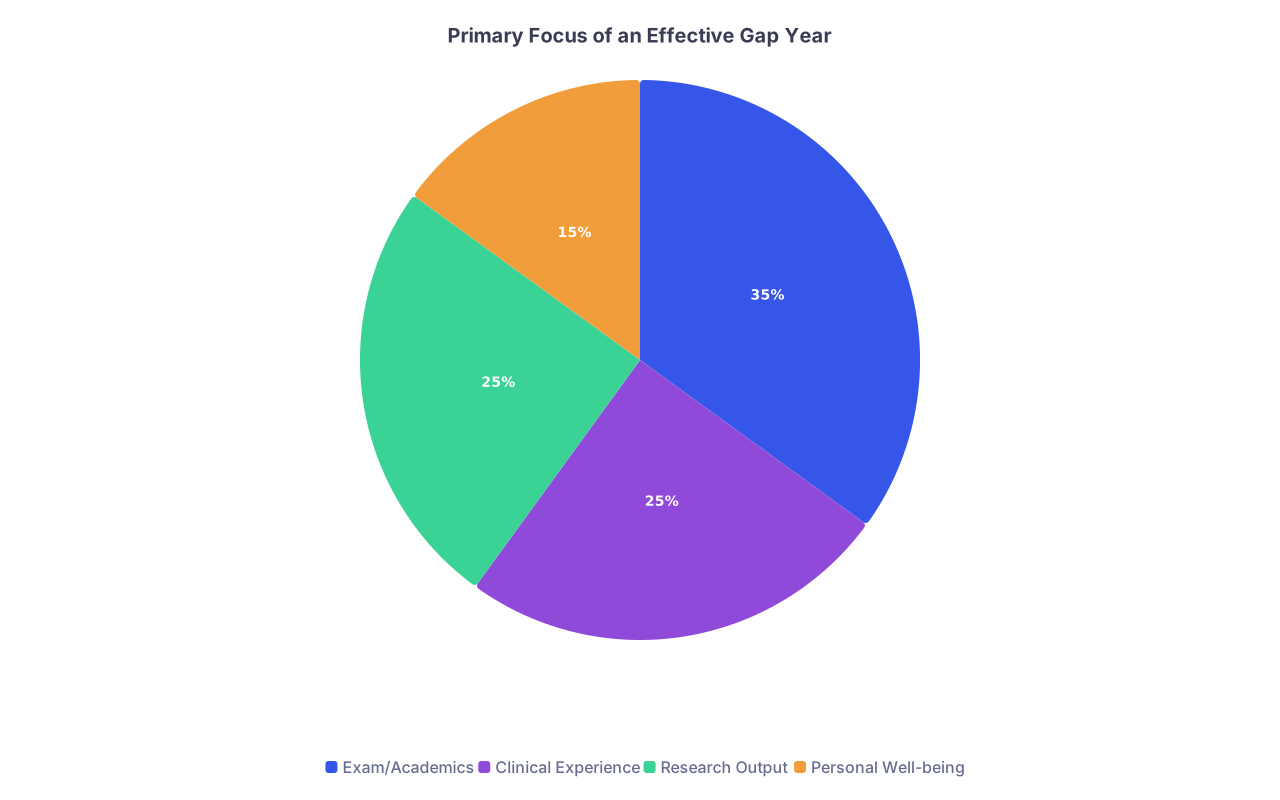
| Category | Value |
|---|---|
| Exam/Academics | 35 |
| Clinical Experience | 25 |
| Research Output | 25 |
| Personal Well-being | 15 |
Notice: it’s not 25–10–10–10–10–10–10. It’s a clear priority.
Example 1: Low Step 2 CK, Average Everything Else
You do NOT:
- Full-time research
- 2 part-time jobs
- Weekly clinic in 3 different settings
- Volunteering “for the CV”
You DO:
- 3–4 months primarily dedicated to Step 2 CK (or Step 3), near full-time
- Simple, low-maintenance 1–2 day/week clinical or research work
- After exam: increase clinical/research hours, but still with margin
Result:
- Noticeable score jump
- One or two solid clinical experiences
- You’re rested enough to be a functioning human at interviews
Example 2: Failed to Match, Weak Letters, Average Scores
You do NOT:
- Try to juggle 4 different short rotations in different hospitals
- Take random “CV-filler” roles just to list more things
- Start 5 research projects you can’t finish
You DO:
- 1 anchor role (e.g., full-time clinical research or a sub-I equivalent position in your specialty of interest)
- Show up like a resident: prepared, on time, helpful, consistent
- Become indispensable to 1–2 attendings who then write detailed letters explaining your growth and reliability
- Maybe 1 side project that’s realistic to complete (poster, abstract)
Result:
- Strong, believable advocacy from people actually known to programs
- Clear narrative: “This is how I’ve grown since last time.”
Example 3: IMG With Limited U.S. Experience
You do NOT:
- Piecemeal 10 observerships of 1–2 weeks each
- Add 6 online courses “in leadership”
- Scatter yourself across three hospitals without anyone really owning you
You DO:
- 1–2 longer-term clinical experiences where you’re consistently visible
- Possibly one research or QI project at that same site
- Invest in communication and cultural skills (presentations, patient interactions, charting style)
Result:
- 2–3 concrete letters from U.S. physicians who saw you work over months
- A story that makes sense: “I used this year to really adapt to the U.S. system and show how I function on a team.”
How to Avoid Overstuffing: Guardrails That Actually Work
Overstuffers don’t need motivation. They need brakes.
Here are the brakes.
1. Hard Cap Your Commitments
Set a rule before you start:
- No more than 2 major and 1 minor ongoing commitments at any time
Examples:
Major = full-time research, part-time clinical job, full-time Step study
Minor = single weekly volunteer clinic, one realistic side project
If you already have:
- Full-time research job
- Dedicated Step 2 study schedule
Then “just adding”:
- Weekly free clinic
- Writing a review paper
- Part-time scribing
…is how you wreck both the research and the Step score.
If something new comes up that’s actually good? You don’t stack it. You trade for it. Something else gets dropped intentionally.
2. Time-Box Before You Say Yes
Before you commit, make yourself answer:
- How many hours/week realistically will this take when it’s in full swing?
- What will I drop if it takes more than that?
- What does “done” look like for this activity?
If you can’t define what “done” means (poster, manuscript, letter, X hours of experience), that’s a red flag. You’re probably volunteering to be indefinite free labor.
3. Force a Written Priority List
Write it out in one sentence:
“If I get to the end of this year and I have improved X and completed Y, this year was a success.”
Common primary X’s:
- Step 2 CK score
- US clinical experience
- Quality of letters
- Genuine specialty confirmation
- One meaningful research output
If an opportunity does not directly serve X or Y, be suspicious. Not automatically no. But suspicious.
4. Mid-Year Brutal Audit (Not Optional)
Plan a check-in at the halfway point (mark it in your calendar now):
- What did I actually complete (not “working on”)?
- Where did I overestimate my capacity?
- What can I quit without burning bridges?
- Is my main weakness meaningfully better yet?
If the answer to that last question is “not really,” you’re probably still doing too much of the wrong things.
A Simple Visual: Overstuffed vs Focused Year

| Step | Description |
|---|---|
| Step 1 | Start Gap Year |
| Step 2 | Many small roles |
| Step 3 | Missed deadlines |
| Step 4 | Weak outputs |
| Step 5 | Flat Step/skills |
| Step 6 | Scattered narrative |
| Step 7 | Higher risk of no match |
| Step 8 | Few chosen priorities |
| Step 9 | Consistent work |
| Step 10 | Tangible outcomes |
| Step 11 | Improved metrics/letters |
| Step 12 | Coherent story |
| Step 13 | Stronger match chances |
| Step 14 | Overcommit? |
You want the bottom path. That means saying no more than you say yes.
FAQ (Exactly 4 Questions)
1. Won’t doing less make me look lazy compared to other applicants who did a ton during their gap year?
No. Programs don’t rank you by how many line items you can cram into ERAS. They care about: improved scores, clear growth, strong letters, and believable stories. A gap year with a 20-point Step bump, one solid research product, and an attending saying “I’d hire them tomorrow” beats a bloated list of half-finished experiences every time. Lazy is scattered effort with no real result, not a focused plan with meaningful outcomes.
2. I already overcommitted. How do I back out without burning bridges?
Be honest, early, and specific. Talk to your PI or supervisor and say: “I overestimated how much I could take on while studying for Step 2. I don’t want to compromise the quality of what I do for you. Can we narrow my role to X for the next few months, or transition Y to someone else?” People would rather you renegotiate than quietly underperform for a year. What burns bridges is vanishing, missing deadlines, and delivering low-quality work while pretending you’re fine.
3. Is it ever worth it to take a purely research gap year with almost no clinical work?
Sometimes, but only if research is the main thing holding you back in a research-heavy specialty (neurosurgery, derm, rad onc, some IM subspecialties) and your scores and clinical performance are already solid. Even then, I’d still keep some clinical exposure—occasional clinic, case conferences, or ICU rounds—so you don’t look like you stepped entirely away from patients. A pure research year is a tool, not a default. If your bigger issue is exams, professionalism, or clinical skills, a research-only year is often the wrong move.
4. How do I explain a “lighter” gap year on ERAS and in interviews without sounding defensive?
You don’t apologize for it. You own it. Example: “I knew my Step 2 score was my biggest barrier and that I needed a clear improvement there, not just more activities. So I devoted the first part of my year to a structured study schedule and raised my score from 218 to 238. At the same time, I worked two days a week in a community clinic, where I followed a panel of patients longitudinally. It wasn’t about doing everything; it was about doing the right things well.” That sounds like judgment, not laziness.
Key points to walk away with:
- Overstuffing your gap year doesn’t make you impressive. It makes you look scattered, unreliable, and unchanged where it counts.
- A strong gap year is narrow and deep: a few priorities, real outcomes, mentors who know you well, and a story that matches your weaknesses.
- If your calendar looks like punishment, not strategy, stop. Cut, refocus, and protect the parts of this year that actually move your application forward.


