

The gap year itself does not impress anyone. The story behind it does.
Program directors are not sitting around saying, “Wow, they took a gap year, 10 bonus points.” They’re asking one thing: Will I remember this person when I’m staring at a spreadsheet with 120 names on it at 10 p.m. the night before the rank list is due?
I’ve been in those rooms. I’ve heard the comments that never make it into official advice. Let me walk you through what actually sticks in PDs’ heads—and what gets forgotten 3 seconds after you say it.
What PDs Are Really Doing When They Hear Your Gap Year Story
Let’s strip the mystique away.
On interview day and especially during rank-list meetings, your “gap year” is being interrogated on three levels:
- Does this explain anything on the application that matters? (red flags, timing, late Step 2, extra research)
- Does this year show that you handle uncertainty and delayed gratification like an adult, not a panicked student?
- Is there a hook that makes you memorable for the right reasons?
That’s it. Everything else is noise.
The official language is “holistic review.” The unofficial language in the room sounds more like:
- “Who was the one that worked with the county jail system? That guy was impressive.”
- “She ran her own tutoring business and paid her way—super mature.”
- “Is he the one who kind of drifted and then took Step 2 late? I’m not convinced.”
Your job is to make sure you’re in the first two categories, not the third.
The Gap Year Stories PDs Actually Remember
There are patterns. Certain stories come up again during rank meetings even when no one has your file open.
1. The “Structured Responsibility” Story
This is the single most “sticky” type of gap year story.
PDs love evidence that you can carry structured responsibility outside the nice padded walls of medical school. They trust it more than your honor-society certificates.
Examples that get retold in the room:
- The scribe who became de facto team lead for a busy ED group, managing schedule chaos and training new scribes.
- The MA who started as rooming patients and ended up coordinating a quality-improvement project in a primary care clinic.
- The research assistant who didn’t just pipette all year, but owned a project from IRB submission through data collection.
Notice the pattern. Not “I had a job.” But “I was accountable to a real-world system that would’ve fallen apart if I screwed up.”
What PDs say out loud:
“She’s already worked full-time in a clinic. Fewer surprises when she’s an intern.”
“He was basically running that research database. He’ll probably be reliable on call.”
If your gap year has any hint of that—team lead, coordinator, manager, founder—you highlight the responsibility progression like a spine through your story.
2. The “Mission With Teeth” Story
Everyone says “I care about underserved populations.” PDs are numb to the phrase.
What cuts through is when your gap year shows commitment with consequences—where someone would actually miss you if you disappeared.
Examples that stick:
- Working full-time for a street-medicine program coordinating housing applications and follow-up care. Not just “shadowing,” but actually being the point person families call.
- A year in a refugee clinic, where you did both the unglamorous admin work and the patient-facing piece—and stayed long enough to see outcomes.
- Running a longitudinal mentorship program for disadvantaged students that still exists after you left, because you built infrastructure, not just “volunteered.”
On rank-list night, this becomes:
“She spent a whole year working with homeless patients and built a continuity system. That’s not a tourism thing—that’s commitment.”
“He stayed in that community job for 18 months. That’s real follow-through.”
They’re not looking for sainthood. They’re looking for stick-with-it-ness and evidence that your so-called “passion” survived when it turned into paperwork, logistics, and occasionally getting yelled at.
3. The “Real-World Adulthood” Story
This one is massively underrated. And PDs talk about it more than you’d think.
There is an unspoken hierarchy of maturity signals. And yes, it absolutely influences how people are ranked when everything else is similar.
Gap year experiences that scream, “This person is already an adult”:
- You supported yourself (wholly or significantly) with a non-glamorous job: server, barista, Uber driver, warehouse worker, retail—while studying for Step or doing research.
- You took care of a sick parent or sibling and can speak concretely about meds, appointments, insurance nightmares, navigating disability systems.
- You dealt with immigration, major financial hardship, or legal chaos and came out organized, not bitter and chaotic.
When we’re in the room, it sounds like:
“This guy worked nights as a server to pay rent while doing research. He’s not going to melt down on night float.”
“She was power of attorney for her dad through chemo. She’ll handle difficult families better than most interns.”
Key here: PDs respect sustained grind. They’re bored by hardship that’s only used as emotional theater without showing what skills you gained from it.
4. The “Research With a Spine” Story
Let me be blunt: “I did a research year” is white noise in competitive specialties. Everyone did.
But there are research-year stories that get remembered:
- You joined a big lab and quickly became the go-to person on a method, database, or analysis tool.
- You shepherded at least one project from concept to submission or publication, not just came in at the tail end to get your name on a paper.
- You were the operational glue: coordinating the team, the IRB, the follow-up—essentially playing junior project manager.
The mistake people make is thinking the topic is what impresses PDs. It’s really the arc of your involvement.
Vague: “I worked on multiple retrospective chart reviews in cardiology.”
Sticky: “I came in to help clean data. Six months later I was organizing three projects, running the weekly lab meeting agenda, and co-writing two submissions because everyone came to me for the numbers.”
What the committee repeats:
“That’s the resident who basically ran their PI’s database. They’ll be a machine with QI projects.”
“She’s already pushed a project through IRB to publication. That’s not nothing.”
If your gap year was research, you’d better have a story beyond “I joined a lab and got some posters.”
5. The “Calculated Risk” Story
Here’s a secret: PDs actually admire intelligent risk-taking. As long as it doesn’t look like impulsive chaos.
Memorable gap-year risks:
- Starting a small company or non-profit that didn’t just exist on paper. Maybe a tutoring service, a telehealth project, an MCAT prep collective, a niche consulting thing. Didn’t have to make a ton of money, but required contracts, taxes, real customers.
- Moving abroad to do structured, supervised work—clinical, public health, or educational—with clear, sustained deliverables and credible oversight. Not a 2-month voluntourism trip in scrubs.
- Building something technical: app, database, EMR plugin, tool that a clinic or community actually adopted.
The line you want them to repeat:
“He started this small tutoring company, hired people, managed payroll. That’s not your average med student.”
“She set up a screening program in rural clinics overseas and handed it off with clear protocols.”
The risk isn’t the selling point. The competence within that risk is.
The Gap Year Stories That Quietly Sink You
Now the part nobody tells you on premed Reddit: some stories make PDs nervous, and they’ll never say it to your face.
1. The “Aimless Drifting” Story
Nothing torpedoes confidence like a story that sounds like you just wandered around for 12 months.
How it comes out:
- “I wasn’t sure what I wanted to do, so I tried a few things and took time for myself.”
- “I needed a break, so I traveled a lot and explored different interests.”
Translation in the room:
“Will they bail when intern year gets ugly?”
“There’s a pattern of avoidance here.”
You can absolutely take time off, travel, breathe. But if your gap year story centers that without a frame of growth, structure, or emerging clarity—you’ve just branded yourself as flaky in the minds of tired PDs trying to avoid problem interns.
2. The “Step 1 (or 2) Damage Control Without Growth” Story
If your gap year came right after a bad Step or failed exam, everyone on the faculty knows why you took it. No point pretending.
What saves you is showing that the year wasn’t just hiding. It was rehab and rebuild.
Weak version:
- “I took time off to study more and improve my score.”
Stronger, stickier version:
- “I realized I’d been studying in isolation and guessing at my weaknesses. During my year off I worked part-time, joined a structured prep program, did weekly tutor check-ins, and changed my whole study system. That new approach is how I passed Step 2 on the first try.”
The faculty whispers you want to avoid:
“They needed a whole year to fix this?”
versus
“They crashed, owned it, rebuilt their process, and it worked. I can trust that.”
Own the failure. Then show a systematic response, not just “I studied harder.”
3. The “Too Good To Be True” Story
Every year, there’s at least one candidate whose gap year story raises quiet alarm bells because it smells embellished.
Red flags:
- Grandiose titles that don’t line up with your level of training: “Medical director,” “Lead clinician,” “Project PI” as a medical student.
- Overseas “clinical” work that sounds a lot like practicing medicine unsupervised.
- Stories with zero documentation: no letter, no formal role, no paper trail.
In rank meetings, this sounds like:
“I don’t fully buy that story.”
“Too much smoke, not enough receipts.”
Once people doubt your honesty, everything else on your application is tainted. And you will never hear about it. You’ll just slide down the list.
How Stories Actually Get Used on Rank Night
Picture this. It’s 9:30 p.m. Rank list due in 48 hours. 140 applicants. People are tired, hungry, and annoyed that the EMR is down again.
This is how your gap year story lives or dies in that room.
First, here’s the mental stack PDs are juggling: scores, clerkship comments, interview impressions, letters, institutional needs (we need someone interested in research / community / staying local). Your gap year is a tiebreaker amplifier, not a replacement for competence.
Here’s what happens in practice:
- Someone says: “Who’s this again?”
- Another person answers with your one-liner story. If your gap year was good, that’s often the hook.
The ones that win:
- “That’s the guy who left for two years, built a free diabetes education program at a community clinic, and still finished a couple of papers.”
- “She took a year off when her mom got sick, became primary caregiver, then came back and honored everything. Super steady.”
If instead the answer is:
- “Oh, that’s the one who kind of floated during a research year and then took Step 2 late.”
You know where this is headed.
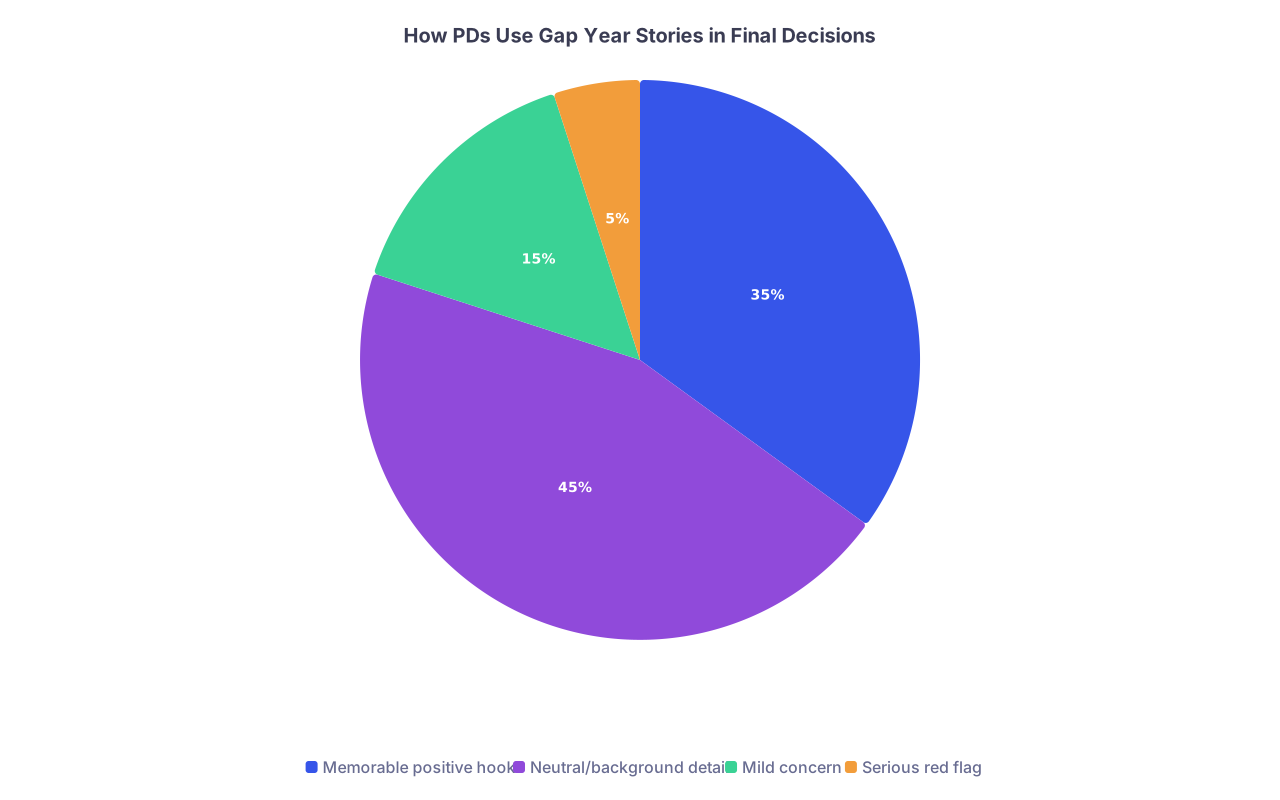
| Category | Value |
|---|---|
| Memorable positive hook | 35 |
| Neutral/background detail | 45 |
| Mild concern | 15 |
| Serious red flag | 5 |
Turning Your Gap Year Into a Story That Actually Sticks
You do not need a glamorous or exotic gap year. You need a coherent arc and a few sharp, repeatable phrases.
Here’s the behind-the-scenes structure that works when PDs hear it over and over.
1. Anchor It With a Clear Goal
Even if the year was messy in real time, you frame it with a goal in hindsight.
Weak:
“I just wanted to explore options and see what was out there.”
Strong:
“I had two priorities: strengthen my [research/clinical/teaching] foundation and test whether [specialty or population] was really where I wanted to commit my career.”
PDs like people who sound like they have a steering wheel.
2. Show Progression, Not Just Activity
This is where most applicants blow it. They list tasks. PDs remember progressions.
Compare:
“I worked as an MA in a cardiology clinic, rooming patients and helping with vitals.”
versus:
“I started as an MA in a busy cardiology clinic, doing the basics. Within six months, I was training new hires and coordinating pre-op checklists because my nurse manager trusted my accuracy and follow-through.”
One gets a nod. The other gets quoted later.
3. Name 1–2 Concrete Outcomes
Not 20 things. Just 1–2 that someone can repeat in a sentence.
- “We cut no-show rates by about 20% after we changed the reminder system I helped design.”
- “Our team published a paper in [journal] on [focused topic], and I owned the data cleaning and analysis pipeline.”
- “The mentorship program I started now runs without me and matched 15 more undergraduates into medical school last year.”
These are the pieces that stick in your PD’s tired brain at the end of a long day.
4. Tie It Directly to How You’ll Show Up as an Intern
The savvy move is always the same: end your gap year answer by translating it into residency performance.
Example for caregiving gap year:
“I was my dad’s primary caregiver through his transplant. It forced me to learn medication schedules, appointments, insurance, and how families absorb bad news. That year is why I’m comfortable now with complex patients and high-stakes conversations, and why I don’t panic when logistics get messy.”
You’re handing the PD a direct line: this experience → this strength on my team.

| Step | Description |
|---|---|
| Step 1 | Hear gap year story |
| Step 2 | Perceived as drifting |
| Step 3 | Neutral, easily forgotten |
| Step 4 | Moderately positive |
| Step 5 | Memorable positive hook |
| Step 6 | Used as tiebreaker in your favor |
| Step 7 | Clear goal? |
| Step 8 | Evidence of growth? |
| Step 9 | Concrete outcomes? |
A Few Brutally Honest Specialty-Specific Notes
Different specialties weight gap years differently, even if no one says so.
| Specialty | Typical Reaction to Gap Years |
|---|---|
| Internal Med | Flexible, narrative matters a lot |
| Gen Surgery | Wants grit, responsibility, stamina |
| Pediatrics | Loves mission-driven, kid-focused |
| EM | Values real-world chaos handling |
| Derm/Plastics | Research productivity heavily weighted |
- Medicine: Loves structured research, QI, teaching, serious caregiving. Very open to non-linear paths if you can articulate growth and maturity.
- Surgery: They want grind and toughness. Assistant jobs in ORs, MA in fast-paced clinics, long-term research with 6 a.m. rounds—these stories play well.
- Pediatrics: Longitudinal work with kids, schools, child advocacy and foster care—if it’s real and sustained, not 2-week camps.
- Emergency Medicine: Chaos tolerance sells. Full-time ED scribing, EMS work, crisis hotlines, street medicine—things that scream, “I don’t fold in messy systems.”
- Competitive specialties (Derm, Ortho, Plastics, ENT): Research years are essentially standard. Your story must be “I became essential in a productive lab and delivered tangible results,” not “I tagged along and got third author.”
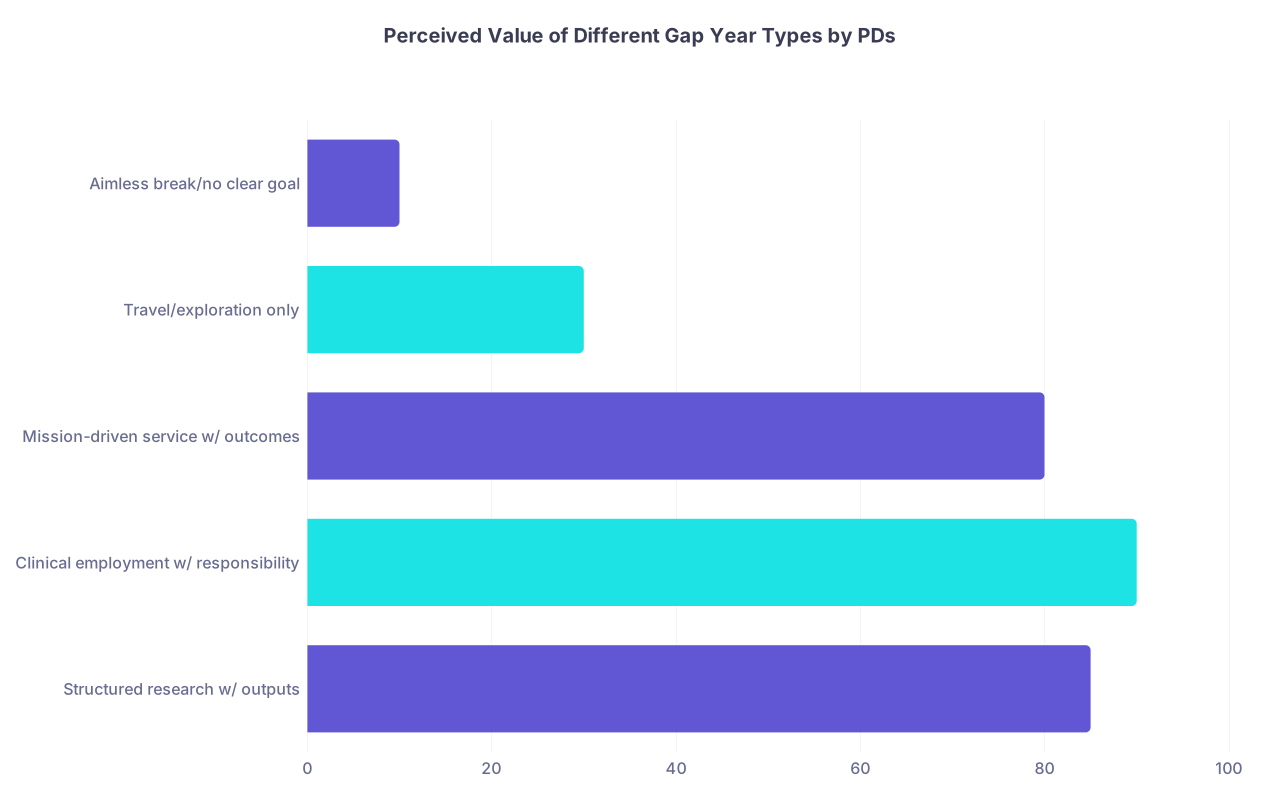
| Category | Value |
|---|---|
| Structured research w/ outputs | 85 |
| Clinical employment w/ responsibility | 90 |
| Mission-driven service w/ outcomes | 80 |
| Travel/exploration only | 30 |
| Aimless break/no clear goal | 10 |
How To Talk About a “Messy” Gap Year Without Getting Burned
Not everyone has a neat, Instagram-ready gap year. Honestly, some of the best residents did not.
If your year was fragmented, here’s how you contain the damage and still come out looking thoughtful.
- Pick one dominant theme in hindsight. Maybe you worked three disjoint jobs and helped family. You frame it as: “That year taught me how to manage competing responsibilities and build better systems under pressure.”
- Admit the imperfection without dramatizing it. “It wasn’t a straight line, but I learned quickly that I need structure. That’s why in the second half of the year I locked into [job/study plan] and stayed with it.”
- End with evidence you’re stable now. Point to consistent performance once you returned: solid clerkships, timely exams, no more chaos.
Faculty aren’t allergic to imperfection. They’re allergic to ongoing instability.
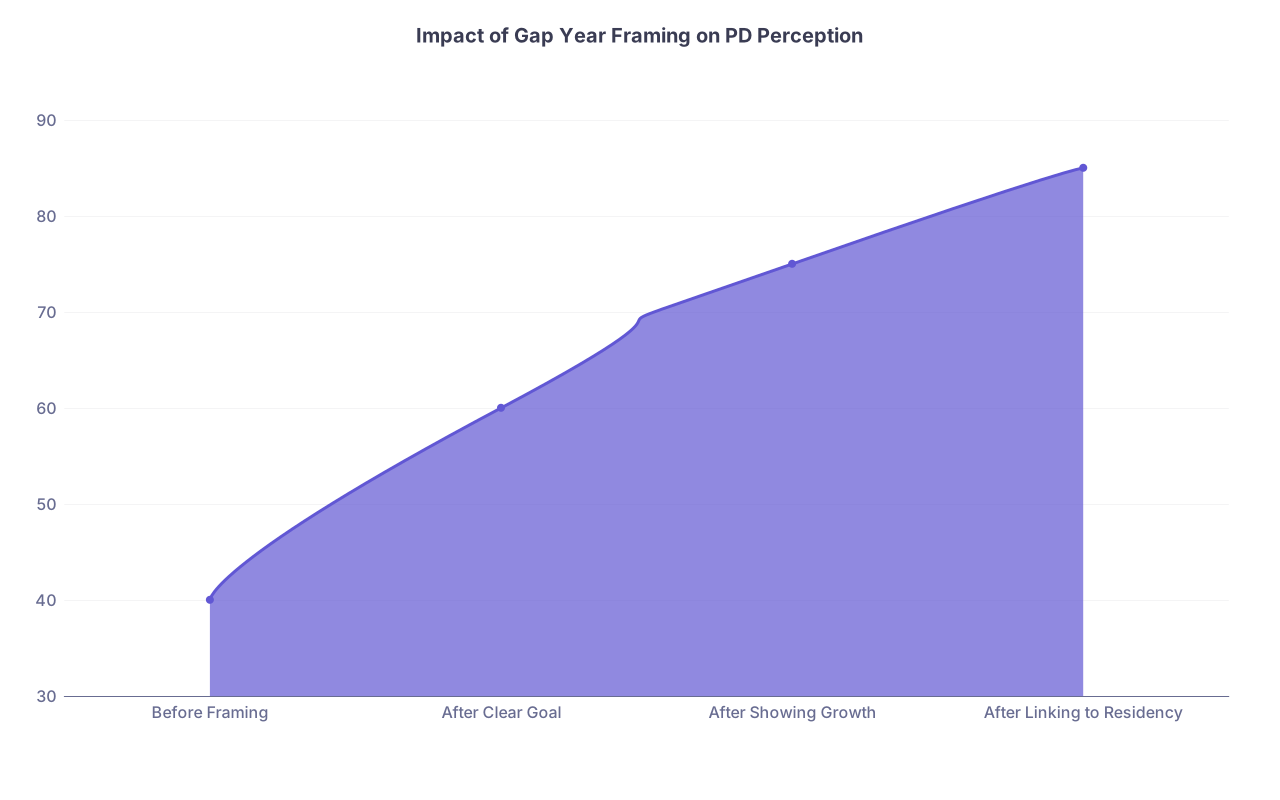
| Category | Value |
|---|---|
| Before Framing | 40 |
| After Clear Goal | 60 |
| After Showing Growth | 75 |
| After Linking to Residency | 85 |
FAQs
1. Does a gap year automatically make me more attractive to PDs?
No. A badly framed gap year is neutral at best and can be mildly damaging. A well-explained year, with clear goals, progression, and concrete outcomes, acts as a multiplier for an already solid application. The gap year itself is not the selling point; the story of what you did with it is.
2. How do I handle a gap year that was mostly about personal or mental health recovery?
You’re honest without oversharing. You say you took time to address health and sustainability, you sought appropriate help, and you developed specific strategies that now support your performance. Then you point to your consistent trajectory since returning: passed exams, strong rotations, reliable behavior. PDs care less about the fact that you struggled and more about whether you built a stable system you’re now living.
3. Should I bring up my gap year story in every interview answer?
No, that gets old fast. Use it strategically. Have a tight 60–90 second version ready for “Tell me about your path” or “I see you took time between X and Y—tell me about that.” Then let pieces of it support other answers about resilience, leadership, teamwork, or working with specific populations. Your gap year is a backbone for your narrative, not the entire skeleton.
Bottom line:
PDs remember gap years that show real responsibility, visible growth, and concrete outcomes.
They forget—or quietly downgrade—stories that sound like drifting, damage control without insight, or glossy but hollow experiences.
If you can turn your year into a sharp, coherent story that someone can summarize in one sentence on rank night, you’re ahead of most of your competition.


