

It is May. You just finished med school, Step 2 is behind you, and you did not match. The sting is raw, but you have a plan: a “productive” clinical gap year. Maybe a year of hands-on U.S. clinical experience, some moonlighting, a research fellowship with clinic time, or a preliminary job in a hospitalist group. You start Googling “clinical gap year positions,” see a few great-sounding roles, and think: “Perfect. I will rebuild my application and crush the next Match.”
Two months later, you are sitting in a cramped apartment, refreshing your inbox. The “perfect” job evaporated once HR realized you need visa sponsorship. The observership you lined up cannot let you touch patients because your limited license application is stuck. Your state licensing board wants documents from three countries you trained in and they will not “expedite” anything. The academic hospital that verbally promised a position suddenly “cannot accommodate your visa situation.”
You are not unlucky. You walked into the two biggest traps of a clinical gap year:
- Visa realities
- Licensing realities
And you treated both as afterthoughts instead of the foundation.
Let me walk you through the common mistakes that quietly destroy gap year plans—and how to avoid each one before you blow 6–12 months of your career.
1. Assuming “Any Clinical Job” Can Sponsor Your Visa
The first huge error: treating visa sponsorship like a detail HR will “figure out.”
For IMGs and many U.S. grads who need visas, this is fatal.
You see a posting:
“Clinical research fellow – oncology. Some direct patient interaction. Ideal for pre-residency candidates.”
You think: “They hire IMGs all the time. They will surely sponsor.”
No. Not necessarily. And often not at all.
The harsh reality on visas for gap-year roles
Most clinical gap-year jobs fall into a few visa-relevant buckets:
- Pure research roles (no patient care) – Often can be done on:
- J-1 research
- H-1B (rare, usually for more senior research positions)
- F-1 OPT (for those just graduating U.S. schools on F-1)
- Mixed research + clinical roles (charting, patient contact, orders) – Usually trigger:
- Licensure requirements
- Institutional credentialing
- More stringent visa scrutiny
- Pure clinical roles (NP/PA-equivalent, moonlighting, clinical associate) – Almost always:
- Require at least some form of license or training license
- Expect independent or semi-independent practice
- Are not designed as “trainee” positions
The common mistake: You assume that if they can sponsor your residency visa, they will sponsor this gap-year role. Wrong category. Residency programs are structured to sponsor J-1/H-1B for accredited training positions. Random gap-year jobs are not.
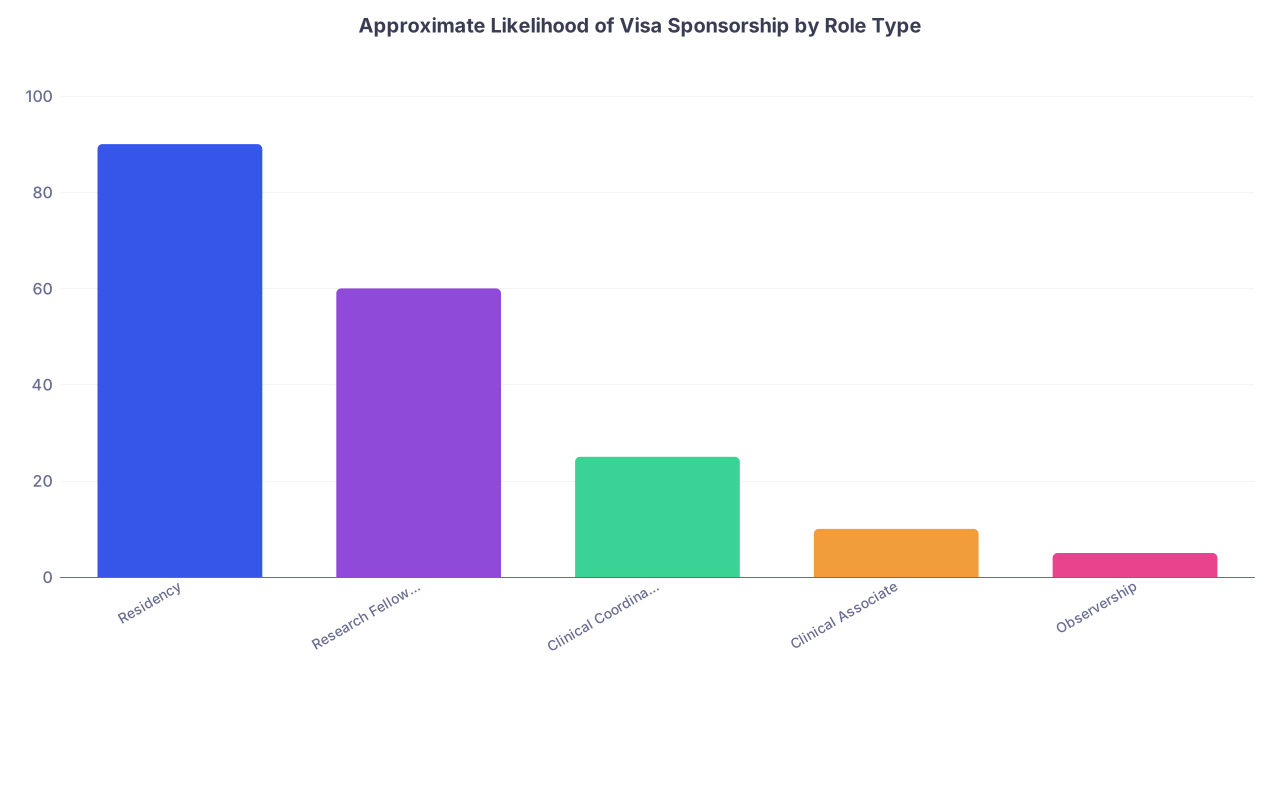
| Category | Value |
|---|---|
| Residency | 90 |
| Research Fellowship | 60 |
| Clinical Coordinator | 25 |
| Clinical Associate | 10 |
| Observership | 5 |
The numbers are approximate, but the pattern is not. Sponsorship drops off a cliff once you leave structured GME training.
Mistake patterns I keep seeing
Taking verbal reassurance as confirmation
An attending says, “We hire international grads, should not be a problem.” That is not HR. That is not legal. That is not binding.Assuming J-1 clinical equals J-1 research
You tell a PI, “I am on J-1 now,” and they think you mean research, but you are actually on a clinical J-1 from residency or plan for that. Completely different categories, different sponsors, different rules.Ignoring timing for H-1B
You decide, “I will just get an H-1B for this job,” in February for a job that starts in July—without noticing the April lottery deadline and employer cap issues.
How to avoid this
Before you emotionally commit to any gap-year clinical role:
Ask the only question that matters upfront
“Do you currently sponsor [J-1 research / H-1B / O-1 / etc.] for positions exactly like this?”
If the answer is anything other than a clear “yes, we do this regularly,” treat it as a “no.”Clarify your current status and constraints in writing
Send HR or the hiring manager an email with:- Your current visa
- When it expires
- What visa options you realistically have
- Your earliest possible start date
Get HR, not just the PI or attending, to confirm sponsorship
A faculty member telling you “we will make it work” has zero authority over institutional sponsorship policies.
If you skip this, you will sign on mentally to a role that collapses three weeks before your planned start date. It happens constantly.
2. Forgetting That “Clinical” = License + Credentialing
Second big oversight: assuming you can do meaningful, hands-on clinical work without any license.
Many “clinical gap year” fantasies sound like this:
- “I will be a clinical associate on the wards.”
- “I will work in urgent care to build my U.S. experience.”
- “I will moonlight at a community hospital.”
All of them run into the same wall: You cannot touch patients in most clinically meaningful ways without either:
- A full unrestricted license
- A training/limited license tied to a residency/fellowship/educational program
- A very narrowly defined ancillary role (e.g., scribe, MA) where you are not functioning as a physician
The common misunderstanding
You think: “I graduated medical school. I passed Step 1 and Step 2. I am a doctor. I can work under supervision.”
The hospital thinks: “You are a liability without a license, malpractice coverage, and credentialing. You cannot write orders. You cannot be on the call schedule. You cannot bill.”

State licensing traps that derail plans
Every state board has its own version of bureaucracy hell, but there are some recurring themes:
Misjudging timelines
You assume you can get a limited/training license in 4–6 weeks. In many states, it regularly takes 3–6 months. Especially if:- You trained outside the U.S.
- You have multiple previous licenses
- You have ANY “yes” answers (discipline, gaps, repeats)
Not realizing some roles require a license even if not called “residency”
Titles like:- “House officer”
- “Clinical associate”
- “Junior hospitalist” Often require the same licensing and credentialing as residency—just with worse pay and no ACGME credit.
Underestimating primary source verification headaches
Boards and hospitals often insist on:- Original transcripts, sealed and mailed
- Official verification of every prior license
- Confirmation of all previous training posts
If your med school or prior institution is slow? You are stuck.
How this practically wrecks a gap year
Scenario I have seen multiple times:
- Position start date: July 1
- Offer issued: March
- Candidate applies for limited license: mid-April (already late)
- Board requests additional documentation: May
- School responds slowly: June
- License approved: Mid-August
By then:
- The hospital had to cover your shifts somehow.
- They either rescind the offer, convert it to a purely research role, or delay your start so long that your “clinical year” shrinks to 3–4 months.
You planned for a “full clinical year.” You end up with a brief, fragmented stint that does not meaningfully change your application.
How to avoid this
Start with the board, not the job posting
Before you even apply:- Identify the state(s) where you are likely to work.
- Read that board’s rules for:
- Training licenses
- Limited licenses
- Requirements for IMGs
- Look at their posted processing times—and mentally double them.
Ask the employer who handles licensing logistics
Good institutions:- Know exactly which license you need
- Have a GME or medical staff office that helps push things along
Terrible institutions: - Say, “You just apply to the board on your own” and shrug
Lock in your paperwork pipeline early
Get these ready long before you sign a contract:- Official medical school transcripts
- MSPE / Dean’s letter
- ECFMG certification verification
- License verifications from every jurisdiction you have ever been licensed in
You want to be the annoying person who has everything ready the week the offer hits, not the person starting from zero in May for a July start.
3. Overlooking Status Gaps and Unlawful Presence Risks
The third landmine is more subtle but more dangerous: falling out of status while you are “waiting for something to come through.”
Common mindset:
“I will graduate, stay with my friends, look for a job, and once I find one, they can file my visa.”
If you are on F-1, J-1, or any non-immigrant status tied to education or training, this is how people quietly fall out of status and trigger long-term consequences.
Where this bites hardest
F-1 students finishing U.S. med school:
- You need OPT (or other authorized work permission) to legally work in a gap year.
- OPT has strict application windows and start date frames.
- If you miss them, you cannot just “freelance clinical work” while you wait.
J-1 research scholars finishing a research year:
- Your DS-2019 has a clear end date.
- Staying beyond that without proper extension or change of status is not “a little late.” It is unlawful presence.
J-1 clinical housestaff who did not match into the next program:
- Your J-1 clinical training category is tightly regulated.
- You cannot seamlessly slide into random non-GME clinical jobs on that same visa.
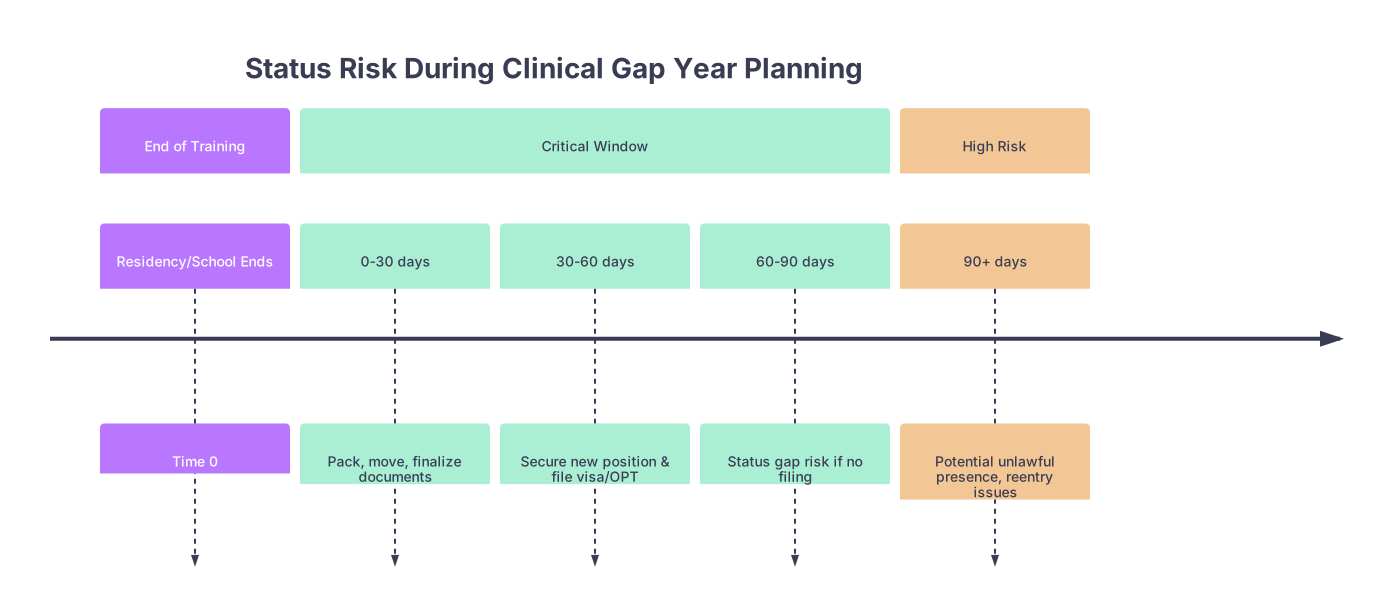
| Period | Event |
|---|---|
| End of Training - Residency/School Ends | Time 0 |
| Critical Window - 0-30 days | Pack, move, finalize documents |
| Critical Window - 30-60 days | Secure new position & file visa/OPT |
| Critical Window - 60-90 days | Status gap risk if no filing |
| High Risk - 90+ days | Potential unlawful presence, reentry issues |
Mistake patterns
Treating “grace periods” like flexible suggestions
You hear “60-day grace period” and interpret it as: “I have two months to figure out my life.” No. You have two months to either:- Start a new authorized program, or
- Change to a different status, or
- Leave the country
Assuming volunteer work is always fine
Many think, “I will just volunteer in a clinic. No pay, no problem.”
Immigration authorities care about whether you are engaging in work-like activity that someone would normally be paid for. “Volunteering” in a role equivalent to paid clinical staff can absolutely be treated as unauthorized employment.Waiting for a “perfect” offer before taking any legal step
By the time you find that perfect gap-year job, your clock has run out to change status safely without leaving and re-entering.
How to avoid this
Map your status timeline directly against your gap-year plan
Write down:- Last day of current authorized status
- Any grace period
- Earliest possible start date for new role
- Visa processing times for your likely category
Talk to an immigration attorney early, not when problems start
Not Reddit. Not your co-resident who “figured it out.” A real attorney.
One consultation can save you a year of your life and your ability to return.Have a “legal fallback” plan
Examples:- If OPT fails → be ready for a research-only J-1 position.
- If H-1B is not possible → shift your gap year to pure research or remote work while maintaining status appropriately.
A “gap year” cannot include a gap in lawful status. That is the kind of mistake that does not just derail your year. It derails your career.
4. Misclassifying “Observerships” and “Externships” in Visa and Licensing Terms
Another subtle but common mistake: assuming all “clinical experiences” are created equal from a regulatory standpoint.
They are not.
The illusion of clinical involvement
You see:
- “Hands-on externship”
- “Supervised clinical experience”
- “USCE gap-year program”
Some of these are:
- Paid, patient-facing, and absolutely require:
- Proper work authorization
- Institutional privilege
- Malpractice coverage
Others are:
- Shadowing-only observerships where:
- You cannot write notes
- You cannot touch patients
- You are essentially an observer in the corner
The trap: You think you are signing up for a robust clinical year, but visa and licensing constraints force the institution to treat you as a glorified shadow.
| Type | Pays Salary | Patient Contact | Usually Needs License | Typically Visa-Sensitive |
|---|---|---|---|---|
| Observership | No | Minimal | No | Low |
| Externship | Sometimes | Moderate | Sometimes | Medium |
| Research + Clinic | Sometimes | Variable | Often | High |
| Clinical Associate | Yes | High | Yes | Very High |
Where IMGs and reapplicants mess this up
Assuming “externship” always means hands-on
Some programs use “externship” as marketing while structurally running an observership.
You find out on day one that you cannot touch a single patient or place a single order.Failing to understand what your visa allows
If you are on:- B1/B2
- ESTA
You cannot perform clinical duties, even unpaid, that a U.S. resident or attending would normally do. Period. Shadowing only.
Selling weak observerships in your application as “robust clinical work”
PDs know the difference. If your gap year was 10 months of mostly passive observership because of visa/licensing limits, they can tell.
How to avoid this
Interrogate the role before you accept
Ask very specific questions:- “Can I write notes in the EMR?”
- “Can I place orders (even if they require co-sign)?”
- “Will I be listed on the clinical schedule?”
- “Do I need any sort of license or malpractice coverage?”
Cross-check with your visa type
If the job:- Involves regular patient contact
- Generates billable services
- Requires you to function as part of the clinical workforce
It will almost certainly require appropriate work authorization.
Align expectations with what PDs will actually value
Ten months of high-quality, documented, supervised clinic time (with notes, recommendations, and real responsibility) is vastly more valuable than a year of standing in corners of U.S. hospitals with the label “observer.”
5. Ignoring State-Specific Licensing Rules for Repeated Attempts, Gaps, and Non-Standard Training
This one blindsides reapplicants and IMGs constantly.
You think: “I just need a license for this job.”
The state board thinks: “We are evaluating your entire training history.”
Where it goes wrong
Multiple Step failures or late passes
Some states:- Limit total Step attempts
- Require passing all Steps within a certain time frame (e.g., 7 or 10 years)
You might be “fine” for residency applications nationwide but ineligible for a particular state’s license, even training license.
Non-traditional training pathways
If you:- Switched specialties
- Left a residency before completion
- Had long gaps between training positions
Some boards will: - Ask for detailed, official explanations
- Stall your application for months
Foreign rotations that are poorly documented
IMGs who rotated in multiple countries can run into:- Missing verification from hospitals that no longer exist
- Language and documentation barriers
That translate into “delayed” or “incomplete” for the board.
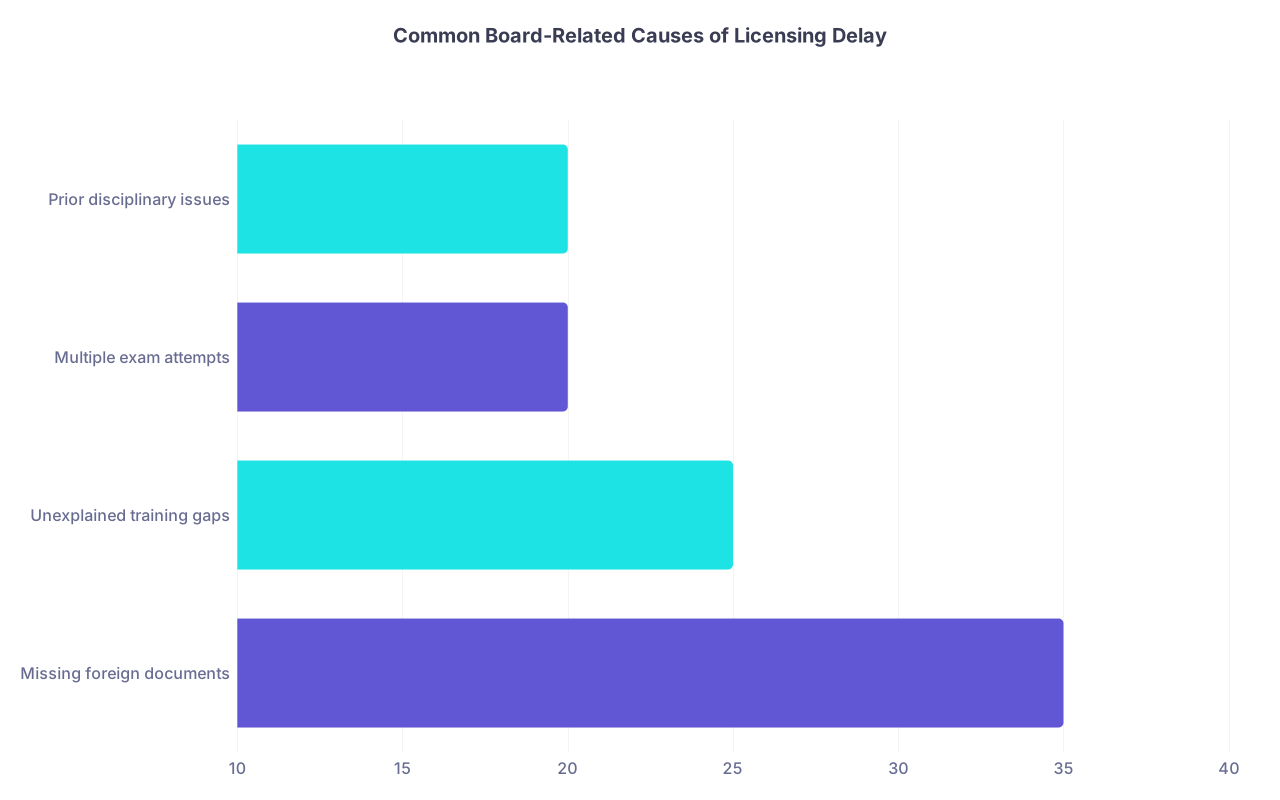
| Category | Value |
|---|---|
| Missing foreign documents | 35 |
| Unexplained training gaps | 25 |
| Multiple exam attempts | 20 |
| Prior disciplinary issues | 20 |
Those are rough percentages from what I have seen and heard from applicants over the years, not official data. The pattern holds.
Why this matters for a gap year
Your clinical gap-year job might require only a training or limited license, but the board is still:
- Looking at your exam history
- Looking at your training history
- Asking “Is this person on a clearly safe, structured trajectory?”
If your file raises eyebrows, they do not move faster just because it is “only” a limited license.
How to avoid this
Know your red flags before the board does
Be honest with yourself about:- Step/COMLEX failures
- Prior program withdrawals, non-renewals, or dismissals
- Extended gaps without clinical work
Pre-screen states you are targeting
Some states are far more IMG-friendly and flexible with attempts and gaps. Others are brutal. Do not pick a job in a hostile licensing state just because the title sounds great.Prepare thorough, professional explanations
If you have:- Failed exams
- Program interruptions
- Personal leaves
Draft clear, concise, documented explanations now. Do not cobble them together in a panic when a licensing analyst emails you.
6. Letting the Gap Year Drift While Licensure/Visa “Works Itself Out”
Final, quiet mistake: treating visa and licensing as background processes while you “get started” on your gap year, then discovering months later that:
- Your position never materialized.
- You cannot do the clinical part you planned.
- You lost a full application cycle waiting.
The drift usually looks like this:
- April: Decide to do a clinical gap year.
- May–June: Send scattershot emails, “network,” talk to mentors.
- July: Still no concrete, fully vetted role with clear visa/licensing plan.
- August–September: ERAS opens; you reapply with nothing substantial to show for the last 4–5 months.
- October–November: A job finally comes through…starting January, after the peak interview season.

| Step | Description |
|---|---|
| Step 1 | Match Failure |
| Step 2 | Drifting Plan: Find Something Clinical |
| Step 3 | Unclear Visa/Licensing |
| Step 4 | Delayed Start or No Job |
| Step 5 | Weak Reapplication |
| Step 6 | Planned Path: Clarify Status & License First |
| Step 7 | Target Feasible States & Roles |
| Step 8 | Secure Written Offer + HR Visa Confirmation |
| Step 9 | Start Role Before or Early in ERAS Cycle |
| Step 10 | Stronger Reapplication |
You cannot afford a “gap year” where the clinical part only starts after your applications go out. That is not a clinical year. That is a lost year.
How to avoid drift
Structured, not complicated:
Within 2 weeks of realizing you need a gap year:
- Map your current visa/status timeline.
- Identify 1–2 visa categories that realistically fit you.
- Identify 2–3 states that are feasible for licensing.
Within 4–6 weeks:
- Have at least 5–10 targeted, realistic positions you are actively pursuing, each vetted for:
- Visa feasibility (confirmed by HR/legal, not assumed)
- Licensing path and timeline
- Start any necessary licensing applications even if you do not have a final offer yet, when possible.
- Have at least 5–10 targeted, realistic positions you are actively pursuing, each vetted for:
By July 1 (ideally earlier):
- Either be in a role, or have a contract start date and active license/visa process underway with realistic approval before fall.
If you are still “figuring things out” in July, you are playing from behind.
Your Next Step Today
Open a blank page and write three headers:
My Current Status and Deadline
- Exact visa/status
- Last day of authorized stay
- Any grace period details
Licensing Reality Check
- States I am actually eligible for (given my exam attempts, training, IMG status)
- Documents I already have vs still need
Clinically Realistic Role Types
- Roles that match what my visa will actually allow
- Roles that exist in states where I can realistically get a license in time
Fill those three sections in—today. Not next week. You will immediately see which of your “dream” gap-year ideas are fantasies and which are viable.
Then, for any role you are already eyeing, email the contact person and ask one direct question:
“Can you confirm whether your institution has recently sponsored a candidate with my visa status for a position like this, and whether this role requires a training or limited license in [state]?”
If that email makes you nervous, that is exactly why you must send it. Better a blunt “no” now than a slow, painful collapse of your gap year six months from today.


