

What exactly are you getting in return for your “amazing gap year opportunity” that pays you zero dollars and calls you “part of the team”?
If you are between medical school and residency—or about to graduate and thinking of a “productive” gap year—you are squarely in the crosshairs of one of the most common forms of exploitation in medicine: the unpaid or badly underpaid “research / clinical / leadership” position that runs on your desperation, fear, and hope.
Let me walk through how people get trapped in this, what red flags almost everyone ignores, and how you can protect yourself without burning bridges.
How the Gap Year Becomes the Free Labor Trap
Most people do not set out to be exploited. They fall into it step by step.
Here is the usual story I keep seeing:
You did not match. Or you are switching specialties. Or your application is a little light on research or US clinical experience. Faculty tell you: “A focused year could really strengthen your application.” That part is true.
Then a “perfect” role appears:
- “Full‑time research assistant with direct attending mentorship”
- “Clinical scholar position with patient contact and strong letters”
- “Pre‑residency fellow” or “gap-year clinical associate”
And then the phrase that should make you pause:
“We do not have funding for salary, but we can offer incredible experience and a strong letter.”
You convince yourself it is a sacrifice that will pay off. One year. You will grind now, match later, and future you will be grateful.
Except you are not doing a scholarly sabbatical. You are doing a full‑time job. For free. In a system that absolutely can pay people, but chooses not to when they know someone scared and ambitious will say yes.
That is the trap.

| Step | Description |
|---|---|
| Step 1 | Graduate / Did Not Match |
| Step 2 | Anxiety About Competitiveness |
| Step 3 | Faculty Suggest Gap Year |
| Step 4 | Unpaid or Low‑Paid Offer |
| Step 5 | Accept on Fear / Hope |
| Step 6 | Ask Questions & Set Boundaries |
| Step 7 | Overwork, Limited Support, Exploitation |
| Step 8 | Negotiate, Decline, or Find Better Role |
| Step 9 | Evaluate? |
You are not “lucky” to be given unpaid work that keeps a lab or clinic running. You are doing real labor. And sacrificing one of the few years you might have flexibility, rest, or paid income.
Why You Are So Vulnerable Right Now
You are not getting taken advantage of because you are naive. You are getting taken advantage of because the incentives are stacked against you.
These are the pressure points programs exploit:
Fear of permanent career damage
“If I do not fix my CV this year, I will never match.”
That panic makes you willing to accept anything that looks like a lifeline, including bad deals that a less desperate person would laugh off.Over‑respect for authority
Medicine trains you to defer to attendings. You internalize: “They know what I need.” So when someone with a big NIH grant and a lofted title says, “This is what successful applicants in your position do,” you override your own financial and personal limits.Lack of salary transparency in academia
You probably have no real sense of what a full‑time research assistant, coordinator, or pre‑residency fellow is supposed to make. Usually because nobody tells you. That makes it easy for a department to call something a “special trainee role” and quietly bypass HR rules.Immigration and visa issues
If you are an IMG or on a visa, your leverage is worse. People know you need U.S. experience, letters, and maybe sponsorship. The worst “volunteer fellowships” I have seen were targeted at IMGs who felt they had zero alternatives.
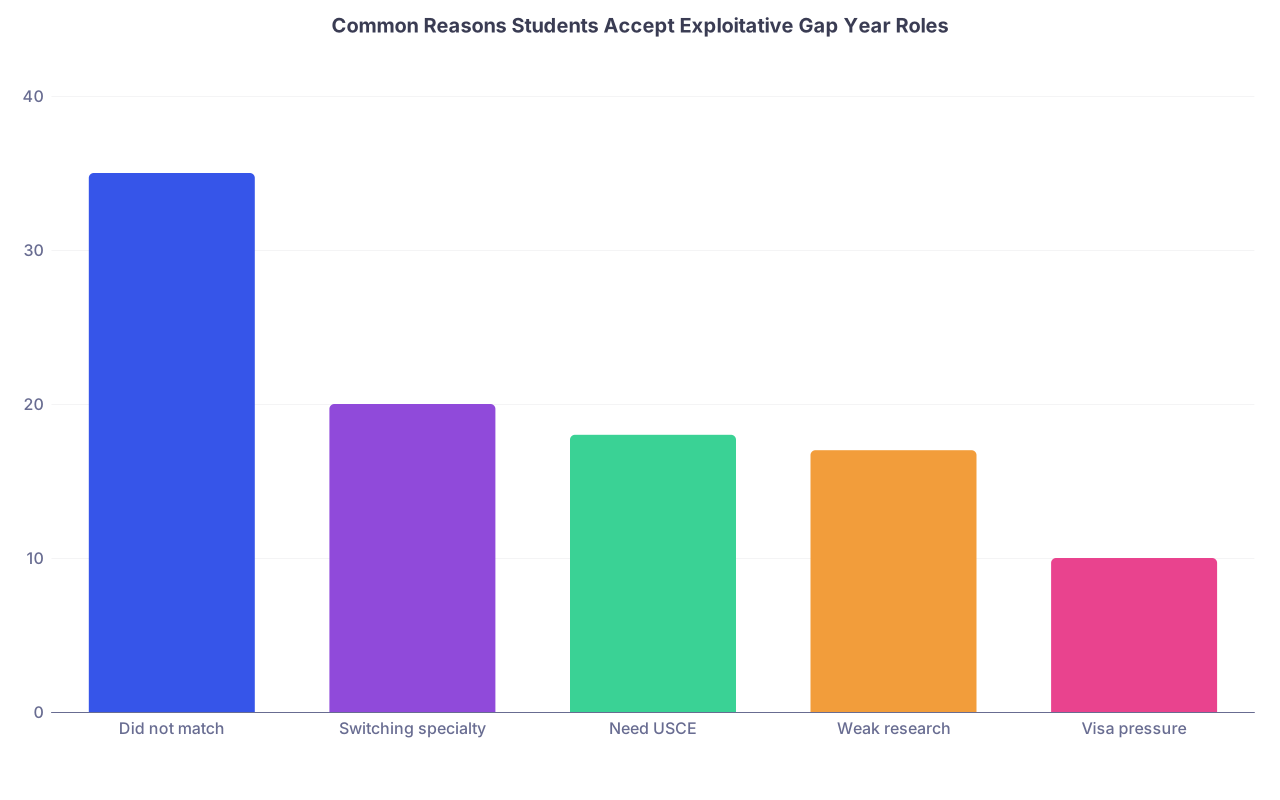
| Category | Value |
|---|---|
| Did not match | 35 |
| Switching specialty | 20 |
| Need USCE | 18 |
| Weak research | 17 |
| Visa pressure | 10 |
When you stack all that, the classic free‑labor gap year position almost sells itself: “Work here for a year, and your application will be fixed.” It is not always a lie. It is just often a terribly expensive way—financially and psychologically—to get marginal benefit.
The Red Flags: How Exploitation Usually Looks Up Close
You want to know what trouble looks like before you sign anything. These are the warning signs you should not ignore.
1. “Volunteer” Title, Full‑Time Workload
If the position is advertised or described as:
- “Volunteer clinical research fellow”
- “Unpaid pre‑residency associate”
- “Visiting scholar (no stipend)”
…and then the expectations sound like a 40–60 hour job, that is exploitation dressed up as opportunity.
You are doing what paid staff, residents, or fellows would normally do. You just are not being paid.
2. Vague Promises, No Concrete Deliverables
Another classic pattern: glowing but non‑specific promises.
“We’ll get you publications.”
“You’ll be first author on a paper.”
“You’ll get a great letter.”
But when you press for specifics, everything gets fuzzy:
- No clear project with a timeline
- No written commitment about authorship expectations
- No defined check‑in points for progress
You are being sold vibes, not outcomes. And vibes do not go on ERAS.
3. Misuse of “Mentorship” as Currency
Real mentorship is guidance, advocacy, doors opened, not a replacement for pay.
Be wary when you hear:
- “You’re paying in time; I’m paying in mentorship.”
- “If I fund you, I’ll have less incentive to push your career.”
- “I didn’t get paid during my research time either.”
This is manipulation. They are monetizing your gratitude.
4. You Are Doing Service Work, Not Career‑Building Work
A little grunt work is normal. Endless grunt work is not.
Bad sign: you are essentially the department’s unpaid coordinator:
- Endless data entry
- Cold‑calling patients
- Scheduling, tracking IRBs, chasing signatures
- Covering clinics “to help out” without structured teaching
If 80–90% of your time is service that an hourly staff member could do, your “gap year” is functioning as free staffing, not training.

5. Zero or Token Salary With No Benefits
Quick rule: if the role is full‑time and clinical or quasi‑clinical, and you are getting:
- No health insurance
- No institutional email / ID
- No HR onboarding
- Paid less than a full‑time research assistant in that institution
You are likely in a loophole. Institutions do this to dodge employee protections and costs. You absorb the risk; they get the productivity.
6. Fear‑Based Pressure to Accept Quickly
Notice the language used to push you:
- “Spots fill quickly; you should commit soon.”
- “I would hate for you to fall further behind while you think about this.”
- “People in your situation usually say yes immediately.”
This is sales, not advising.
A legitimate mentor will encourage you to ask questions, compare options, and take a few days to think. Predatory setups rush you so you do not have time to realize what you are giving up.
How to Evaluate an Opportunity Without Getting Steamrolled
You do not need to reject every gap year research or clinical role. Some are excellent and can genuinely change your trajectory. The key is knowing how to interrogate the offer before you say yes.
Here is the minimum due diligence I would do.
1. Start With the Basic Job Facts
You are not “bothering” anyone by asking for clarity. You are acting like an adult.
Ask directly:
- What is the expected weekly time commitment?
- What is the compensation? Salary? Stipend? Benefits? None?
- Who is my direct supervisor?
- Where will I physically work?
- How long is the appointment? Fixed term or open‑ended?
If those answers are evasive or keep changing, that alone is a bad sign.
2. Drill Down on Outcomes, Not Buzzwords
Your goal is not “be in a prestigious lab.” Your goal is to improve match outcomes. That means concrete outputs.
Ask:
- What have past people in this role actually achieved? (Pubs, posters, match results)
- Can I speak with one or two former trainees privately?
- What specific projects will I work on in the first 3 months?
- How is authorship decided?
If they cannot produce previous trainees, or every “success story” is vague (“many of our scholars match to great places”), you are probably looking at free labor, not a structured pipeline.
| Feature | Healthy Position | Exploitative Position |
|---|---|---|
| Compensation | Market-rate salary or clear stipend | Unpaid or token amount |
| Role clarity | Written description and duties | Vague, “we’ll see as we go” |
| Deliverables | Specific projects, timelines, goals | General “experience” and “exposure” |
| Past track record | Documented, reachable alumni | Stories but no verifiable examples |
| Work type | Mix of learning, research, some grunt | Mostly service / menial work |
3. Calculate the Real Cost to You
Do the math. Literally.
- How much will you spend on rent, food, loans, exam fees, applications?
- If you work 50 hours/week for $0, what is your effective hourly “wage”? Negative.
- Compare that to a modestly paid job (e.g., scribe, RA, telehealth triage) that could support both living expenses and limited academic work.
This is where many people lie to themselves: “It’s just one year.” One year of debt, burning out, and pushing personal life on hold is not minor.
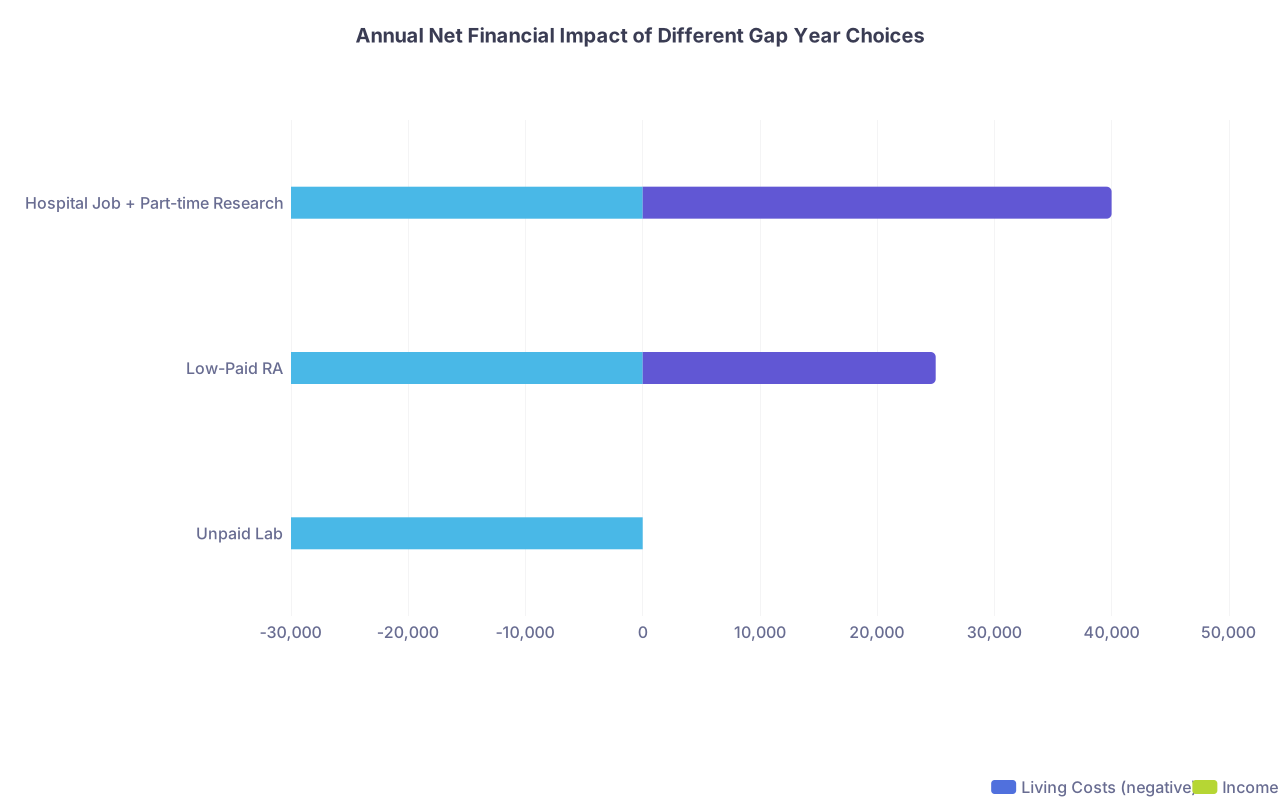
| Category | Living Costs (negative) | Income |
|---|---|---|
| Unpaid Lab | -30000 | 0 |
| Low-Paid RA | -30000 | 25000 |
| Hospital Job + Part-time Research | -30000 | 40000 |
4. Consider Power Dynamics and Boundaries
Ask yourself:
- If things go bad, can I leave without destroying my future?
- Is my visa tied to this role?
- Am I overly dependent on one attending for letters?
If the answer is “I am completely trapped if I sign,” you need either stronger protections (contract, clear term, multiple letter writers) or a different plan.
Smart Gap Year Alternatives That Do Not Exploit You
You need to strengthen your application. That does not automatically mean “work for free in a famous department.”
There are more balanced options that protect your dignity and still move your CV forward.
1. Paid Research Assistant or Coordinator Roles
They may not sound glamorous, but a standard RA or coordinator job with HR onboarding, salary, and benefits is usually safer than some made‑up “pre‑residency fellow” that mysteriously cannot go through HR.
Upside:
- Steady income
- Clear work hours
- Real publications if you choose your PI carefully
- Less likely to be pressured into 60–70 hour weeks
You can negotiate time for writing, conferences, or Step studying. People do this successfully every year.
2. Clinically Relevant, Paid Work
Scribing, telemedicine triage, hospitalist extender roles, urgent care jobs—these can look perfectly fine on an application if framed correctly, especially if your weakness is clinical exposure or time since graduation.
Combine that with 5–10 hours/week of targeted:
- Small, realistic research projects
- Quality improvement projects
- Teaching or tutoring
You end up with a balanced narrative and money in your account.

3. Short, Time‑Boxed Research Blocks
Instead of a year‑long indentured service, design 3‑ to 6‑month focused blocks:
- Join a specific ongoing project with clear endpoints (e.g., one manuscript, one abstract, one QI poster)
- Agree on a defined weekly time commitment
- Put authorship expectations in writing (even informally in email)
Then reassess after that period. You are not chained for a full year, and you have leverage: they want continuity; you want fairness.
How to Push Back Without Burning Bridges
Sometimes you get an offer that is almost good—except for the exploitation part. You do not have to either fully accept or fully walk away. There is a middle ground: controlled pushback.
Here is how to do it without lighting a match to the relationship.
1. Name Your Constraints Calmly
You do not need to justify your existence. Just state facts.
Example language:
“I appreciate the opportunity. Realistically, I cannot commit to a full‑time unpaid role for a year because of loan and living expenses. Is there any funded version of this position or a reduced time commitment that would still make sense for you?”
If their response is annoyance or guilt‑tripping, that tells you exactly how they see you: as labor, not as a trainee.
2. Set Explicit Boundaries Around Time
If they insist it must be unpaid, then you insist it must be time‑limited and part‑time.
“I can commit 15–20 hours per week over the next 6 months. I can focus on X and Y projects. After that, we can revisit based on how things are going.”
You avoid 60‑hour weeks while still gaining something to put on ERAS.
3. Put Agreements in Writing
Do not rely on memory or vibes. Send a follow‑up email summarizing:
- Time commitment
- Compensation (or explicit absence of it)
- Main projects
- Expected duration
- Check‑in or review points
If they are uncomfortable with written clarity, you should be uncomfortable with the role.

When You Are Already Stuck in a Bad Gap Year
Plenty of people reading this are not deciding whether to enter a bad situation—they are already in it.
You realize you are overworked, unpaid or underpaid, and not getting what was promised. What now?
Document everything
Keep track of hours worked, tasks done, and your contributions to projects. You may need this to negotiate authorship or letters later.Start renegotiating scope
Pick a moment (not in crisis) and say:“Over the last three months, most of my time has been spent on [X service tasks]. I would like to shift more toward [Y projects] that would result in concrete outputs for my application. Can we prioritize 1–2 projects and adjust my other responsibilities?”
Quietly explore exits
You are not obligated to complete the “full year” if the terms have effectively changed. Look for:- Paid RA roles in the same institution
- Part‑time clinic work elsewhere
- Remote research/chart review with other PIs
Protect your mental health first
Burnout during a gap year is brutal. You are not even in residency yet and already feel done. That is a red flag that your current setup is unsustainable, not that you are weak.
Quick Reality Checks Before You Say Yes
Run any “opportunity” through these filters:
- Would I advise a close friend to take this exact deal if they had my finances and goals?
- If I remove the program’s name and prestige from the equation, does this still look rational?
- Am I mostly motivated by fear (“I will be ruined if I say no”) rather than by a clear plan (“This aligns with what I need because…”)
If your stomach tightens and your brain starts rationalizing, stop. That is you noticing the trap.

| Step | Description |
|---|---|
| Step 1 | Identify Weaknesses |
| Step 2 | Determine Main Goal |
| Step 3 | Screen Only Paid or Part-time Offers |
| Step 4 | Evaluate Outcomes & Track Record |
| Step 5 | Negotiate or Decline |
| Step 6 | Accept with Written Terms |
| Step 7 | Seek Alternative Paid Work + Targeted Projects |
| Step 8 | Exploitation Flags? |
FAQs
1. Is it ever worth doing an unpaid full‑time gap year position?
Rarely. The only situations where I have seen it make sense:
- Extremely time‑limited (3–4 months)
- Concrete, high‑yield output almost guaranteed (e.g., first‑author paper already in progress, data collected)
- You have financial support that does not involve high‑interest debt
- The mentor has a proven record of getting people in your exact position matched
Even then, I would push hard for at least modest pay or reduced hours. The bar for “worth it” is very high.
2. How do I ask about previous trainees without sounding accusatory?
Be straightforward and neutral:
“I would love to understand how people in this role have done in the past. Could you share where some of them ended up matching, and whether it would be possible for me to speak with one or two of them about their experience?”
If they refuse or dodge, that is your answer. Good programs are usually proud to connect you with alumni.
3. Will saying no to a bad offer hurt my chances with that department later?
Less than you think. If an attending holds a grudge because you could not work for free or asked for boundaries, that is not someone whose letter you want defining your career. Say no politely, express appreciation, keep the door open:
“Thank you again for considering me. Given my financial situation, I will need to pursue a paid position this year, but I would be very interested in collaborating on specific projects if opportunities arise.”
You maintain professionalism without agreeing to be exploited.
Key points:
Protect yourself from the “free labor” gap year trap by (1) demanding clear terms and realistic outcomes before committing, (2) refusing full‑time unpaid roles disguised as “mentorship,” and (3) prioritizing paid, structured positions or balanced part‑time arrangements that actually move your application forward without wrecking your finances and sanity.


