

Program directors do not read your gap year emails the way you think they do.
You’re obsessing over “Dear Dr. X” versus “Dear Program Director,” arguing with friends about whether to attach a new CV as a PDF or paste bullets into the body. Meanwhile the people actually reading these emails are asking three much simpler questions:
- Are you steady or desperate?
- Are you maturing or just drifting?
- Are you going to make my life easier or harder if I rank you?
Let me walk you through how those judgments really get made.
What PDs Actually See When Your Email Lands
Let me be blunt: your email is not landing in a Zen garden. It’s landing in a war zone.
Program directors and coordinators open your message wedged between a Joint Commission notice, a faculty complaint, and a reminder that clinic is double-booked next Tuesday. No one is sitting with a latte carefully analyzing your prose.
Here’s what actually happens.
Most PDs do not see your email first. The coordinator does. They skim it in 10–15 seconds and decide which pile you go into:
- “Forward to PD—potentially relevant”
- “Quick reply with generic answer”
- “Ignore unless applicant emails again”
That first 10–15 seconds is where you win or lose. And what determines it is not what you think—grammar, humility platitudes, or saying “thank you for your time” four different ways.
They are scanning for:
- Who are you? (Applicant ID, year, specialty, are you already in their ERAS list?)
- What are you doing right now in your gap year? (Job, research, prelim, observership?)
- What do you want from them? (Update only, signal interest, ask for interview, or beg?)
- Are you professional, concise, and sane?
If those are clear, your email survives. If not, it gets buried.
How PDs Categorize Gap Year Applicants
Here’s another secret most people never tell you: PDs mentally sort gap-year applicants into a few buckets the moment they realize you’re in a gap year.
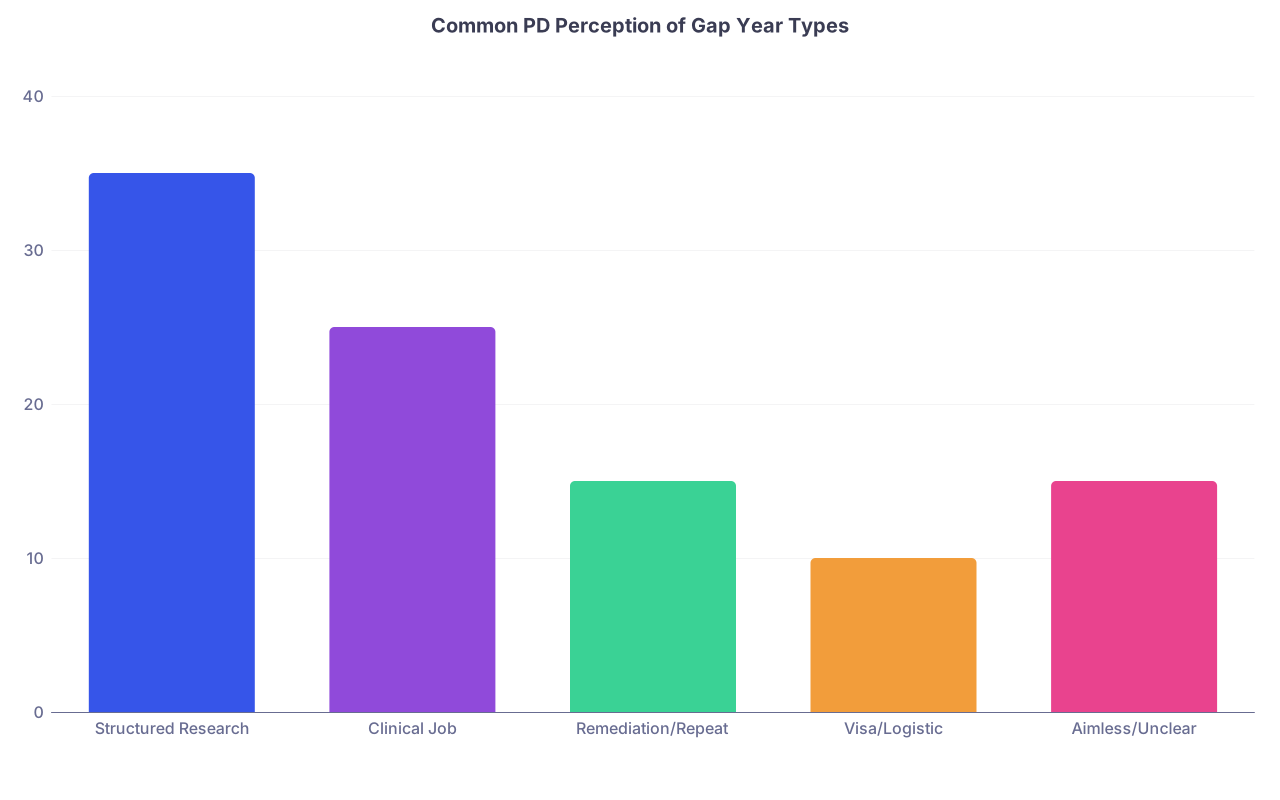
| Category | Value |
|---|---|
| Structured Research | 35 |
| Clinical Job | 25 |
| Remediation/Repeat | 15 |
| Visa/Logistic | 10 |
| Aimless/Unclear | 15 |
I’ve heard this exact phrasing behind closed doors when PDs and faculty review “gap year emails” and applications:
- “The intentional builder” – Research fellow, chief research assistant, MPH, structured fellowship. Clear purpose, clear plan.
- “The working clinician” – Hospitalist scribe, internal medicine prelim, urgent care PA in another country, ED tech, etc. Actually seeing patients or in a care environment.
- “The fixer” – Remediating exams, repeating a year, doing extra clinical time after academic problems.
- “The logistics case” – Visa issues, family illness, military obligation, pregnancy, or other unavoidable life events.
- “The floater” – “Taking time to explore interests,” “considering options,” “studying,” but no real anchor.
Your outreach email either locks you into one of these categories or drags you out of the wrong one.
If your email screams “floater” or “desperate fixer with no insight,” you’re done. If it shows you as an intentional builder or a mature fixer—very different story.
The Anatomy of a Gap Year Email That PDs Respect
Let me tell you exactly what a PD and coordinator look for structurally, even if they never say it out loud.
They want:
- A subject line that makes sense
- A quick reminder of who you are
- A one-sentence statement of your current position or gap year role
- A focused update or request
- A tone that’s professional, calm, and not clingy
Anything beyond that? Gravy if it’s good, dead weight if it’s not.
Subject lines that get opened vs. ignored
You’re overcomplicating this. Coordinators and PDs are scanning and sorting by subject line constantly. Subject lines that work are boring and specific.
These get opened:
- “Application Update – [Full Name], AAMC# XXXXXXXX – Gap Year Research Position”
- “Status Update – [Full Name], Internal Medicine Applicant – New Clinical Role”
- “Reapplicant Update – [Full Name], PGY-1 Prelim Year Progress”
These get skimmed or deleted quickly:
- “My Story and Passion for Your Program”
- “Hoping for Another Chance”
- “Following Up Again” (especially if it’s the third time)
Think like an overworked coordinator, not a novelist.
The Subtext PDs Read Between Your Lines
What PDs are really judging in your email isn’t just what you say, but what your choices expose.
They’re silently scoring these dimensions:
1. Emotional regulation
Are you composed or unraveling?
I’ve seen emails that killed an applicant’s chances in one paragraph:
“I was really shocked and disappointed not to receive an interview… I believe a mistake may have occurred because my scores are above your average…”
That goes straight into the “risk of being high-maintenance” mental bucket. In contrast:
“I understand how competitive this season is and appreciate your consideration of my application. I wanted to briefly update you…”
Same disappointment. Totally different signal about emotional stability.
2. Insight and maturity
If you had a rough prior cycle or a red flag, PDs are not looking for excuses in your email—they’re looking for insight.
Bad:
“I had a lot going on and my scores don’t reflect my true potential.”
Better:
“During my prior cycle, I struggled with time management and overcommitted to research at the expense of clinical performance. Over this past year I’ve structured my schedule more deliberately…”
They’re asking: does this person understand what went wrong and do they have a realistic plan, or are they just telling me “this time will be different” with no evidence?
3. Professionalism and clarity
A rambling, emotionally loaded, typo-ridden wall of text is a red flag. Not because PDs are grammar snobs, but because that email is a tiny sample of how you’re going to sign out patients, write notes, communicate with staff.
You’re being judged as:
“Can this person communicate like a colleague?”
or
“Is this going to be another resident who writes four-paragraph emails when I ask a yes/no question?”
What To Actually Put In Your Gap Year Update
Let me cut through the noise and tell you the components that matter.
Your email should—very briefly—answer these questions:
- Who are you and what is your status relative to this program?
- What are you doing with your gap year, in concrete terms?
- What has improved or changed since your original application?
- What is your level of interest in this program, and what are you hoping for?
That’s it.
The “who you are” problem
PDs and coordinators see thousands of names. “Hi, this is John” is useless.
You need, early in the first sentence:
- Full name
- AAMC/ERAS ID
- Applicant type (US MD, US DO, IMG, reapplicant, prelim)
- Specialty
That quick clarity shows you understand how this game works. And you immediately look more like a colleague and less like a student blasting emails.
How specific should your gap year description be?
More specific than you’re probably being.
Bad:
“I am currently taking a gap year to work on research and clinical experiences.”
That tells a PD absolutely nothing. And it smells like padding.
Good:
“I am currently a research fellow in the cardiology division at Beth Israel Deaconess, working on outcomes projects related to heart failure readmissions. I’m also spending one day per week in clinic with the HF team, participating in patient care under supervision.”
Now they can picture you. They can also imagine what you’re learning and how it might translate into residency.
If you’re doing something less “prestigious,” do not hide it. Frame it clearly:
“I am working full-time as a medical scribe in a busy community emergency department in New Jersey, where I consistently work 4–5 shifts per week and have become more comfortable with rapid clinical decision-making and documentation.”
PDs respect people who are in the arena, not at home “studying for Step” indefinitely.
How Often To Email – And When You Cross The Line
Most applicants mess this part up. Either they never email at all and disappear, or they email every 10–14 days and become a running joke in the office.
Here’s the rough rule PDs actually use, even if they never articulate it.
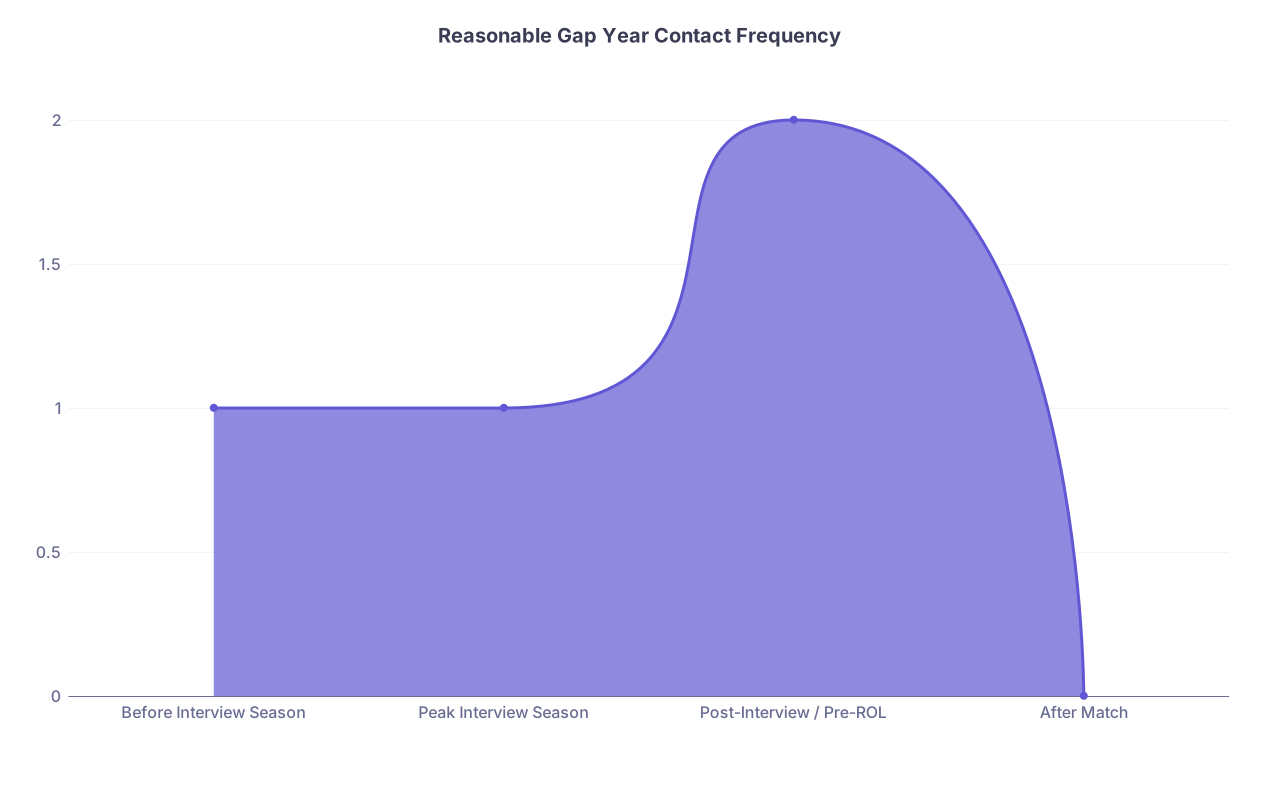
| Category | Value |
|---|---|
| Before Interview Season | 1 |
| Peak Interview Season | 1 |
| Post-Interview / Pre-ROL | 2 |
| After Match | 0 |
Think of an academic year in phases:
Pre-interview season (September–early November)
If you’re a reapplicant or gap-year applicant, one well-crafted update email is fine. If nothing material changes, you’re done.Peak interview season (November–January)
This is not the time to send three different “just checking in” emails. They are drowning. One significant update (new publication accepted, major exam score, new job role) is acceptable.Post-interview / pre-rank list (January–February)
If you interviewed: one thank-you / interest clarification email is normal. If this program is truly your number one: one honest, clearly worded “will rank you first” email is enough.
If you did not interview there: continuous emails at this stage look oblivious. Most programs are not handing out surprise interviews in February because of an email.After Match
Do not try to litigate your rank position or ask “how close” you were. Any email sent after Match that is not “thank you for the opportunity, I learned a lot from the process” is usually a bad idea.
Two to three thoughtful, spaced-out emails per season to a single program is plenty. More than that and you’re in “this person might be a problem” territory.
The Ugly Truth About “I’ll Rank You #1” Emails
Let me be very clear: PDs know a significant fraction of “I will rank you number one” emails are lies or half-truths. They trade stories about them.
I’ve sat in rooms where PDs pull up emails and say, “This person told us we were #1 and clearly matched elsewhere.”
What they’re evaluating in those emails is not just interest—it’s integrity.
If you send that kind of email, you’d better mean it. And your wording should not be lawyerly hedging.
Strong and honest:
“I want to thank you again for the opportunity to interview. After meeting the residents and learning more about your curriculum, I can say with confidence that [Program Name] is my top choice, and I will be ranking your program first.”
Squishy and obvious:
“You remain one of my top choices and I could see myself being very happy at your program.”
That second one is background noise. PDs have learned to treat it as such.
What Hurts You More Than You Realize
Let’s get into the mistakes that quietly hurt you, because I’ve seen applicants tank a decent shot with one badly judged outreach.
1. Over-sharing your personal drama
You may have had genuine, painful reasons for needing a gap year: illness, family crisis, mental health struggles. Those are real and they matter. But your gap year email is not your therapy session.
Bad:
“I fell into a deep depression, my relationship ended, and I moved back in with my parents. I’m finally getting back on track…”
From a PD lens, that reads as: high risk of instability during residency.
More appropriate:
“During my final year of medical school I faced significant personal challenges that impacted my performance. I have since sought appropriate support, stabilized my situation, and am now working full-time as a clinical research coordinator at…”
You acknowledge reality. You show growth. You do not invite them into the rawest version of your story in a cold email.
2. Attaching your entire life
Multiple attachments, long PDFs, five new letters, a new personal statement—dumped into one unsolicited email. This overwhelms and annoys coordinators.
If you must send an updated CV, send one PDF. And explicitly say:
“For your convenience, I’ve attached an updated one-page CV; I’m also happy to upload any materials through ERAS if that’s your preference.”
That shows you understand process and boundaries.
3. Trying to negotiate your way into an interview
This is the kind of thing that kills respect instantly:
“If you could just give me one chance at an interview, I’m sure I could show you I deserve a spot.”
Or:
“I know my Step 1 score is below your usual cutoff, but I promise I’ll work harder than anyone.”
Programs are not car dealerships. PDs interpret this as not understanding professional boundaries—or worse, as a predictor of future pressure and bargaining over schedules, evaluations, or remediation.
How Coordinators Actually Talk About Your Emails
Here’s the part no one tells you. Coordinators have long memories, and they talk.
I’ve sat in offices where coordinators scroll through a list of applicants and say things like:
- “He’s the one who emailed like six times in November about his research poster.”
- “She kept calling and asking if the PD had read her email yet.”
- “This one is very polite and only updated when something real happened—she’s nice to work with.”
Those little labels stick. And when there’s a borderline decision—one last interview slot, one more spot on the rank list—that reputation matters.
Your email tone is building one of two narratives for them:
- “Reliable, stable, maybe a bit anxious but professional.”
- Or: “Needy, boundary-pushing, energy-draining.”
You know which side you want.
A Clean Gap Year Email Template – And Why It Works
I’ll give you a stripped-down version of an email structure that has actually played well in PD discussions.
Do not copy this line-for-line like a robot. But copy the skeleton.
Subject: Application Update – [Full Name], AAMC# XXXXXXXX – Gap Year Clinical Role
Email body:
Dr. [Last Name] and [Program Name] Residency Team,
My name is [Full Name] (AAMC# XXXXXXXX), an [US MD / DO / IMG] applicant to your [Specialty] residency program for the [20XX–20XX] cycle.
I’m currently in a gap year working as a [Position] at [Institution]. In this role, I [1–2 specific responsibilities: “work full-time on inpatient wards”, “coordinate cardiology clinical trials”, “see patients in a primary care clinic under supervision”].
Since submitting my ERAS application, a few updates:
– [1–2 items: new publication accepted, new leadership role, new exam score, progression in current job]
– [Another specific, relevant item if you truly have it]
I remain very interested in [Program Name] given [1–2 honest, specific reasons—curriculum element, patient population, geography tied to family or support, etc.]. If there is any additional information I can provide to support your review of my application, I’d be glad to do so.
Thank you for your time and consideration.
Best regards,
[Full Name]
[Phone]
[Email]
That’s it. No begging. No five-paragraph essay on “why your program.” Concrete role. Concrete updates. Professional tone.
It works because it communicates exactly what PDs and coordinators need in under 200 words.
How This Plays Out In Real Rank Meetings
Let me close the loop and explain how your gap year email can actually move the needle when PDs and faculty are building rank lists.
Imagine a borderline case. Two applicants with similar scores and backgrounds. One did a gap year, one went straight through.
The committee is skimming notes. Someone says:
“This is the applicant who did a gap year in research and sent that very clear update email about their new cardiology project and clinic exposure. Coordinator said they were polite and easy to communicate with.”
Subtle, but powerful. You’ve gone from “name on a list” to “coherent human with a trajectory.”
I’ve also heard the opposite:
“We had a lot of contact from this person during the season… multiple emails and calls asking if we had reviewed their application yet. Might be more work than they’re worth.”
If everything else is equal, that’s enough to nudge you down a few spots. Sometimes enough to push you off the rank list entirely.
You’re not just writing an email. You’re giving PDs and coordinators a tiny, high-density sample of what it would feel like to work with you for three years.
If your gap year outreach shows clarity, stability, and a sense of direction, you stand out in a good way. If it shows desperation, chaos, or self-absorption, you confirm all the worst stereotypes about “gap year” applicants.
Use the gap year email to tell a very simple story:
You hit a pause. You chose something real and structured. You’re doing well there. And you’re ready—calmly, seriously—to step into residency.
With that in place, your next problem is not the email. It’s what you actually do with the year. But that’s a different conversation—and we can get into how PDs judge different gap year choices next.


