

The fellowships that impress academic program directors the most are not the ones you keep seeing on Instagram.
Let me tell you what really happens behind those closed-door rank meetings.
What PDs Actually Think When They See a Gap Year
When an academic PD sees “Gap Year Fellowship” on your ERAS, the first reaction is not: “Wow, they’re so well-rounded.”
The first reaction is: Why did they take a gap year, and did they actually do anything serious with it?
Then they look at three things, in this exact order:
- Did this fellowship clearly advance their academic trajectory (research, teaching, leadership, niche expertise)?
- Is there evidence of real output (papers, posters, grants, curricula, measurable impact), not just “participated in” fluff?
- Does the fellowship connect to their stated career goals or is it just random résumé garnish?
Here’s the uncomfortable truth:
A focused research or policy fellowship that no premed has ever heard of will impress an academic PD ten times more than a brand-name “leadership” program with glossy marketing and zero tangible output.
Let’s go through the fellowships and categories that quietly move your application from “solid” to “short-list.” I’ll also tell you which ones PDs side‑eye more than they’ll admit.
1. The Gold Standard: Dedicated Research Fellowships at Major Academic Centers
If you want raw insider truth: nothing reassures an academic PD more than seeing a legitimate, full‑time research year in a serious group that regularly publishes.
I’m talking about things like:
- A 1-year research fellowship in cardiology at a place like MGH, Penn, Duke.
- A funded clinical research year in heme/onc at an NCI-designated cancer center.
- A health services research year in a big internal medicine department (think UCSF, Michigan, Hopkins).
Not the “2–4 hrs/week during fourth year” stuff. A real gap year where research is your job.
Why PDs love this:
In those closed-door meetings, the conversation goes like this:
“This applicant did a dedicated research year with the outcomes group at Brigham. Three abstracts, one first-author manuscript under review, and they presented at AHA. They’ll be fine with QI projects and scholarship requirements.”
You just made their life easier. Academic PDs are under pressure from their chairs and GME to:
- Maintain or increase resident scholarly output
- Keep up departmental publications
- Show “academic engagement” to accrediting bodies
You walk in already pre‑trained, and they know someone else has already vetted you in a research environment.
The research fellowships that impress most have a few features:
- They’re housed in departments known for publishing (medicine, surgery, peds, EM, anesthesiology, etc.).
- The PI has a track record of residents and students getting first-author work.
- The applicant can show concrete deliverables: accepted abstracts, submitted manuscripts, even just well-defined roles on ongoing projects.
Let me be very blunt:
A low-key research year with a productive PI in a “mid-tier” name institution often impresses PDs more than a “prestigious” fellowship with no output.
I’ve sat in meetings where we looked at:
- Applicant A: “Harvard-affiliated” research year, 1 poster, 1 manuscript “in preparation,” vague role.
- Applicant B: Regional university, 3 first-author manuscripts, 2 national conference presentations, clear methods skills.
Applicant B wins every time with academic faculty.
2. NIH / Federal Research & Policy Fellowships: The Quiet Power Move
Most students chronically underestimate how strong certain federal or national fellowships look to academic PDs.
When we see:
- NIH Intramural Research Training Award (IRTA)
- NIH Clinical Research Training Program–style positions
- CDC research/service fellowships in EIS-adjacent labs or units for pre‑residency folks
- Certain VA-funded research positions linked to health services or outcomes groups
…the reaction in the room is usually: “Okay, this one’s serious.”
Why? Because we know:
- Those spots are competitive and involve actual selection, not just “whoever can pay tuition.”
- You get trained in rigorous methodology (stats, trial design, outcomes, epidemiology).
- You’re exposed to mentors and networks that can write heavyweight letters.
Academic PDs—especially in IM, neuro, peds, psych—are very NIH‑conscious. Someone with NIH time on their CV is a safer bet for future fellowships, grants, and departmental prestige.
The hidden advantage:
PDs know NIH and federal mentors write brutally direct letters. A strong letter from a senior NIH PI means something. It often reads less inflated than letters from your home institution. That reliability quietly boosts your credibility.
So yes, a gap year at an NIH lab or similar federal research unit scores major points—often more than some sexy private-sector or global NGO brand name.
3. Specialty-Specific, Homegrown “Research Fellow” Positions
Another insider category that rarely gets public praise but carries a lot of weight:
those unofficial or semi‑official “research fellow” roles many big departments create to churn out data and papers.
You’ve probably seen versions of this:
- Orthopedic surgery research fellows churning out sports medicine or trauma projects for a year.
- Emergency medicine “research scholars” embedded in clinical trials units.
- Neurosurgery research/education fellows working on database studies, outcomes research, and curriculum.
These positions often don’t have a fancy external name, but PDs love them—especially if:
- The PI or division is known nationally.
- Prior fellows have strong publication lists and matched well.
- The work is clearly sustained and focused, not scattered volunteer research.
The internal conversation is simple:
“They survived a year with Dr. X? Okay, they can handle academic pressure.”
“Three ortho papers, one podium presentation, and data analysis skills. That’s plug-and-play for our QI projects.”
What impresses PDs most from these:
- Depth in a niche (e.g., sepsis outcomes, stroke systems, transplant outcomes).
- Clear research roles: data collection, statistical analysis, protocol design.
- Evidence you didn’t just “exist” there—you drove projects.
If your goal is an academic career in that specialty, this is one of the most efficient and respected gap year paths.
4. Health Policy, Quality, and Outcomes Fellowships: Catnip for Academic IM, EM, Peds, Psych
Here’s where a lot of applicants misjudge things.
They assume only hard science research matters. PDs in academic departments know that’s outdated. There is a huge appetite for residents who can think in systems, policy, and outcomes.
Fellowships that quietly impress:
- Health policy fellowships with real legislative or systems exposure (e.g., working with a state health department, health policy think tank, or a serious academic policy center).
- Patient safety and quality improvement (QI) fellowships embedded in large hospital systems with measurable projects.
- Health services/outcomes research fellowships in places like VA centers, major ACOs, or large academic centers.
Why academic PDs like these:
Their reality is endless:
- M&M conferences demanding system-level fixes.
- ACGME requirements for resident involvement in QI.
- Pressure from hospital leadership to show value-based care improvements.
Someone who spent a year:
- Running QI projects with actual data,
- Learning PDSA cycles, Lean/Six Sigma basics,
- Working with EMR data, outcomes metrics,
…is immediately useful to the program.
In selection meetings, phrases like these matter:
“They did a QI fellowship and implemented a sepsis pathway for two hospitals.”
“They worked on readmission reduction and can lead some of our institutional projects.”
That sounds like free labor—but it’s also genuinely valuable. You become the go‑to resident for QI, and PDs love having that person.
5. Educational Fellowships: Underrated but Powerful in Academic Programs
Another quiet winner: medical education fellowships before residency.
Not the fluffy “leadership retreats”; I mean:
- Formal medical education research fellowships within an Office of Medical Education or GME.
- Curriculum design fellowships where you build OSCEs, revamp clerkships, or study assessment methods.
- Simulation-based education roles with research components.
PDs with academic mindsets recognize the value instantly. Many of them are clinician‑educators themselves. They know:
- There’s a shortage of residents who can teach well and design structure.
- Med-ed scholarship is a legit academic lane now—journals, conferences, promotion tracks.
If your gap year shows:
- Completed med‑ed projects (e.g., published curriculum, MedEdPORTAL paper, education poster at a national meeting).
- Real involvement in assessment, OSCEs, simulation, or faculty development.
- Clear intention to be a clinician‑educator.
…you’ve just aligned yourself perfectly with what many academic PDs want in future chief residents and junior faculty.
I’ve heard versions of this so many times:
“They did a year in medical education, helped design simulation cases, and have a MedEdPORTAL publication. This is future chief material.”
That phrase—future chief material—is exactly what you want whispered when your application shows up.
6. The Huge Differentiator: Output vs. Optics
Let’s be brutally honest: PDs don’t care what the fellowship calls itself. They care what it produced and how it’s framed.
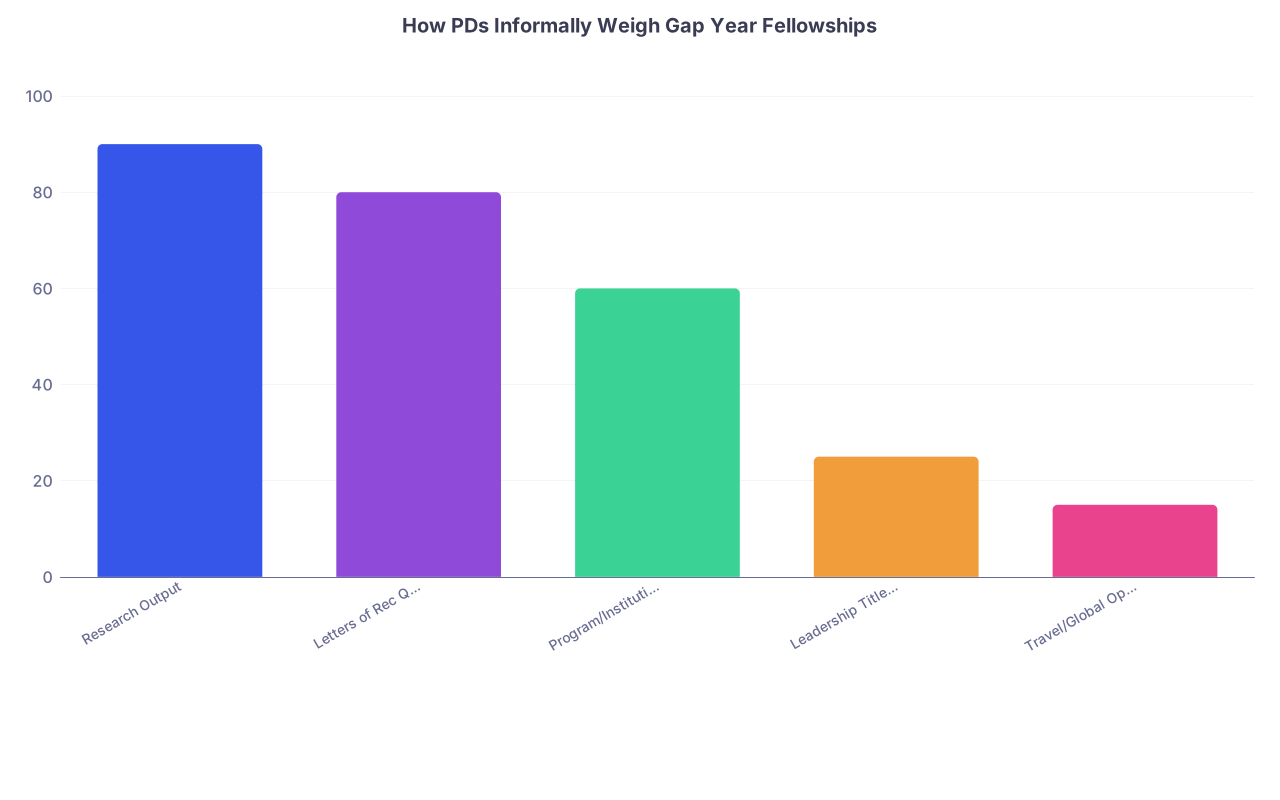
| Category | Value |
|---|---|
| Research Output | 90 |
| Letters of Rec Quality | 80 |
| Program/Institution Name | 60 |
| Leadership Title Only | 25 |
| Travel/Global Optics | 15 |
Here’s what quietly impresses them most:
- Publications (especially first- or second-author).
- National or high‑quality regional presentations.
- Strong letters from people they actually recognize (or whose titles carry real academic weight).
- Clear responsibilities: project lead, curriculum designer, data analyst.
Here’s what impresses them much less than you think:
- Generic “leadership” bullet points with no specifics.
- Excessive international mission language with no continuity, outcomes, or scholarship.
- Highly branded fellowships with no tangible deliverables.
You could do a very unknown, low-profile institutional fellowship and still blow away a “famous” one if you come out with:
- 2–3 real publications,
- strong methods skills,
- and a letter that says you showed up like a junior faculty member.
7. The Fellowships PDs Are Quietly Skeptical About
Here’s the part nobody advertises on websites.
There are categories that raise PD eyebrows more than they raise your stock, especially at academic programs:
Vague “global health fellowships” without scholarship
If your gap year is mostly “we visited X country and helped at clinics” with nothing about:
- capacity building,
- long‑term partnerships,
- or at least research/quality projects,
then academic PDs often classify it as “nice experience” but not academically impressive. Harsh, but real.
Leadership/advocacy fellowships with no hard outcomes
Don’t confuse glamor with impact. Unless you:
- wrote policy,
- led measurable campaigns,
- or produced scholarly work,
year-long leadership titles without output make PDs wonder if this was just glorified networking.
Paid clinical “gap year jobs” dressed up as fellowships
Certain “fellowships” are basically scribe programs or glorified MA/assistant roles. PDs know these exist. They’re not fooled by the word “fellow.” They treat them as jobs, not academic fellowships.
None of these are automatic red flags, but they generally won’t impress an academic PD unless you carve out real, concrete accomplishments within them.
8. Matching the Fellowship to Your Stated Career Path
The most impressive fellowship can be neutral—or even slightly confusing—if it doesn’t connect to your application narrative.
PDs hate incoherence.
If you say you want academic cardiology and your gap year is an amorphous “leadership and narrative medicine” fellowship with no research, you’ll get questions. They’ll assume you were avoiding the hard academic work.
On the other hand:
- Gap year: Outcomes research in heart failure.
- Application: States interest in academic cardiology.
- CV: Multiple HF-related abstracts and a manuscript.
That is a story. It makes sense. PDs trust it.
The combination that really stands out:
- Dedicated gap year fellowship in a focused area
- Coherent personal statement and experiences building on that theme
- Evidence of follow-through during 4th year and beyond (continuing projects, manuscripts submitted, etc.)
That’s what makes PDs say, “This person knows where they’re going.”
9. How PDs Actually Compare Different Gap Years
Here’s the internal logic, stripped of the marketing language.
| Fellowship Type | Typical PD Impression (Academic Programs) |
|---|---|
| Major academic center research fellowship | Very strong |
| NIH / federal research or policy year | Very strong |
| Specialty-specific research fellow role | Strong |
| Health policy / QI / outcomes fellowship | Strong |
| Med-ed scholarship fellowship | Strong, esp. for future chiefs |
| Branded leadership programs w/ outputs | Moderate–strong, depends on deliverables |
| Unstructured global health year | Weak–moderate unless tied to scholarship |
| Generic “fellow” clinical/assistant role | Weak (viewed as job, not academic) |
Is this written down anywhere? Of course not. Admissions committees will never publish this hierarchy. But this is how the conversation sounds in real rooms.
10. Making Any Fellowship Impress More: How You Work It
Even a good fellowship can look average if you treat it like a 9-to-5 box to check.
If you want your gap year to quietly impress academic PDs, you push it into one of these buckets:
Turn It Into Scholarship
Whatever the official label, ask:
- Can I get involved in study design, data analysis, or manuscript writing?
- Is there potential for MedEdPORTAL, QI abstracts, or education research?
- Can I present at a national or at least high‑quality regional meeting?
Secure Heavyweight Letters
You want letters that say things like:
“They functioned at the level of a junior resident or research associate.”
“They independently drove projects forward and required minimal supervision.”
Those are the phrases that get quoted in rank meetings.
Own a Niche
Come out of the year able to say:
- “My work focused on sepsis outcomes in older adults.”
- “I specialized in transitions-of-care QI.”
- “I developed simulation-based curricula for acute care scenarios.”
PDs remember niches. “General leadership experience” is forgettable.
11. If You’re Still Choosing: A Blunt Framework
If you haven’t locked in your gap year yet and your target is an academic residency, use this simple rule:
If Fellowship A has:
- A famous name, shiny website, and vague deliverables,
and Fellowship B has:
- A solid, publishing PI,
- Clear expectation of manuscripts,
- Real chances to present at national meetings,
Pick Fellowship B.
Name recognition helps less than you think. Output and mentorship help more than you realize.
And if you’re torn between research vs. policy vs. education: align it with your imagined self 5–10 years out.
Academic hospitalist with med-ed focus? Education or QI/patient safety fellowship.
Future subspecialist researcher? Classic research year.
Health systems or administration path? Policy/QI/health services.
Tie the choice to a believable trajectory, not fear or FOMO.

| Step | Description |
|---|---|
| Step 1 | Choose Gap Year Fellowship |
| Step 2 | Research-Focused |
| Step 3 | Policy/QI/Education |
| Step 4 | Other/Clinical Only |
| Step 5 | High Scholarly Output |
| Step 6 | Low Scholarly Output |
| Step 7 | Strong Academic PD Impression |
| Step 8 | Neutral/Weak PD Impression |
| Step 9 | Type of Fellowship |

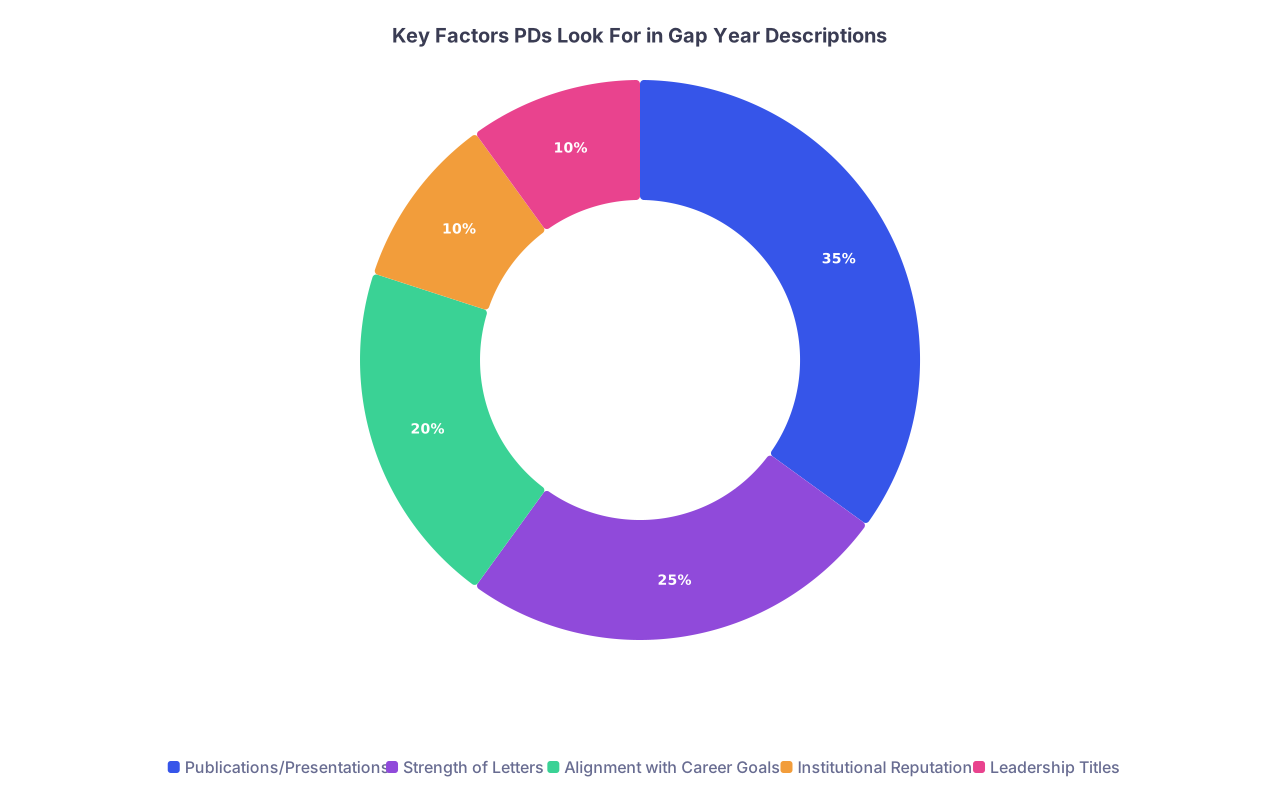
| Category | Value |
|---|---|
| Publications/Presentations | 35 |
| Strength of Letters | 25 |
| Alignment with Career Goals | 20 |
| Institutional Reputation | 10 |
| Leadership Titles | 10 |

FAQs
1. Is it better to do a famous branded fellowship or a lower-profile but productive research year?
For academic PDs, a productive research year at a mid‑tier institution usually beats a shiny name with weak output. If the “less famous” option offers real manuscripts, conference presentations, and close mentorship, choose that. Programs care about what you did, not just where you sat.
2. Will a non-research fellowship hurt my chances at an academic program?
It will not automatically hurt you, but it also will not help much unless you extract tangible outcomes from it—policy briefs, QI projects, curricula, or publications. A policy, QI, med-ed, or even global health fellowship can be very impressive if you treat it as an academic year, not just an experience year.
3. How many publications from a gap year actually look impressive?
There’s no magic number, but from an academic PD’s perspective, something like 1–2 first-author works plus a few co-author papers or abstracts already puts you clearly in the “serious” category. The context matters: quality of venue, your role, and whether the work fits your long-term goals.
4. How should I explain my gap year fellowship in my personal statement and interviews?
You frame it as a deliberate, strategic choice that advanced specific skills and clarified your career path. Be explicit: what you worked on, what you produced, what you learned, and how that prepares you to contribute as a resident in that specific program. Tie it tightly to the kind of academic physician you’re trying to become.
Here’s the bottom line:
- Academic PDs are quietly most impressed by research, policy/QI, and med-ed fellowships that produce real, citable work.
- The name of the fellowship is secondary; output, mentorship, and alignment with your long-term story drive their decisions.
- If you treat your gap year like a serious academic apprenticeship—not a 12‑month pause—you’ll walk into residency interviews already looking like future faculty, not just another applicant.


