

It’s July, 10:30 p.m. You’ve just uploaded your updated CV into ERAS, and you’re staring at that one line you hope no one stares at too hard:
“2023–2024: Gap year – personal reasons.”
You tell yourself: “I’ll explain it in the interview.”
Let me stop you right there.
If you’ve made a program director curious, that’s fine. If you’ve made them suspicious, you’re done at some places before anyone ever hears your explanation. And yes—many of them decide how they feel about your gap year in less than 10 seconds of looking at your CV.
I’ve sat in rank meetings where your file gets about 90 seconds. I’ve watched PDs and faculty skim the ERAS print-out and literally circle the gap year with a red pen and say, “What happened here?” Sometimes they dig. Often, they don’t.
Let me walk you through what they actually see, what screams “problem,” and how you can turn a potential red flag into a quiet non-issue—or even an asset.
How PDs Actually Scan Your Timeline
Most applicants think PDs read their application like a novel. They don’t. They scan your timeline like a detective looking for inconsistencies.
The sequence in their head is simple:
- Med school start → med school end
- Expected graduation → actual graduation
- Step scores and dates
- Clinical rotations timeline
- Then: any interruption, delay, or blank space
On the printed ERAS CV or the PDF view, the eye goes straight to date alignment. When something doesn’t line up, here are the first three silent questions they ask:
- Was this voluntary or forced?
- Was this productive or empty?
- Is this going to repeat in residency?
If they like the answers their brain supplies in two seconds, they move on. If not, you’ve just become “borderline” or “too risky” in their mind.
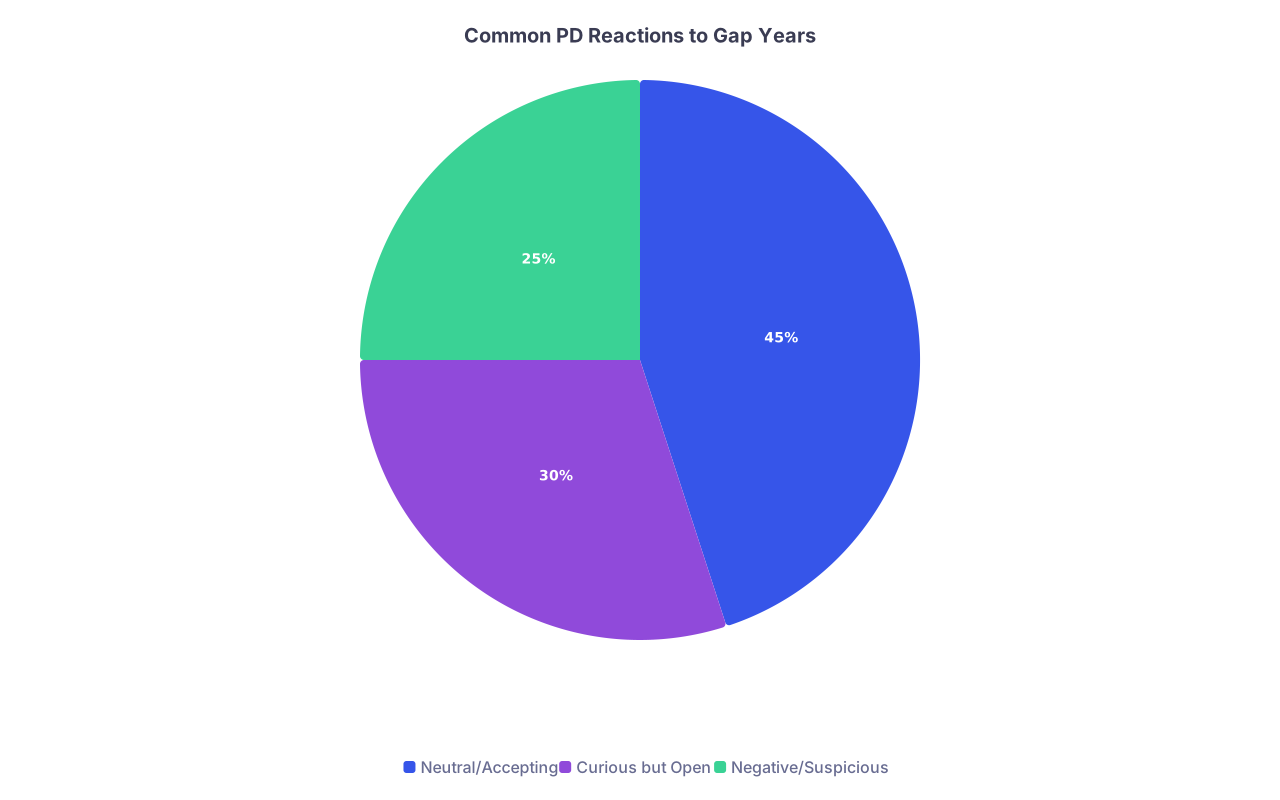
| Category | Value |
|---|---|
| Neutral/Accepting | 45 |
| Curious but Open | 30 |
| Negative/Suspicious | 25 |
Those numbers aren’t from a formal study. They’re from many years of sitting in rooms with PDs and hearing variations of:
- “This is fine, lots of people take research years.”
- “We need to ask about this.”
- “Nope. Hard pass. Too many questions.”
You want to land in the first category. At worst, the second.
The Fastest Red Flags: What Jumps Off the Page
There are certain patterns that trigger program directors almost instantly. You can think your narrative is compelling, but if the CV layout screams trouble, they may never get far enough to hear your story.
1. The Vague, Empty “Personal Reasons” Gap
This is the classic self-inflicted wound.
“2022–2023: Personal leave for family reasons.”
“2023–2024: Time off for personal circumstances.”
I’ve heard PDs say word-for-word: “That means one of three things: illness, disciplinary problem, or visa/immigration mess. If they’re not specific, I assume the worst.”
It’s not fair, but it’s how risk-averse people think.
The problem isn’t that you had a medical issue, a sick parent, or a baby. The problem is that the entry is vague, passive, and unanchored to anything constructive.
If you absolutely must summarize something sensitive, the CV still needs a credible frame:
“2023–2024: Approved medical leave of absence; returned to full clinical duty and academic good standing.”
“2023–2024: Family caregiving responsibilities while completing remote research in [X].”
Now a PD sees: yes, there was something, but you came back, and you were not just sitting inert.
2. Unexplained Delay in Graduation
You were supposed to graduate in 2023. Your CV says MD, Class of 2024. There’s no explicit “research year,” “LOA,” or structured program listed.
PDs notice this instantly. They’ve seen every possible version:
- Step 1 or Step 2 failures
- Remediated clerkships
- Professionalism issues
- Being “invited to take time away” by your dean
When the timing is off and there’s no clear, clean entry saying what you did with that time, most academic programs assume trouble. Community programs sometimes shrug, but the competitive ones will not.
The honest, structured version is always less dangerous than the blank:
“2019–2023: Coursework and clinical rotations
2023–2024: Research fellow, Department of [X], [Institution]; graduation deferred to May 2024.”
Even if the research year was retrofitted after an exam failure, framing it as a structured, productive year is far better than making everyone play detective.
3. “Gap” That’s Filled with Fluff
This one is more subtle but PDs spot it immediately.
You took a gap year “to do research,” but your CV shows:
- One poster at a minor conference
- Ten hours/month at a free clinic
- “Medical volunteer” with no clear role
- No publications, no real responsibilities, no continuity
Faculty are not stupid. They can tell when “dedicated research year” was really “I didn’t know what else to do, and I only kind of did things.”
The hidden red flag they see: poor initiative, poor follow-through, inflated description of your efforts. That’s what they worry will show up in residency when work actually matters.
A research year without a publication is not fatal. A research year with no clear structure, no supervisor, and no visible growth? That’s fatal at some places.
Patterns That Scream “Risk of Struggle”
There are certain combinations that almost always get discussed in rank meetings. Not politely, either.
1. Gap Year + Step Fail/Low Score
You think, “I failed Step 1, took time off to regroup and do research. I’ll show them I bounced back.”
What they sometimes see is: “Academic difficulty + time off = may struggle with in-training exams, boards, or workload.”
This is where details matter. The worst presentation is:
- “LOA 2022–2023: academic reasons”
- No mention of Step retake date or score improvement
- A random, weak research entry detached from mentors they know
The stronger version is:
- Clear, honest explanation in MSPE or dean’s letter
- Documented Step improvement (or at least solid Step 2)
- A tightly described, supervised research experience with a known faculty name
Same story, very different read.
2. Multiple Short, Unrelated “Mini-gaps”
PDs hate inconsistency. When they see:
- 3 months doing USCE
- 2 months “self-study”
- 4 months “volunteering”
- A few random observerships with gaps in between
They see fragmentation, indecision, or visa/employment issues. Your narrative of “I explored different opportunities” sounds to them like “I couldn’t commit, couldn’t get anything substantial, or couldn’t stay in one place.”
I’ve heard surgeons say in meetings: “If they hop around like this now, they’ll quit the program when it gets hard.” That’s the association you’re fighting.
3. Long Gap with No Clinical Contact
For residency, especially in anything procedural or acute (EM, surgery, IM), a multi‑year gap with no patient contact is a massive red flag.
Programs worry about:
- Clinical skills decay
- Documentation unfamiliarity
- Needing extra supervision to get up to speed
- Malpractice risk
If you’ve been away from hands-on clinical work for more than 18–24 months, many programs quietly filter you out. They might not say it to your face, but you’ll feel it in the lack of interviews.
| Time Away | Typical PD Reaction | Hidden Concern |
|---|---|---|
| < 6 months | Mostly neutral | Vacation, brief transition |
| 6–12 months | Mild concern | Were they productive? Any clinical contact? |
| 12–24 months | Wary | Skills rust, commitment, exam readiness |
| > 24 months | Often red flag | Will they function safely as interns? |
| > 36 months | Automatic screen-out at some places | Need retraining, too risky |
The Hidden “Social” Red Flags Behind Gap Years
Not every red flag is about scores or skills. Some are about what your gap year implies about who you are to work with.
1. The “I’m Too Good for Anything That’s Not Glamorous” Year
PDs roll their eyes at certain patterns:
- Only “global health” stints in glamorous locations with nothing longitudinal or sustainable
- Fancy-sounding but vague “consulting” or “startup” roles with no clear output
- Instagram-worthy “service projects” that evaporate after 2 weeks
If your gap year reads as performance rather than substance, some faculty will say out loud: “Will this person do scut? Will they answer pages at 2 a.m. without complaining?”
The fix is not to avoid interesting things. It’s to show real responsibility, continuity, and humility in whatever you did.
2. The “Burnout Disguised as Exploration” Year
Some students burn out hard, take time off, and then coat the year with buzzwords:
“Explored my interests in wellness, medical humanities, and advocacy while recalibrating my career trajectory.”
Faculty who’ve been around recognize it: emotional crash, disengagement, avoidance. That’s not automatically disqualifying. Many residents have gone through it and done fine.
But if your entire year looks like you stepped away from all structured responsibility, PDs worry you’ll crumble when residency pressure hits. They’re not looking for superheroes. They’re looking for people who can show up when they’re tired and still be safe and reliable.
A burnout year that quietly included therapy, recovery, plus a part‑time but consistent role (tutoring, research, clinic work) reads much better than a year described as “figuring myself out” with nothing anchored in the real world.
International Grads: The Unspoken Bias Around Gap Years
If you’re an IMG, the bar and the scrutiny are both higher. That’s just the reality.
Here’s what PDs talk about when your CV hits the table and shows multiple gap periods:
- “Are they here just until they get papers, then they’ll leave?”
- “Why weren’t they working clinically in their home country?”
- “Are these observerships just a smokescreen for not matching before?”
Stringing together a series of observerships with big gaps in between looks like desperation, not dedication.
The IMGs who do better are the ones whose gap years look like this:
- A clear, full‑time research position under a US faculty member who will actually pick up the phone
- Repeated, ongoing clinical exposure in a consistent setting
- A story that shows upward trajectory—more responsibility, more trust, better roles
If you moved countries, spent 6–12 months dealing with visas, language exams, and licensing, it should still be framed as structured effort, not passive waiting:
“2022–2023: Relocation to the US; completed USMLE Steps 1–3, TOEFL, and ECFMG certification; began US-based research in [X].”
It’s not perfect, but it’s coherent and purposeful.
How to Turn a Potential Red Flag into a Neutral (or Even a Plus)
You can’t retroactively change what happened. You can absolutely change how it shows on paper and how it lands in a PD’s brain.
Anchor the Gap in Something Concrete
Every year out should have:
- A role
- A supervisor
- A setting
- A product (teaching, research, QI, work)
“Gap year” by itself is dead on arrival. “Research fellow,” “Clinical instructor assistant,” “Full-time caregiver while completing [X]” is survivable.
Tie It to Your Specialty Choice
If your gap year looks random, it amplifies concern. If it clearly feeds your specialty choice, it softens it.
An EM applicant who spent a year doing ED research, ED scribing, or ED QI committees? That lands much better than someone who “traveled” and “volunteered” in environments unconnected to acute care.
A psych applicant who took time off for mental health and then did structured work in advocacy or counseling—with appropriate boundaries around disclosure—often gets empathy, not judgment, from psych PDs.
You want the PD to think: “Okay, they had a detour, but that detour made them more committed to what they’re applying for now.”
Be Brief but Direct in Your Explanation
Programs hate evasiveness more than they hate the truth. The interview version, when they ask about the gap year, should be:
- 1–2 lines of what happened
- 2–3 lines of what you did with that time
- 1 line of what you learned and how you’re now stable/ready
Example:
“I took an approved leave after my third year because of a health issue that needed surgery and recovery. During that time, I stayed connected through remote chart review research with our cardiology group and returned once cleared. It actually made me much more intentional about how I manage my time and stress. Since returning, I’ve completed all rotations on time and passed Step 2.”
That’s enough. Long, meandering life stories are what make PDs start getting nervous.
Things PDs Won’t Tell You, But I Will
Here are a few unfiltered truths from actual conversations behind closed doors.
Some programs have hard filters for “graduation year” that automatically screen out anything more than 3–5 years out. Your individual story never gets read. That’s not personal; it’s mass triage.
A clean, continuous timeline will always be easier than the same application with multiple interruptions, even if your reasons were all legitimate. Life isn’t fair, and neither is residency selection.
They forgive almost anything that is:
- Clearly explained
- Followed by stability and strong performance
- Corroborated by faculty who vouch for you
They forgive almost nothing that feels like you are hiding something, even if what you’re hiding is relatively minor.
Some PDs are themselves people who took leaves, failed exams, or burned out. Those are often the ones who fight for the red-flag applicants who have a strong recovery story and a clean recent track record.

| Step | Description |
|---|---|
| Step 1 | See gap in dates |
| Step 2 | Assume risk; likely downrank |
| Step 3 | Question follow-through |
| Step 4 | Neutral or mild positive |
| Step 5 | Concern: may struggle |
| Step 6 | Is it clearly labeled? |
| Step 7 | Structured & supervised? |
| Step 8 | Recent performance strong? |
Your job is to push their mental flow as far toward “neutral or mild positive” as possible before they ever meet you.
If You’re Currently in a Gap Year and Reading This
You’re not doomed. But you cannot afford to float.
Here’s what you should be doing right now:
- Get something formal: a real title, a real supervisor, regular hours.
- Maintain or regain clinical contact where possible and legal.
- Produce something tangible: poster, QI project, curriculum, database, protocols.
- Keep your narrative tight: this year is not you wandering; it is you building toward residency.
And document everything. PDs care less about your intent and more about what you actually did.
The Bottom Line
Three things to keep front and center:
- PDs scan your CV for breaks in continuity and unexplained delays. If you leave gaps vague, they’ll fill them with the worst-case scenario.
- The real red flag isn’t the gap year itself; it’s an unstructured, unproductive, or poorly framed year that suggests risk, instability, or low follow-through.
- You can’t erase the gap, but you can control the story: anchor it in concrete roles, connect it to your specialty, show stability and growth afterward, and be brief, direct, and unapologetically honest when asked.
You don’t need a perfect, unblemished path. You need a believable, coherent trajectory that convinces a PD you’re ready to show up on July 1st and do the work.


