

The way you explain your gap year will either quietly reassure faculty—or light up every red-flag sensor in the room.
I’ve sat in the post‑interview debriefs. I’ve heard what program directors and faculty actually say after you walk out. And your gap year story is almost never judged for the content alone. It’s judged for what it reveals about your judgment, reliability, and trajectory.
Let me walk you through what really matters on their side of the table.
How Faculty Actually Think About Gap Years
Most applicants think: “They’re going to judge me for taking time off.”
That’s not quite right. Faculty judge you for why you took time off, what you did with it, and how you explain it.
Inside the committee room, we basically sort gap years into four buckets:
| Gap Year Type | Default Faculty Reaction |
|---|---|
| Structured, intentional | Positive / Respect |
| Productive but improvised | Neutral to positive |
| Personal crisis / health | Cautious but understanding |
| Aimless / unexplained | Negative / Red flag |
Here’s the part most people don’t tell you: a gap year can help you if you frame it correctly. It can completely sink you if you don’t.
Faculty are listening for three things, always:
- Does this person make intentional, adult decisions?
- Are they reliable enough not to implode mid‑residency?
- Did they grow in a way that benefits us if we train them?
If your explanation does not answer those three questions—clearly and calmly—you’re leaving faculty to fill in blanks. And they’ll fill them with the worst possibilities: remediation, professionalism problems, mental health crises, visa issues, failure to match previously, or inability to handle stress.
The Core Formula: How to Structure Your Gap Year Answer
Let me give you the structure faculty wish every applicant used. They won’t tell you this explicitly, but they respond very well to it.
Your answer should follow this spine:
- Brief context: why the gap happened (one or two sentences)
- What you did: concrete activities, responsibilities, outcomes
- What you learned: skills, insights, mindset relevant to residency
- How it connects: why that year makes you a stronger resident now
If you wander, over‑share, or sound defensive, you’re done. The moment it sounds like an excuse instead of a decision, faculty mentally tag you as “risk.”
Here’s a clean example for someone who took a research year:
“After my third year, I realized I wanted to pursue academic internal medicine and that my research experience wasn’t where it needed to be. So I took a dedicated research year with the cardiology group at [Institution]. I coordinated a multi-center registry, learned REDCap and basic stats, and was first author on an abstract we presented at AHA.
That year forced me to manage my own time and handle rejection when projects didn’t work out. I came back to fourth year much more organized, and it solidified that I want to train at a program where I can combine strong clinical training with research—like yours.”
Short. Owned. Forward‑looking. No drama.
Faculty are thinking: intentional, productive, self‑aware, no obvious red flags.
Now let’s break down what they like and what they quietly hate, depending on the type of gap year you had.
If Your Gap Year Was Academic or Research‑Focused
These are the “easy” gap years—if you do not get arrogant or vague.
Faculty want to hear:
- That you chose this on purpose, not because you flamed out
- That you can describe what you did in concrete, non‑fluffy terms
- That you understand your role in the research hierarchy
- That you can translate research skills into residency value: organization, perseverance, data literacy
They do not want:
- Overinflated claims (calling yourself “leading a major project” when you were entering data)
- Name‑dropping without substance
- Tangents about how toxic your previous environment was
- Ten minutes about biostatistics when they just asked a simple “tell me about your year”
Here’s how a research year sounds when it lands badly in faculty ears:
“I really wanted to boost my CV so I joined a lab and did a lot of projects. I learned so much, and it was really transformative. We’re submitting several papers and I’m hoping for some high‑impact publications.”
Translation in the debrief room: “So… what did they actually do? Sounds like resume fluff. Pass.”
Now compare this:
“I spent the year in Dr. X’s oncology lab working on outcomes in older adults receiving immunotherapy. My main responsibilities were data abstraction from the EMR, managing our REDCap database, and writing the first draft of a retrospective analysis; that abstract was accepted at ASCO.
The experience taught me how much discipline it takes to carry a project from idea to completion, and I think that’s directly applicable to seeing patients through a hospital course or continuity clinic—keeping track of details over time.”
That’s what faculty like to hear. Specific, grounded, not braggy, and tied directly to residency.
If Your Gap Year Was for Personal or Family Reasons
This is where people usually screw it up—not because of the reason itself, but because they either over‑disclose or under‑explain.
Real talk: most faculty are not monsters. They understand illness, caregiving, burnout, grief. Half of them have dealt with sick parents while on service. They are not automatically judging you for being human.
But they are assessing:
- Did you handle a hard situation with some level of maturity?
- Are the underlying issues likely to recur during residency?
- Can you talk about it without falling apart or sounding unstable?
You need a middle path: enough clarity that they’re not guessing, but enough boundaries that you’re not trauma‑dumping in an interview.
Here’s the version that raises red flags:
“I had a lot going on mentally and needed to step away. It was a really dark time. I’m still working through some of it but I’m definitely in a better place.”
Faculty translation: “Unstable. Could crash again under stress.”
Better version:
“At the end of my third year I was dealing with untreated anxiety and significant family stress, and it was affecting my functioning. I made the decision with my dean and a mental health professional to take a year away from clinical rotations, focus on treatment, and stabilize things at home.
I stayed engaged in medicine by working part‑time as a clinical assistant in an outpatient clinic. I’ve been in consistent care, my symptoms are well‑controlled, and I completed my fourth‑year rotations without any issues.
That year forced me to build much better coping strategies and a support system. I’m very aware of my limits now, which I think will help me be more sustainable as a resident.”
That’s the kind of answer that, in the post‑interview meeting, gets comments like: “Handled it appropriately,” “Seems stable now,” or “Not a concern for me.”
For family caregiving:
“My father was diagnosed with advanced heart failure and needed a transplant evaluation. My siblings work hourly jobs and I was the only one with flexibility. I took a leave to coordinate his care, manage appointments, and support my mother.
During that time, I also worked as a part‑time scribe in a cardiology clinic to stay connected clinically. He’s now stable with a plan in place, my siblings and I have divided responsibilities, and I’ve since completed all of my remaining clerkships.
That experience deepened my understanding of what families go through navigating complex care systems. It’s changed the way I think about discharge planning and communication.”
What faculty hear: mature, loyal, took responsibility, still stayed clinically engaged, situation contained.
The specific phrase they want to feel is: “problem addressed and contained.” Not: “problem ongoing and diffuse.”
If Your Gap Year Was Because You Didn’t Match (Or Failed Exams)
This is the one people try to hide. And that’s dangerous.
Most residency faculty can smell a prior non‑match from a mile away: extra year, odd timing, strange ERAS chronology. When you dodge, they’ll silently mark you as evasive. That’s worse than being honest.
When you’ve had a previous non‑match or exam failure, the only safe strategy is:
Honest + accountable + concrete changes + positive trajectory.
Here’s the version that kills you:
“The match is very unpredictable and I guess I just got unlucky. I broadened my list this year.”
Faculty’s internal response: “No insight. Blaming the system. Same outcome likely.”
Much better:
“I applied last year in dermatology with a narrow list and no geographic flexibility and I didn’t match. Looking back, my application wasn’t competitive enough for that field, and my advising wasn’t very strong.
I took this year to reassess and realized that the parts of derm I loved—complex medical management, longitudinal relationships—are all present in internal medicine. I worked as a hospitalist scribe and completed two sub‑internships in IM, both of which confirmed that fit.
I’ve been very honest with myself about my prior decision making, and I’m applying this year with a much more thoughtful, realistic plan focused entirely on internal medicine.”
Or for a failed exam:
“I failed Step 1 on my first attempt. It was a wake‑up call about my study habits and time management. I sat down with our learning specialist, increased my practice questions significantly, and adjusted my schedule. On my second attempt I passed with a solid margin, and on Step 2 I scored a 244.
I took an extra few months away to consolidate that new approach before coming back to clinicals. Since then I’ve had strong clerkship evaluations and no academic issues.
It taught me that I can’t wing it and that I do better with structure and early preparation—both of which I’ve already started applying to how I’m preparing for residency.”
Faculty are not thrilled about previous failure, but they will accept it if the trajectory clearly goes up, and if you show adult-level reflection instead of excuses.
If Your Gap Year Was… Honestly, Kind of Random
This is the category people are most anxious about:
- Traveling
- Working an unrelated job
- “Taking time to figure things out”
- Hopping between odd jobs and short gigs
Let me be blunt: random is not fatal. But aimless is. You cannot present it as you floating through life.
Your job is to retroactively impose structure and purpose on that time.
Common weak answer:
“I was burnt out, so I took some time to travel, work a bit, figure things out, and now I’m ready.”
Faculty’s translation: “This person bails when stressed. Will they disappear during residency?”
Better:
“I finished medical school feeling burned out and uncertain about my specialty choice. Rather than rush into a path I wasn’t committed to, I took a structured year to earn income and gain perspective. I worked full‑time as a medical assistant in a primary care clinic while living at home to save money.
During that time, I realized I consistently looked forward to chronic disease management visits and care coordination, which pointed me toward internal medicine. I also learned a lot about clinic flow, EMR efficiency, and communicating with patients outside visits.
By the end of the year, I was confident about pursuing residency and entered this cycle with much more clarity and energy.”
Even if what you actually did was Starbucks + short-term scribe + travel, you frame it as:
- Specific responsibilities
- Specific insights
- Clear line from those experiences to your specialty and readiness
You do not dwell on “I was lost” even if you were. You emphasize that you used the time to move from uncertainty → clarity, not from responsibility → running away.
How Long Your Answer Should Be (And What To Emphasize)
Faculty are busy and impatient. Most of them are silently clocking how long you take to answer anything. Rambling = lack of focus.
Your gap year explanation, in an interview, should usually be about 60–90 seconds. Two minutes max if it’s truly complex.
Think of it as three short blocks:
- The decision: “I chose to…” or “I needed to…” (not more than 2–3 sentences)
- The actions: concrete tasks, roles, responsibilities
- The growth: 2–3 clear takeaways tied to residency
If you’re not sure whether you’re going on too long, you probably are.
And remember: they may ask follow‑ups if they want more detail. Leave room for that.
What Raises Red Flags Instantly (From the Faculty Side)
Let me lay out the patterns that reliably make committees nervous. I’ve heard these exact phrases in debriefs:
- “I still don’t understand what they actually did that year.”
- “A lot of vague talk about ‘mental health’ but no sense of stability now.”
- “Blamed everyone else—advisors, school, system—but never owned their decisions.”
- “Seemed very defensive when I asked about the gap.”
- “Said they were ‘just burned out’ and needed time. Residency will not be easier.”
Faculty don’t need you to be perfect, but they do need to feel like you’re:
- Stable now
- Honest
- Capable of self‑reflection
- Not likely to disappear or implode mid‑intern year
Your gap year story is really a proxy exam for those traits.
Practicing This Without Sounding Scripted
You do need to rehearse this answer. If you try to “wing it,” you’ll either under‑share, over‑share, or ramble into dangerous territory.
But over‑rehearsed is its own problem. Faculty can hear “Step 2 style” memorized lines from across the table.
The balance that works best is:
- Write out your answer in full once.
- Boil it down to 4–5 bullet phrases (not full sentences).
- Practice answering from the bullets, not the script, until it feels natural.
- Test it on someone who doesn’t know your whole story. Ask them:
- “What do you think I did that year?”
- “What do you think I learned?”
- “Do I sound defensive, unstable, or vague anywhere?”
If their answers don’t match what you intended, fix the story, not their perception.
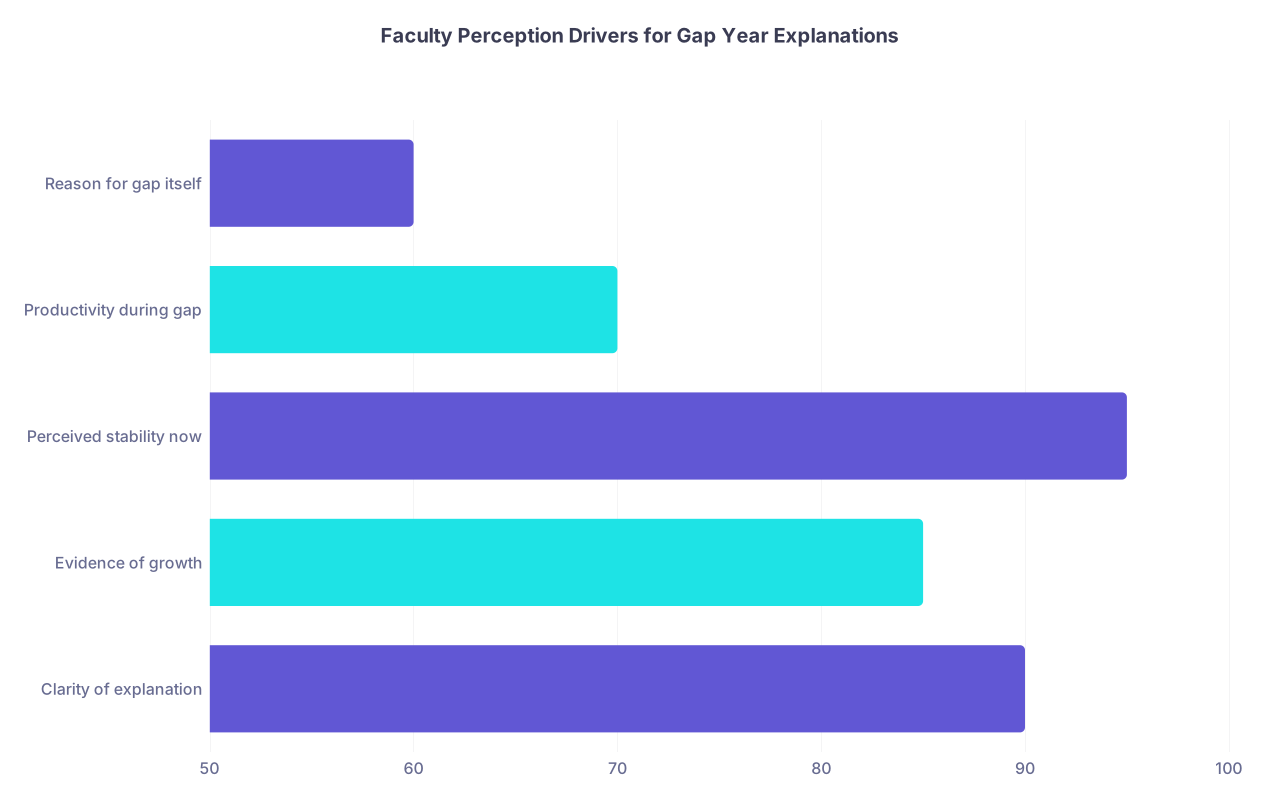
| Category | Value |
|---|---|
| Clarity of explanation | 90 |
| Evidence of growth | 85 |
| Perceived stability now | 95 |
| Productivity during gap | 70 |
| Reason for gap itself | 60 |

| Step | Description |
|---|---|
| Step 1 | Identify Gap Year Type |
| Step 2 | 1-2 sentence context |
| Step 3 | List concrete activities |
| Step 4 | Extract 2-3 skills/insights |
| Step 5 | Connect to residency readiness |
| Step 6 | Practice 60-90 sec answer |
| Step 7 | Why did it happen? |
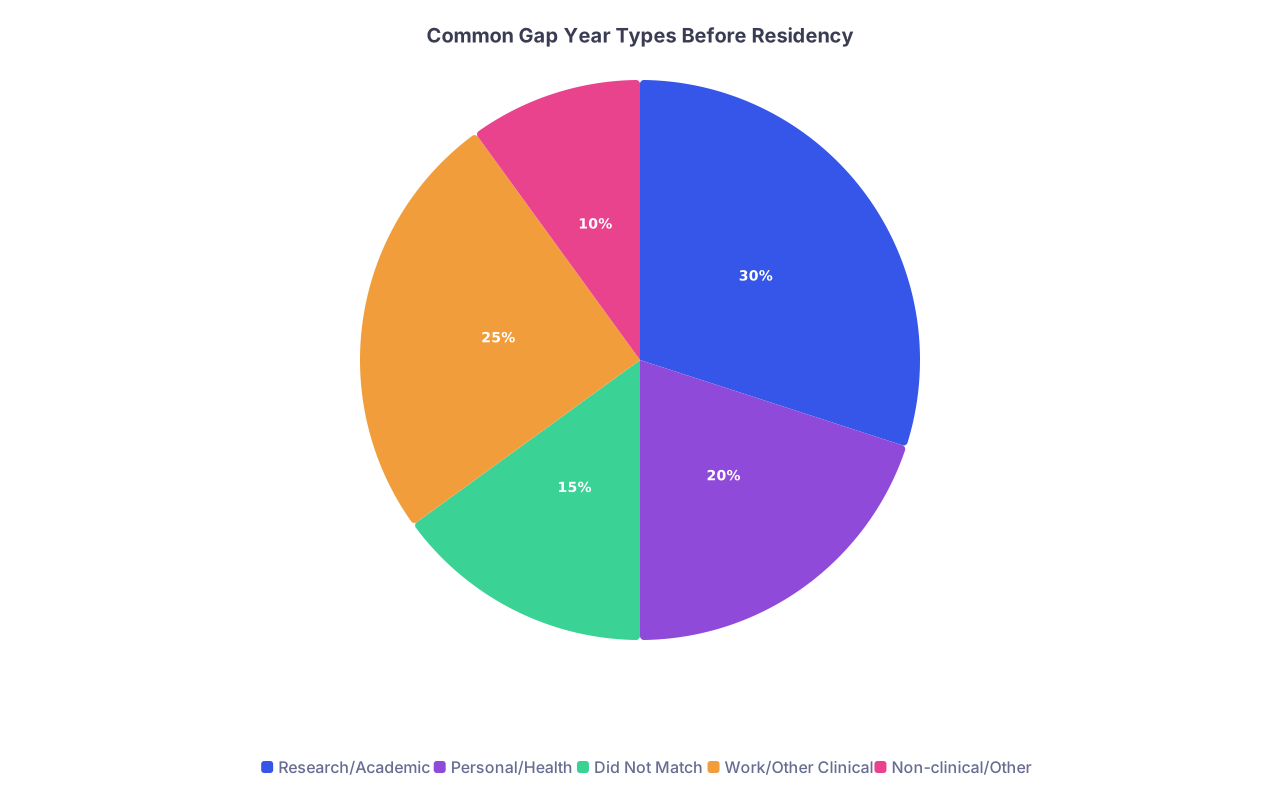
| Category | Value |
|---|---|
| Research/Academic | 30 |
| Personal/Health | 20 |
| Did Not Match | 15 |
| Work/Other Clinical | 25 |
| Non-clinical/Other | 10 |


Quick Examples You Can Model (By Scenario)
A few tight templates you can adapt to your reality.
1. Research Gap Year
“I took a dedicated research year between third and fourth year to strengthen my foundation in [field]. I worked with Dr. X at [institution] on [brief topic], where I was responsible for [2–3 concrete tasks]. We presented at [meeting] and are preparing a manuscript.
That year taught me how to manage long‑term projects, handle data carefully, and communicate findings—skills I think translate directly to managing complex patients over a hospital stay or in continuity clinic. It also confirmed that I want to stay involved in academic work during residency.”
2. Personal Health Gap Year
“During my third year, I was dealing with untreated depression that was affecting my performance and wellbeing. After talking with my dean and a psychiatrist, I took a formal leave to focus on treatment. During that time, I stayed connected to medicine by [brief activity: part‑time clinical work, structured studying, etc.].
I’ve been in consistent care, my symptoms are well managed, and since returning I’ve completed my remaining rotations with strong evaluations. Going through that process forced me to build healthy coping tools and ask for help early—habits I plan to carry into residency.”
3. Didn’t Match Previously
“I applied last year in [initial specialty] and did not match. In retrospect, my application wasn’t competitive enough, and I applied too narrowly. I took this year to reassess my goals and gain more clinical experience in [new specialty], working as [role] and completing [sub‑I/rotations].
That experience made clear that [specific aspect] of [new specialty] is the best fit for how I like to work. I’ve also been more realistic and intentional about my application strategy this year.”
4. Work/Financial Gap Year
“I’m the primary financial support for my family, so after graduating I took a gap year to work full‑time and build a financial cushion before residency. I’ve been working as [role] in [setting]. Day to day I [concrete tasks].
It’s been a good reality check about the pressures patients face outside the hospital, and it’s strengthened my communication and teamwork. Having that financial buffer also means I can focus fully on residency without worrying about my family’s basic needs.”
FAQ: What Faculty Really Want To Know
1. Should I bring up my gap year myself if they don’t ask?
If the gap year is obvious on your application (extra year, leave, etc.), you should address it briefly when they ask any version of “walk me through your journey” or “tell me about your path.” You do not need a dramatic preamble, but you also should not pretend it’s invisible. One clean, confident explanation early prevents suspicious follow‑up questions later.
2. How honest should I be about mental health?
Honest but contained. You can name depression, anxiety, burnout, or “mental health issues” without listing symptoms, medications, or graphic details. Your job is to show that: it affected you, you sought appropriate help, you’re now stable, and you’ve built systems to stay that way. If you can’t say “I’m functioning well now and have completed X without issues,” you’re not ready to interview.
3. What if my gap year was mostly non‑medical (travel, non‑clinical job)?
You don’t need to hide it, but you do need to extract grown‑up lessons from it. Emphasize responsibilities, not leisure. “I worked 50 hours a week as a restaurant manager and learned to handle conflict, scheduling, and high‑stress environments” lands better than “I backpacked for six months and found myself.” Lean on transferable skills and any ways you stayed even loosely connected to healthcare.
4. Will a gap year automatically hurt my chances?
No. I’ve seen gap‑year applicants ranked higher than same‑year classmates because their explanations showed maturity, resilience, and clear direction. What hurts you isn’t the year; it’s a sloppy, evasive, or chaotic story about it. Managed well, your gap year can actually differentiate you as someone who has lived through something and grown from it.
5. How do I know if my explanation is raising red flags?
If your explanation centers on how overwhelmed, lost, or helpless you were—and doesn’t convincingly land on “here’s how I’m stable and effective now”—you’re raising flags. If you blame others more than yourself, or if you can’t describe specific, structured activities and takeaways, you’re raising flags. The safest litmus test: after giving your answer to a blunt friend or mentor, ask, “Would you worry about me as your intern?” If they hesitate, fix the story until they do not.
Bottom line:
Faculty are not grading the “prestige” of your gap year. They’re evaluating whether you used that time like an adult, whether you’re stable now, and whether your trajectory points up. Own your story, be concrete, and always connect the year back to why you’ll be a stronger resident—not just a more interesting applicant.


