

Program directors do not see all gap years the same way. Some buy you credibility. Others are a red flag they will not say out loud.
Let me walk you through how they actually talk about this behind closed doors. Because what gets said on panels and what gets said in ranking meetings are not the same thing.
The Unspoken Hierarchy of Gap Years
There is a quiet hierarchy PDs use when they see “2023–2024: Gap Year” on your ERAS. They’ll never admit this on a webinar, but I’ve watched this play out in committee rooms for years.
At a high level, this is how most PDs mentally rank gap years:
| Type of Gap Year | Initial PD Reaction |
|---|---|
| Planned research year with strong output | Positive / Advantage |
| Planned structured program (MPH, MBA) | Neutral to Positive |
| Failed match with focused remediation | Cautious but workable |
| Failed match with vague activities | Negative / Risky |
| Unexplained or chaotic time off | Major red flag |
Now layer on the key difference you asked about:
- Planned year off → starts neutral and can become a positive.
- Failed match gap year → starts negative and must be carefully rehabilitated.
Same 12 months. Completely different starting position in the eyes of most PDs.
What PDs Think When They See “Failed Match → Gap Year”
Here’s the part nobody says out loud: your re-applicant file is read differently from the first page.
PDs do not start by asking, “Is this a good candidate?”
They start with, “Why did nobody take them last year?”
They’re trying to protect themselves. No PD wants to explain to their chair why they took someone who failed to match twice or became a problem resident.
Let me show you the internal script in their heads when they see a failed match gap year.
1. The Silent Autopsy: “What went wrong?”
Before they read your new experiences, they go backwards.
They look at your previous application year with a specific set of questions in mind:
- Were the scores just too low for this specialty?
- Any obvious professionalism concerns? (leaves of absence, comments in MSPE)
- Letters weak or generic?
- School reputation weaker than usual?
- Too few programs applied to? Geographic restriction?
- Did they apply to a reach-only list?
I’ve sat with PDs flipping between last year’s PDF and this year’s. One of them in IM literally said, “I want to understand if the system failed them, or if they failed themselves.”
That’s your reality as a re-applicant: you’re under a microscope for pattern recognition.
2. The Gut Check: “Did they learn anything?”
This is the real test.
Once they understand why you likely missed the first time, the PD looks at your gap year to see if it matches the problem.
- Low Step 2? Did you retake or at least crush a high-stakes exam (like in-service, if prelim)?
- Weak letters? Did you get new, stronger clinical letters from known attendings?
- Poor interviewing? Did someone invest in you—mock interviews, feedback, career office notes?
- Unrealistic list? Did you apply more broadly, with backup plans consistent with your record?
They’re not always looking for perfection. They’re looking for pattern change. Are you the same applicant with a 1-year delay stamp? Or a different, sharper, more self-aware version?
If you look the same, you die in the stack. Quietly.
3. The Risk Calculation: “Can I defend this to my faculty?”
Here’s the harsh politics: in ranking meetings, PDs sometimes have to justify every “non-obvious” pick.
That includes:
- Prior failed match
- Prior probation
- Big board score deficits versus peers
- Unusual paths (foreign schools, several years out from graduation)
You want your gap year story to give the PD ammunition to defend you.
“I know they failed to match last year. But look:
- they did a surgical prelim at X with excellent evaluations,
- took on call like a categorical,
- picked up a strong letter from Dr. Y,
- and they applied much more reasonably this year.”
I’ve heard almost that exact speech in a ranking meeting.
Compare that to:
“They took a year off, did some tutoring and a little research. No new letters. Seems nice.”
That one doesn’t survive debate.
How Planned Years Off Land Very Differently
A planned year off—documented in advance, explained in your MSPE, aligned with something concrete—does not trigger the same suspicion.
PDs go through a very different thought process.
1. “Was this intentional and coherent?”
If your dean’s letter says:
“Student elected a research year between MS3 and MS4 to pursue cardiology outcomes research under Dr. X. Completed structured research program with salary support.”
PD mental reaction: “Ok. Intentional. Not running from failure.”
The key word in their mind is coherence. Does your year off:
- Align with your long-term goals?
- Fit the rest of your story?
- Show follow-through and completion?
A planned research year with 2–3 abstracts and at least one significant project looks mature. It signals you can commit to something beyond short-term checkboxes.
2. “Is this adding value or just killing time?”
Not all “planned” years are respected equally.
Good: NIH research fellowship, T32 research year, VA quality improvement project, MPH at a legit program, MBA with healthcare focus, chief year, formal teaching fellowship.
Bad (in their eyes): “Personal exploration,” “travel,” “shadowed a few doctors,” or a vague “time to reflect on my career path” with nothing concrete accomplished.
I’ve watched PDs roll their eyes at essays full of “recharged, reflected, and found myself” with no deliverables. PDs are outcome people. They think in patient volumes, RVUs, QI metrics. “Growth” without evidence doesn’t impress them.
The Core Difference: Reactive vs Proactive Narrative
Strip away the details, and PDs are primarily asking:
- Did this person step away from the straight path because they had to? (reactive)
- Or because they made a strategic move with a plan and executed it? (proactive)
Failed match gap year → by definition starts as reactive.
Planned year off → starts as potentially proactive.
Your job, if you’re in the failed match group, is to convert that reactive narrative into something that now looks proactive.
That’s where most applicants screw up. They treat the year like a pause button, not a re-engineering project.
What a “Good” Failed Match Gap Year Looks Like to PDs
Let me give you the blueprint PDs secretly prefer, because I’ve seen them bump these applicants up the rank list.
1. Clinical Relevance Front and Center
If you failed to match into IM and then spent a year doing generic non-clinical research without touching patients, most PDs will worry you’re rusty.
On the other hand, if you:
- Do a prelim year (IM, transitional, gen surg) with solid evaluations
- Or secure a full-time clinical job related to your target field (hospitalist scribe, clinical research coordinator on an inpatient team, etc.)
- Or set up consistent, longitudinal clinical volunteering with actual responsibilities
…you’re much easier to defend.
One PD in FM put it bluntly: “If I’m going to hand someone a pager on July 1, I want to know the last year of their life did not look like an academic sabbatical.”
2. Clear, Documented Improvement
You need receipts. PDs do not want to guess that you improved.
Ways they see improvement:
- New letters explicitly saying “ready for residency,” “excellent team member,” “would rank highly”
- MSPE addendum or dean’s note explaining what you did and how you grew
- Concrete outcomes: more interviews this cycle, conference presentations, poster awards, increased responsibilities at your gap-year position
- Step 3 taken and passed (for some IM/psych/FM applicants, especially IMGs and re-applicants, this matters more than people admit)
I’ve watched PDs scroll straight to the new letters for re-applicants. They know most re-appliers say they’ve improved. They want to see if any respected attending has staked their name on that statement.
3. Mature Ownership of the Failure
This is where most personal statements implode.
Bad version:
“I was surprised not to match despite my strong application. I believe the competitive nature of the specialty and unfortunate circumstances contributed.”
PD interpretation: no insight, blames the system, will be a headache.
Good version:
“I did not match last cycle. Looking back, I overestimated the strength of my application for this specialty and applied too narrowly. My interview skills were underdeveloped, and my letters did not highlight my clinical strengths. Over the past year, I sought regular feedback, expanded my application strategy, and focused on…”
That kind of language goes over well. You don’t have to self-flagellate. But you must sound like someone who can audit their own performance and course-correct.
A PD in psych once said in a meeting, “If they can’t analyze why they didn’t match, how are they going to analyze why a patient keeps relapsing?”
What a “Good” Planned Year Off Looks Like to PDs
Now contrast that with the student who planned a year off from the start.
1. Structured, Supervised, and Productive
The magic trifecta PDs like:
- Structure: Part of a defined program, fellowship, degree, organized research position.
- Supervision: Clear mentor or PI who can write a strong, specific letter.
- Productivity: Something to show for it—projects completed, courses finished, measurable contributions.
For example, a med student targeting cardiology who takes a year between MS3 and MS4 to do outcomes research at a major academic center, ends up with:
- 1–2 poster presentations at AHA
- Co-authorship on a manuscript (even in submission)
- Strong letter from a known cardiologist
That reads as ambition, not delay.
2. Logical Fit With Long-Term Goals
PDs love when things line up.
- Future surgeon → formal surgical research year, OR-based QI, simulation education
- Future academic IM → T32 research, MPH, outcomes research
- Future admin leader → MBA with healthcare management
They don’t need you to be perfectly on-brand. But if your stated goal is community FM and your gap year is a generic MBA at a for-profit online program, expect some confused looks.
I watched a PD say, “I don’t understand why someone who says they just want to practice in a small town took an MBA instead of getting more clinical exposure.”
Your explanation has to close that gap.
How PDs Compare Two Identical Years Used Differently
Let’s make this concrete.
Same activities, two different narratives:
- Applicant A: Failed to match in EM. Spent a year working as an ED scribe, did a QI project on door-to-needle time, took Step 3, and got a new letter from an ED director.
- Applicant B: Always planned to take a year between MS3 and MS4 to work as an ED scribe and “explore EM more deeply,” did the same QI project, no failed match history.
On paper, the year is almost identical. But the context shifts interpretation.
Applicant B: PD reaction → “Explored, confirmed interest, gained experience. Fine.”
Applicant A: PD reaction → “Recovered from a miss. Did they learn? Is this enough to overcome whatever blocked them last year?”
The second applicant must show visible upward movement from their previous version. The first one just has to look coherent.
What PDs Won’t Say Publicly About Gap Years After a Failed Match
Here are some things PDs say privately that never make it into official guidance.
“Two failures to match is almost always the end for that specialty.”
I’ve heard this in multiple fields. Not every PD agrees, but many do.
If you failed to match once, your gap year strategy has to be laser focused. There’s not a lot of tolerance for a mediocre “try again.” For very competitive fields (derm, plastics, ENT), even a single failed match is usually the cue to pivot.
“We worry more about professionalism than about low scores.”
If your record hints at professionalism problems (repeated leaves, vague “personal issues,” unexplained time out of training), a vague gap year just multiplies those concerns.
Clear structure, accountability, and excellent new letters are your only antidote.
“If they did nothing clinically relevant for a year, I assume they’ll be rusty and slow.”
This is particularly brutal in procedural and acute care fields. A pure, non-clinical research gap year after graduation without any patient contact often hurts more than you think, especially if you’re already 1–2 years out.
How to Present Each Type of Gap Year in Your Application
Let’s talk presentation, because how you frame the same facts can swing a PD’s gut reaction.
If You Failed to Match and Took a Gap Year
Your entire application should answer three questions clearly:
- What happened last cycle?
- What did you do about it?
- Why are you a better bet now?
Where that shows up:
- Personal statement: Brief, honest explanation, then >70% of the space on what you did and who you are now.
- Experiences: Emphasize continuity, responsibility, and outcomes from your gap-year work.
- Letters: Ask your letter writers explicitly to speak to your readiness for residency and your growth during this period.
- Interviews: Have a 60–90 second, clean, non-defensive explanation of the failed match and gap year, then pivot to what you bring now.
If You Planned a Year Off
Your application should answer:
- Why did you plan this year?
- What did you actually achieve?
- How does it make you a better intern on July 1?
Same tools:
- Personal statement: Don’t oversell. Just show your reasoning, your work, and your outcomes.
- MSPE: Ideally references the planned year clearly so PDs see it was not remedial.
- Letters: Get at least one from that year-off experience, especially if research or another degree.
A Visual: How Different Activities During a Gap Year Are Perceived
Let me quantify how PDs often emotionally weight different types of gap-year activities, especially after a failed match.
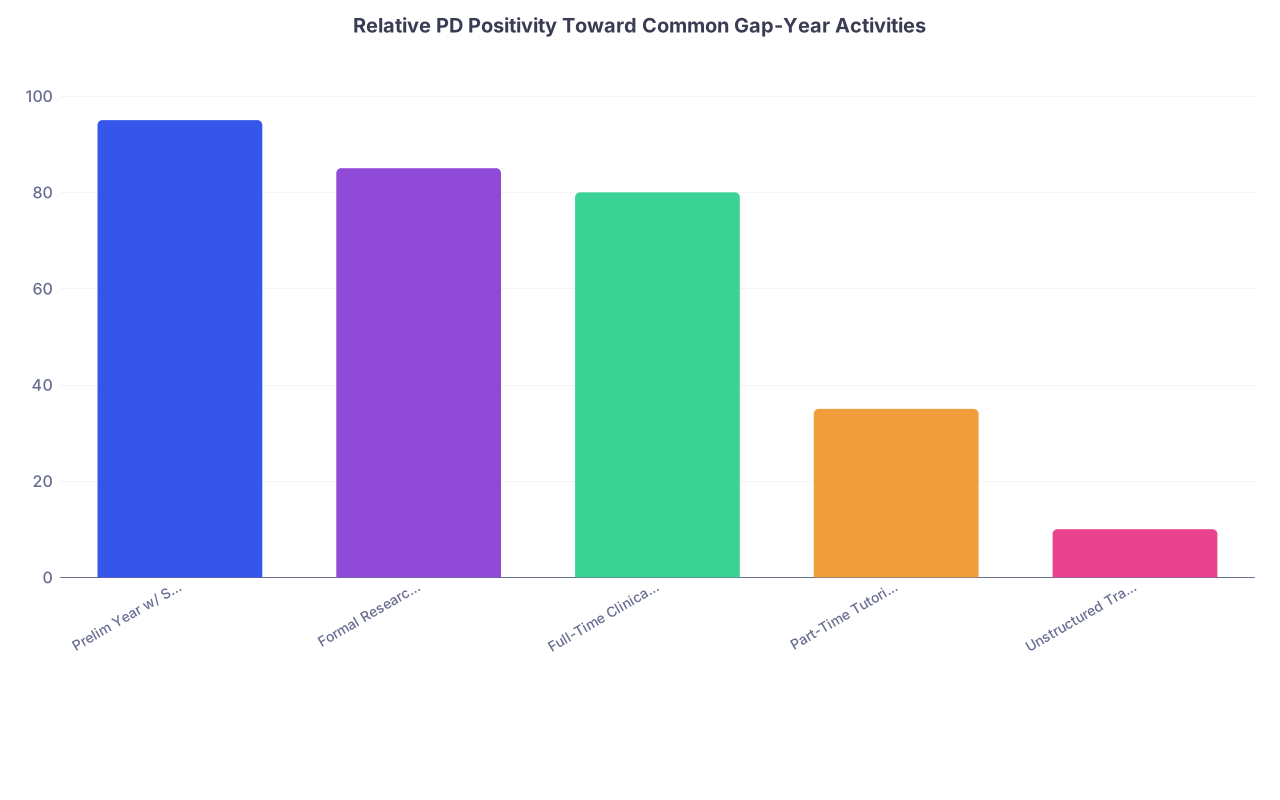
| Category | Value |
|---|---|
| Prelim Year w/ Strong Eval | 95 |
| Formal Research Fellowship | 85 |
| Full-Time Clinical Job | 80 |
| Part-Time Tutoring Only | 35 |
| Unstructured Travel | 10 |
This is not a literal scale, but it reflects the relative vibe I’ve heard in rooms.
They respond best to things that look the most like real training: prelim year, structured fellowship, serious clinical work. They respond worst to vague “time off” with little to show.
The Hard Truth About Timing and Graduating Year
One more insider point people don’t tell you until it’s too late: your year of graduation matters more once you start racking up gap years.
A 2026 grad with:
- 1 planned research year → still reads as “fresh.”
- 1 failed match + 1 gap year → now functionally 2 years out of med school at the start of residency.
Some programs have quiet cutoffs. They’ll say “we review all applications holistically,” but I’ve watched filters eliminate people >5 years from graduation unless they have continuous, strong clinical training (like other residency or extensive practice abroad).
If you’re going to take time, especially after a failure, stack it with as much continuous, supervised, documented clinical involvement as you can.
Final Perspective
Here’s the piece you need to hear plainly: a failed match does not end your path, but it does permanently change the way your file is read. You don’t get to pretend it didn’t happen. And you shouldn’t try.
The PDs you’re applying to have sat in those March meetings where programs match fewer than they wanted, where good students slip through cracks, where geography and randomness knock people out. They know the system isn’t perfectly fair. But by the time you show up in ERAS again, they’re not looking to litigate last year. They’re asking who you are now, and what you did with the time you were given.
A planned year off is an elective.
A gap year after a failed match is an audition.
If you treat it like “time to think,” it will sink you. If you treat it like a one-shot chance to prove you’re the kind of person who comes back smarter, more focused, and more useful to a team, many PDs will give you a serious second look.
Years from now, you will not primarily remember the sting of not matching. You’ll remember whether you used that punch as an excuse to step back—or as the moment you decided to become someone no selection committee could reasonably pass over twice.
FAQ (Exactly 5 Questions)
1. Should I explicitly say “I failed to match” in my personal statement, or just imply it?
Name it directly and briefly. One clear sentence is enough: “I did not match in the 2024 cycle.” Then move quickly to what you learned and what you did about it. Dodging the phrase or hiding it makes PDs suspicious; they already know from ERAS history and MSPE.
2. Is a prelim year better than a non-clinical research year after a failed match?
For most core clinical specialties (IM, FM, psych, peds, surgery), a strong prelim year with good evaluations is usually more reassuring to PDs than a purely non-clinical year. You look “warm,” trainable, and already functioning in a residency environment. The exception is ultra-competitive academic tracks where a major research fellowship can carry more weight, but even then, lack of clinical contact is a concern.
3. If my year off was for personal or family health reasons, how much do I disclose?
You don’t need to detail diagnoses or private matters. You should, however, offer a concise, honest framework: “I took a year away from training due to a significant family health issue, which is now resolved/stable. During that time, I maintained involvement in X and am fully able to commit to residency.” PDs mainly want to know: is this likely to affect reliability going forward?
4. How many new letters do I need after a failed match?
Ideally at least two new, strong letters from your gap-year activities—especially from clinical supervisors. PDs compare old and new: if your letters level up to “would be an excellent resident” and “I would gladly have them in our program,” that’s powerful evidence you’ve grown. Keeping only your old letters suggests stagnation.
5. Does taking Step 3 during a gap year actually help?
For many re-applicants—especially IMGs, those a few years out from graduation, or those in IM/psych/FM—it can help more than anyone publicly admits. A solid Step 3 pass (and especially a strong score where numeric) reassures PDs that your test-taking days aren’t behind you, and that licensing is unlikely to become a future problem. It won’t rescue a weak overall file, but it can tip you from “too risky” to “worth interviewing.”


