

Most gap year boss letters are quietly ignored. A few are nuclear weapons that move you up an entire bracket on the rank list. You need to understand the difference.
Let me tell you what really happens when a program director opens a letter from your research PI, chief, clinic director, or “gap year boss.” It’s not what your school’s career advisor is telling you, and it’s not what that generic Reddit advice thread keeps repeating.
What PDs Actually Look For When They Open Any LOR
Program directors are not reading your letters like English professors grading essays. They’re triaging risk and hunting for signal in a pile of fluff.
Here’s what really happens.
They open a PDF. They glance at the letterhead and the signature block before they read a word of the body. Name. Title. Institution. Specialty. That first visual impression tells them 70% of what they expect to get from the letter.
If the letter is from:
- A known name in the specialty
- A respected institution in that field
- Someone they’ve co-authored with, sat on a panel with, or seen present at conferences
…they slow down and read more carefully.
If instead they see:
- “Medical Scribe Supervisor, [Random Community Clinic]”
- “CEO, Startup Telemedicine Company”
- “Volunteer Coordinator, Non-profit”
They do not automatically dismiss it, but the burden of proof is higher. Much higher. Now the question in the PD’s head becomes: Is this worth my limited time, or just a nice character reference?
So understand this: the default is that your gap year boss letter is a “nice-to-have,” not a decision-maker. Unless it crosses one of three thresholds:
- It shows you operating like an intern already.
- It provides unique information other letters cannot.
- It comes from someone whose judgment the PD implicitly trusts.
If your letter does not do one of those three, it’s background noise.
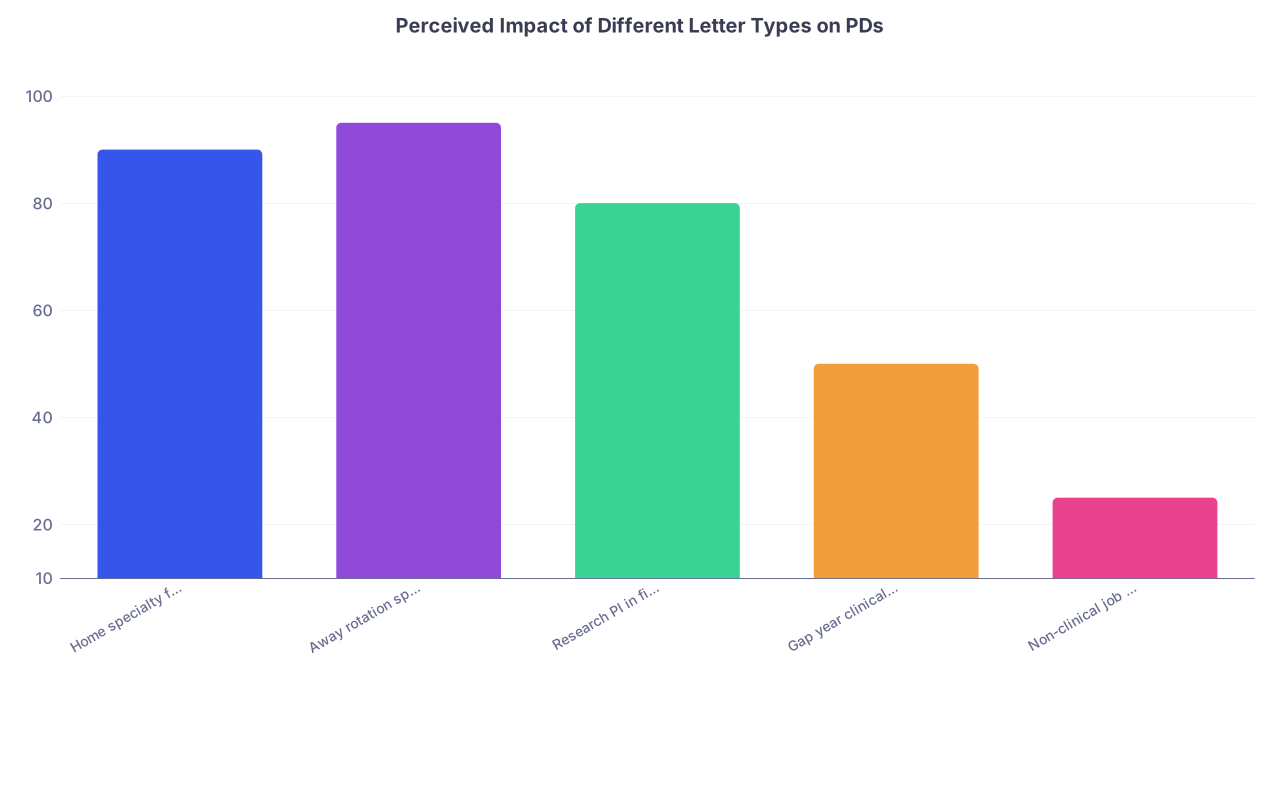
| Category | Value |
|---|---|
| Home specialty faculty | 90 |
| Away rotation specialty | 95 |
| Research PI in field | 80 |
| Gap year clinical boss | 50 |
| Non-clinical job supervisor | 25 |
Those numbers aren’t from a formal publication; they’re the rough internal “weights” that come up when faculty talk behind closed doors. This is the mental math they actually do.
The Three Real Categories of Gap Year Letters
I’ve watched PDs react to gap year letters for years. They fall into three buckets, and I’ll walk you through how each one lands in the room.
1. The “Shadowing 2.0” Letter (Usually Useless)
This is the most common. It’s also the one nobody will tell you is basically worthless.
You know the type. It says things like:
- “Pleasure to have them in our clinic”
- “Always punctual and professional”
- “Will make an excellent physician”
- “Patients loved them”
What PDs think when they read that: So what?
I’ve literally heard an associate PD at a mid-tier IM program say, while scrolling a gap year letter:
“Yeah, yeah, would be an asset to any program, blah blah. Next.”
These letters read like extended character references. Fine for jobs. Not enough for residency.
Why? Because every decent medical student can be polite, on time, and nice to patients. That doesn’t differentiate you. PDs are trying to predict how you’ll function when you’re tired, overworked, and making actual medical decisions with real consequences.
If all your gap year boss saw was you “fitting in,” updating EMR templates, shadowing, or doing scribe-level work with zero ownership, the letter will reflect that. And PDs will file it mentally under “good kid, but no new data.”
2. The “Already Functioning Like an Intern” Letter (Gold)
This is the gap year letter that does move the needle. It’s rarer, and it requires you to have actually done substantive work with responsibility.
Here’s what catches a PD’s eye:
- “They handled pre-rounding lists and independently gathered focused histories and exams under my supervision.”
- “They consistently recognized abnormal labs and imaging and brought them to me with a proposed next step.”
- “When I was running late, I trusted them to start the encounter, collect a differential, and present concise plans.”
Notice the difference? This is no longer “nice hard-working student.” This is “mini-intern who already understands workflow, prioritization, and clinical responsibility.”
When a PD sees that, especially from someone in the same specialty, the internal reaction is:
This one’s going to be ready on July 1. Less babysitting.
And that matters more than you think.
I’ve watched rank list meetings where two applicants were basically tied: similar Step scores, similar grades, both with solid home institution letters. The tiebreaker was a gap year letter from a busy community cardiologist who wrote:
“We had him in our clinic as a gap year assistant. By the end of the year I had him review labs and imaging, prep charts, and anticipate follow-ups. This is exactly the kind of resident I’d be comfortable having on my service.”
The room paused. Someone said, “That’s strong.” The applicant moved up several spots. No drama. No speeches. Just quiet respect for a letter that actually said something.
3. The “Power Letter from a Known Name” (Multipliers)
The third type is where your gap year letter punches above its weight class.
This only happens if:
- Your gap year boss is known in the specialty (or locally in the region)
- They rarely write letters, and when they do, they mean it
- They speak the same language PDs speak
An ortho PD told me flat out: “If I see a letter from [he named two specific surgeons] that says ‘I’d take this person in my program,’ they move up. I trust those guys. They don’t hand that phrase out casually.”
So if your gap year is with a big-name PI, a department vice chair, a core faculty member, or someone who regularly sends people into residency, their letter carries more weight than the typical “gap year boss.” Especially if it’s in the same field you’re applying into.
Here’s the real trick: it’s not just the name. It’s how they write. PDs know which senior people write strong, specific letters… and which ones write spammy, copy-pasted ones. That reputation travels.
How PDs Actually Use Gap Year Letters in Decisions
Let’s strip away the fantasy. Your gap year letter is not going to rescue a catastrophically weak application. But it can:
- Break ties
- Push you out of the “risk” bucket
- Justify ranking you higher than your paper stats alone would suggest
Here’s what happens in real discussions.
You’re on the bubble. Maybe your Step is a little lower than their usual. Or you’re an IMG with one US rotation. Or you’re changing specialties. In the meeting, someone says:
“I liked them on interview day, but I’m a little nervous about [insert concern].”
Now your gap year letter gets pulled mentally off the shelf. If it says:
“Showed excellent clinical judgment, handled increasing responsibility, I would trust them as an intern from day one.”
That directly counters the concern. Now the PD can say, “Well, look, Dr. X had them for a whole year and basically says they’re functioning at an intern level. I’m comfortable ranking them here.”
If the letter instead says:
“They are hardworking, compassionate, lovely to work with, and will make a great physician.”
That does not solve any risk. It’s just vibes.

When Gap Year Letters Quietly Hurt You
There’s a dirty little secret nobody talks about: a “positive” gap year letter can still hurt you if it reveals the wrong things between the lines.
Faculty read subtext. Here’s what throws up quiet red flags:
- Overemphasis on “polite, kind, compassionate” with zero mention of clinical reasoning, reliability, or growth
- Passive language: “observed,” “was present,” “accompanied,” instead of “managed,” “organized,” “led”
- Obvious templating or vague timeframes: “worked with us over some months” vs. “full-time from July 2024–June 2025”
- Faint praise like “performed at the level expected for their training”
I’ve seen PDs skim a gap year letter that was supposed to be a glowing one and then say, “Huh. No mention of independent work. That’s a bit telling for a whole year together.”
They will never tell you this, but if you spend a full gap year with someone and all they can say is that you showed up and were nice, the implicit read is: either you didn’t take on any real responsibility, or they didn’t trust you with it. Neither looks great.
The other way these letters hurt: mismatch with the rest of your file.
If your personal statement screams “I learned to handle complex, longitudinal care in my gap year clinic,” but your boss’s letter barely mentions anything beyond vitals and rooming patients? That undermines your narrative. PDs notice that.
How to Engineer a Gap Year That Produces a Strong Letter
This is where you actually have leverage. The letter is downstream of the year you build for yourself.
If you want the kind of gap year letter that PDs respect, you need three things:
- Longitudinal exposure with one main supervisor
- Real, escalating responsibility
- Clear framing that this work is directly relevant to residency
Let me be blunt: the “gap year scribe bouncing between per diem sites with five different attendings” setup rarely produces a powerful letter. Why? No single doc sees you enough to put their name on you.
You want one primary boss who sees you consistently for months. Someone who is:
- Willing to let you grow into more responsibility
- Actually understands residency (ideally is faculty or at least works closely with residents)
- Comfortable writing letters and knows what they’re used for
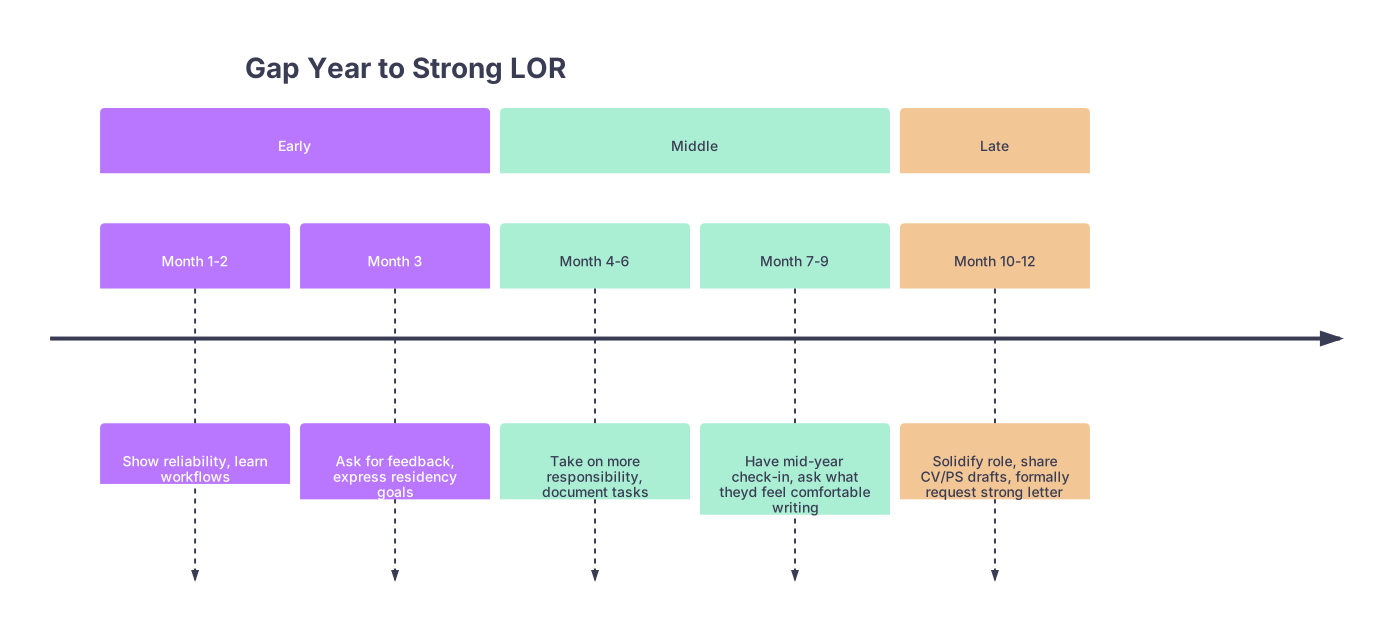
| Period | Event |
|---|---|
| Early - Month 1-2 | Show reliability, learn workflows |
| Early - Month 3 | Ask for feedback, express residency goals |
| Middle - Month 4-6 | Take on more responsibility, document tasks |
| Middle - Month 7-9 | Have mid-year check-in, ask what theyd feel comfortable writing |
| Late - Month 10-12 | Solidify role, share CV/PS drafts, formally request strong letter |
I’ve watched the difference between the student who just “shows up and waits to be used” and the one who deliberately builds a narrative of increased responsibility and then hands their boss a short bullet-point summary of what they actually did.
Guess which one gets the letter that says, “Handled X, Y, and Z responsibilities at a level comparable to a new intern.”
Hint: not the passive one.

How to Ask for a Gap Year Letter Without Getting a Lukewarm One
Here’s the line nobody outside faculty rooms admits: half the “strong letters” students request are not actually strong. They’re just… letters.
Your job is to prevent that. You do it at the moment you ask.
Do not say:
“Would you be willing to write me a letter of recommendation?”
You’ll get a default yes. Whether or not they actually have anything meaningful to say.
Better version:
“I’m applying to internal medicine this cycle. You’ve seen me over the year as my responsibilities increased. Do you feel you know my work well enough to write a strong letter that specifically comments on my readiness for residency-level responsibilities?”
That word – strong – gives them an out. If they hesitate, pause, or say anything like “Well, I can write you a letter,” you should not use them as a primary clinical letter. At most, that’s a supplemental or backup.
And yes, I’ve seen letters from gap year bosses that read like this:
“I did not work extensively with her but during the times we overlapped she appeared enthusiastic and professional.”
PD reaction: Why did you choose this person for a letter?
You can avoid that scenario completely by being direct before you ever upload their name in ERAS.
Where Gap Year Letters Actually Matter Most
There are three scenarios where gap year letters carry disproportionate weight.
1. Non-traditional or Extended Route Students
If you’re a non-traditional, reapplicant, or took more than one gap year, PDs want to know: did you stay clinically engaged, or did your skills decay?
A letter from a gap year boss that states:
“She maintained and even sharpened her clinical reasoning during this year, regularly working up patients and presenting to me, staying current with evidence-based guidelines.”
…reassures them you didn’t go dormant.
2. Applicants with Red Flags
Failed Step, LOA, professionalism concern. You will not fix those with one letter. But you can change the trajectory of the conversation.
I watched this happen in real time:
Applicant with a Step 1 failure. On paper, risky. But the gap year IM clinic director wrote:
“We hired him aware of his Step 1 history. Over a full year, he demonstrated excellent reliability, took feedback well, and consistently showed clinical judgment and maturity comparable to our PGY-1 residents.”
In the meeting, someone asked, “Do we think that Step failure is still relevant?” The PD said, “After a full year like this? I’m less worried.” That applicant matched.
Without that letter, I doubt they were ranked as high, if at all.
3. People Pivoting Specialties
You did a prelim year, or you rotated heavily in one field and now are switching. Your story can sound flaky unless someone credible says, “No, this pivot makes sense and they did real work here.”
A gap year in the new specialty, with a boss who writes:
“She approached this year to confirm her fit for neurology, not as a stopgap. She dove into the work and functioned at a level that convinces me she’s well-suited for the field.”
…gives PDs cover to take a chance on you.
| Scenario | Impact Level |
|---|---|
| Traditional applicant, clean record | Low–Moderate |
| Non-traditional, long path | High |
| Applicant with exam red flag | High |
| Switching specialties | High |
| Already loaded with strong specialty letters | Low |
How Many Gap Year Letters Should You Actually Use?
PDs value quality over quantity. Most are reading 3–4 main letters. The rest are skimmed, if at all.
If you’re applying, say, internal medicine, the strongest core set is usually:
- 2–3 specialty letters (IM attendings, sub-I, away rotation)
- 1 from a gap year boss or research PI if it adds something unique
If your gap year boss is not in your specialty and doesn’t work directly with residents, that letter should be supplemental, not replacing a core clinical letter. It’s additive character and work-ethic information, not your foundation.
But if your gap year boss is an IM attending who runs a busy clinic and has basically seen you functioning like an intern for 12 months? That letter can absolutely be one of your primary LORs. I’ve seen PDs call those “better than a one-month sub-I letter” because of the time depth.

The One Thing PDs Care About Above Everything Else
Strip away the formalities, the templates, the scoring rubrics. What PDs really want from any letter – including your gap year boss’s – is an answer to this question:
“On July 1, am I going to regret putting this person on my call schedule?”
Every sentence in that letter is either helping or failing to answer that.
The best gap year letters say, in essence:
- “I know what interns do.”
- “I’ve seen this person do intern-like work.”
- “I would trust them in that role.”
Everything else is decoration.
If your gap year doesn’t put you in a position to earn that kind of statement, then your gap year boss letter becomes a soft, pleasant background note. Fine. Not fatal. But don’t kid yourself that it’s a major weapon in your application.
If instead you intentionally build a role with real responsibility, identify a boss who understands training, and ask directly for a strong letter that speaks to readiness – then yes, that insider letter can be the thing that quietly nudges a PD’s hand when they’re stuck between you and Applicant #147.
And no, they will never email you and say, “Your gap year letter moved you up.” They’ll just move your name up the list. That’s how this game is actually played.


