

It’s late January. 7:15 pm. The clinic’s long over, the last add-on case just closed. A half-eaten tray of sandwiches is sitting in the corner of a conference room. On the wall: a projection of a giant spreadsheet of names, scores, and color-coded notes.
You’re one of those names.
And next to your name, in a small notes column, it says:
“Gap year – research”
or
“2-year gap – family”
or
“Multiple gaps – ?”
Now the conversation starts.
Let me walk you through what actually gets said about that gap year when your file comes up. Not the sanitized version you hear on panels. The real one from rank meetings I’ve sat in, with program directors, salty senior attendings, tired chiefs, and the one bulldog APD who remembers everything.
First: Is Your Gap Year Obvious Or Suspicious?
Before anyone even talks, this is what happens:
The coordinator or PD opens your ERAS file, the CV timeline, and your MSPE. People scan it for 10–15 seconds. They’re looking for continuity.
Gaps jump out instantly. I promise you this. Everyone in that room has reviewed hundreds of applications. They can read timelines like radiology studies.
There are three gut reactions to a gap year:
“Clean and intentional” – They see:
- Graduate May 2023
- Research fellow July 2023 – June 2024
- Applied to residency 2024–2025 cycle
No one flinches. This is fine. Often positive.
“Explained but soft” – They see:
- Graduate May 2022
- “Time off for family reasons” or vague “personal growth”
- Tutoring, some volunteer work, applied later
This triggers a question: is this someone who’ll show up and grind, or someone who’s ambivalent?
“What happened here?” – They see:
- Long overlapping or unexplained periods
- Multiple gaps, repeated extra years, Step failures, leaves
- No coherent story tying it together
This is where the red pens come out.
Nobody cares that you had a gap. They care why and what you did with it.
How Program Directors Actually Categorize Gap Years
Directors don’t use your language. They use theirs. In their heads (and sometimes explicitly in that room), your gap year ends up in one of a few buckets.
| Gap Type | Gut Reaction in Rank Room |
|---|---|
| Structured research | Mild to strong positive |
| Funded fellowship | Strong positive |
| Dedicated Step remediation | Cautious, case-dependent |
| Personal/family leave | Neutral to cautious |
| Travel/'finding myself' | Skeptical unless framed well |
| Work outside medicine | Depends on narrative |
Now how those actually sound when they talk about you:
1. The Research Gap Year
What gets said in the room:
- “This is the guy who did a year with the HF group at Penn, right? Two posters, one middle-author paper.”
- “Yeah, and Dr. X from their lab wrote that letter. It’s solid.”
- “He actually produced something. This isn’t fake research.”
This is the most politically safe gap year. In competitive fields (derm, ortho, ENT, rad onc, plastics), it’s practically a currency. In IM, EM, peds, psych, it’s nice but not mandatory.
What matters is not “research” on paper. It’s concretes:
- Were you funded or in a real structured role?
- Are there actual outputs (abstracts, posters, manuscripts, grants)?
- Did an attending in that field stake their name on you?
Weak version (what hurts you):
- “Research year” at your home institution, but:
- No abstracts.
- No letters from PIs.
- No clear project ownership.
Then you hear: “What did they do for a year?”
That’s never a good question to trigger.
2. The “Step Study/Remediation” Gap Year
This one is tricky. And it’s where PDs diverge sharply.
In the room, it sounds like:
- “He took a year after failing Step 1.”
- “How’d he do on the second try?”
- “241.”
- “MSPE comments?”
- “Some concern about test-taking early, but improved on clinical rotations.”
- “Any pattern of remediation?”
- “No, just that one failure.”
If your gap year was to remediate a Step failure, two things make or break you:
Did you clearly improve, or are scores still weak/erratic?
A failure followed by a solid pass with Step 2 in a comfortable range is often accepted, especially in non-ultra-competitive fields.Did you do anything besides just study?
A full year of “studying for Step” and nothing else looks bad. People know you cannot study 8 hours a day for 12 months for a single exam. They just don’t believe it.
The thought in the room is: “If they had a whole year and did nothing but finally pass a test, what does that say about productivity and resilience?”
The best reframe I’ve seen:
- They retook Step.
- Simultaneously did:
- Some part-time research or QI,
- Tutoring,
- Or a structured remediation program with documented improvement.
- Strong letter from a dean or remediation faculty explaining growth.
Then the narrative becomes: “Had a setback, handled it, came back stronger.” Directors are absolutely willing to accept that story—if it’s supported by evidence.
3. The Family/Personal Circumstance Gap
This comes up a lot more than applicants think. Ill parents. Your own illness. Childbirth. Visa issues. Burnout that almost broke you.
People around the table aren’t robots. Most understand life.
How it gets discussed:
- “She took a year off to take care of her mom with advanced cancer.”
- “Is that actually documented or just a line?”
- “Mentioned in PS, consistent with timing in MSPE. Volunteer work at home hospital during that time.”
- “Any productivity?”
- “Some community work, helped with a local clinic. Nothing academic.”
- “Her clerkship comments are excellent.”
Here’s the unspoken algorithm they’re running:
- Was the reason legitimate and clearly explained?
- Did you re-enter and then perform well? Or did the wheels keep wobbling?
- Did you completely check out of medicine during that time or maintain some engagement?
If you took time for family/health but then came back and crushed rotations, many PDs respect that. The gap year becomes a context point, not a scarlet label.
Silent red flags:
- Vague “personal issues” with no details anywhere.
- Major time off plus ongoing professionalism issues in MSPE.
- Story doesn’t match timeline.
If you want that gap year not to hurt you, give them just enough detail to stop their imagination from filling in something worse.
4. The “I Traveled / Found Myself / Did Non-Medical Stuff” Gap
This is where you’re most likely to be misunderstood.
What they actually say:
- “They took a year to travel.”
- “Doing what?”
- “Says: ‘Traveled, explored different cultures, personal growth.’”
- Silence for two seconds.
- “Any clinical exposure?”
- “Not really.”
- “…Okay. So they stepped away from medicine right after graduation.”
Here’s the problem: residency is a pressure cooker. Program directors are risk managers. They fear people who might be ambivalent.
A pure “I backpacked for a year” gap reads, to many, as: “I’m not sure I want this.” Fair or not.
Can you make it work? Yes. But only if it’s anchored to something:
- Travel plus global health work with continuity and letters.
- A structured program (Fulbright, Peace Corps, Teach For America, etc.).
- Meaningful non-clinical work you can clearly tie to being a better doctor: teaching, leadership, language immersion with concrete competence.
“I needed a break before residency” is honest, but not strategic. On rank day, honesty without framing can punish you.
5. The Work-Outside-Medicine Gap
You took a job in tech, consulting, finance, startup, education. On paper, this can look either impressive or suspicious.
In the room, it sounds like:
- “He did two years at McKinsey.”
- “Why is he coming back now?”
- “Any evidence of clinical continuity?”
- “Shadowed monthly, did some QI consulting with a hospital system.”
- “Letters?”
- “One from their consulting supervisor, two from med school era.”
Someone will ask: “Is this a hobbyist or is he actually committed to medicine?”
Program directors will try to sort you into:
- “Bringing big-picture skills into our field”
versus - “One foot out the door; will leave for an MBA or industry ASAP.”
If you held a serious role with clear responsibility and now have a coherent story—especially backed with solid clinical references—you can come out ahead. I’ve seen PDs get legitimately excited about someone who did serious work in data science or healthcare ops if it clearly feeds into their interest in, say, systems-based practice or informatics.
But again: if your clinical record is lukewarm and you disappeared into a non-medical world for two years with no ongoing clinical contact, it feels like you’re drifting back because the other thing didn’t work out. Programs can smell that.
What Actually Happens in the Rank Meeting When Your Name Comes Up
Let’s zoom fully into that room.
Your name is on the screen. Usually there’s:
- A scorecard (Step, clerkship grades, maybe a composite score).
- A few one-liners from interviewers.
- Quick bullets: “Gap yr – research at ___”, “2 yrs consulting”, “Step failure – remediated”, etc.
Here’s the order of operations most places follow, roughly:
Snapshot review (10–20 seconds)
People silently scan:- Scores
- School
- Honors/AOA
- Red flags: leaves, gaps, failures
Interview recap (30–60 seconds)
Someone who interviewed you speaks:- “I interviewed her. Very mature. Talked a lot about caring for her dad during that year off.”
- “He was a little vague about his two-year gap and why he didn’t apply earlier.”
Context from PD or APD (30–60 seconds)
Especially for any “non-standard” path:- “Just to remind everyone, he did a funded research year at our own institution. The ICU attendings here liked him.”
- “This was the applicant who took time off for mental health. The dean’s letter is very explicit; he’s been stable and high-performing since.”
Micro-debate (30–90 seconds)
This is where your gap year gets weaponized either for or against you, depending on:- How clean your story is.
- How consistent your performance is before and after.
- Whether someone in the room is willing to go to bat for you.
You’ll hear three basic archetypes speak up:
The Risk-Averse Attending:
“Do we really want the person who stepped away from medicine for two years? We’ve had problems with people like that before.”The Contextual APD:
“Yes, but look at what he did with it. And his performance after is stellar. I don’t see any ongoing issues.”The Memory-of-Everything Chief:
“Remember, this is the one who took a year for research but never actually got anything submitted. I worry about follow-through.”
Where you land on the list depends less on “having a gap” and more on which of those voices wins.
If your gap year is:
- Clearly explained.
- Consistently documented across PS, interviews, MSPE.
- Paired with strong current performance and good letters.
Then the gap becomes a background fact, occasionally even a strength.
If it’s:
- Vague,
- Misaligned with your narrative,
- Or followed by more instability,
Then, yes, on rank day it pushes you down.
How Different Specialties Secretly See Gap Years
They won’t say it on websites. They absolutely say it in rooms.
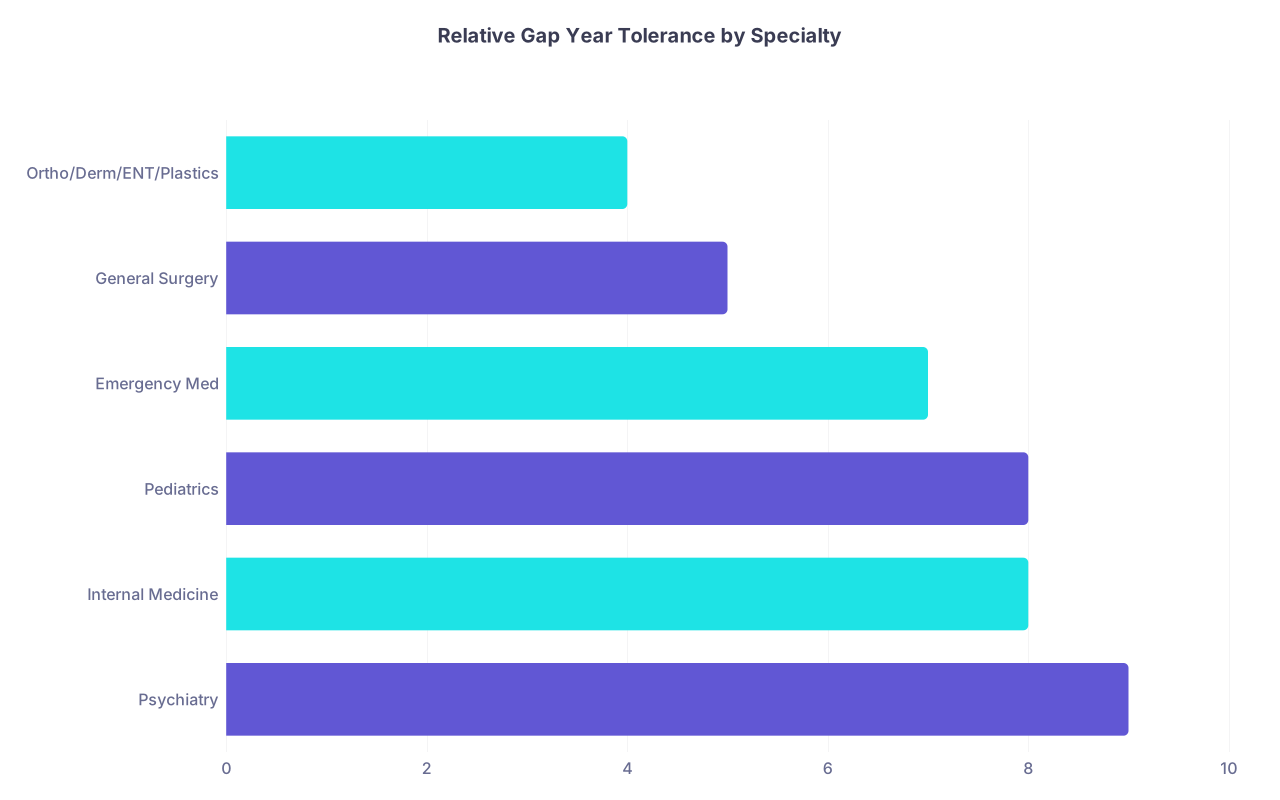
| Category | Value |
|---|---|
| Psychiatry | 9 |
| Internal Medicine | 8 |
| Pediatrics | 8 |
| Emergency Med | 7 |
| General Surgery | 5 |
| Ortho/Derm/ENT/Plastics | 4 |
Scale: 10 = very tolerant, 1 = strongly suspicious
Medicine, Peds, Psych
Generally open-minded. They see a lot of non-traditional paths.
- A legit research year? Often a plus.
- Time for family/health with strong comeback? Commonly accepted.
- Weird, drifting multiple years with no productivity? Still a problem.
EM
Historically more flexible, but getting more competitive. They want evidence you can handle chaos and actually show up.
- Gaps are fine if your story is coherent and performance is strong.
- Multiple leaves, professionalism flags, or vague gaps? Hard pass.
Surgery and Competitive Surgical Fields
Surgery remembers. Bad experiences with a certain type of applicant shape years of decisions.
They’re harsh on:
- Vague “finding myself” gaps.
- Any hint of ambivalence.
They’re more accepting of:
- Hard-core research years with output.
- Military or serious service work.
- Clear life events (illness, family) followed by relentless performance.
I’ve heard, word for word:
“Residency is not the time for someone to be ‘figuring things out’.”
So if your gap year sounds like that, you’re in trouble in these rooms.
The Stuff You Don’t See: How Your Explanation Gets Distorted
You might’ve given a beautifully nuanced explanation on interview day. Here’s the uncomfortable news: on rank night, almost nobody has time to re-read your personal statement. They rely on memory and scrawled notes.
This is why your gap year narrative must be:
- Short.
- Concrete.
- Repeated consistently.
What lives in their heads is not your carefully worded paragraph. It’s a compressed version, like:
- “Took a year to care for sick parent; then crushed third year.”
- “Two years in consulting; wants to bring systems thinking to medicine.”
- “Step 1 failure, took a year, then did fine.”
- “Did a ‘research year’ but nothing tangible; I’m not convinced.”
Your job is to make damn sure that compressed version helps you, not hurts you.
How To Frame Your Gap Year So Rank Day Goes Your Way
Let me be blunt: the story you tell changes what happens in that room. You can’t erase the gap. You can absolutely control its meaning.
Here’s the pattern that works:
Own it early and clearly.
Don’t hide it in a vague line. One crisp sentence in your PS and one crisp, consistent answer in every interview.Anchor it to specific actions, not vague feelings.
Bad: “I needed time for personal growth and reflection.”
Better: “I spent a year working full-time on X, where I did A, B, and C that led to Y.”Show continuity with medicine, even if partial.
Shadowing. Free clinic. Teaching. Research. Something that proves you didn’t fully detach.Demonstrate a strong trajectory after the gap.
What rank committees care about most is: “What have they done lately?”
If the gap is followed by excellence, it quickly becomes a footnote.Give your letter writers the language to back you up.
If your mentor writes: “During his research year, he was one of the most productive students I’ve worked with,” that line will absolutely be quoted out loud in that room.
A Quick Visual: How Your Gap Year Gets Processed

| Step | Description |
|---|---|
| Step 1 | See Gap in Timeline |
| Step 2 | Speculation & Risk Aversion |
| Step 3 | Neutral to Negative |
| Step 4 | Concern about reliability |
| Step 5 | Gap reframed as maturity or growth |
| Step 6 | Is it clearly explained? |
| Step 7 | Is there meaningful activity? |
| Step 8 | Post-gap performance strong? |
You can’t control step A. You can control every downstream branch.
FAQ – The 5 Questions I Get Over And Over
1. Is one gap year before residency actually a problem?
One clearly explained, productive gap year is almost never a problem. In some fields, it’s actually a positive. The trouble starts when the year is vague, unproductive, or just a parking lot for a Step failure with no demonstrated growth. One intentional year? Fine. Multiple disjointed years with mixed performance? Very different story.
2. How detailed should I be about personal or mental health reasons?
You don’t need to spill your entire psych history. You do need enough detail to stop people from imagining something worse. Think: “I took a medical leave to address a mental health condition. I engaged in treatment, recovered, and since returning have performed at a high level, as reflected in X, Y, Z.” Vague “personal reasons” with no explanation is what makes committees nervous.
3. Do I need a letter that specifically addresses my gap year?
If your gap year was for research, a fellowship, or a structured role, yes—get a letter from that period. If it was for health/family, you don’t need a “gap year letter,” but you want at least one faculty or dean-level person who can attest to your stability and performance after you returned. On rank day, someone will ask: “Has this been an ongoing issue?” A strong, recent letter is your best shield.
4. I took time off just to rest and avoid burnout. Can I say that?
You can, but if you present it as “I needed a break before residency,” many around that table will quietly move you down. They’re looking for people who can push through hard stretches. If that time off also included meaningful work, volunteer commitments, study, or personal development that you can tie to resilience or insight, frame it that way. Pure “I was tired” doesn’t sell well in that room.
5. Will programs in competitive specialties automatically reject me for a gap?
No. I’ve seen gap-year applicants match derm, ortho, ENT, the works. But in those fields, your gap must look like strategy, not drift. Funded research, a strong mentor, multiple pubs, clear commitment to that specialty. Competitive programs are brutal about perceived ambivalence. A sharp, intentional gap year with measurable output? They’ll respect it. A soft, wandering one? You’ll get cut before rank night even starts.
If you remember nothing else:
- Your gap year itself isn’t the problem. How clearly and productively you used it is.
- On rank night, your entire story is compressed into a few sentences. Make sure the gap-year sentence helps you.
- Give them a reason to say: “This gap made them stronger,” not: “This gap makes me nervous.”


