

The way you talk about your gap year will matter more than what you actually did.
That sounds unfair, but I have watched applicants with beautiful, “on paper” gap years get passed over because their story was incoherent. And I have seen people with messy, accidental, even chaotic gap years match at strong programs because they framed it correctly.
You are not selling activities. You are selling a through-line.
This is gap year branding. And if your activities look disconnected, you need to fix the story now, not three days before ERAS submission.
Let’s build that story step by step.
Step 1: Stop Apologizing for Your Gap Year
Before you craft anything, you need to kill one bad habit: apologetic framing.
Program directors can smell insecurity a mile away. The “I know my path looks a bit all over the place, but…” line? I have seen it sink people who were otherwise solid.
You are allowed to have:
- A failed research position
- A job outside medicine (scribing, tutoring, even nonclinical work)
- Time off for family, burnout, or health
- Multiple short gigs instead of one steady job
None of that is automatically disqualifying. The problem is when you act like it is.
So first rule:
You do not confess your gap year. You explain it.
Practical reset:
Stop calling it a “gap” in your own head. Call it:
- “Professional development year”
- “Training year between medical school and residency”
- “Transitional clinical and research year”
Delete phrases from your draft documents like:
- “Unfortunately, I had to take time off…”
- “I realize this appears disjointed…”
- “I know my path isn’t traditional like other applicants…”
Replace with:
- “During my dedicated research year…”
- “In this transitional year before residency…”
- “Over the past year, I focused on three complementary areas…”
You are not on trial. You are presenting a portfolio.
Step 2: Extract the Through-Line from Disconnected Activities
Your activities look disconnected because you are staring at the surface level:
- Three months of research in cardiology
- Six months as a medical scribe in the ED
- Tutoring Step 1 for income
- Brief caregiving for a sick parent
- A late switch in specialty interest
On the surface: chaos.
Underneath: there is almost always a pattern. You just have not dug it out yet.
You need a unifying theme that all activities can plausibly support. This is brand positioning.
Common themes that work extremely well:
- Commitment to underserved or vulnerable populations
- Development of clinical reasoning and communication
- Learning health systems and team-based care
- Evidence-based practice and clinical research
- Resilience and professional maturity
- Systems improvement and workflow efficiency
Pick one primary theme and one secondary. Then force every activity to answer:
“How does this experience support that theme?”
Concrete example
Applicant’s raw list:
- Research assistant: heart failure outcomes project (Aug–Dec)
- Medical scribe: community ED (Jan–Aug)
- Part-time Step tutor (Jan–Aug)
- Two months at home helping after a parent’s surgery (Oct–Nov)
On paper, nothing obviously connects.
Now let’s frame:
Primary theme: “Learning how complex patients move through the health care system.”
Secondary theme: “Developing communication skills across disciplines and with patients.”
Now re-interpret each activity:
- Heart failure research → Understanding longitudinal outcomes and system-level factors that affect readmissions and mortality.
- ED scribing → Front-line view of acute care, triage, and how patients enter the system, especially under-resourced settings.
- Step tutoring → Deepening clinical reasoning and explanation skills; translating complex concepts clearly.
- Caregiving for parent → Firsthand perspective on navigating appointments, discharge planning, and the emotional side of being on “the other side” of the bed.
Suddenly, not random. Very coherent.
Your job: do this for your own year.
Step 3: Build a Simple “Gap Year Brand Statement”
You need one clean, memorized answer for:
“So tell me about your gap year.”
If you improvise this, you will ramble. Rambling sounds unfocused. Unfocused sounds risky.
Use this 3-part structure:
Framing sentence (1–2 lines)
What this year was for.Buckets of activity (2–3 areas)
Group activities into categories, not a chronological list.Outcome / value add (1–2 lines)
What did this year do for you as a future resident?
Template you can steal
“I used this year as a structured transition between medical school and residency to focus on [primary theme], specifically through three main areas: [Bucket 1], [Bucket 2], and [Bucket 3]. Together, these experiences gave me [concrete outcomes] that I will bring to residency, especially in [target specialty].”
Worked example
“I used this year as a structured transition between medical school and residency to deepen my understanding of how complex patients move through the health care system. I focused on three main areas: outcomes research in heart failure, front-line clinical exposure as a scribe in a community emergency department, and teaching Step content to junior students to sharpen my own clinical reasoning and communication. Together, these experiences gave me a much more system-level view of patient care and made me more deliberate about how I communicate with both patients and team members—skills I am eager to bring into internal medicine training.”
Short. Confident. Cohesive.
Write your version. Out loud, it should be 30–45 seconds. No longer.
Step 4: Group Your Activities into “Brand Buckets”
The biggest mistake: describing every activity as a separate, disconnected thing.
The fix: brand buckets. You are not a collection of gigs; you are three focused pillars.
This is how you talk about the year in your personal statement, interviews, and even LOR requests.
Common buckets that work well:
- Clinical exposure
- Research and scholarship
- Teaching and mentorship
- Leadership and systems work
- Personal responsibilities / resilience / health
- Skills-building (language, QI, informatics, etc.)
Take your activities and cluster them. Example:
Raw activities:
- ED scribe
- Cardiology research
- Volunteer at free clinic
- MCAT instructor
- Family caregiving
- Short contract as a telemedicine triage assistant
Possible buckets:
- “Direct patient care and frontline exposure”
- ED scribe
- Free clinic volunteer
- Telemedicine triage
- “Understanding outcomes and evidence-based care”
- Cardiology research
- “Communication and teaching”
- MCAT instructor
- “Personal perspective and resilience”
- Family caregiving
Now, when you write or talk, you say:
“During this year, my activities fell into three main areas…,”
instead of, “Then I did this, then this, then this…”
| Bucket | Activities Included |
|---|---|
| Frontline clinical exposure | ED scribe, free clinic, telemed |
| Evidence-based practice | Cardiology outcomes research |
| Communication and teaching | MCAT / Step tutoring |
| Personal resilience and insight | Family caregiving |
You can have three or four buckets. More than that, and the story starts fragmenting again.
Step 5: Rewrite Your ERAS Experiences to Match the Brand
Most people treat the ERAS activities section like a bland job description. That is a waste.
Program directors skim. They remember themes and impact, not bullet-point duties.
You want every significant entry to quietly reinforce your brand statement.
Structure your descriptions like this
Each experience description should show:
- Context + role – 1 sentence
- Actions tied to your theme – 1–2 sentences
- Impact / growth – 1 sentence, ideally with specifics
Example: Scribe job, unbranded vs branded.
Weak version:
“Worked as a scribe in a busy community ED documenting physician–patient encounters, entering orders, and assisting with chart review. Gained exposure to a wide variety of acute presentations.”
Branded version (theme: systems + communication):
“Worked as a scribe in a high-volume community emergency department, documenting complex encounters and tracking patients from triage through disposition. Paid close attention to how attending physicians framed diagnoses and plans for patients with limited health literacy and how system constraints (boarding, lack of follow-up access) affected real-time decision-making. This role sharpened my ability to synthesize information quickly and reinforced my interest in improving continuity for patients who rely on the ED for primary care.”
See the difference? Same job. Completely different signal.
Do this for:
- Research roles
- Teaching/tutoring
- Nonclinical jobs
- Volunteer work
- Family or health-related time (when appropriate to include)
Step 6: Decide What to Downplay and What to Feature
You do not have to highlight everything equally. Branding is selective.
Anything can exist in ERAS, but you have three primary spots that drive your story:
- Personal statement
- “Most meaningful” experiences (if you are using that style in any supplemental forms)
- Interview talking points
Use these for your strongest, on-brand items.
What to feature
Ask three questions of each activity:
- Does it tie directly into the skills or values my target specialty cares about?
- Did I have real ownership, responsibility, or depth?
- Can I tell a compelling story from it?
If yes to at least two, it is a candidate to feature.
What to downplay (but not hide)
- Very short gigs (1–2 months) unless they are clearly impactful.
- Purely “filler” work that does not generate strong skills or stories.
- Side hustles that are hard to connect (DoorDash, random temp jobs), unless you use them to demonstrate resilience or financial responsibility in a measured way.
You can still:
- List them in ERAS (accurately)
- Mention them briefly as part of “maintaining financial stability”
- But do not build your main brand around them.
Step 7: Stitch the Gap Year into Your Specialty Narrative
Your gap year story does not stand alone. It must plug cleanly into:
“Why this specialty, and why now?”
Common scenarios people mess up:
- Switched specialties during gap year
- Initially unmatched, now reapplying
- Struggling Step scores → took time to strengthen application
- Burnout → took time to recover and reconsider
Each of these needs a clear before → gap year → after arc.
Example: Reapplicant after not matching
Bad version:
“I did not match, so I took a year to improve my application by doing more research and working as a scribe.”
Better, structured version:
What happened
“I applied to internal medicine last cycle and did not match. My application had limited longitudinal clinical experience and no substantial research.”What you decided to do (intentional)
“I treated this year as a focused opportunity to address those gaps directly.”What you actually did (bucketed)
“I took on a full-time role as an ED scribe to deepen my frontline clinical exposure and a part-time position in a cardiology outcomes lab, which has already led to two abstracts and a manuscript in preparation.”What changed concretely
“This year has sharpened my clinical reasoning, given me a clear sense of the realities of inpatient care across settings, and strengthened my ability to ask meaningful clinical questions—making me far better prepared to start residency than I was a year ago.”
Own the story. Do not dodge it.
Step 8: Prepare Tight, Rehearsed Responses to Predictable Questions
You will get some version of these in interviews:
- “Walk me through what you have been doing since graduation.”
- “Why did you decide to take time before starting residency?”
- “It looks like you changed directions—can you tell me about that?”
- “How has this year prepared you for intern year?”
You cannot wing these. You’ll ramble. Or overshare. Or sound defensive.
Build scripted skeletons (not robotic memorization) for each.
Example responses
1. “Walk me through what you’ve been doing since graduation.”
Use the brand statement from Step 3.
“I used this year as a structured transition to focus on [theme]. I did that in three main ways: [Bucket 1], [Bucket 2], [Bucket 3]. [1–2 specific sentences about outcome].”
2. “Why did you decide to take time before residency?”
“I recognized that before starting residency, I needed [what you needed: more clinical independence, better exam performance, time to care for family, etc.]. Rather than rushing into a position where I might not perform at my best, I chose to take a focused year to [exact steps]. It ended up being extremely valuable because now I [concrete readiness point].”
3. “How has this year prepared you for intern year?”
“Three main ways. First, [clinical skill or exposure]. Second, [system or research understanding]. Third, [personal maturity / resilience change]. For example, [1 specific example].”
Write your drafts. Say them out loud. Tighten them until they are 30–60 seconds each.
Step 9: Align Your Letters of Recommendation with the Brand
Here is where most people drop the ball. They do the work of creating a great narrative, then hand their letter writers vague, generic CVs.
You need your letters to echo your brand, not contradict it.
When you ask for a letter from someone connected to your gap year (PI, supervisor, etc.), give them:
- A one-page summary including:
- Your target specialty
- 2–3 bullet points about your gap year theme and buckets
- Specific things they observed you doing that match that theme
Example email paragraph:
“To give context: I am applying to Internal Medicine and have used this year to deepen my understanding of how complex patients move through the health care system and to strengthen my communication and clinical reasoning skills. In your lab, this has looked like [1–2 specific behaviors]. If you are able to comment on my [data ownership / independence / curiosity / communication across the team], that would align strongly with how I am presenting my application overall.”
You are not scripting their letter. You are aligning.
Step 10: Fix the Biggest Red Flags Proactively
Some gap-year patterns trigger concern almost automatically. You cannot ignore them; you have to pre-emptively address them.
Here are three big ones and how to handle them.
1. Long periods of apparent inactivity
If you have 3–6+ months with no formal position, you must explain:
- What was happening
- What you learned or changed
- Why that time is not predictive of unreliability in residency
Example:
“I had a three-month period where I was primarily focused on caring for a parent after major surgery. During that time, I maintained my clinical knowledge by [specific actions: question banks, CME modules, journal clubs with peers]. Once my parent was stable and had appropriate support in place, I returned to full-time work as [position].”
Do not over-dramatize. Just be concrete and specific.
2. Nonmedical or “odd” jobs
DoorDash. Retail. Tech support. Whatever you did to pay the bills.
You do not need to center them, but if they show up, you can frame them as:
- Evidence of responsibility
- Time-management under financial pressure
- Real-world communication with nonmedical people
One line in an interview is enough:
“I also worked part-time in [job] to support myself financially, which pushed me to be very disciplined with my time and gave me a different perspective on how nonmedical colleagues view the health care system.”
Then pivot back to your main brand.
3. Specialty switch during the gap year
Do not pretend this did not happen. Explain the inflection point clearly.
Structure:
- What you originally thought you wanted and why
- The specific experiences that made you re-evaluate
- What you did after that realization to confirm the new choice
- How the previous path still adds value
Example:
“I initially planned to apply in neurology, but during my research year I spent more time on the inpatient service and realized that what I enjoyed most was managing complex, multisystem medical issues over time rather than focusing on a single organ system. I then sought additional exposure in internal medicine through [activities] and confirmed that this is where my interests and strengths align. My neurology background still helps me tremendously with neuro-heavy admissions and complex diagnostic reasoning.”
Direct. Mature. No drama.
Step 11: Plug the Brand into Your Personal Statement
Your personal statement is not a diary entry or a trauma essay. It is a strategy document.
Your gap year should occupy a clear but not overwhelming portion of it—usually 1–2 paragraphs that:
- Define the theme of your year
- Connect it to your choice of specialty
- Show specific examples of growth or contribution
Rough outline:
- Opening: Brief, clinical or patient-centered anecdote that signals your specialty interest.
- Middle:
- Tie from that anecdote to your broader interest in the field
- Introduce your gap year as a deliberate extension of that interest
- Briefly describe your buckets with 1–2 concrete vignettes
- Closing:
- What you now know you want in residency
- What you bring because of this year (not in spite of it)
Do not retell your entire resume. Use the gap year as evidence for your claims about who you are as a budding resident.
Step 12: Stress-Test Your Brand with Someone Ruthless
You are too close to your own story. You will assume connections that are not obvious to an outsider.
You need one honest person—mentor, chief resident, recently matched friend—to stress-test.
Ask them to do three things:
Read your personal statement and ERAS experiences.
Listen to your 30–45 second “gap year” answer.
Answer, without prompting:
- “If you had to summarize my ‘brand’ as an applicant in one sentence, what would you say?”
- “Does anything in my story feel confusing, defensive, or like I am hiding something?”
- “If you were a PD, what question would you ask me about this year?”
If their summary does not match the theme you thought you were projecting, your branding is not clear enough. Go back, tighten, simplify.

| Step | Description |
|---|---|
| Step 1 | List All Activities |
| Step 2 | Choose Primary Theme |
| Step 3 | Create Brand Buckets |
| Step 4 | Write Brand Statement |
| Step 5 | Revise ERAS Entries |
| Step 6 | Draft Personal Statement |
| Step 7 | Prepare Interview Answers |
| Step 8 | Align Letters of Rec |
| Step 9 | Stress-Test with Mentor |
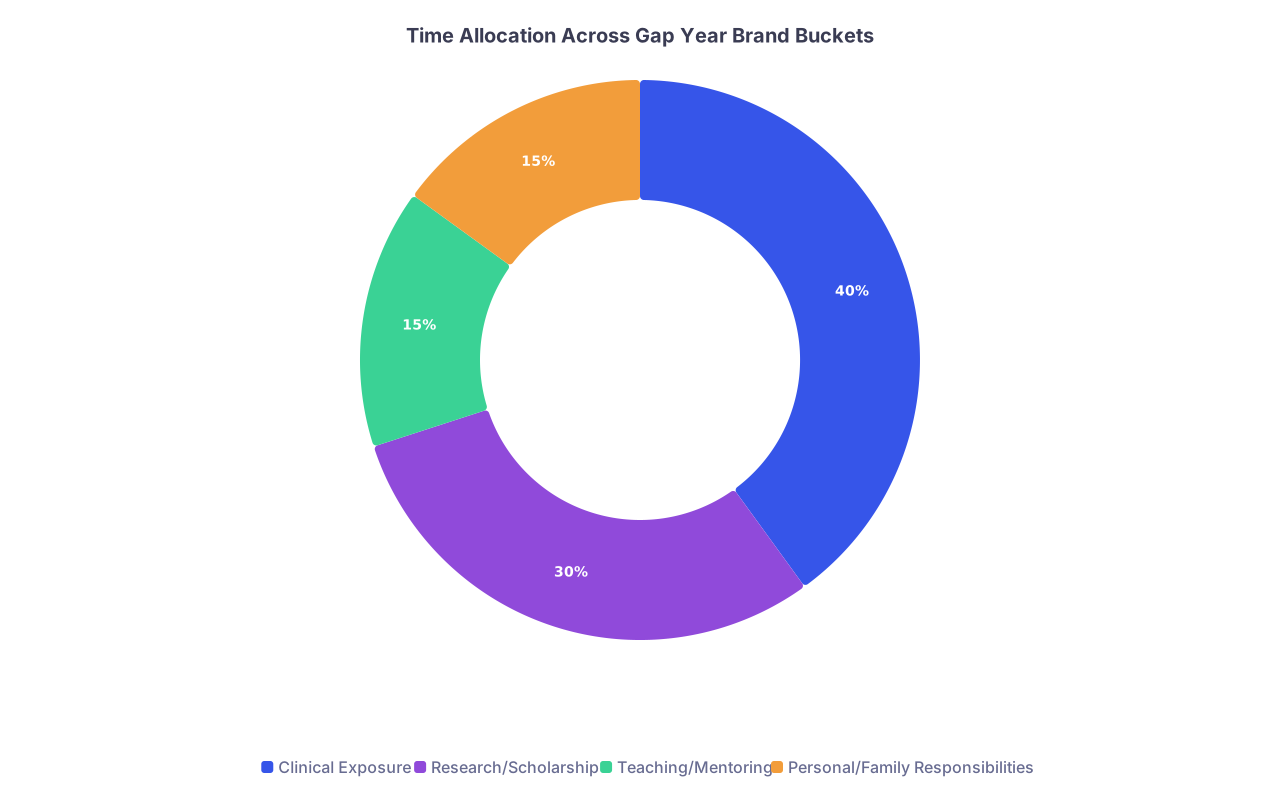
| Category | Value |
|---|---|
| Clinical Exposure | 40 |
| Research/Scholarship | 30 |
| Teaching/Mentoring | 15 |
| Personal/Family Responsibilities | 15 |
What You Should Do Today
Do not wait until ERAS opens to fix this. Your next steps are straightforward.
- Write down every single thing you did since graduation. All of it. Work, family, study, volunteering. One page.
- Circle 3–4 activities that feel most substantial or meaningful. Those will anchor your brand.
- Choose one primary theme that can honestly connect those circled activities. Write a one-sentence version of it.
- Draft your 30–45 second gap year brand statement using the template above. Say it out loud. Edit until it sounds like you on a good day.
Then open your ERAS activities section and your personal statement draft and ask:
“Does every major paragraph quietly reinforce this theme?”
If not, start with one entry—just one—and rewrite it tonight so it does.


