

Your clinical gap year job will either be a warm body shift-filler or a letter‑generating machine. The difference is not luck. It is a system.
You are not “just” an MA, scribe, research assistant, or prelim. You are a future applicant building currency: people who are willing to go on record that you are excellent. Let me show you how to engineer that.
Step 1: Choose (or Re‑shape) a Job That Can Produce Strong Letters
If you already have a job, skim this section for how to reshape it. If you are still choosing, be more ruthless and strategic than most people are.
What actually produces strong letters
Strong letters come from:
- Direct, repeated observation of your clinical work
- Genuine personal rapport
- Evidence you improved something (workflow, patient care, teaching, research)
- A recommender who is credible in your target field
So any job that gives you:
- Face‑time with attendings and senior residents
- Longitudinal contact (months, not weeks)
- Ownership over specific tasks or projects
…can become a letter factory.

Ranking common gap year jobs by “letter potential”
| Role | Letter Potential | Typical Contact with Attendings |
|---|---|---|
| Medical Scribe | High | Daily, direct |
| Research Assistant | High | Weekly / project-based |
| MA / Nurse Tech | Medium-High | Variable by site |
| Clinical Instructor | High | Frequent faculty interaction |
| Hospital Volunteer | Low | Minimal and indirect |
Notice something: it is not about prestige. It is about access.
If you are stuck in a low‑contact role
You fix this by deliberately increasing structured interaction, not by complaining the role “doesn’t offer much.”
Concrete moves:
- Ask to join team meetings or case conferences as a note‑taker.
- Volunteer for simple QI projects: “I could track turnaround time for X and make a brief summary.”
- Offer to help with literature searches, protocol summaries, or patient education materials.
- Ask attendings if you can shadow them on off days or during lighter clinics.
You are trying to move from “that nice gap‑year person” to “someone whose work I actually know well.”
Step 2: Become the Person Attendings Want to Write About
You cannot game this with a single heroic week. Strong letters reflect patterns. You build those patterns deliberately.
The baseline: never give them a reason to hesitate
You need to be mind‑numbingly reliable before you try to be impressive.
- Show up early. Not on time. Early.
- Zero drama about schedules, coverage, or minor inconveniences.
- Learn the EMR, workflows, and clinic culture fast. Ask good questions once, write the answers down, and stop asking the same thing repeatedly.
- Own your mistakes immediately and publicly: “Dr. Smith, I mis‑entered this med. I already corrected it and double‑checked the rest of the chart.”
If an attending feels any doubt about your professionalism, they will soften your letter. That “damn with faint praise” letter is poison.
The upgrade: behave like a junior resident, not a temp
You want your behavior to map to resident‑like qualities. Concrete checklist:
Clinical thinking (at your level)
- When appropriate, quietly draft problem lists, assessment ideas, or differential diagnoses, even if you cannot enter orders.
- For research roles, proactively suggest clinically relevant angles: “We are seeing many readmissions for X; should we track that as an exploratory endpoint?”
Anticipation
- Have the patient fully pre‑charted before they enter the room.
- Prep forms, consents, and education materials in advance.
- For rounds: pre‑pull labs, imaging, recent notes without being asked.
Communication
- Give tight, structured updates: “For Mrs. J: vitals stable, labs pending, daughter called and updated, follow‑up with PT arranged for tomorrow.”
- Never surprise your attending with bad news discovered late.
Team citizenship
- Help the nurses when clinic backs up. Grab EKGs, walk patients, print AVS.
- Offer to stay 10–15 minutes late when chaos hits. You will be remembered.
Think like this: every shift, someone is mentally writing a one‑sentence summary of you. Your job is to make that sentence something like:
“She functions like a reliable PGY‑1 already.”
Not:
“Nice, but still pretty green and passive.”
Step 3: Engineer Situations That Generate Letter‑Worthy Stories
The best letters read like this:
“He identified a safety issue in our discharge workflow, collected data without being asked, and helped us cut medication errors by 30%.”
Not:
“She is hard‑working and pleasant to be around.”
You need to feed your recommenders raw material.
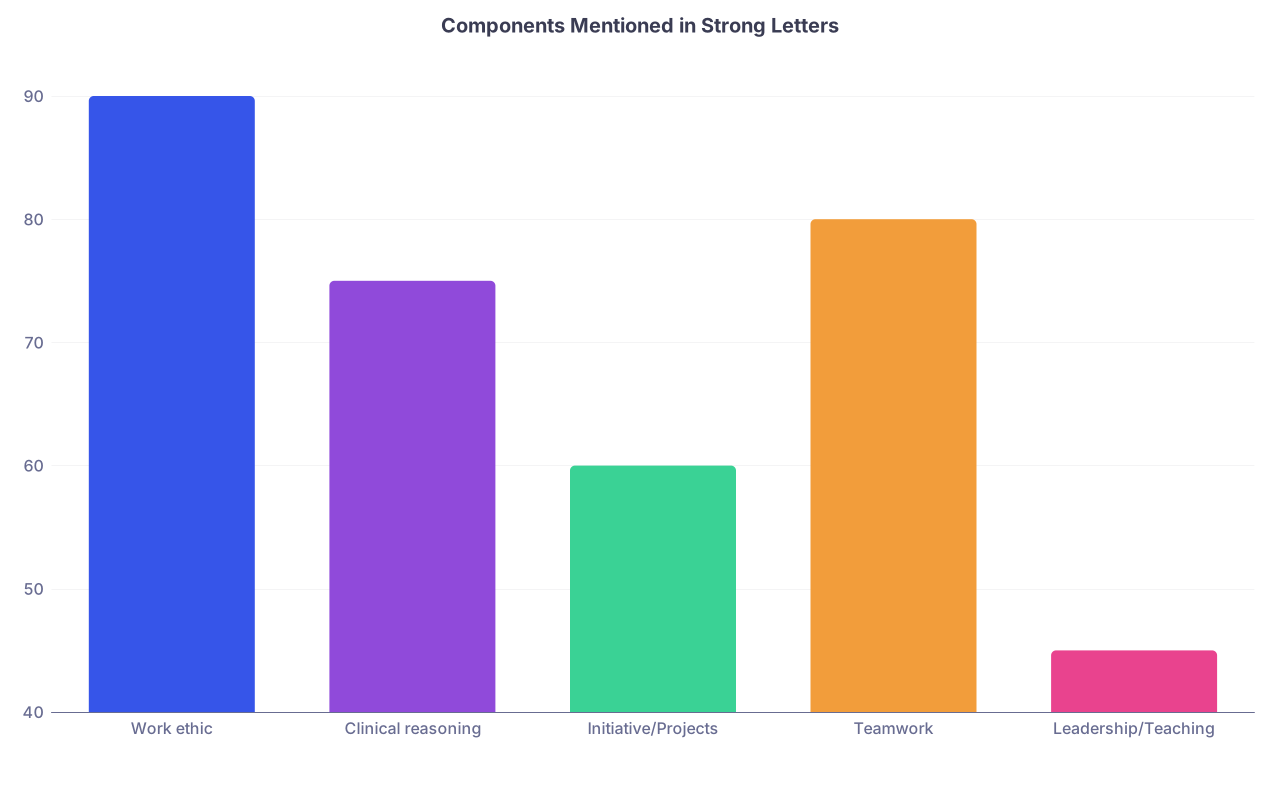
| Category | Value |
|---|---|
| Work ethic | 90 |
| Clinical reasoning | 75 |
| Initiative/Projects | 60 |
| Teamwork | 80 |
| Leadership/Teaching | 45 |
Mini‑project menu you can actually pull off
Pick 1–2 of these, not all. The key is follow‑through.
Micro‑QI project (2–3 months)
- Identify a repeated annoyance: delayed prior auths, missing med lists, no‑show chaos.
- Track baseline for 2–4 weeks.
- Implement one tiny intervention: new checklist, reminder template, shared spreadsheet.
- Measure again and summarize in 1 page with a simple graph.
- Present it at a staff meeting with your attending’s blessing.
Patient education resource
- Common problem: patients leaving confused about new diagnoses.
- Create a one‑page, plain‑language handout for something common in that clinic (HF, asthma, anticoagulation, wound care).
- Run drafts by nurses, the attending, and possibly a patient rep.
- Pilot it and ask MAs / nurses if it helps.
Data or chart review within an existing research project
- If your attending does any research, volunteer to:
- Abstract data from charts
- Build REDCap forms
- Do lit searches and annotated bibliographies
- Aim to become the person they think of when a new data task comes up.
- If your attending does any research, volunteer to:
Workflow optimization
- Build an intake template or smart phrase that saves the team 10 minutes per patient.
- For scribes: design more efficient documentation macros while aligning with attending preferences.
- For MAs: reorganize supply rooms, vaccine stations, or intake scripts with nurse lead.
Then you make sure your attending sees this. Not via bragging. Via structured, brief updates:
“Dr. Lee, over the past two months since we started the new med‑rec checklist, omitted meds dropped from 7 per week to about 2. I put the data in this one‑page summary if you ever want to look at it.”
What you are doing is putting specific, quantifiable achievements in their line of sight. Those end up verbatim in letters.
Step 4: Build Real Relationships, Not Just Proximity
Being physically present near attendings all year does not guarantee a good letter. They need to know you as a person, not just a role.
Learn how your attendings think and what they value
Silent rule: attendings write stronger letters for people who “get” them.
Watch and note:
- Do they care obsessively about timeliness? Clinical thoroughness? Teaching?
- Are they research‑oriented, operations‑oriented, or pure clinicians?
- What annoys them in learners? What impresses them?
Then you align:
- If they are research‑heavy: show up prepared with literature, read their papers, ask good questions.
- If they are clinically meticulous: double‑check your vitals, meds, allergies, histories before they touch the chart.
- If they are patient‑experience fanatics: observe their phrases and adopt their style of explaining.
No fakery here. You are choosing which parts of yourself to amplify with each attending.
Have 1:1 career conversations early (and briefly)
Do not wait until 3 months before ERAS to say, “So uh… can you write my letter?”
Earlier script, around month 2–3:
“Dr. Ahmed, I wanted to share my longer‑term goal so you have context for why I ask certain questions. I plan to apply to internal medicine residencies next cycle and hope to be working at the level of a strong intern by then. If you ever notice things I should work on clinically or professionally, I would really appreciate your feedback.”
That one conversation does three things:
- Flags you as serious about your development.
- Invites feedback, which many attendings are hesitant to give unprompted.
- Plants the idea that you are on the residency track, i.e., letter‑worthy.
Then you follow up by actually using their feedback. When you fix something they mentioned, quietly point it out once:
“Based on your feedback about my presentations being too detailed, I tried to keep the last few to one‑liner plus problem‑based bullets. If you see other ways I can tighten them, please let me know.”
That combination—initiative + responsiveness—is exactly what people love to describe in letters.
Step 5: Ask for the Right Letters, the Right Way, at the Right Time
You do not want “a” letter. You want specific letters from carefully chosen people.
Who should you target?
You want a mix:
- 1–2 attendings in your target specialty who directly observed your clinical work
- 1 person who saw you over a longer time frame (6+ months) in any substantial role
- 1 research or project mentor, if research matters in your field

Aim for someone who can say “I supervised this person closely,” not “I met them twice.”
Timing your request
For a one‑year job, ideal timing:
- Start planting seeds by month 3 (career conversation, feedback requests).
- Explicitly ask 2–3 months before ERAS opens, when you have a long enough track record but before attendings get buried in application season.
- For research mentors, you can ask slightly earlier if your project phase wraps up.
How to ask for a strong letter (and screen out weak ones)
Do not just say, “Can you write me a letter of recommendation?”
Use wording that allows them to opt out gracefully if they cannot be effusive.
Script:
“Dr. Patel, I am planning to apply to pediatrics this cycle and I would be honored if you felt able to write a strong, positive letter of recommendation based on our work together in clinic over the past 9 months. Do you feel you know my clinical abilities and work style well enough to do that?”
If they hesitate, hedge, or say anything short of an enthusiastic yes, you back off:
“I completely understand. I really appreciate your honesty and your mentorship this year.”
A lukewarm letter can sink an application. Better to have fewer, stronger voices.
What to give your letter writers
Make it absurdly easy for them to praise you with specifics.
Send a concise packet:
- Updated CV
- Draft of your personal statement, or at least a 1‑page “career story”
- ERAS photo (if ready)
- Bullet list: “Suggested points based on our work together”
That last item matters. It should be short and concrete, not braggy.
Example bullets:
- “Consistently arrived 15–20 minutes early to prepare charts, which helped clinic run on time.”
- “Independently initiated micro‑QI project on med reconciliation; tracked baseline and post‑intervention error rates showing ~60% reduction in omitted meds.”
- “Often anticipated next steps during clinic, preparing imaging and consult notes before being asked.”
- “Sought detailed feedback on clinical reasoning; by mid‑year was able to propose reasonable initial plans for common complaints.”
You are not telling them what to write. You are jogging their memory and giving them accurate facts to choose from.
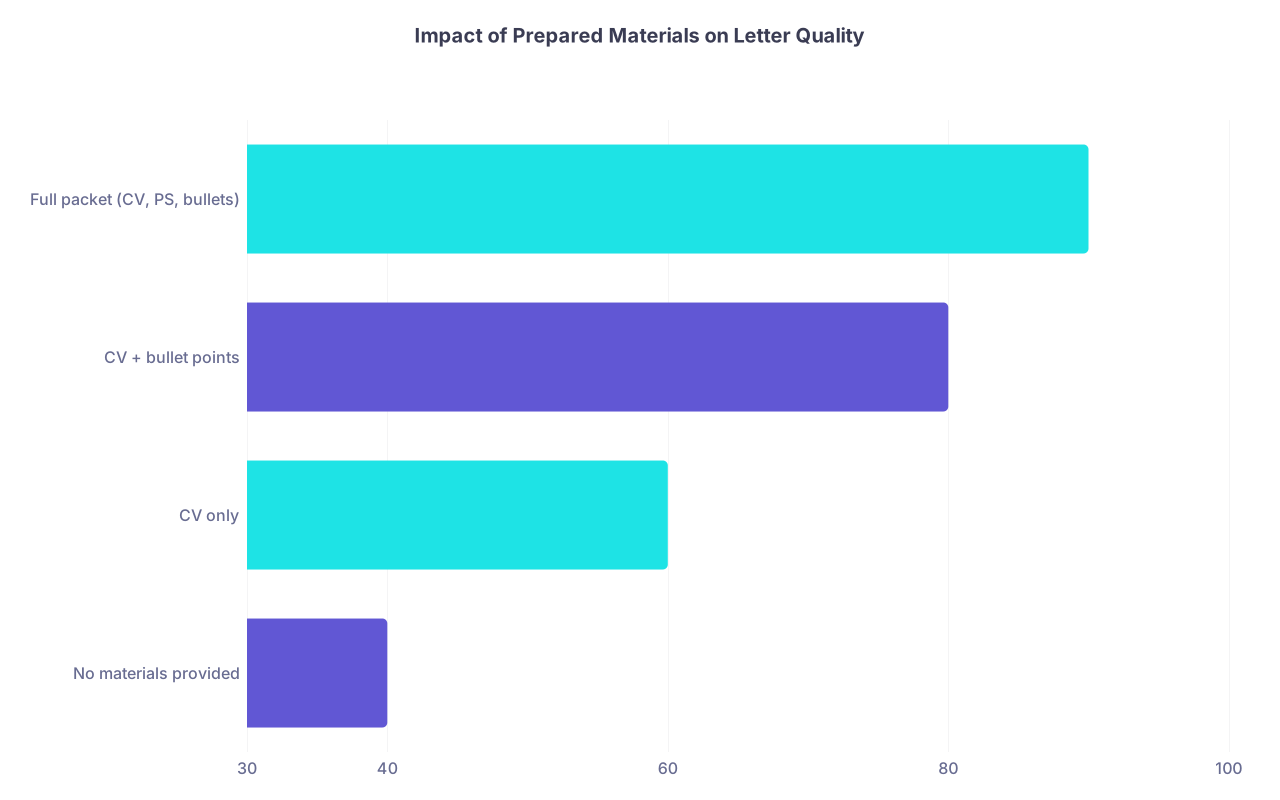
| Category | Value |
|---|---|
| No materials provided | 40 |
| CV only | 60 |
| CV + bullet points | 80 |
| Full packet (CV, PS, bullets) | 90 |
(Values represent approximate “likelihood of detailed, specific letters” from what I have seen.)
Step 6: Align Your Day‑to‑Day Work with What ERAS Committees Actually Read
Most applicants never think about this: what exactly do PDs scan for in letters?
They are looking for evidence of:
- Reliability and professionalism
- Clinical reasoning at the appropriate level
- Work ethic without martyrdom
- Ability to function on a team under pressure
- Trajectory: are you improving quickly?
So structure your gap year to give your letter writers examples in each category.
Weekly self‑check protocol
Run this simple checklist at the end of each week:
Did I do anything this week that:
- Solved a problem?
- Helped the team in a visible way?
- Led to specific gratitude from patients or staff?
Did I get any feedback (positive or negative)?
- If yes, did I implement a change within 1–2 weeks?
Did I interact with my potential letter writers in a way that showed growth?
- New responsibilities?
- Better communication?
- Increased independence (appropriate for role)?
If the answers are mostly “no” for several weeks, you are coasting. Fix that immediately.
Simple interventions if you are coasting:
- Ask your attending, “Is there one additional responsibility I could take on this month that would help the team and also help me prepare for residency?”
- Ask a nurse or MA, “What is one annoying thing about our workflow I might be able to help with?”
- Ask your research mentor, “Is there a sub‑project I could own more independently?”
You are not fishing for compliments. You are fishing for responsibilities that produce stories.
Step 7: Manage the Back End – Follow‑Up, Thank‑Yous, and Future Leverage
Letters are not a one‑and‑done transaction. You are building a network for residency and beyond.
Follow up on submissions
Use ERAS or institution processes to track whether letters are uploaded. If a letter is pending:
- Wait at least 2–3 weeks after your initial request and provision of materials.
- Send a brief, respectful nudge:
“Dear Dr. Kim, I hope your week is going well. I just wanted to gently follow up regarding the letter of recommendation for my internal medicine residency applications. ERAS shows it as not yet uploaded. I know your schedule is demanding, so please let me know if there is any additional information I can provide that would make this easier.”
One reminder is usually enough. If nothing happens, you may need another writer in reserve.
Close the loop after Match
After you match, email each letter writer individually:
- Thank them specifically
- Tell them where you matched
- Include 1 sentence linking your match to their mentorship (“Your QI ideas helped me talk about systems‑based practice in interviews.”)
This does two things:
- You behave like a professional adult, not a transactional applicant.
- You keep the door open for fellowships, jobs, or future letters.
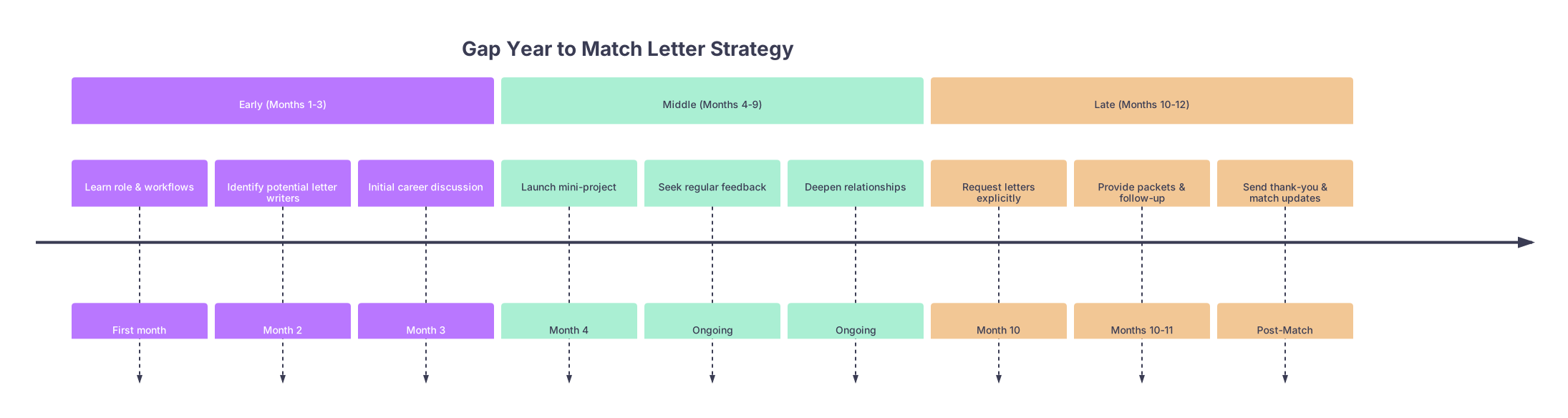
| Period | Event |
|---|---|
| Early (Months 1-3) - Learn role & workflows | First month |
| Early (Months 1-3) - Identify potential letter writers | Month 2 |
| Early (Months 1-3) - Initial career discussion | Month 3 |
| Middle (Months 4-9) - Launch mini-project | Month 4 |
| Middle (Months 4-9) - Seek regular feedback | Ongoing |
| Middle (Months 4-9) - Deepen relationships | Ongoing |
| Late (Months 10-12) - Request letters explicitly | Month 10 |
| Late (Months 10-12) - Provide packets & follow-up | Months 10-11 |
| Late (Months 10-12) - Send thank-you & match updates | Post-Match |
This is how your “gap year job” quietly becomes a professional reference ecosystem.
Two Quick Case Examples (Realistic, Not Fairy‑Tale)
Case 1: The Scribe Who Matched at a Competitive IM Program
Role: ED scribe, nights and weekends.
Starting point: No research, average Step scores, small state school.
What he did:
- Picked 2 attendings he liked and aligned with (one academic, one operations‑focused).
- Became fanatically reliable: never late, zero schedule drama, consistently pre‑charted patients.
- Noticed frequent delays in stroke alerts due to incomplete outside med lists.
- With ED nurse manager’s blessing, built a simple phone script and checklist for getting outside med lists from nursing homes.
- Tracked 20 stroke cases pre‑ and post‑intervention; door‑to‑needle times improved by a modest but real margin.
- Presented a 5‑minute slide deck at ED staff meeting; sent a 1‑page summary to both attendings.
- Asked both of them for “strong letters” with bullet points about this project and his work habits.
Result: Both letters heavily emphasized his initiative, systems thinking, and reliability. PDs love that combination. He matched solidly above what his scores alone would have predicted.
Case 2: The Research Assistant Who Almost Wasted a Great Year
Role: Cardiology research assistant.
Starting point: Strong scores, weak clinical exposure, socially anxious.
First 4 months:
- Did only what was assigned. Showed up, did data entry, went home.
- Barely spoke to the PI beyond quick hallway nods.
- Thought “my CV and Step scores will carry me.”
Mid‑year pivot:
- Realized no one actually knew her beyond “quiet but competent.”
- Scheduled a 15‑minute meeting with the PI:
- Shared IM+cards career interest
- Asked for feedback on how to contribute more meaningfully
- PI suggested she own a sub‑analysis on readmission predictors.
- She did the heavy lifting on data cleaning and basic stats, met with the PI monthly, and eventually gave an abstract‑level presentation to the division.
- She also started attending weekly cardiology conferences and asking 1–2 thoughtful questions, nothing excessive.
When she finally asked for letters, both the PI and a clinical cardiologist had specific stories: independent work, data ownership, improved confidence, and ability to discuss cases thoughtfully during conference. Those letters did far more for her than the raw “research assistant” title.
FAQ (Exactly 2 Questions)
1. What if my attending does not know me well but is “famous” in the field—should I still ask them for a letter?
No. A generic letter from a big name is weaker than a detailed letter from a mid‑tier attending who actually supervised you. Program directors care far more about content than status. A letter that says, “I have limited interaction with this applicant but they seem pleasant” from a big‑name cardiologist is almost useless. Prioritize writers who have seen your work repeatedly, given you feedback, and can describe your growth over time. Name recognition is a minor bonus, not the main event.
2. I feel awkward “selling” myself with bullet points and project summaries. Will attendings see this as pushy?
If you do it wrong, yes. If you do it right, they will be grateful. The key is tone. You are not dictating what they must write. You are providing accurate reminders so they do not have to reconstruct your year from memory at midnight after a 14‑hour day. Keep your bullet list factual, short, and focused on concrete behaviors rather than self‑praise. Most attendings will quietly thank you for making their job easier—and your letters will be sharper because of it.
Bottom line:
- Choose or reshape your gap year job so you work closely and repeatedly with a few key supervisors.
- Behave like a junior resident, not a temp—then engineer specific projects and feedback loops that create compelling stories.
- Ask early, ask clearly for strong letters, and hand your writers the raw material they need to describe you as the kind of colleague they would actually want on their team.


