

Starting a one-year research position in the middle of an ongoing project is not a disadvantage. It is an opportunity—if you handle it correctly—to look unfairly productive in a very short amount of time.
Most people waste the first 3–4 months “getting oriented,” doing generic data cleaning, and lurking in meetings. Then they panic six months in when they realize they have nothing tangible for ERAS or fellowship applications. You are not going to be that person.
You have one job: turn a mid-stream research role into clear, concrete outcomes that read well on a CV and sound impressive in an interview. I will walk you through exactly how.
Step 1: Diagnose the Situation in Week 1–2
You cannot maximize anything until you know what you have walked into. Most residents and gap-year folks skip this diagnostic step. That is why they end the year saying, “The project just wasn’t ready yet.”
A. Map the Project in Brutal Detail
Your first two weeks should look like an aggressive needs assessment.
Ask your PI and primary mentor for a single, focused orientation meeting. Go in with an agenda. Something like:
- “What is the primary research question of the overall project?”
- “What are the specific aims and hypotheses?”
- “What has already been done? By whom?”
- “What needs to be completed in the next 3–6–12 months for:
- a manuscript?
- a conference abstract or poster?
- a grant progress report?”
Then get specific:
- Ask for:
- Latest protocol
- IRB approval letter and amendments
- Data dictionary
- Prior analysis scripts (R, Python, STATA, SPSS, whatever they use)
- Any prior abstracts, posters, PowerPoints
Print (or digitally annotate) the protocol. Highlight where the project actually is relative to what was planned.
You want to answer three questions in your own notes:
- Where is the project stuck?
- What tasks are “below the waterline” (unsexy but essential: data cleaning, chart review, follow-up calls)?
- What deliverables are realistically possible within 12 months?
B. Identify the Bottlenecks
Every mid-stream project has one of a few predictable choke points. Name them early.
Common bottlenecks:
- Patient recruitment is crawling.
- Data entry is incomplete or inconsistent.
- IRB modifications are pending and no one owns them.
- The dataset exists but no one has time to analyze it.
- A manuscript draft is started but languishing.
Your goal: identify one or two bottlenecks where:
- You have enough control to push it forward.
- Success within 6–9 months could produce:
- a first-author abstract, or
- a co-author paper, or
- a strong “work in progress” with clear metrics (N enrolled, analyses completed, etc.).
Write this down in one page for yourself:
“Project X: Current status, key bottlenecks, and what I can own.”
You will use this page later in conversations, emails, and letters of recommendation fodder.
Step 2: Negotiate a Clear Role and Tangible Outputs
Most people drift because their role is vague. “Help with the project” translates into “do random tasks and hope something publishable appears.” That is how you waste a gap year.
You want a defined scope and clear outputs.
A. Have the “Deliverables Conversation” Early
Within your first 2–3 weeks, schedule a second, shorter meeting with your PI or main mentor. Go in with a proposal, not an open-ended question.
Example script:
“I know the big-picture goal is to [brief summary]. From what I’ve seen so far, it seems like there are a few key tasks:
- Completing data collection on [N] more patients
- Cleaning and organizing the REDCap dataset
- Running initial analyses on [primary outcome]
- Drafting a manuscript or at least a conference abstract
Given that I am here for 12 months and will be applying for [residency/fellowship] in [month], I want to make sure I focus on work that can realistically lead to:
- At least one first-author abstract or poster, and
- At least one co-author manuscript submission.
Here is how I think I could contribute over the next 6–9 months: [outline]. Does that align with your priorities, and can we lock in a primary project that I can really own?”
You are doing three things here:
- Signaling seriousness and planning.
- Framing your productivity in their language: abstracts, manuscripts, data.
- Forcing clarity about what “success” looks like.
Do not walk out of that meeting without:
- A primary project you own (or co-own).
- A realistic expected product (poster, small manuscript, major dataset).
- A rough timeline (“aim to submit abstract by [month]”).
B. Put It in Writing (Email)
Immediately after the meeting, send a concise summary email.
Something like:
“Thank you for meeting with me today. To recap my understanding of the plan for this year:
- Primary focus: [study title / question]
- My responsibilities: [recruitment, chart review, coding, analysis, drafting intro/methods, etc.]
- Expected deliverables:
- Abstract/poster for [conference name & deadline]
- Aim to submit manuscript to [target journal level] by [target month]
- Secondary tasks:
- Assist on [co-author project] with [specific role]
Please let me know if I have misunderstood anything.”
This email becomes your reference point later if the project drifts or expectations change.
Step 3: Build a Ruthless 12-Month Timeline Around Deadlines
You care less about “when the project ends” and more about “when something citable can exist on my CV.”
You are in the residency/fellowship application game. That means conference and ERAS timelines matter more than the natural life cycle of the project.
A. Anchor Around Real Deadlines
Find:
- Major specialty conferences and their abstract deadlines.
- ERAS opening and submission timeline.
- Any grant or departmental reporting deadlines that motivate your PI.
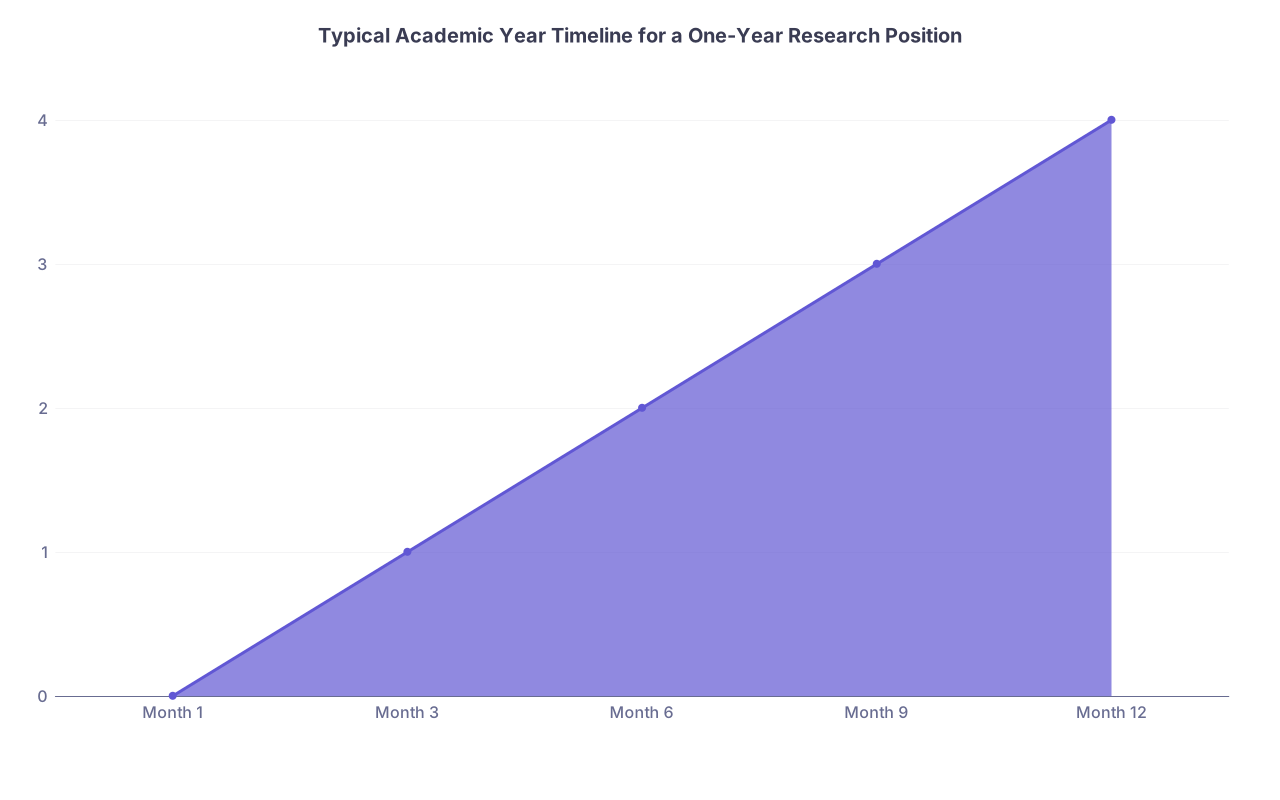
| Category | Value |
|---|---|
| Month 1 | 0 |
| Month 3 | 1 |
| Month 6 | 2 |
| Month 9 | 3 |
| Month 12 | 4 |
Now build your year backward:
- If major conference abstract is due in March:
- You need cleaned, locked data by early February.
- You need main analyses by late January.
- You need primary data collection finished by December.
Create a simple month-by-month plan on one sheet. Not a fantasy Gantt chart. A blunt checklist.
Example (starting in July):
July–August:
- Learn protocol, IRB constraints, data dictionary.
- Clean existing dataset, standardize variables.
- Fix REDCap forms if allowed.
- Close all knowledge gaps (stats refresh, specific software).
September–November:
- Complete data collection on remaining N.
- Weekly recruitment goals.
- Start running descriptive stats, spot-check data quality.
December–January:
- Finalize dataset.
- Run primary and key secondary analyses.
- Draft abstract, send to PI.
February–March:
- Submit abstract(s).
- Start full manuscript draft (Intro + Methods at minimum).
- Identify next abstract/paper angle if dataset is rich.
April–June:
- Revise manuscript with co-authors.
- Submit to a journal.
- Pull out small side analyses for quick abstracts/posters if time.
Print this timeline. Keep it visible. Use it to politely nag.
Step 4: Become the Person Who Pushes the Project Over the Finish Line
You are starting mid-project. That means much of the innovation work is already done. Your comparative advantage is execution.
You want your PI thinking: “Before they came, this project was stuck. Now it is moving.”
A. Own the Unsexy Work
I am blunt about this: the resident or research fellow who quietly solves the annoying, time-consuming problems wins authorship and strong letters.
Examples of high-value “unsexy” tasks:
- Cleaning hundreds of messy chart-review entries.
- Harmonizing variable names across multiple datasets.
- Writing reproducible code (RMarkdown, Jupyter notebooks, do-files) so future analyses are easy.
- Drafting IRB amendments and continuing reviews under guidance.
When you take on these tasks, frame them as leverage:
“If I standardize and clean the dataset now, it will be much faster to run all our planned analyses and future secondary projects. I am happy to take that on.”
Then actually deliver.
B. Track and Quantify Your Contributions
You are not doing this just to “help the lab.” You are doing it so:
- Your CV shows measurable achievements.
- Your letters of recommendation have numbers and outcomes.
Keep a running log (one simple document):
- Number of patients recruited/abstracted (N=…).
- Number of charts reviewed.
- Number of REDCap fields created or fixed.
- Analyses you ran (“Generated multivariable logistic regression models for [outcome], adjusted for [covariates].”)
- Documents you drafted (IRB amendment, abstract sections, manuscript sections).
You will use this log to:
- Update your PI quarterly with a 5–10 line progress email.
- Build your ERAS “Experiences” descriptions.
- Brief letter writers before they submit recommendations.
Step 5: Engineer Actual Outputs (Not Just “Experience”)
A one-year research position that yields “I learned a lot about research” is a failure from a residency application standpoint. You need output.
Let us be specific.
A. Your Ideal Minimum Output from a One-Year Position
If you manage your year well, a realistic, strong package looks like:
| Output Type | Target Number |
|---|---|
| First-author abstract/poster | 1–2 |
| Co-author abstracts/posters | 1–3 |
| Manuscripts submitted | 1–2 |
| Manuscripts in progress | 1–3 |
Can you do more? Of course. But if you hit this, you look productive by typical standards.
B. Design a First-Author Project You Can Actually Finish
If your main project is giant and long-term (multi-center RCT, large prospective registry), you may not see final outcomes in a year. So you carve out something manageable.
Strategies that work:
Subset analysis
- Focus on:
- a specific subpopulation (e.g., patients over 65, those with renal impairment),
- a particular outcome (readmissions, complications),
- or a starter time window (first 6 months of data).
- Turn that into: “Early experience with…” style abstract.
- Focus on:
Methods/feasibility paper
- If the main trial will not be done, see if your team would value:
- a protocol paper,
- a feasibility analysis (recruitment rates, reasons for exclusion),
- or a baseline cohort description.
- If the main trial will not be done, see if your team would value:
Quality improvement angle
- Many clinical projects overlap with QI.
- Example: “Implementation of [pathway] reduced [metric].”
- Easier to complete; still citable and discussable in interviews.
You pitch this early:
“Given the long-term timeline of the full study, I was wondering if we could define a smaller sub-project that I can drive to completion this year—for example, a baseline cohort description or a focused subgroup analysis that could be an abstract. I am happy to do the heavy lifting.”
C. Stack Small Wins Early
You do not want your entire year’s value hinging on one massive manuscript that dies in reviewer purgatory.
Look for fast-turnaround wins:
- Internal departmental research day posters.
- Regional conferences (easier acceptance than national meetings).
- Case series or brief reports loosely related to your lab’s topic.
- Secondary analyses from datasets that are already nearly complete.
Your strategy:
- Primary year-long project that you gradually move toward a serious manuscript.
- One or two short, quicker items that can be submitted within the first 6–8 months.
Step 6: Manage Up Without Being Annoying
PIs are busy, distracted, and often disorganized. Waiting passively for direction is how your year evaporates.
Your job is to manage up—professionally.
A. Use Short, Focused Communication
No long essays. Busy people do not read them.
Example monthly check-in email:
Subject: Brief update on [Project] – [Your Name]
Hi Dr. [PI],
Quick update on [project name]:
- Data collection: [X/Y] patients completed (goal: [target date for full N]).
- Data cleaning: [e.g., “All baseline variables checked; started cleaning outcomes.”]
- Analyses: [e.g., “Ran preliminary descriptive stats; next step is [analysis].”]
- Deliverables: On track to submit abstract to [conference] by [deadline].
This week I plan to:
- [Task 1]
- [Task 2]
Please let me know if you would like me to adjust priorities or if there is anything else higher-yield I should focus on.
Best,
[Your Name]
Short. Concrete. Easy to skim. Signals competence.
B. Ask for Targeted Feedback, Not Generic “Thoughts”
Instead of, “Can you look at this?” try:
- “Can you review the Methods section to confirm that I have correctly captured the study design and variables?”
- “Can you let me know if these three figures capture the main story of the data, or if you would prefer a different primary outcome representation?”
Give them specific questions and, if possible, discrete chunks of work (2–4 pages, not 20).
Step 7: Build Skills That Last Beyond This Year
You are not just collecting lines on a CV. You are building tools you will use the rest of your career.
A. Choose One Core Technical Skill to Level Up
Do not dabble in five things. Choose one primary skill to significantly improve:
- Statistical analysis in R or STATA
- Data wrangling in Python or SQL
- REDCap design and data management
- Basic machine learning workflows (if relevant and not gimmicky)
Then deliberately practice.
Concrete plan:
- Pick one online course / resource.
- Apply each concept directly to your dataset.
- Document your work in reproducible scripts.
Example: If you choose R:
- Learn tidyverse basics.
- Write scripts that:
- Clean the data.
- Generate all tables and figures.
- Save outputs in standardized formats.
Future attending-you will be grateful.
B. Write as Much as Possible
Writing is the rate-limiting step in most labs. If you can write, you are valuable.
Push to draft:
- Methods sections.
- Results sections once analyses are done.
- Abstracts and poster text.
Ask your PI:
“Once we have the analysis plan confirmed, would you be comfortable if I write the first draft of the Methods and Results? You can then revise as needed.”
They almost always say yes. Now you have tangible writing experience that comes up in interviews.
Step 8: Translate the Year into Match-Relevant Language
You can do everything right in the lab and still undersell it in residency or fellowship applications. You need to translate your experience.
A. Frame Experiences in ERAS Entries
When you fill out ERAS “Experiences,” do not just write “Research assistant on XYZ project.” That is lazy.
Describe:
- Your role: “Led data cleaning and analysis for a prospective cohort study of [population].”
- Your scale: “Abstracted data for 250 patients; managed REDCap database with >150 variables.”
- Your outcomes: “First author on abstract accepted to [Conference]. Co-author on manuscript submitted to [Journal].”
Example bullet:
“Designed and executed data cleaning pipeline for 300-patient cohort, implemented in R, which enabled timely submission of first-author abstract to [Conference].”
That sounds like someone who gets things done. Because it is.
B. Prepare 2–3 Tight Stories for Interviews
In residency and fellowship interviews, you will be asked about your research. Do not ramble.
You want:
1–2 minute “elevator pitch” of your main project:
- Clinical question.
- Study design.
- Your role.
- Key findings or anticipated impact.
A story that showcases problem-solving:
- Project was stuck because of X.
- You diagnosed it.
- You did Y.
- Outcome: abstract, manuscript, cleaned dataset, or accelerated recruitment.
A reflection on what you learned:
- About research design.
- About collaboration.
- About managing a long-term project.
Interviewers remember clarity. Not jargon.
Step 9: Protect Yourself from Common Failure Modes
I have watched people waste these one-year positions in remarkably predictable ways. You can avoid most of it.
A. Failure Mode: You Get Stuck on a Dead Project
Sign: Six months in, still “waiting for data” or “IRB is delayed” and your PI keeps saying, “Soon.”
Fix:
At month 3–4, if you sense persistent delays, request a meeting and say:
“I am concerned that given the IRB/timeline challenges, I may not have a complete project by the time I apply this fall. Is there an existing dataset or smaller project where I could take more ownership and realistically generate an abstract or manuscript?”
Be explicit about your application timeline.
Ask to be looped into ongoing, more mature projects in the group.
Do not wait until month 9 to have this conversation.
B. Failure Mode: You Become Generic Free Labor
Sign: You are doing endless chart review, recruitment, and clerical tasks but not attached to a specific paper or abstract.
Fix:
- Tie every major chunk of effort to a concrete output.
- Ask: “For the charts I am reviewing on [topic], is there a plan for a manuscript or abstract? If so, what could my role be on that paper if I continue this work?”
Push (politely) for authorship discussions early, especially if you are doing substantial intellectual or time-intensive work.
C. Failure Mode: No Documentation, No Credit
If you are doing real work but have zero record of it, you will:
- Forget details when writing ERAS.
- Make it harder for letter writers to praise you concretely.
- Underrepresent your contributions.
Fix:
- Keep that simple contribution log.
- Before letter requests, send your PI:
- Updated CV.
- 0.5–1 page summary of what you did: N recruited, data cleaned, analyses run, abstracts and manuscripts, conferences.
Make it easy for them to advocate for you.
Step 10: If You Are Already Halfway Through the Year
Maybe you are reading this at month 6 and realizing you have been drifting. Fine. Salvage time.
Here is the triage protocol.

| Step | Description |
|---|---|
| Step 1 | Month 6 Realization |
| Step 2 | Identify fastest abstract/manuscript option |
| Step 3 | Ask to join mature project |
| Step 4 | Propose concrete abstract plan to PI |
| Step 5 | Schedule meeting & clarify role |
| Step 6 | Set 3-month micro-deadlines |
| Step 7 | Document contributions for ERAS |
| Step 8 | Any data near-complete? |
Audit what exists:
- Is there any dataset already collected where analyses could be done in 1–2 months?
- Is there a half-written abstract or paper sitting idle?
Propose a single, specific quick-win project:
- “We already have [N] patients and [outcome] data. If I focus on [analysis X], could we aim to submit an abstract to [nearest conference] or a brief manuscript by [date]?”
Ruthlessly prioritize:
- For the next 3 months, drop lower-value activities.
- Focus on one or two outputs that can be real by the time ERAS matters.
It is not ideal, but I have seen people turn a meandering first half-year into a surprisingly solid second half by doing this.
A Quick Visual: What “Maximized” vs “Wasted” Looks Like

| Aspect | Maximized Year | Wasted Year |
|---|---|---|
| Role definition | Clear project ownership, written plan | Vague tasks, no defined deliverables |
| Data work | Cleans, analyzes, documents | Passively enters data |
| Outputs | 1–2 first-author, several co-author items | “Working on a manuscript” only |
| Communication with PI | Monthly concise updates, targeted questions | Sporadic, waits for direction |
| Match narrative | Clear story: problems solved, skills gained | Generic: “I learned about research” |
A Note on Specialty Competitiveness
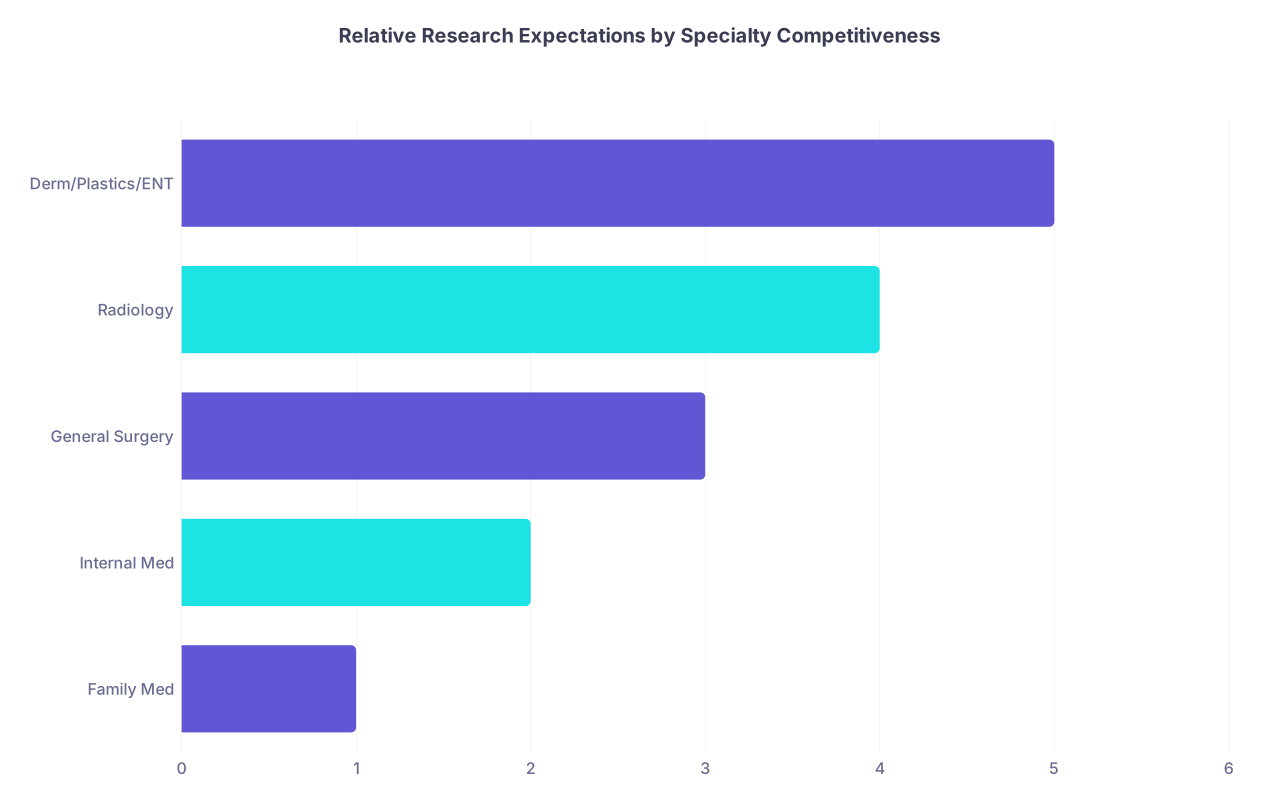
If you are heading toward a highly competitive specialty (derm, plastics, ortho, ENT, rad onc), the bar is higher. You know that.
Use your one-year position to:
- Get into your specialty’s conferences.
- Work with recognizable names in the field.
- Produce at least one thing where you are clearly first author.
| Category | Value |
|---|---|
| Family Med | 1 |
| Internal Med | 2 |
| General Surgery | 3 |
| Radiology | 4 |
| Derm/Plastics/ENT | 5 |
Do not pretend all fields expect the same research footprint. They do not.
Putting It All Together
You have one year. You started mid-project. That is not an excuse for having nothing to show. It is a constraint you design around.
If you:
- Diagnose the project status in the first 2 weeks
- Negotiate a clear role and tangible outputs
- Build your year around real deadlines
- Become the person who executes and finishes work
- Engineer at least one first-author and a few co-author outputs
- Translate your work into match-relevant language
…you will walk out with a CV that looks significantly stronger than your peers, and letters that say what programs want to hear: “This person gets things done.”

Your Next Step Today
Do one concrete thing right now:
Schedule a 30-minute meeting with your PI or main mentor and draft the email you will send afterward summarizing:
- Your primary project
- Your specific responsibilities
- The 1–2 deliverables you will aim to complete this year
- The timeline anchored to at least one real abstract deadline
Open your calendar, pick the slot, and send the request. That single action will force the clarity that most people never get—and it is the first move to actually maximizing this one-year research position.


