

Most gap years before residency are wasted because people rely on motivation instead of systems. That is the mistake you cannot afford to make.
You have one job this year: build weekly systems that survive stress, fatigue, and uncertainty. Not “grand plans,” not aspirational Notion boards. Systems. Routines that run even when you are tired, anxious about the Match, or stuck in a boring research job.
Let me give you a blueprint that actually holds up in the real world of:
- 8–5 research or clinical work
- ERAS chaos
- Personal life that refuses to pause just because you are “between” things
You will build:
- A weekly structure that fits any gap year situation
- A commitment protocol that keeps habits alive when your week explodes
- A Match-focused work system so your application gets stronger every month
- A maintenance protocol for clinical knowledge, mental health, and relationships
We are not chasing perfection. We are chasing durability.
Step 1: Decide Your Gap Year “Operating Mode”
Most people skip this and then wonder why their weeks feel chaotic. You need to define what your gap year actually is.
There are only four real modes:
- Research-heavy (full-time lab / outcomes / QI work)
- Clinical-heavy (hospitalist scribe, research coordinator with patient contact, clinic MA, etc.)
- Mixed (part-time clinical, part-time research, tutoring, etc.)
- Recovery + Application (after a rough med school run, focused on health + ERAS rehab)
Each mode changes your weekly systems.
Quick rule:
- If you work ≥ 40 hrs/week → your system must be minimal and brutally prioritized.
- If you work < 30 hrs/week → treat the extra time like a part-time job for your future self.
Decide your mode right now and stick to it for the rest of this article. I will assume you are:
- Working ~40 hrs/week (or close)
- Applying in the upcoming ERAS cycle
- Want to avoid the “I blinked and my gap year vanished” problem
Step 2: Build a Fixed Weekly Skeleton (Before You Add Goals)
People start with goals: “I will publish two papers, learn Python, study 4 hours/week, get jacked, and sleep 8 hours.” Then they die in month 2.
You start with time, not goals.
Here is the Weekly Skeleton that works for 90% of gap year residents-to-be:
| Category | Hours/Week | Non‑negotiable? |
|---|---|---|
| Paid work (research/clinical) | 40 | Yes |
| Application work (ERAS, letters, personal statement, interview prep) | 4–6 | Yes (seasonal) |
| Academic maintenance (reading, QBank, CME videos) | 3–4 | Yes |
| Long-term career projects (research writing, QI, coding, teaching) | 3–5 | Yes |
| Health (exercise + sleep focus) | 6–8 | Yes |
| Social / personal life | 6–10 | Flexible |
This is the starting skeleton. You then:
- Block work hours (obvious).
- Choose two weeknights where you reliably have 90 minutes of real brainpower.
- Choose one weekend half-day (morning or afternoon) that you protect like a clinic block.
Those 3 blocks (2 weeknights + 1 weekend half-day) are where your gap year is won or lost.
- Weeknights → light/medium cognitive tasks
- Weekend half-day → deep work: writing, structuring projects, mock interviews, etc.
If your schedule is constantly changing (shifts, PRN work, etc.), you do this differently:
- Every Sunday night, you schedule the upcoming week from scratch.
- You still create three protected blocks (at least 60–90 minutes each) as if they were shifts.
No blocks = no system. You are just reacting.
Step 3: The “Two-Tier” Weekly System (So It Survives Chaos)
You need a system that does not shatter every time you get sick, have to cover a shift, or your PI dumps data on you Friday at 4 pm.
Do this:
Tier 1: Minimum Viable Week (MVW)
This is your floor, not your ideal.
On a bad week, you commit to only:
- 1 hour of application / career work
- 1 hour of academic/clinical maintenance
- 2 short workouts (20–30 minutes each)
If you hit only this, the week is still a win. You did not lose ground.
Concrete example of an MVW:
- Tuesday 7:00–7:30 pm → read 1–2 recent articles in your target specialty or do 10–15 UWorld questions
- Thursday 7:30–8:30 pm → edit one paragraph of personal statement or spend 60 minutes refining your CV
- Saturday 10:00–10:30 am → bodyweight workout at home; Sunday 6:30–7:00 pm → walk + stretch
That’s it. Four touchpoints. Designed so small that even post-call you can pull it off.
Tier 2: Target Week
This is when life is “normal” and you are not in disaster mode.
Target Week example:
- Application / career: 3–4 hrs
- Academic maintenance: 2–3 hrs
- Projects / research: 2–3 hrs (beyond work duties)
- Health: 3× workouts (30–45 min), sleep ≥ 7 hrs most nights
You never plan above your Target Week. You are not building an Instagram grind schedule. You are building something that can last 9–12 months.
Step 4: Core Weekly Blocks – What You Actually Do In Them
The biggest failure point: people “block time” then sit down and have no idea what to do. So they “organize” files or tweak their resume font for 40 minutes.
You will pre-define the contents of each weekly block.
Block 1: Application / Match Work (1–4 hours weekly depending on season)
This block runs all year, but what happens inside it changes by phase.
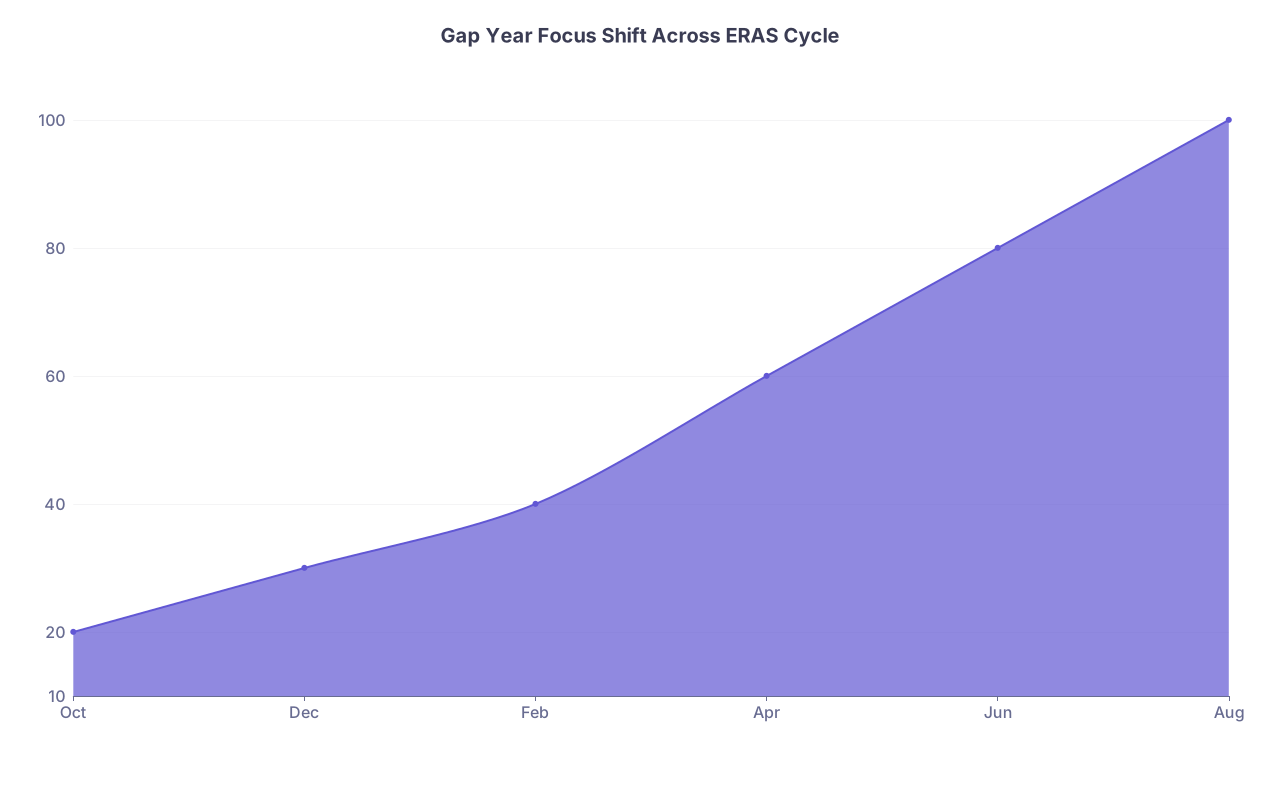
| Category | Value |
|---|---|
| Oct | 20 |
| Dec | 30 |
| Feb | 40 |
| Apr | 60 |
| Jun | 80 |
| Aug | 100 |
Use this rough timeline (for an application targeting September submission):
October–December
- Audit your past: updated CV, list of experiences, rough idea of “story”
- Identify letter writers early, especially from gap-year work
- Research programs; build a preliminary list (state, IMG-friendliness, DO-friendliness, Step cutoffs, etc.)
January–March
- Draft personal statement v1, then v2
- Create ERAS activity bullets (achievement-focused, not task-based)
- Do 1–2 low-stress mock interviews (even just with a co-resident or mentor)
April–June
- Finalize personal statement and CV bullets
- Confirm letters: remind writers with a clear, polite timeline
- Build spreadsheet of programs with preferences / pros / cons
July–September
- Application assembly and polish
- Final program list + tailored secondary statements if needed
- Interview prep: common questions, scenario practice, specialty-specific themes
Each week, you pick 1–2 tiny deliverables, not vague tasks.
Instead of: “Work on ERAS” Use: “Rewrite 4 experience bullets for my top 10 activities” or “Cut 100 words from personal statement by removing fluff.”
Block 1 checklist template for a week:
- Update 3 ERAS bullets from task-focused → outcome-focused
- Email 1 possible letter writer with a concise, respectful ask
- Add 2 programs to my spreadsheet with notes on what they value
You should be able to answer every Sunday: “What did I add to my application this week that did not exist last week?”
Block 2: Clinical / Academic Maintenance (1–3 hours weekly)
You are not going to be “ERAS ready” if your clinical brain rusts. Also, interviewers can tell when your knowledge fell off a cliff 9 months ago.
Keep this brutally simple. Pick one main tool and stick with it:
- UWorld (or AMBOSS) – 10–20 questions twice weekly
- Weekly guideline reading – like 1 section of ACC/AHA, IDSA, or specialty-specific guidelines
- NEJM / JAMA / specialty journals – 1–2 key articles per week with short written takeaways
My simple, effective structure:
Weeknight A – 30–45 min
- 10–15 questions in your future specialty or IM/FM if undecided
- Review only what you got wrong + 1 concept you knew but want rock-solid
Weeknight B – 30 min
- One recent article or guideline section
- Write down 3 bullets: “Key point”, “How it changes what I say to patients”, “What most residents get wrong about this”
This is not Step studying. This is muscle maintenance.
Step 5: Weekly Review + Planning Ritual (30 Minutes That Saves You 30 Hours)
If you skip this, your weeks blur and nothing compounds. You feel “busy” but your ERAS does not change.
Every Sunday (or your day off), run this 30-minute system:
1. Look Back (10 minutes)
Open a note or physical notebook. Use the same three lines every week:
- Application moves: What concrete progress did I make? (e.g., “PS v1 drafted,” “CV updated,” “Emailed Dr. X about a letter.”)
- Knowledge/skills: What did I learn or reinforce? (e.g., “ACS NSTEMI management refresher,” “learned how to interpret sleep study reports.”)
- Systems check: What blocks were skipped and why? (fatigue, poor sleep, unrealistic goals, surprise work)
You are looking for patterns:
- Always missing Thursday block? Then stop scheduling it there. Move it.
- Always skipping after 9 pm? Stop pretending you are night-productive.
2. Look Ahead (20 minutes)
You do not “hope” productivity happens. You assign it.
- Check your fixed commitments (work schedule, appointments, call coverage).
- Choose:
- 1–2 Application tasks
- 1–2 Academic tasks
- 1 Project / long-term career task
- Place each into a specific 30–90-minute block in your calendar.
Examples:
- Tuesday 7:00–7:45 pm – Rewrite “leadership” ERAS entry (from duties → outcomes)
- Thursday 7:30–8:00 pm – Do 10 UWorld cardio questions, review wrong answers
- Saturday 9:30–11:00 am – Draft Results section for research manuscript or analyze dataset slice your PI sent
Your week is now pre-decided. When the time comes, you do not negotiate, you execute.
Step 6: Match-Boosting Work Systems Inside Your Gap Year Job
If you are in research or a clinical job, you can either just draw a paycheck or you can weaponize it for your Match.
You do that by turning vague work into output that ERAS understands:
- Abstracts
- Posters
- Manuscripts
- QI projects
- Teaching / curriculum development
System: From “Just Working” to Concrete Products
Use this 4-step loop with any PI, attending, or supervisor.
Clarify goals early
- Ask directly: “I want to apply to [specialty] this fall. What’s a realistic research or QI product we can submit before then?”
- Aim for at least 1 abstract or poster before applications. 2+ is great, but not required.
Break the project into weekly micro-tasks
- “Literature search for Introduction”
- “Draft 5 slides of background”
- “Clean 50 rows of data and check for missing values”
- “Write rough Methods section bullets”
Attach tasks to your protected weekend block
- This is not “extra work.” This is training for residency, where working on off-days is normal for academic output.
- Keep tasks small enough that completion is obvious in 60–90 minutes.
Close the loop with your supervisor weekly
- 1 email or 5-minute in-person touchpoint: “Here’s what I did this week. Here’s what I plan to do next week. Any changes?”
- People give more opportunities to the person who reliably moves things forward.
Step 7: Mental Health and Burnout Protection – As a System, Not an Afterthought
Gap years can be psychologically brutal:
- Watching classmates post resident life on Instagram
- Feeling “behind”
- Uncertainty about whether you will match this cycle
You do not manage that with vague promises to “take care of myself.” You systematize it.
Build a Basic Psychological Safety Net
Minimum viable system:
- 1–2 social anchors/week – Non-negotiable low-stress interactions (coffee, phone call, walk with a friend)
- 1 solo decompression ritual – Same day, same time each week (Saturday morning walk, Sunday evening reading, whatever)
- 1 check-in question on Sunday – “What is the actual thought that has been stressing me out this week?”
If the answer to that Sunday question is consistently some version of:
- “I won’t match.”
- “I am behind everyone else.”
- “My gap year is pointless.”
Then you need to turn that vague anxiety into actionable risk management, not rumination.
Examples:
Worried about matching?
- Expand your program list by 10–20 safer programs.
- Reach out for an honest read from a mentor in your specialty.
- Build a parallel plan (prelim year, backup specialty, research-heavy cycle) as a pressure release valve.
Feeling behind in knowledge?
- Commit to a January–June micro-curriculum in your specialty with 1–2 chapters/articles per week.
- Schedule 1 shadowing / clinical day per month if your job is non-clinical.
This is how you use your system to fight anxiety—by converting fear into specific, scheduled steps.
Step 8: Adjusting Intensity by Season – Not Every Month Should Look the Same
Another way gap years fail: someone tries to maintain “high intensity” all 12 months. That is not sustainable.
Instead, run your year in phases.
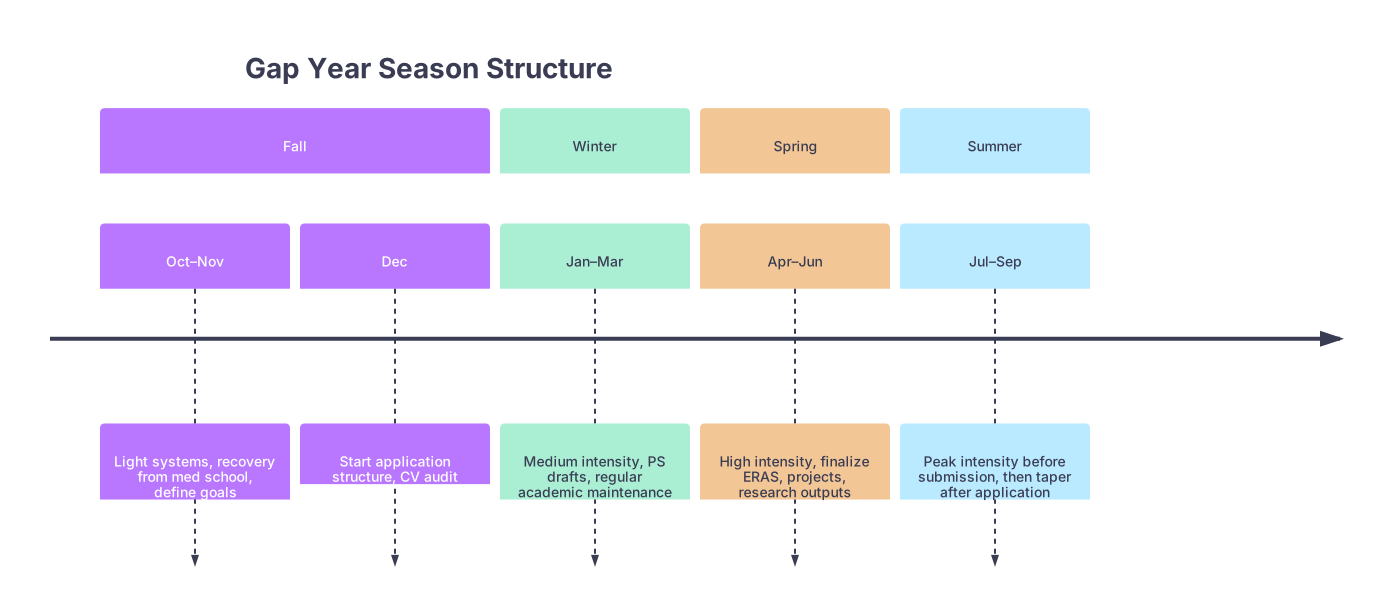
| Period | Event |
|---|---|
| Fall - Oct–Nov | Light systems, recovery from med school, define goals |
| Fall - Dec | Start application structure, CV audit |
| Winter - Jan–Mar | Medium intensity, PS drafts, regular academic maintenance |
| Spring - Apr–Jun | High intensity, finalize ERAS, projects, research outputs |
| Summer - Jul–Sep | Peak intensity before submission, then taper after application |
Phase 1: Stabilize (Oct–Dec)
- Focus: sleep, health, light academic maintenance, define application story
- System: Minimum Viable Week + 1 career block
Phase 2: Build (Jan–Mar)
- Focus: personal statement v1–2, ERAS bullets, early research outputs
- System: Target Week, with 2–3 hrs/week for application work
Phase 3: Execute (Apr–Jun)
- Focus: finalize written materials, complete main research/QI project deliverables
- System: Target Week + short sprints (extra weekend hours when needed)
Phase 4: Submit and Shift (Jul–Sep)
- Focus: assemble and submit application, then switch to interview prep + continued maintenance
- System: Heavier front-loaded July–Aug, then stabilize again once ERAS is in
If you are already in the middle of the year, do not overthink it. Start the phase you are in now and proceed.
Step 9: Non-Negotiable Tools That Make This Easier
You do not need a $70 planner and five productivity apps. You need three simple tools:
Calendar with time blocks
- Google Calendar or Outlook. Color code: work, application, academic, personal.
- Everything important gets a time slot. If it is not on the calendar, it is fantasy.
One running “Gap Year Log”
- Single Google Doc / Notion page / physical notebook.
- Sections:
- Weekly review notes
- List of concrete outputs (abstracts, manuscripts, talks, projects)
- Application progress checklist
- This becomes gold when you write ERAS bullets and prep interviews.
Task list with 3–5 items per week
- Reminders app, Todoist, pen-and-paper.
- Never more than 5 “must-do” items weekly outside work.
- If your list is 17 items long, you are lying to yourself.
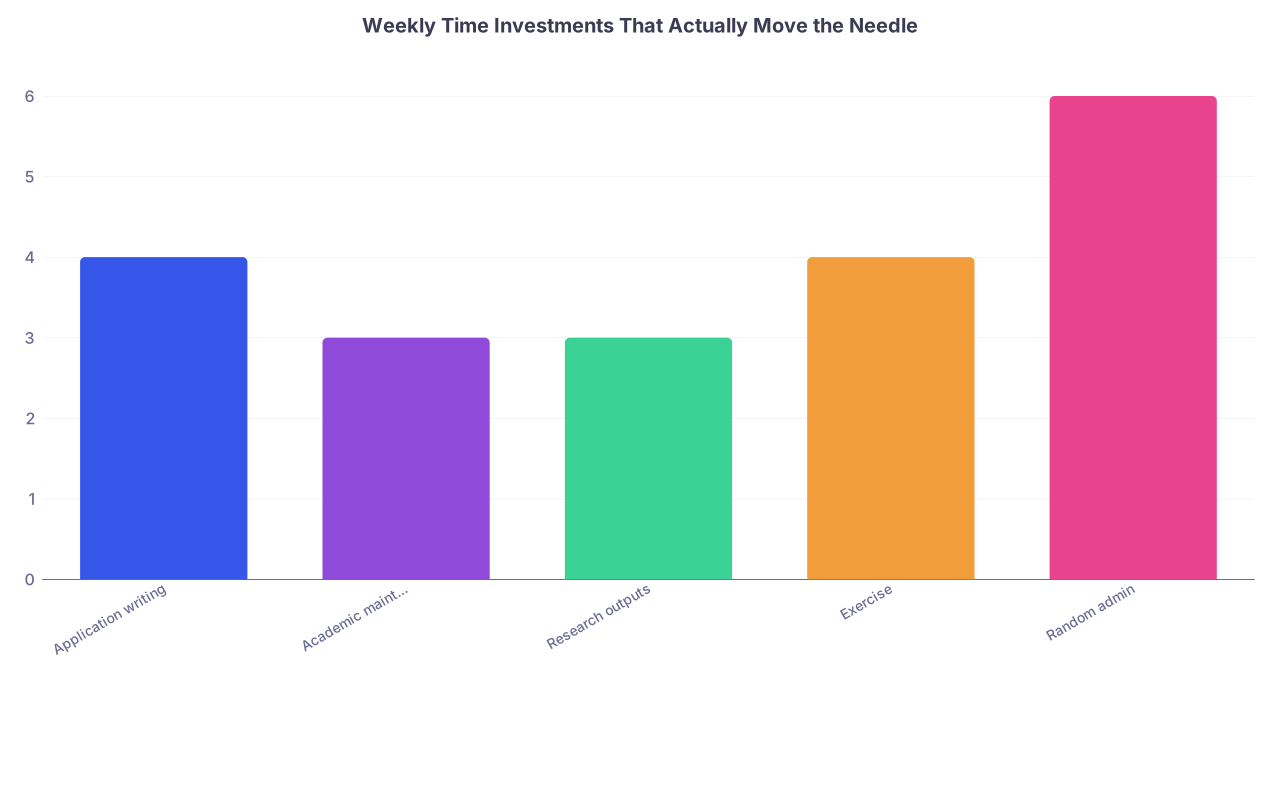
| Category | Value |
|---|---|
| Application writing | 4 |
| Academic maintenance | 3 |
| Research outputs | 3 |
| Exercise | 4 |
| Random admin | 6 |
The point: most people overspend time on low-yield “random admin” and underspend on application writing and academic maintenance. Your system fixes that.
Step 10: What Happens When You Fall Off for 2–3 Weeks
You will fall off. Busy season at work, travel, family issues, illness, mental exhaustion. The question is not if, it is how you restart.
Here is the Restart Protocol:
Acknowledge, do not audit.
- No forensic analysis of why you failed. That is procrastination disguised as reflection.
- Just one line in your log: “Missed 2 weeks due to X. Restarting today.”
Run a Minimum Viable Week, only.
- 1 hr application, 1 hr academic, 2 workouts.
- That is it. No Target Week, no extra tasks. You re-prove to yourself that you can execute.
Shrink the next week too if needed.
- Two consecutive MVWs are better than one heroic Target Week followed by another crash.
Use one “win log” item.
- Write down one concrete win from the restart week: “Rewrote PS intro,” “Did 15 UWorld questions with full review.”
- This re-anchors your identity as someone who follows through.
That is how people who actually match after chaotic gap years operate. Not by never falling. But by having a protocol when they do.
Condensed Blueprint
If you remember only a few things from all this, remember these:
Systems beat motivation.
Build a weekly skeleton (2 weeknights + 1 weekend block), with a Minimum Viable Week and a Target Week. Everything else hangs on that.Every week must produce something ERAS can see.
A better bullet, a refined personal statement, a small project step, a bit of preserved knowledge. Track it in a single gap year log.Run your gap year in phases, not permanent grind.
Stabilize → Build → Execute → Submit. Adjust intensity by season and use a Sunday 30-minute review to keep the system alive.
Do this, and your gap year stops being “time off” and becomes the most strategically useful year you have before residency.


