

It’s July. You’re staring at your ERAS draft. In the “Experiences” section sits that line that defines your whole last year:
“2023–2024: Research Fellow, Department of Surgery, Big Name University.”
You’re wondering what’s going to happen when a program director clicks it. Do they think: “Impressive, dedicated, academic material”?
Or: “Couldn’t match, tried to slap lipstick on it”?
I’ve watched that click from the other side. I’ve sat in the room when the PD scrolls, raises an eyebrow, and says, “Okay, what’s the story with this gap year?”
Let me walk you through what actually goes through their heads. Not the sugar-coated version your school’s “career office” gives you. The real one.
The First Thing a PD Thinks When They See a Research Year
No one sees “research gap year” on ERAS and doesn’t form an immediate hypothesis.
There are three default narratives PDs jump to based on your application context:
- You’re a gunner aiming high (competitive specialty, strong scores, big-name lab).
- You’re damage-controlling (red flags, low scores, failed to match once).
- You’re filling time because you didn’t know what else to do.
They use the rest of your file to decide which bucket you belong in. Fast.
Here’s the unstated rule: program directors do not care that you “did a research year.” They care why you did it, where you did it, and what came out of it.
You’ll never see that written in a handbook, but it’s how they actually talk about you.
The Silent Sorting: When a Research Year Helps vs Hurts
Every PD I know, regardless of specialty, is doing this mental sort in the first 30 seconds.
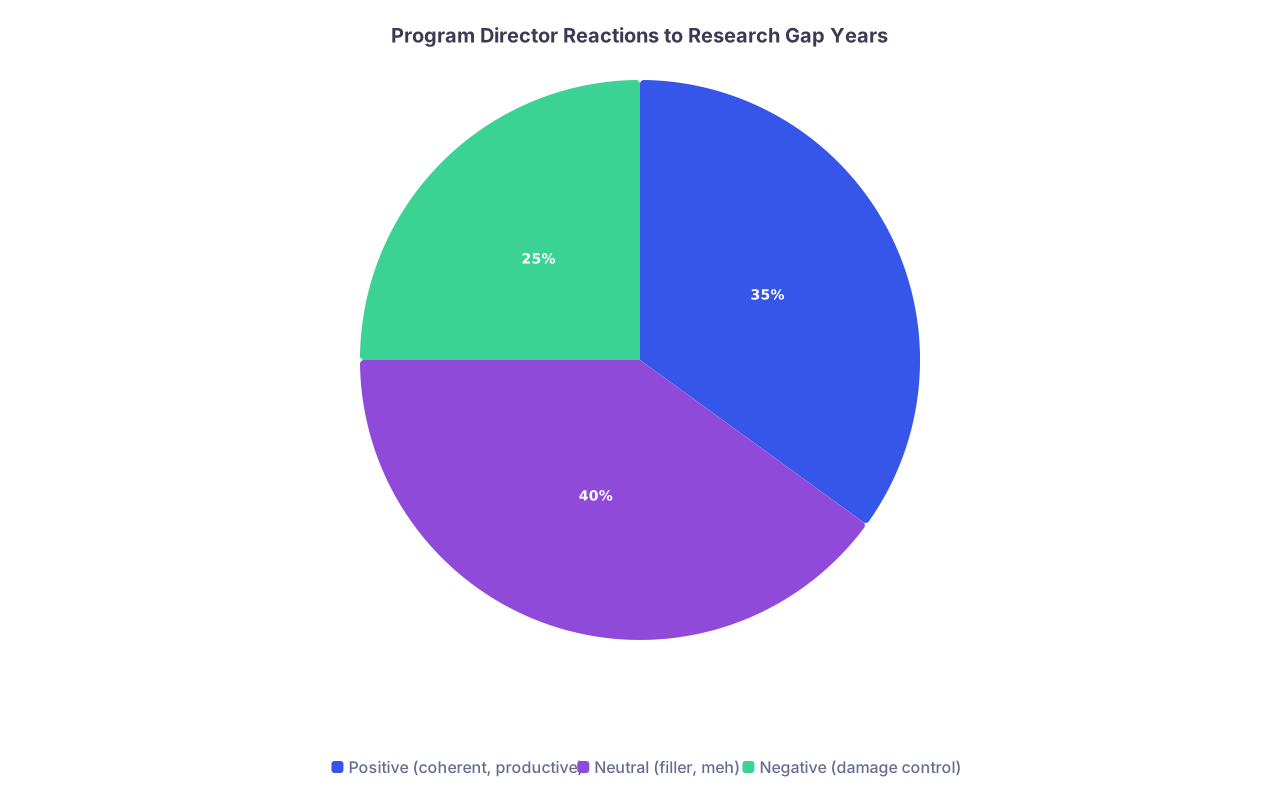
| Category | Value |
|---|---|
| Positive (coherent, productive) | 35 |
| Neutral (filler, meh) | 40 |
| Negative (damage control) | 25 |
Those numbers aren’t from a paper; they’re the rough distribution you’ll hear behind closed doors at selection meetings. Let me break down what lands you in each pile.
The Positive Pile: “This Makes Sense”
This is where you want to be. The research year looks purposeful and coherent with the rest of your story.
That looks like:
- You’re applying to a research-heavy or competitive specialty: derm, plastics, ortho, ENT, rad onc, neurosurgery, academic IM, etc.
- You did the year at a known program or under a name that PDs recognize.
- You show actual output: pubs, abstracts, posters, not just “data collection.”
- Your letters from the year are strong and specific, not generic fluff.
Example: A student with solid scores but from a mid-tier med school wants derm. They do a year at a big academic derm department, get on 2–3 papers (even middle-author), present at a national meeting, and have a letter from a PD or division chief. That student’s research year is seen as a smart, strategic investment.
I’ve heard PDs say verbatim: “I like that they took a year to focus. Shows commitment.”
The Neutral Pile: “Okay, But So What?”
This is the biggest category. The research year isn’t necessarily a red flag, but it also isn’t a big plus.
This happens when:
- There’s research, but no obvious deliverables.
- The project doesn’t clearly connect with your chosen specialty.
- The mentorship seems weak—no big name, no PD letter, no “this person is a future star” vibe.
- It feels like you did it because “everyone in [X specialty] does research.”
On selection committees, those people get comments like:
“Did a research year. Looks… fine. Nothing amazing.” Then the discussion moves on.
No one is impressed you took a year. They’re impressed if you used the year.
The Negative Pile: “Damage Control / Red Flag”
This is where you land if the research year looks like a smokescreen.
Common scenarios:
- You failed to match in the same specialty last year and now there’s a “research year” at the same institution with zero or minimal output.
- You have glaring red flags (Step failures, professionalism issues) and it looks like you’re trying to distract from them with some generic research.
- The timeline is weird—lots of “pending” and “submitted” work but nothing actually accepted or presented, even near the end of the year.
What PDs actually say in that room:
“So they didn’t match last year and this is what they did with 12 months?”
Or worse: “They say it’s a research year, but I’m not really seeing anything.”
If your research year is clearly a reapplication maneuver, PDs examine it under a microscope. They want proof you didn’t just spend a year hiding.
How Different Specialties Really Weigh a Research Year
Anyone who tells you “research helps for all specialties” is technically right and practically useless. The weight is not the same.
Here’s roughly how PDs think about it across the spectrum:
| Specialty Type | Impact of Research Gap Year |
|---|---|
| Super-competitive (derm, PRS, NSG, ENT, rad onc) | Often expected / strong plus |
| Academic-heavy (cards, heme/onc, GI, pulm/crit) | Big plus if productive |
| Mid-competitive (EM, anesthesia, OB/GYN, radiology) | Helpful but not decisive |
| Community-heavy (FM, psych, peds, community IM) | Mild plus or neutral |
In the hyper-competitive fields, a research year is now practically normalized. In some derm and plastics shops, if you didn’t take one, that triggers more questions than if you did.
But here’s the nuance you won’t get from forums: even in those fields, PDs distinguish between “serious, integrated research year” and “tourist in the lab.”
I’ve sat with a derm PD scrolling through two apps:
- Applicant A: Research year at their own institution, 3 abstracts, 1 middle-author pub, strong letter from the chair.
- Applicant B: Research year at a random place, 0 pubs, 1 local poster, generic letter.
Exact quote: “We interview A. B did a year and has nothing to show for it. No thanks.”
In less research-heavy specialties, a research year can even backfire if it feels misaligned. For example, a community FM program director looking at an applicant who took a year off to do bench immunology work might say: “Why is this person going into family med if they’re so into the lab? Are they going to be happy here?”
They won’t say that to you. They say it in the ranking meeting.
What PDs Look for Inside the Research Year Entry
This is where people blow it. They think the title “Research Fellow” is enough. It isn’t.
When a PD clicks that entry, they’re scanning for five things:
Continuity and commitment
Does this clearly connect to your specialty choice and the rest of your CV? Or does it look like a random detour?Productivity
Not just “worked on.” They want verbs with outcomes: wrote, analyzed, presented, published.Level of responsibility
Were you a data-entry grunt or actually writing manuscripts, presenting, leading sub-projects?Mentorship / name recognition
They absolutely look at who supervised you. Do they know them? Trust their judgment?Maturity and professionalism
Your descriptions and LORs should show you behaved like a junior colleague, not a student who needed hand-holding.
The PDs I’ve seen scroll don’t read your whole ERAS line-by-line at first. They skim. They look for bolded outcomes (accepted, presented, published), well-known conference names, and recognizable journals.
If you have a research year with zero accepted anything by application time, that’s a problem. They know not everything gets published in 12 months, but something usually happens if you were truly engaged.
The Hidden Red Flags: What Makes a Gap Year Look Bad
Let me be blunt. There are certain patterns that make a research year toxic instead of helpful. These are things PDs whisper to each other when your file’s not in the room anymore.
1. The “Laundry List, No Substance” Problem
You list six ongoing projects, all with vague titles, no outcomes, and you’re “Collecting data” in every description. No abstracts. No poster presentations. No manuscripts even listed as “submitted.”
That screams one of two things: you didn’t drive anything forward, or you’re inflating your involvement in projects that aren’t really yours. Neither interpretation helps you.
2. The Timeline That Doesn’t Add Up
You claim to have done a full-time research year, but you only list 8–10 hours/week of activity, or your start and end dates don’t make sense with graduation and rotations. PDs absolutely notice.
They aren’t just looking at hours. They’re asking: “If they were full-time for a year, where’s the output?” If there’s no output and the hours are low, it looks like you just needed a plausible label for a gap in your timeline.
3. The “I Did Research But Can’t Explain It” Interview Disaster
This one is brutal. You walk into the interview, get hit with:
“So tell me about your main research project last year. What was your role and what did the study show?”
And you:
- Struggle to explain the hypothesis.
- Can’t summarize key results.
- Don’t know the study design beyond “retrospective chart review.”
- Default to: “I mainly helped with data collection.”
I’ve watched PDs literally cross people off their interview list after that. It’s an authenticity test. If you spent a year on something and can’t talk about it, they assume you either padded your CV or disengaged.
The Difference Between a “Real” Research Year and a Box-Checking One
On paper, two people can both have “Research Fellow, Department of X, Year Y.” In reality, PDs sniff out the difference pretty quickly.

Here’s how they separate them:
A Real, High-Value Research Year Looks Like:
- You worked under a PI who regularly publishes in the field you’re applying to.
- You can point to at least one concrete product: poster at a national meeting, manuscript under review, or a clearly defined, nearly-ready paper.
- You had consistent, longitudinal involvement. Not three months in one lab, two months in another, and chaos in between.
- Your letter from that year is strong, detailed, and speaks to growth, work ethic, and academic potential.
Those applicants come across in interviews like junior fellows. They know their project, they understand why it mattered, and they can tie it back to patient care and their future trajectory.
A Box-Checking, Low-Value Research Year Looks Like:
- You mainly emailed surveys and filled in spreadsheets.
- The PI barely knows you and writes a bland letter: “X was involved in several studies. They were pleasant to work with.”
- Your ERAS experiences use vague language: “assisted with,” “involved in,” “participated in research.”
- You can’t answer basic questions about the project aims and interpretations.
PDs are not fooled by volume. Ten flimsy “projects” impress them less than one well-executed, clearly articulated study you truly owned a piece of.
How PDs Use a Research Year to Judge You (Not Just Your CV)
Here’s the real secret: PDs aren’t actually evaluating your research. They’re using your research year as a stress test of your professional behavior.
Over and over, I’ve watched them draw character conclusions from how that year looks.
They’re asking themselves:
- Did you finish what you started?
- Did you build and maintain mentoring relationships?
- Can you communicate complex work clearly?
- Did you show initiative or did you just wait for tasks?
If your research year shows initiative — you took on a subproject, pushed a manuscript forward, presented at a meeting — they extrapolate that to how you’ll function as a resident. Initiative is rare. PDs know it when they see it.
On the flip side, if your research year looks like an unstructured, low-yield drift, that triggers concern: “Are they going to need micromanagement? Are they self-directed at all?”
Gap Year vs Post-Match “Research Year”: The Context Problem
There’s a big difference in how PDs read:
- A planned research year before applying (you delay graduation or strategically insert a year).
- A research year after not matching (you graduate, don’t match, then scramble into a “research position”).
They almost never say this out loud, but the second one is judged more harshly. Not because taking a second shot is bad — many respect that — but because the bar is higher.
If you’re reapplying and that reapplication is built on a research year, PDs ask a very specific question:
“Does this year convincingly change their trajectory?”
If the answer is no — same scores, no major new letters, minimal research output — then the research year just highlights that you burned another year without changing the fundamentals.
I’ve seen reapplicant files get this exact comment:
“They did a ‘research year’ but this file looks almost the same as last year.”
Those applicants rarely move up the list.
How This Actually Plays Out in Rank Meetings
Let me give you the part no one tells you about — how your research year is discussed when PDs and faculty are ranking.
Picture a conference room, list on the screen, applicant files open. They hit your name.
Someone (often the PD or associate PD) reads a quick summary: “This is the one who did a research year at [Institution] in [Specialty].”
Three versions of the conversation happen.
Version 1: The Research Year as a Plus
“Research year with Dr. [Big Name] at [Top Program], two posters at [Major National Meeting], a pending first-author paper. Strong letter from the PI, calls them ‘one of the best students I’ve worked with in years.’ They talk very clearly about the project in the interview. Definitely academic-track potential.”
What happens? They go higher on the list. Simple.
Version 2: The Research Year as Neutral Filler
“Did a research year at [Mid-tier place], seems like mostly data collection. No publications yet, one local poster. They said they learned a lot, but honestly their clinical performance and personality are the main selling points.”
What happens? They’re ranked based on everything except the research year. The year neither kills them nor saves them.
Version 3: The Research Year as a Red Flag
“Took a research year after not matching last year. They list six projects, but I don’t see any actual products. In the interview, they struggled to explain their main study. The research letter is okay, but pretty generic.”
What happens? Comments like: “I’m not sure this year really added anything” or “I worry they don’t follow through.” They slide down, or off, the rank list.
That’s the reality. Your research year is a “force multiplier” if done right — or a huge spotlight on your weaknesses if not.
The Bottom Line: What PDs Actually Care About
Strip away all the premed mythology and here’s how program directors really view a research gap year on ERAS:
They don’t reward the existence of the year. They reward the story and substance of it.
They’re trying to answer: Does this year make you more likely to be a productive, reliable, and engaged resident in my program?
If your research gap year:
- Aligns clearly with your specialty,
- Produces concrete, understandable outcomes,
- Comes with strong, specific letters from people PDs trust,
- And you can talk about it like an adult who owned their work,
then PDs see it as a strong positive, especially in academic and competitive fields.
If it’s vague, low-yield, poorly explained, or transparently a cosmetic attempt to cover for other issues, they see right through it.
Remember these core truths:
- A research year is not a magic eraser; it amplifies who you already are — disciplined and focused, or drifting and passive.
- PDs judge the quality and coherence of the year, not the title “research fellow.”
- In the room where your name is actually discussed, your research year is treated as either a meaningful investment or evidence you don’t finish what you start. Make sure it’s the former.


