

The wrong gap-year supervisor can kill your residency chances without ever raising their voice.
Not with a screaming red flag letter. With a polite, “supportive,” perfectly poisonous one. And you will never see it.
If you’re in a gap year before residency and leaning on a PI, research director, chief, or clinic lead for a letter of recommendation (LoR), you’re walking through a minefield. Most applicants obsess over Step scores and personal statements, then casually hand their future to the nearest “Dr. Big Name” because they seem “nice enough.”
That’s how people get quietly filtered out.
Let me walk you through the landmines I’ve seen up close—and how you avoid being the next “seems fine, low enthusiasm” reject on a rank list.
The Silent LoR Killers: What PDs Actually Hate
Program directors are not reading your letters for adjectives. They’re reading for subtext and for red flags. A bland or lukewarm letter is not neutral; it’s negative.
Here’s what quietly toxic letters often include:
- Vague praise with no specifics
- “Damning with faint praise” phrases
- Subtle professionalism concerns
- Comparisons that place you in the middle of the pack
- Generic copy-paste language that screams “I barely know this person”
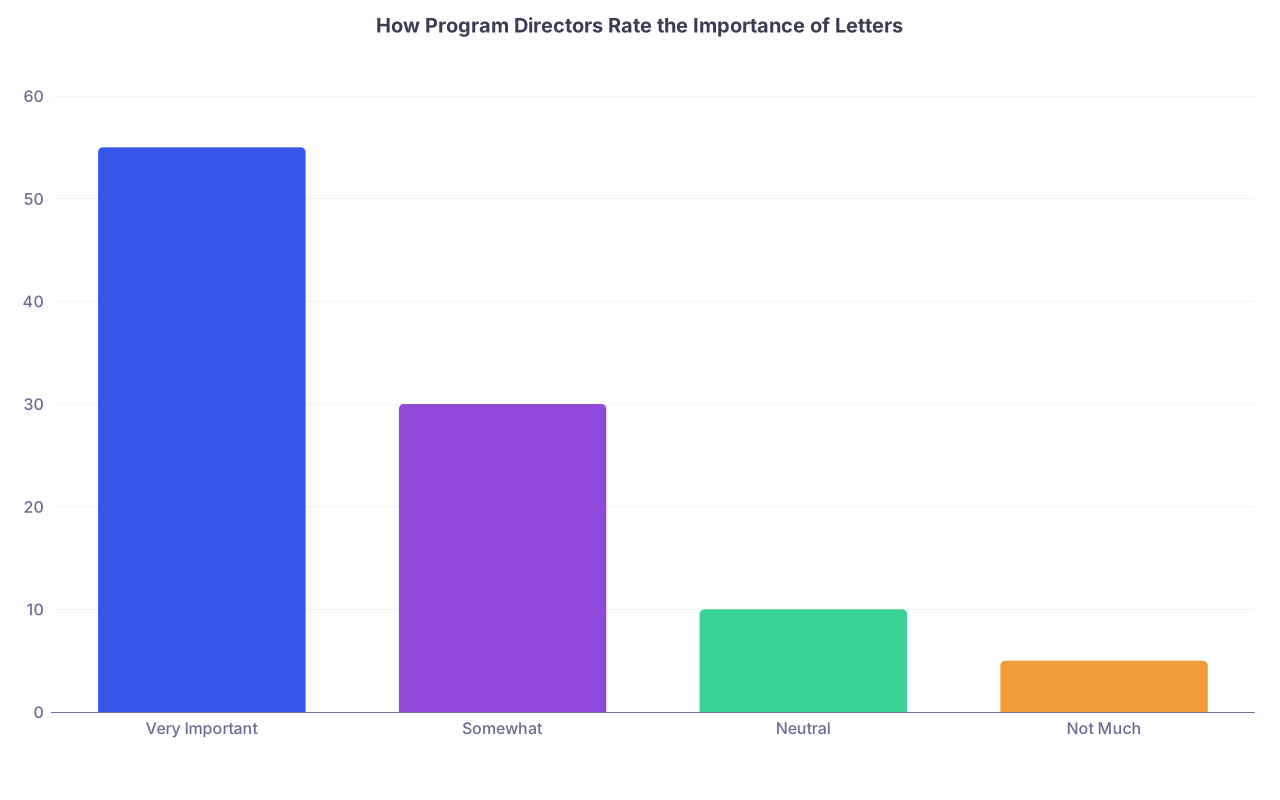
| Category | Value |
|---|---|
| Very Important | 55 |
| Somewhat | 30 |
| Neutral | 10 |
| Not Much | 5 |
Those “neutral” letters? They are not neutral in a competitive field. They are death.
Common quiet-killer lines:
- “X completed their work as assigned.” (Translation: bare minimum)
- “I expect X will be a solid resident.” (Translation: not a star, maybe a risk)
- “Given appropriate supervision, X can manage patient care.” (Translation: do not let this person work independently anytime soon)
- “X was pleasant to work with.” (Translation: nothing else good to say)
Gap-year supervisors—especially in research—are notorious for these. Not because they’re evil. Because:
- They don’t understand residency selection.
- They don’t know you well enough.
- They write the same letter for everyone.
- No one taught them how much harm a weak letter can do.
Your job is not to “find someone who likes you.” Your job is to ruthlessly filter out anyone who might accidentally sink your application.
Landmine #1: The Big-Name PI Who Barely Knows You
This is the classic trap.
You spend a gap year in a famous lab. You think: “A letter from this Harvard / Hopkins / Big Cancer Center PI will be gold.” So you chase the prestige.
Here’s the problem: PDs would rather have a strong, detailed letter from a community attending who watched you grind on service than a three-paragraph snow job from a brand-name PI who can’t remember your last name without your CV.
Watch for these warning signs in a gap-year supervisor:
- They frequently get your name wrong or confuse you with other students.
- They never observed you interacting with patients, staff, or a real team.
- They mostly interacted with you via email or once-a-month check-ins.
- They rely heavily on your written summaries and other people’s feedback.
- They obviously don’t know which specialty you’re applying to.
Program directors can smell a template letter from a mile away. The “I am pleased to recommend X, who worked in my lab” followed by generic productivity comments and zero anecdotes? That’s a soft “no.”
If your PI can’t tell a specific story about you—something only they could know—your letter is already weak.
How to avoid this:
Do not chase name recognition at the cost of depth. If the choice is:
- A world-famous PI who knows you superficially, or
- A less-famous attending who has actually seen you struggle, grow, and show up consistently
You take the second every single time.

Landmine #2: The “Nice” Supervisor Who Writes Lukewarm Letters
There’s a dangerous assumption applicants love to make: “They’re so nice. They’d never hurt my chances.”
Wrong. The nicest people write some of the most useless letters.
Because they don’t like conflict. So instead of saying, “I don’t know you well enough to advocate for you,” they say, “Sure, I’d be happy to write you a letter.” Then they submit something safe, vague, and utterly forgettable.
In LoR-land, “forgettable” = “do not rank highly.”
Red flags before you ever ask them:
- They constantly describe everyone as “great” or “fantastic” in conversation. That’s what their letters sound like too—zero differentiation.
- They avoid giving you critical feedback.
- They’re chronically overcommitted and late on everything.
- Former gap-year students tell you, “Yeah, they wrote me a letter,” but never say it was strong, detailed, or game-changing.
You are not asking for a letter. You are asking for advocacy.
If you are not sure they are willing to actively go to bat for you, you do not ask.
What you say instead of the generic ask:
“Dr. X, I’m applying in internal medicine and I only want to request letters from people who can strongly support my application. Based on what you’ve seen of my work, do you feel you could write a strong letter for me?”
That word—strong—is your tripwire. Watch their face. Listen for hesitation.
If they say anything like:
- “I can write you a letter.”
- “I’d be happy to write something.”
- “I don’t usually compare students, but I can describe your work.”
You back out. Politely.
“Thank you, I really appreciate your honesty. I may circle back if I need an additional letter, but I’ll prioritize people who have directly supervised my clinical work first.”
You are not being rude. You are protecting your match.
Landmine #3: Research-Only Supervisors for Clinical Specialties
This one hurts, because a lot of gap-year roles are research-heavy with zero patient care.
If you’re going into internal medicine, surgery, EM, OB/GYN, peds, psych—anything with real clinical work—programs want to see you function in a care environment. How you:
- Communicate with nurses and staff
- Handle responsibility and uncertainty
- Show up on time, consistently
- Take feedback
- Manage stress and fatigue
A pure research PI cannot comment on those. So they start reaching. They over-interpret:
- “X was always responsive over email.” (Okay, that’s the floor.)
- “X showed persistence in troubleshooting experiments.” (Nice, but not residency.)
- “X presented data at lab meeting.” (Fine. Still not bedside behavior.)
One research letter can be helpful, especially if you’re applying to a competitive academic program or a research-heavy specialty like radiation oncology or physician-scientist tracks.
But stacking your application with gap-year research letters and no strong clinical letters? Program directors hate that.
| Letter Type | PD Reaction |
|---|---|
| Detailed clinical | Strongly positive |
| Detailed research + some clinical behavior | Mildly positive |
| Pure research, vague | Neutral to negative |
| Generic template | Negative |
| Faint praise | Actively harmful |
Use research gap-year supervisors strategically:
- One solid research letter that speaks to your work ethic, independence, and communication can help.
- Two is usually unnecessary unless you are explicitly targeting research-heavy tracks.
- Three research letters and no strong clinical letters? That screams “hasn’t proven themselves where it matters.”
If your gap year is 100% research, make sure your core clinical letters from MS4 are rock-solid and prioritized. The gap-year research PI becomes the supplement, not the centerpiece.
Landmine #4: The Supervisor With a Reputation You Don’t Understand
Some faculty are political landmines and you, as a gap-year student, have no idea. You just see them as “famous in this field” or “runs a big lab.”
Program directors see something else entirely.
I’ve watched applicants torpedo themselves because their gap-year “mentor” had:
- A history of being difficult to work with on committees
- A reputation for over-hyping their trainees
- Public conflicts with major departments or program leadership
- A habit of writing everyone as “top 1%” so their letters are treated as noise
You have to do some reconnaissance.
Discreetly ask:
- Senior residents: “How are Dr. X’s letters viewed?”
- Fellows: “Would you want a letter from Dr. X if you were applying right now?”
- Past gap-year students: “Did programs ever specifically comment on Dr. X’s letter, good or bad?”
If you hear:
- “Everyone gets a ‘top 5%’ from them”
- “Programs know their letters are over-the-top”
- “They write late and sometimes don’t submit”
- “Honestly, I wish I’d picked someone else”
That is not a person you anchor your application to.
Landmine #5: Supervisors Who Don’t Understand Your Specialty
Another subtle but deadly problem: letters that are technically positive but completely misaligned with your specialty’s culture and priorities.
Example: You’re applying for general surgery. Your gap-year supervisor is a basic science PhD who has never set foot in an OR and thinks “residency” means working in a lab longer.
They’ll emphasize:
- Your meticulousness on Western blots
- Your patience with failed experiments
- Your ability to analyze big data sets
All good. But if they don’t hit:
- Work ethic under pressure
- Ability to function in high-stakes settings
- Communication with a team
- Reliability and stamina
Surgical PDs just shrug.
Those letters are filler. At best.
You want gap-year letters that translate your work into residency-relevant behaviors:
Instead of: “They ran multiple analyses accurately.”
You want: “They managed multiple complex projects with competing deadlines, communicated progress regularly, and never dropped a responsibility.”
Instead of: “They’re good with statistics.”
You want: “They quickly learned new tools and applied them independently, asking for help appropriately when truly stuck.”
If your supervisor can’t make that translational leap—if they barely understand what a resident’s day looks like—limit their role in your letter stack.
Landmine #6: The Supervisor Who Will Trash You If You Cross Them
Let me be blunt: some people should never be given the power of a confidential letter over your career.
You’ve probably met one:
- Holds grudges over minor conflicts
- Publicly humiliates staff or students
- Talks trash about former mentees who left their lab
- Boasts about “telling the truth” in letters
- Uses phrases like “I don’t sugarcoat things”
You might think, “Well, I’ve never had an issue with them.” That’s not the point. You are betting your career on their emotional stability and sense of proportion when asked about your weaknesses.
I’ve personally seen letters that included:
- “Occasionally late but overall okay.”
- “Sometimes needed prompting to stay on task.”
- “Not as strong as some of my prior mentees, but capable.”
That kind of language can push you from “ranked” to “do not rank.” Especially in competitive specialties.
Do not be the person who:
- Argues with this type of supervisor, then
- Still uses them for a letter because “they know me best.”
If there has been any significant conflict, any formal remediation, or any tension with your gap-year supervisor that hasn’t fully resolved with time and trust, do not use them. You can’t spin your way out of a negative line once it’s in ERAS.
Landmine #7: You Don’t Manage the Timing and Content
Even a supportive supervisor can accidentally hurt you if you give them:
- No lead time
- No context
- No guidance on what matters for your specialty
Late letters look unprofessional. And they limit how many programs actually see a complete file before deciding who to interview.
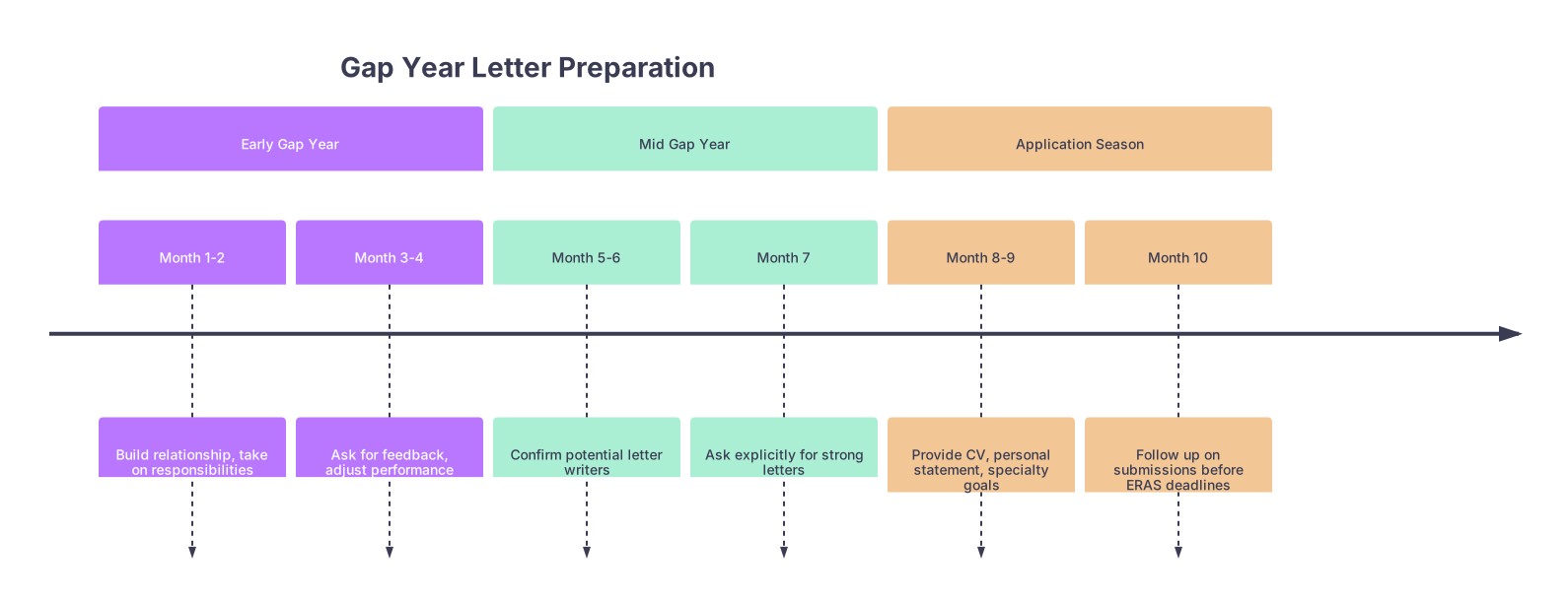
| Period | Event |
|---|---|
| Early Gap Year - Month 1-2 | Build relationship, take on responsibilities |
| Early Gap Year - Month 3-4 | Ask for feedback, adjust performance |
| Mid Gap Year - Month 5-6 | Confirm potential letter writers |
| Mid Gap Year - Month 7 | Ask explicitly for strong letters |
| Application Season - Month 8-9 | Provide CV, personal statement, specialty goals |
| Application Season - Month 10 | Follow up on submissions before ERAS deadlines |
Here’s how you avoid timing/content landmines:
- Ask early—months, not weeks, before ERAS opens.
- Provide a short summary of:
- Your specialty choice
- Your long-term goals
- Specific projects you did with them
- Behaviors you hope they can comment on (work ethic, communication, reliability)
- Remind them of concrete examples:
- The time you stayed late to finish recruitment
- The night you handled a last-minute abstract submission
- The conflict you helped resolve calmly
No, you’re not writing your own letter. You’re giving them ammunition to write a better one.
And yes, you should follow up if they’re late. Politely, but firmly. This is your career, not a favor they’re doing on a whim.
Landmine #8: You Overvalue the Gap Year and Undervalue MS4
Gap-year letters are supplements, not substitutes, for real clinical evaluations.
Some applicants make this mistake:
- Rocky third year with mixed evaluations
- Then a “clean” gap year in a research or non-clinical role
- They lean heavily on the gap-year supervisor to “fix the narrative”
Program directors are not idiots. A glowing research-year letter does not erase:
- Borderline professionalism comments MS3
- Low narrative evaluations in core rotations
- Weak shelf performance across the board
If anything, the contrast raises suspicion.
Use the gap year to build a pattern of reliability and maturity, yes. But your priority must still be:
- Strong Sub-I / acting internship evaluations
- At least two powerful clinical letters from MS4 attendings in your chosen field
- No new professionalism issues
Then the gap-year supervisor can say, “And on top of that, they did high-level work in X setting and were consistently dependable.”
If you’re thinking, “My gap-year PI will rescue my application,” you’re already on thin ice.
Practical Damage Control: How to Choose Gap-Year Letter Writers Safely
Let’s get concrete. Here’s what you actually look for before you commit to a gap-year supervisor letter.
You want someone who:
- Has seen you over time (not just a 4-week block).
- Has watched you handle difficulty—deadlines, failed experiments, complex projects.
- Has a reputation for writing detailed letters, not just “good person” fluff.
- Understands at least roughly what residency in your specialty demands.
- Responds to emails on time and meets basic deadlines.
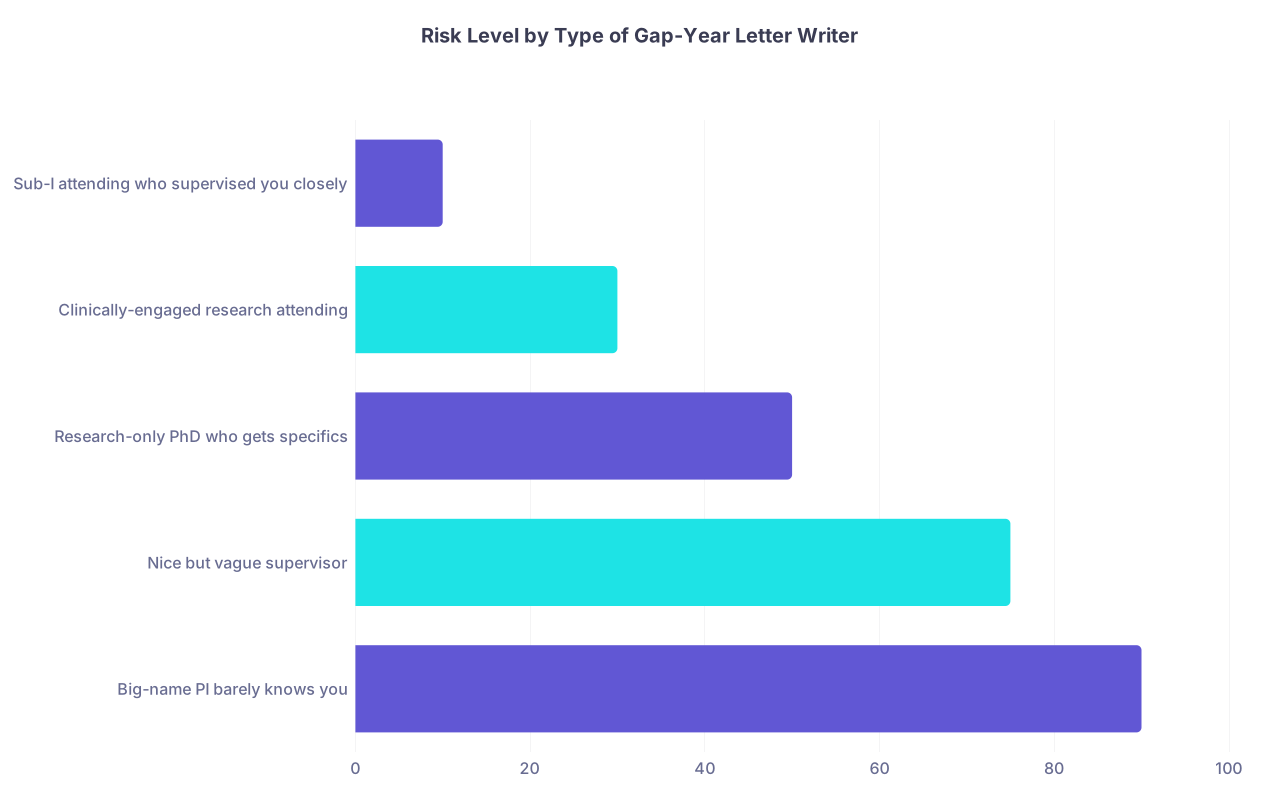
| Category | Value |
|---|---|
| Big-name PI barely knows you | 90 |
| Nice but vague supervisor | 75 |
| Research-only PhD who gets specifics | 50 |
| Clinically-engaged research attending | 30 |
| Sub-I attending who supervised you closely | 10 |
(Risk level is exactly what it sounds like: higher means more likely to hurt you.)
If you’re forced to include a gap-year letter (for example, because most of your recent work is in that role), then:
- Pair it with the strongest possible clinical letters.
- Carefully coach the supervisor on what matters.
- Confirm they truly feel comfortable writing a strong letter. If there’s any hesitation, back off.
And one more thing: you do not need four letters from the same institution or same year to look “consistent.” You need 3–4 people who can clearly, concretely, and confidently say: “This person will not be a problem at 2 a.m. when things are falling apart.”
The Bottom Line: Protect Your Application Like It’s Fragile (Because It Is)
If you remember nothing else from this, keep these three points:
A lukewarm or vague letter from your gap-year supervisor is not neutral; it’s negative. Never accept “I can write a letter.” Only accept “I can write you a strong letter” from someone who has actually seen you work.
Prestige is overrated, specificity is not. A detailed, grounded letter from a mid-tier attending who knows you beats a generic “excellent student” letter from a world-famous PI every single time.
You’re not just asking for a letter—you’re choosing who gets to speak for you in a closed room you will never enter. Choose people who are stable, observant, and genuinely invested in your success, or don’t choose them at all.
Protect yourself. Most applicants won’t. That’s your advantage.


