

The most dangerous gap year research mistake isn’t choosing the “wrong” lab. It’s staying in a dead-end project long enough to damage your residency application.
If you’re doing a gap year before residency, you’re on a clock. Programs do not care that you “worked really hard on a project that never went anywhere.” They care about outcomes, stories, and continuity. That’s it.
Let me walk you through the warning signs you’re stuck in a dead-end research situation—and how to get out before it tanks your Match prospects.
The Clock You’re Pretending Doesn’t Exist
You don’t have infinite time. A gap year is brutally short on the research timeline.
For residency applications, what matters from your “research year” isn’t your feelings about research. It’s what’s on ERAS:
- Abstracts
- Posters
- Presentations
- Manuscripts submitted / in press / published
- Solid letters from recognizable names
Here’s the harsh reality of timelines:
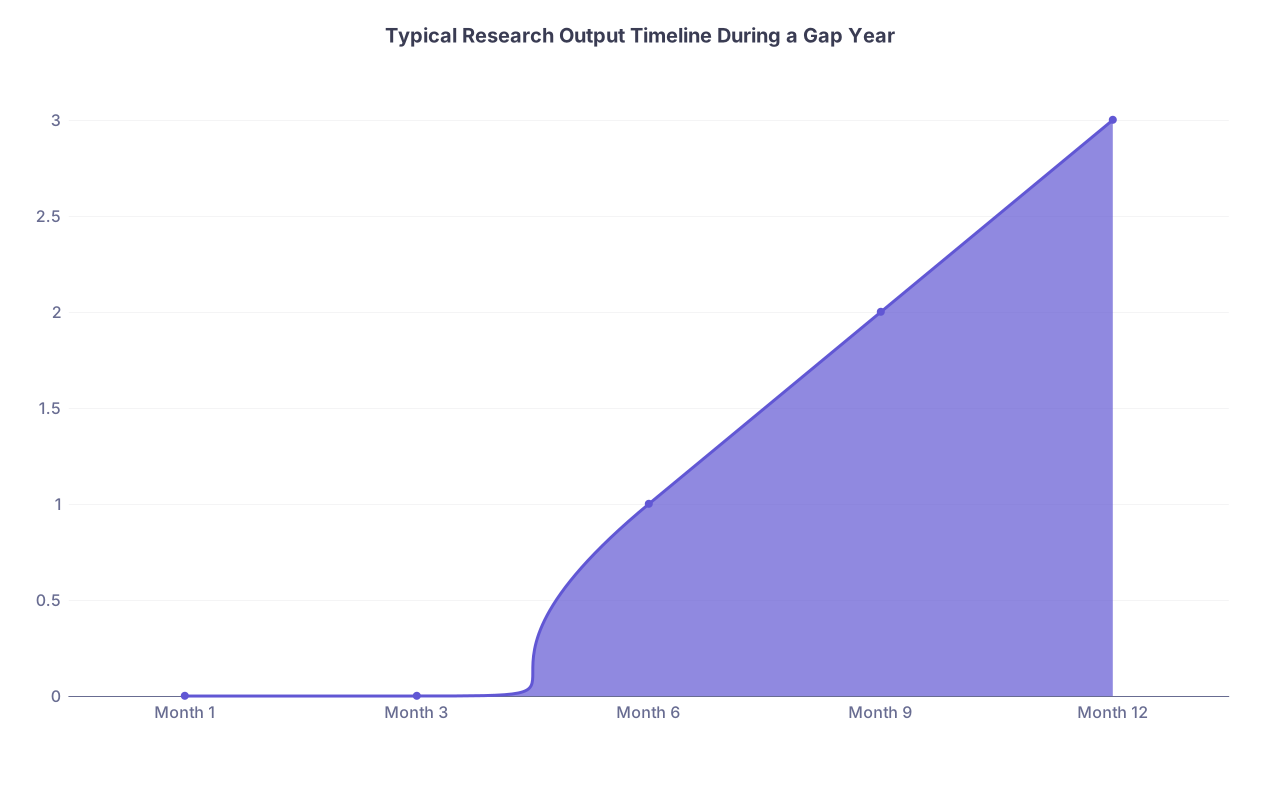
| Category | Value |
|---|---|
| Month 1 | 0 |
| Month 3 | 0 |
| Month 6 | 1 |
| Month 9 | 2 |
| Month 12 | 3 |
That’s if things go well. If you waste the first 4–6 months in a stalled or chaotic project, you don’t have a “back half” of the year to fix it. ERAS opens, and you have… nothing concrete.
The mistake:
Believing “it’s okay, it will all come together later” when you have zero signs of actual progress by Month 3–4.
Red Flag #1: No Clear Project, No Written Plan
If it isn’t written, it isn’t real.
Huge early warning sign: you’ve been “in the lab” or “on the research team” for weeks or months and you still don’t have a specific, written project.
Common versions of this:
- You’re “helping with various projects” but not owning any
- Your “project” changes every time you talk to the PI
- You cannot explain your main research question in 2–3 sentences
If this describes you, you’re in trouble.
Healthy setup in Month 1–2 looks like:
- A defined question: “We’re studying X in Y population.”
- A specific role: “You’re responsible for A, B, and C.”
- A deliverable: “This should lead to a poster at [specific meeting] and a manuscript targeting [journal tier].”
- A timeline: “We’ll aim to submit the abstract by [date].”
If your current situation sounds like:
- “Just get familiar with the data for now”
- “We’ll figure out authorship later”
- “Let’s see where the data take us”
- “We have a lot of ongoing projects; you’ll rotate around”
…you’re not in a research year. You’re in a research holding pattern.
What to do this week:
Email your primary mentor and ask for a 30-minute meeting with one goal: leave with a one-page project plan (question, methods, dataset, your tasks, target conference/journal, approximate timeline). If they can’t produce that, you’ve identified your first serious warning sign.
Red Flag #2: No Real Access to Data or Tools
You can’t produce anything if you can’t actually touch the work.
Bad signs I see all the time:
- You “can’t access the EMR yet” because IRB/training is “still pending”… for 6+ weeks
- The dataset you were promised is “almost cleaned” but somehow never ready
- You’re “not allowed” to run analyses and must wait for a biostatistician who’s never available
- Your mentor keeps saying, “Once X is done, you’ll be able to start,” and X never happens
You can easily lose three to four months just “waiting” if you’re not aggressive about this.

Here’s the line you should draw:
- By 4–6 weeks in, you should:
- Have all required access (EMR, REDCap, imaging servers, etc.)
- Be actively entering or cleaning data or reviewing charts
- Be meeting with your team about preliminary findings or at least variable definitions
If you’re on Week 8+ and still:
- “Reading background papers”
- “Shadowing in clinic until the project starts”
- “Waiting for IT/IRB/biostats”
You’re in a high-risk situation.
What to push for:
- A backup dataset/project that’s already ready to go
- Temporary access to a smaller pilot dataset for you to start learning and analyzing
- Clear dates: “If IRB is not approved by [date], we’ll pivot you to [alternative project].”
If no one is willing to build you a backup plan, understand what they’re saying: your productivity is not a priority.
Red Flag #3: Your Mentor Is a Ghost
I’ve seen more gap years ruined by absentee mentors than by bad projects.
You need a PI or primary mentor who:
- Sees you regularly (every 1–2 weeks minimum)
- Replies to emails within a reasonable timeframe (2–5 business days, not 3–4 weeks)
- Actually reads your drafts and gives concrete feedback
- Advocates for you on authorship and conference submissions
Red flags I don’t want you to ignore:
- Your “mentor” travels constantly, never has time, and keeps passing you to postdocs/other fellows
- You’ve been there 2+ months and never had a full 1:1 meeting about your goals
- You feel nervous every time you email them because they barely respond
- They cancel >50% of scheduled meetings with you
If your main contact is a senior resident or fellow who’s overworked, and the attending PI barely knows your name, your letters and authorship are at risk.

| Step | Description |
|---|---|
| Step 1 | You |
| Step 2 | Primary Mentor |
| Step 3 | Attending PI |
| Step 4 | Biostatistician |
| Step 5 | Research Coordinator |
| Step 6 | Dead-end: No Feedback, No Progress |
That “ghost mentor” often leads straight to the dead end in that diagram.
Fix attempt:
- Request a standing, recurring meeting (every 2 weeks)
- Come with an agenda and specific questions
- Ask: “Who will be responsible for reviewing my drafts within a week?” and get a name
If you try this and still get nothing—no time, no structure—stop pretending this will magically improve. You may need to look for a co-mentor or even another lab.
Red Flag #4: You’re Doing Busywork, Not Scholarship
You didn’t take a gap year to become an unpaid data-entry clerk or spreadsheet monkey.
Look closely at what you’re actually doing most days:
- Just scheduling patients?
- Only calling subjects for follow-up?
- Only scanning/uploading forms?
- Only doing literature searches for other people’s papers?
- Only entering data someone else defined?
Those tasks aren’t useless. But if that’s all you do, you won’t get:
- First-author anything
- Real ownership
- Strong letters that talk about your intellectual contributions
Here’s the rough breakdown you should aim for mid-year:
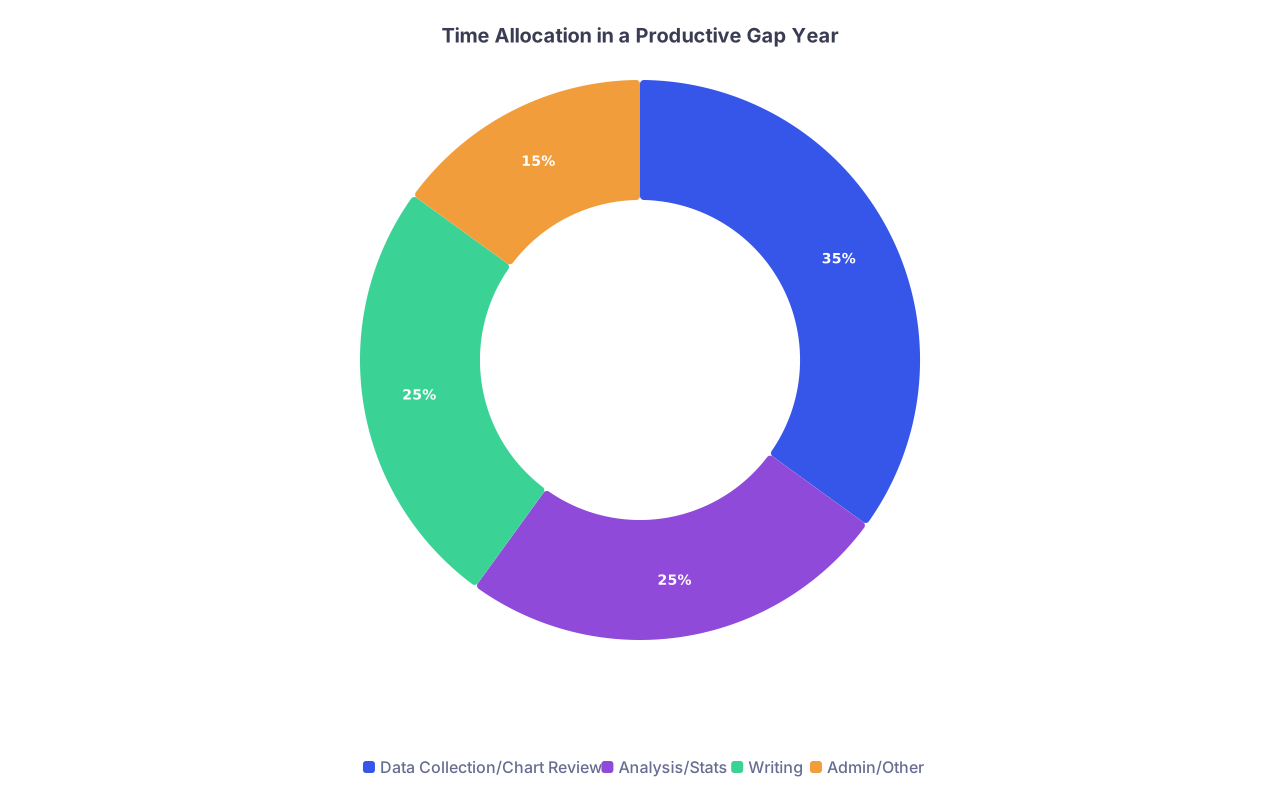
| Category | Value |
|---|---|
| Data Collection/Chart Review | 35 |
| Analysis/Stats | 25 |
| Writing | 25 |
| Admin/Other | 15 |
If “Admin/Other” is currently 70–80% of your time, you’re in a bad setup.
Your gap year should give you at least one project where you:
- Helped refine the research question
- Participated in data analysis decisions
- Wrote significant portions of an abstract or manuscript
- Could present the project without notes
Programs can smell the difference between:
- “I was on several projects”
and - “I led a project.”
How to test it:
Ask yourself, right now: “If my mentor disappeared tomorrow, could I still explain this project and push it toward a poster or manuscript?” If the answer is no, you’re not really the driver.
Red Flag #5: Vague or Shifting Authorship Promises
People get very fake-zen when they talk about authorship. “Let’s not worry about that yet” is the textbook phrase right before you get buried in the middle of the author list.
Dead-end sign: you have no clear authorship expectations for the projects you’re working the hardest on.
Authorship risk patterns:
- You’re the only full-time person on the project, but there are already 4–6 names listed above you
- Your mentor says “we’ll see how it shakes out” whenever you bring up first-author possibility
- A resident/fellow “started the project” years ago but hasn’t touched it in months, yet you’re told you’ll be 2nd or 3rd author maximum
- Every project you’re on has huge teams: 10–20 authors, multiple institutions

At minimum, for any project you’re investing serious time in, you need clarity:
- “If you do X, Y, and Z, you’ll be first author.”
- “You’ll be second author on this; [resident] will be first because they did initial design and IRB.”
- “Realistically, this is a middle-author paper for you. Your main first-author project is [other project].”
If they refuse to have that conversation? You’re volunteering your year to other people’s CVs.
Guardrails to set:
- One primary first-author aim (case series, retrospective, QI, review, something)
- Clear secondary contributions (middle author is fine on additional projects)
- Written email summary: “Just to confirm, my role on [project] is [X], and we discussed that if I complete A/B/C, I’ll be [authorship position].”
No, this won’t legally bind anyone. But it forces clarity early and makes it less likely you get conveniently “forgotten” later.
Red Flag #6: No Connection to Your Target Specialty
This one gets ignored way too often.
If you’re planning on applying to:
- Orthopedics
- Derm
- ENT
- Plastics
- Rad onc
- Or even just a competitive IM program or fellowship track
…and you spend your entire “research year” doing something totally unrelated (like basic science cardiology when you want derm), you’re losing a major advantage.
Programs like:
- Specialty-aligned research
- Specialty-specific mentors who can vouch for you
- Evidence that you understand their field’s literature and questions
| Intended Specialty | Helpful Gap Year Focus | Risky/Misaligned Focus |
|---|---|---|
| Dermatology | Derm outcomes, epidemiology | Basic science unrelated to skin |
| Orthopedics | MSK outcomes, sports med | Purely psych research |
| Radiology | Imaging AI, reading studies | Pure bench molecular biology |
| Cards fellowship | Cardiology trials/outcomes | OB/GYN retrospective studies |
Is it fatal to do something slightly off? No. But if your gap year is your one shot to build a narrative, why would you waste it?
Dead-end pattern: a “cool project” in a field no one in your desired specialty cares about—and with mentors who have zero connections to that specialty.
Reality check question:
“If I gave my ERAS to the PD in my target specialty, could they immediately see how this research year supports that path?” If not, you’re probably off course.
Red Flag #7: No Concrete Outputs by Month 4–6
This is the one everyone lies to themselves about.
By Month 4–6 of a gap year, you should have at least one of these:
- An abstract submitted (not just “almost ready”)
- A case report drafted and under review
- A retrospective project with data collection >50% complete and analysis plan drafted
- A QI project with preliminary data and planned presentation venue
- A review article where the outline is approved and you’re writing sections
If you’re at Month 6 and have:
- No draft abstracts
- No planned conference submissions
- No identifiable first-author project
- Nothing you could honestly put on ERAS as “submitted”
You are in a dead-end setup, whether anyone admits it or not.
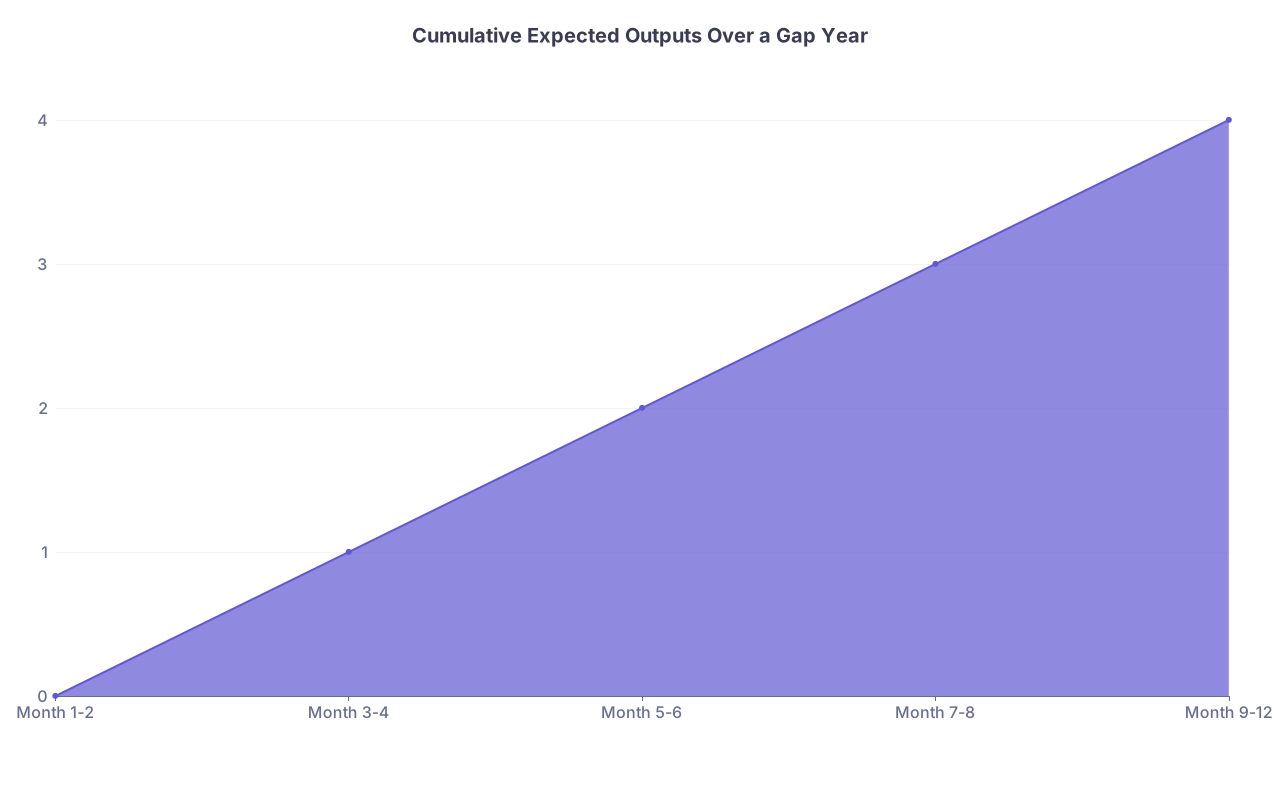
| Category | Value |
|---|---|
| Month 1-2 | 0 |
| Month 3-4 | 1 |
| Month 5-6 | 2 |
| Month 7-8 | 3 |
| Month 9-12 | 4 |
Notice the curve: slow early, but not flat. Flat means you’re stuck.
Blunt truth:
Most labs move slower than they think. If you’re not pushing for early wins—small projects, case reports, posters—you’ll run out of runway.
Red Flag #8: Toxic or Disorganized Lab Culture
Sometimes the problem isn’t the project. It’s the environment.
Watch for this combination:
- No one knows who’s doing what
- There’s constant drama or turnover—research coordinators quitting, students disappearing
- Shared drives and data are a mess; version control is a joke
- Deadlines are flexible until they suddenly aren’t, and then everything is an emergency
- The PI yells, shames, or publicly criticizes trainees
This kind of chaos kills productivity. You’ll spend more time untangling messes than moving projects forward.

And yes, this absolutely bleeds into your letters. A disorganized PI often writes disorganized, generic, or late letters. That hurts you in the Match.
Healthy labs aren’t magically perfect. But they do have:
- Predictable meeting schedules
- Shared tracking (spreadsheets, project boards) for who’s doing what
- Reasonable communication norms
- Clear paths from data to output
If you’re in a circus, don’t assume you’re the one who’ll tame the lions in 10 months.
How to Escape or Salvage a Dead-End Situation
You might be reading this at Month 3. Or Month 8. Either way, all is not necessarily lost—but you cannot keep doing the same thing and expect a different result.
Here’s a rescue plan, broken down very plainly.
Step 1: Get Honest on Paper
Open a blank document and write:
- Current month of gap year
- List each “project” you’re on
- For each project, note:
- Your role (real, not what they call you)
- Current status (data collection %, draft status)
- Probable authorship position
- Likely timeline to any submission or presentation
If you’re seeing a lot of “0–25%” and “no clear authorship” and “maybe next year,” that’s your reality check.
Step 2: Have the Hard Conversation
Schedule a meeting with your primary mentor. Not a hallway chat.
Your script (edit as needed, but don’t water it down too much):
“I’m halfway through my research year, and I’m concerned I may not have enough tangible output for my residency application. I’d like to leave this meeting with a specific plan for at least one project where I’m first author and a clear timeline for abstracts or manuscripts that can realistically be submitted before ERAS.”
Then go project by project. Ask directly:
- “Is this realistically going to be submitted before [date]?”
- “What authorship position should I expect if I complete [X, Y, Z]?”
- “Is there a smaller or simpler project I can take primary ownership of right now?”
If the answers are fluffy, noncommittal, or dismissive, note that mentally. That’s not going to magically turn into support in Month 10.
Step 3: Add or Pivot to High-Yield Projects
You might need to re-balance your portfolio:
- Case reports/series – quick, specialty-relevant, often underutilized
- Small retrospective studies with limited variables and clear questions
- Review articles (not glamorous, but good for first authorship and learning a field)
- QI projects with short cycles and built-in presentations (hospital QI days, etc.)
These can generate abstracts and posters faster than massive, multi-year trials.
Ask around in your department:
- “Are there any small projects no one has time to write up that I could take on?”
- “Does anyone have a case or series that needs a motivated writer?”
You’d be surprised how many attendings are sitting on publishable material they simply never write up.
Step 4: Widen Your Mentor Net
If your main PI isn’t delivering, you need a secondary mentor who will.
Look for:
- Attending or fellow in your target specialty
- Someone already publishing regularly
- Someone whose trainees actually get on papers and go to conferences
You don’t have to quit your current lab to add another mentor. But you might need to shift your hours and priorities.
The Biggest Mistake: Protecting Feelings Over Your Future
A lot of students stay in bad research situations because they don’t want to:
- “Burn bridges”
- “Seem ungrateful”
- “Give up after investing so much time”
You know what residency programs care about more than your PI’s feelings? The story your CV tells and the evidence that you used your gap year well.
You don’t have to set anything on fire. You do have to:
- Stop minimizing warning signs
- Stop believing vague promises with no dates
- Stop sacrificing your application to keep other people comfortable
Protect your Match, not your sunk costs.
Your One Concrete Next Step
Today—before you convince yourself you’re “too busy”—do this:
Open a document and list every research project you’re attached to. For each one, write the earliest realistic date you think anything from it could be submitted (abstract or manuscript). If nothing credible lands before ERAS, email your mentor by tonight and schedule a meeting within the next 7 days to discuss a focused, first-author project with a clear timeline.
If that meeting doesn’t produce a plan you believe in, that’s your answer: you’re in a dead-end setup, and it’s time to pivot before your gap year becomes a permanent liability on your residency application.


