

The most dangerous year for your Step 2 CK score is not MS3. It is the “easy” gap year you think you can coast through.
If you treat a gap year like a victory lap instead of a tightly structured bridge to residency, you will sabotage your Step 2 CK performance, your application timeline, and in some cases your entire Match strategy. I have watched it happen. Strong Step 1, solid clerkships, then a sloppy gap year that tanks their Step 2 and forces them into damage-control mode.
Let me walk you through the mistakes that quietly destroy people during this supposedly “free” year—and exactly how to avoid being one of them.
The Myth That Destroys Gap Years: “I’ll Finally Have Time”
The single most common—and most costly—error is the fantasy that a gap year automatically means more time and better performance.
No. It usually means less structure, more drift, and slower thinking.
During clerkships, your life is scheduled down to the minute. Pre-round. Rounds. Notes. Shelf prep. You are forced into efficiency. When that disappears, you suddenly have:
- No fixed wake-up time
- No fixed end-of-day
- No hard deadlines tied to patient care or grades
You “feel busy” but achieve nothing meaningful. The scattered, errand-filled, part-time-work, sometimes-studying lifestyle is precisely why many gap-year students end up postponing Step 2 CK until the last possible moment—and then walking into the test underprepared and out of clinical shape.
Here is the mental trap:
“I will be less stressed, so I will study better.”
What actually happens:
“I am less stressed, so I underestimate how quickly my knowledge decays and how much structure I just lost.”
If you enter a gap year without a weekly schedule as rigid as an inpatient rotation, you are already behind.
The Knowledge Decay Problem Nobody Plans For
There is a hard, unromantic truth: clinical knowledge rots fast when you are not seeing patients.
During clerkships, Step 2 CK content is reinforced every day. You see CHF, COPD, DKA, postpartum hemorrhage, sepsis. You relate guidelines to real patients. During a non-clinical gap year? You see your couch, your laptop, and your email inbox.
The biggest mistake: letting 6–12 months pass between core clinical rotations and dedicated Step 2 CK study without intentionally maintaining clinical exposure or structured review.
You start the year thinking, “I just finished MS3, so I’m sharp.”
By month 8, “sharp” has turned into “I vaguely remember that from OB but need to look it up again.”
Here is what this looks like in real life:
- A student spends the year on a basic science research fellowship, no patient contact.
- They push Step 2 CK to late summer of the application year.
- They begin UWorld and realize they are missing basic clinical reasoning steps they used to do automatically on wards.
- They need 10–12 weeks to get back to where they were at the end of MS3… but they only gave themselves 6.
Result: rushed prep, mediocre score, and no time to meaningfully improve before ERAS opens.
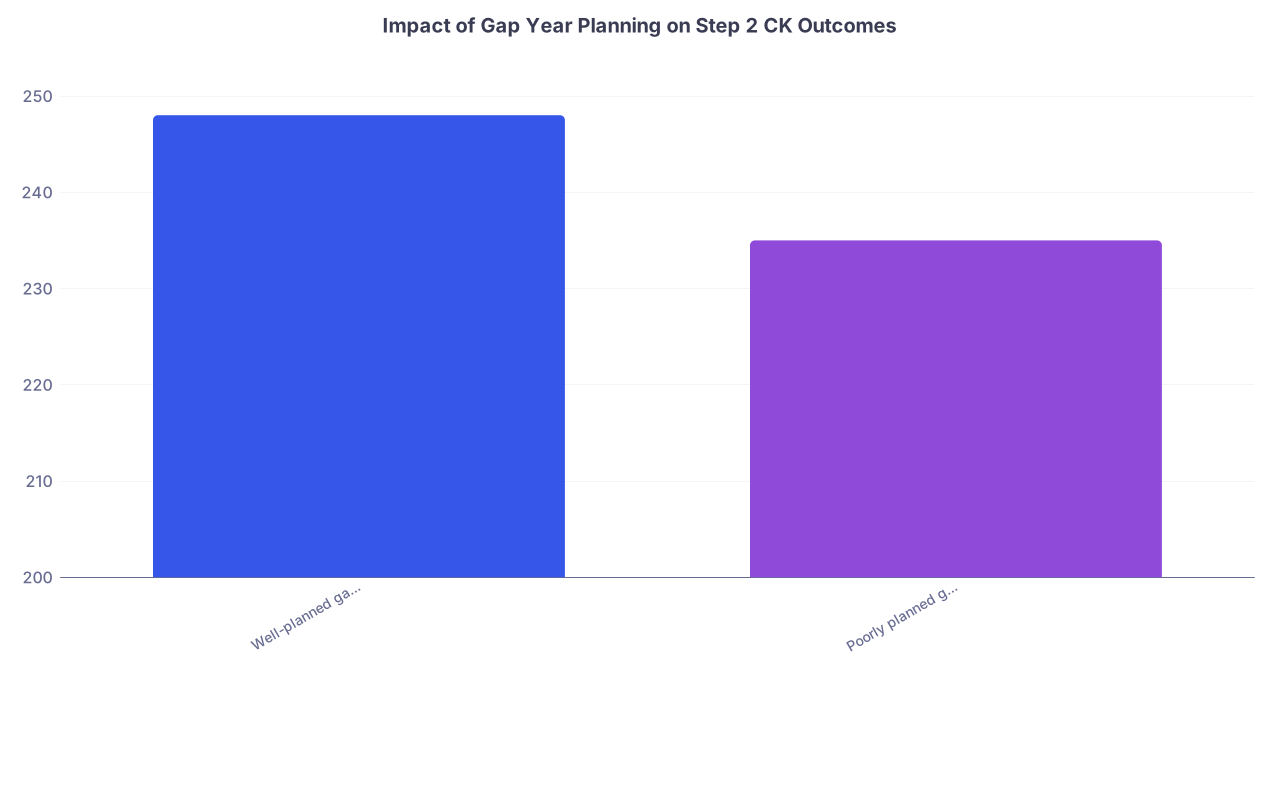
| Category | Value |
|---|---|
| Well-planned gap year | 248 |
| Poorly planned gap year | 235 |
If you are planning a gap year and not actively thinking, “How will I prevent clinical rust?”, you are already making a strategic error.
The Timeline Trap: Step 2 CK Too Late (Or Too Early)
You cannot afford to treat Step 2 CK as “whenever I get to it.” Residency programs do not care that you were busy with your fellowship, your startup, or your “mental health break” if your file is incomplete when they screen applicants.
There are two especially damaging timing errors.
1. Taking Step 2 CK Too Late
Classic scenario:
- You finish MS3 in May or June.
- Plan a research gap year.
- Think, “I will settle into the lab, then study for Step 2 CK later in the year.”
- You keep pushing it: October → December → March.
- Suddenly it is June of the application year and you have not tested.
You have now created four serious problems:
- Programs do not see your Step 2 score when applications open. Many programs increasingly want Step 2 in hand, especially post-Step 1 P/F. Without a score, your application looks incomplete and risky.
- You cut off your own score-recovery window. If your score comes back lower than expected, there is no realistic way to retake or compensate before rank lists.
- You collide with application season. Studying intensely for Step 2 while writing personal statements, filling ERAS, begging for letters, and scheduling interviews is a recipe for doing all of them poorly.
- Your anxiety spikes dramatically. You are tying your single most important exam to your largest career decision. That mental load alone ruins scores.
2. Taking Step 2 CK Too Early (Without Structure)
The less famous, but still harmful, mistake: rushing Step 2 CK at the beginning of the gap year because you “just want to get it over with” but without doing proper dedicated study.
Students do this when:
- They are starting a full-time lab job in July and want to squeeze Step 2 into June.
- They are burned out and promise themselves “a light two weeks of review—should be fine.”
No. Two weeks after MS3 is not magic. If you walk in underprepared, you burn an incredibly valuable opportunity: Step 2 CK as your academic redemption or highlight.
You get one first attempt. Wasting it to clear your schedule for research is backwards thinking.
The Fake Productivity Problem: Busy But Not Building Toward Step 2
Gap years are dangerous because “fake productivity” becomes socially acceptable. You can tell yourself and others you are working hard—because you are. Just not on what will move the needle for residency.
Common pattern:
- 20–30 hours per week: research, fellowship duties, or clinical duties.
- 5–10 hours per week: emails, meetings, travel logistics, admin.
- 0–3 hours per week: deep Step 2 CK study.
You go to bed tired. The week “felt full.” But your test date is creeping closer and your question bank still shows 15 percent completed.
The mistake is not the gap-year activity. Research, teaching, global health—these can be excellent. The mistake is failing to design them around a Step 2 timeline and study structure.
A simple, brutal test: look at your current or planned weekly schedule and show me where the 15–20 hours of focused Step 2 preparation live for the 8–10 weeks before your exam. If you cannot point to them on a calendar, they will not magically appear.
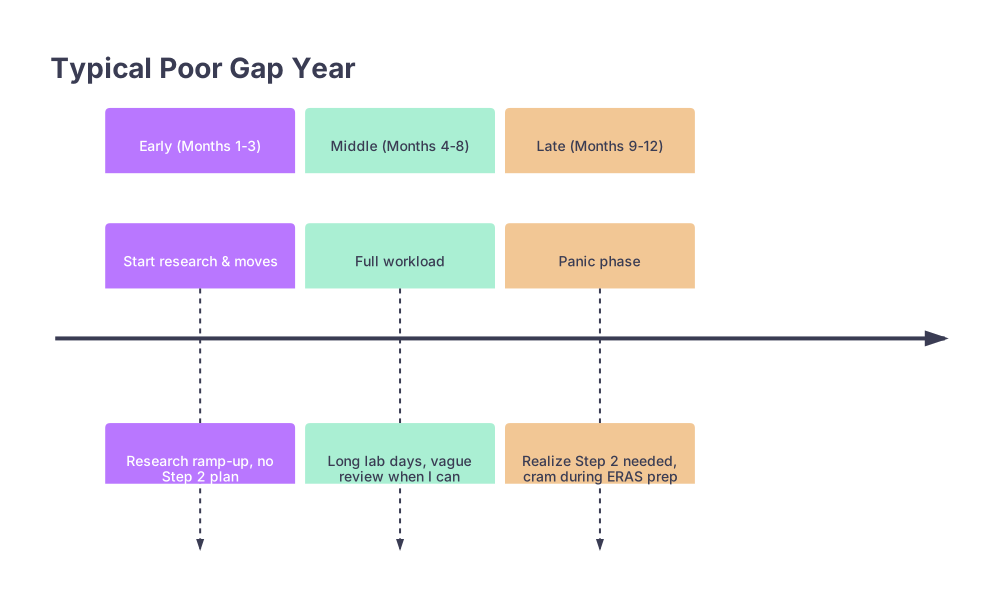
| Period | Event |
|---|---|
| Early (Months 1-3) - Start research & moves | Research ramp-up, no Step 2 plan |
| Middle (Months 4-8) - Full workload | Long lab days, vague review when I can |
| Late (Months 9-12) - Panic phase | Realize Step 2 needed, cram during ERAS prep |
The Money and Lifestyle Trap That Quietly Erodes Study Time
Nobody talks about how financial reality wrecks study plans.
Many students enter a gap year thinking they will “study full-time for a few months” then maybe pick up some paid work. Then the real world hits: rent, loans coming out of forbearance, family expectations. Suddenly:
- You are picking up extra shifts as a scribe, MA, or research assistant.
- You are commuting 1–2 hours a day.
- You are mentally drained by the end of the day, even if the work is not “hard.”
The gentle plan of “5–6 hours of UWorld daily” turns into “I will do blocks on weekends and some nights,” which quickly decays to “I will do a few questions when I have energy.”
Throw in lifestyle drift—late nights, travel, irregular sleep—and your cognitive performance tanks. Step 2 CK is a stamina exam. You cannot fake 9 hours of sharp, clinically focused thinking on 4 hours of sleep and caffeine.
This is where a lot of strong students blow it: they do not explicitly account for energy cost, not just time cost.
You can technically “have time” to study after a 9-hour day in the ED as a scribe. You will not have the mental clarity for high-quality learning. Those hours are low-yield slogging at best.
If your financial situation forces you into full-time work, you must adjust:
- Earlier test date (while you are closer to MS3 and less clinically rusty), or
- Longer timeline with realistic weekly hours, or
- Different work structure (e.g., part-time with fewer days but longer shifts).
Pretending you can treat Step 2 prep like a side hobby around a full adult life is a delusion that ruins scores.
Research Years and Fellowships: How They Help—or Hinder—Step 2
Research or fellowship gap years are not inherently bad. They are often strategically excellent. The damage happens when you treat them as the main event and Step 2 as a side quest.
I have seen three recurring patterns.
Pattern 1: The Overcommitted Star
This person gets into a competitive research fellowship (think HHMI, NIH, major academic center). Their schedule fills with:
- Experiments or data collection
- Weekly lab meetings
- Abstract deadlines
- Manuscript revisions
- Conferences and travel
They become indispensable in the lab. Great for publications. Terrible for carving out dedicated study blocks.
Common mistake: promising their mentor, “Once I finish Step 2 in a couple of months, I’ll be fully on board,” then never actually blocking off that prep time because every deadline feels urgent.
If you are in this situation, do not lie to yourself. You must negotiate protected weeks upfront, before the fellowship starts, or you will be steamrolled.
Pattern 2: The “Flexibility” Mirage
This student joins a semi-structured research year with a laid-back PI who says, “Your Step 2 comes first. Just get the work done whenever.”
Sounds ideal. It is not. The lack of fixed hours and lack of clear deliverables mean your days dissolve into:
- Late starts
- Long, drifting “study” blocks with constant task switching
- Vague guilt about not doing enough research or enough Step studying
The error is treating flexibility as freedom instead of a design problem. You must impose structure when none is given to you.
Pattern 3: The Clinical Research Trap
You think that because you are doing “clinical” research, your clinical reasoning will stay sharp. No.
Chart review does not equal high-quality, test-level clinical thinking. Writing inclusion criteria and extracting lab values is not the same as working up acute chest pain in a 65-year-old smoker with a normal initial ECG.
Do not fool yourself: clinical research may keep the vocabulary in your orbit, but it will not replace targeted, timed, mixed-question practice for Step 2 CK.
Poor Planning + Weak Feedback Loops = Slow Disaster
Another massively underappreciated mistake: you do not build in feedback loops during your gap year.
Students think in terms of “I will study these resources” instead of “I will measure whether what I am doing is actually working on the timeline that matters.”
The consequence is predictable:
- You casually work through UWorld over months with no schedule.
- You delay taking a baseline NBME or UWSA because “I do not want to see a bad score.”
- You keep telling yourself you are “improving” because your UWorld tutor scores look decent.
- You take an NBME two weeks before your scheduled exam and realize your score is 15–20 points below your target.
Now you are out of calendar. Your choices are both bad:
- Push the exam very late and jeopardize application timing, or
- Take it on schedule with a weak score and hope.
Both outcomes were avoidable if you had forced yourself to see numbers earlier and more often.
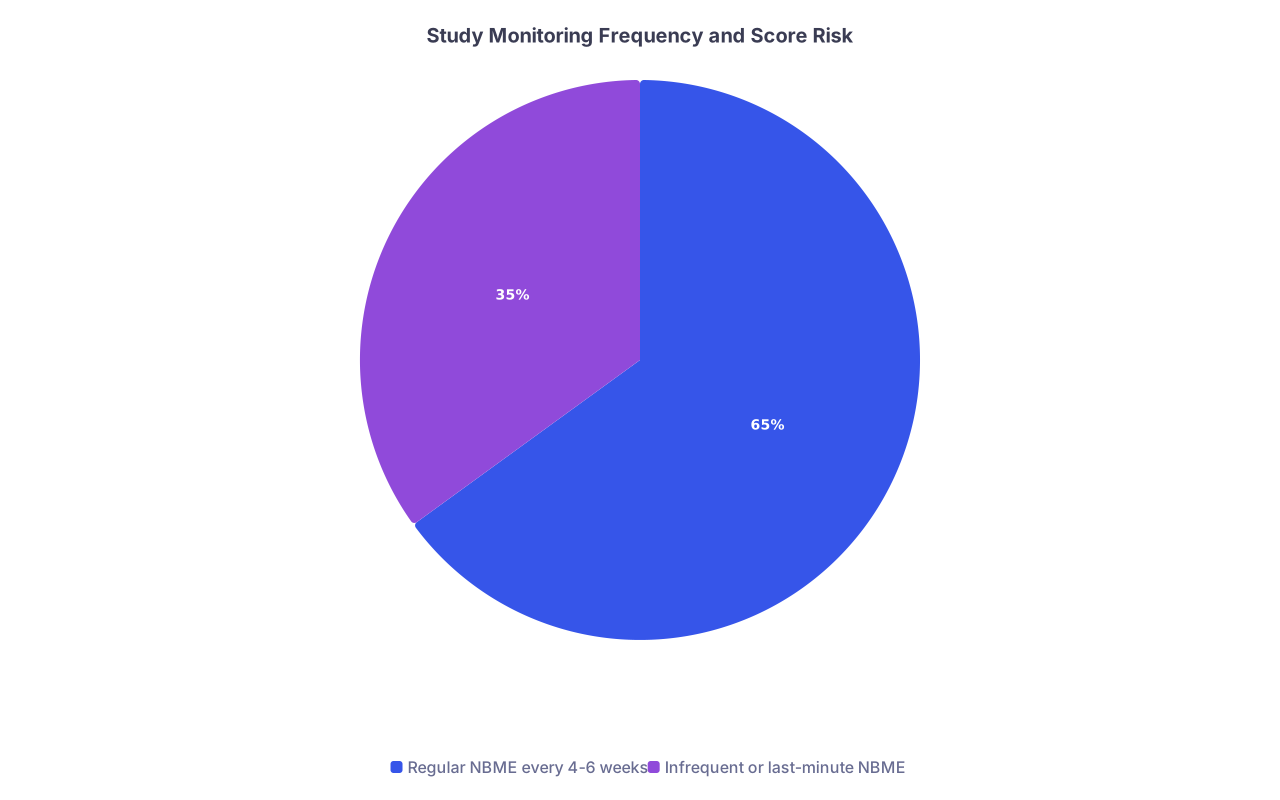
| Category | Value |
|---|---|
| Regular NBME every 4-6 weeks | 65 |
| Infrequent or last-minute NBME | 35 |
The mistake is emotional: you avoid data that might scare you. During a gap year, with no dean or clerkship director checking on you, it is easy to hide from performance metrics until it is too late.
How To Avoid These Gap Year Time-Management Failures
Let us talk solutions. Not fluffy “manage your time better” nonsense. Actual, concrete safeguards.
1. Decide Your Step 2 CK Window Before the Gap Year Starts
Not “sometime next year.” A window. Examples:
- “Between July 10–25, after 4 weeks of full-time dedicated.”
- “In late March, after I finish my heaviest research push and have 8 weeks of 20-hour study weeks planned.”
Anchor this to:
- ERAS opening (September).
- When you want programs to see your score (ideally at application submission).
- How rusty you will be after finishing clerkships.
2. Lock in Your Weekly Study Hours in Writing
You need to be honest about non-negotiables: work, commuting, family.
Then on a calendar, map:
- Which days are dedicated Step 2 heavy (e.g., 6–8 hours).
- Which days are lighter maintenance (e.g., 2–3 hours).
Your weekly schedule should not be a vibe. It should look like a rotation schedule you could hand to a program director without embarrassment.
3. Set Hard Milestones for Qbank and Practice Exams
Before you start, decide:
- When you want UWorld 1st pass done (e.g., 3–4 weeks before exam).
- Which weeks you will take NBMEs / UWSAs.
- Minimum acceptable scores to keep your current test date.
Then actually hold yourself to it. If an NBME comes back way below target two months out, that is the moment to reconsider workload, not two days before the exam.
4. Protect Clinical Exposure If Your Gap Year Is Non-Clinical
If you are stepping away from wards for 12 months, you must plan to:
- Work occasional clinical shifts (scribe, MA, clinic assistant) with learning intention, or
- Shadow a few days per month with a high-yield attending who will actually teach, or
- Build a structured weekly review of clerkship topics via cases, not just Anki.
You cannot afford to let your brain drift entirely into pipettes and p-values.
5. Negotiate Boundaries With Mentors and Employers Upfront
Do not hope your future PI, boss, or attending will “understand” when the time comes. Before you accept anything:
Say something like:
“I will be taking Step 2 CK around [month]. For 6–8 weeks before that, I will need protected time to study [X hours per week / Y weeks fully off]. If that is not workable, I should be honest about that now.”
If they balk at the idea that your board exam matters, that is a red flag, not a challenge to “prove you can do both.”
If You Are Already in a Messy Gap Year
Maybe you are reading this halfway through a gap year that already went off the rails. Fine. Do not fix it by making a second mistake.
Stop and:
- Write out your real weekly obligations and energy drainers.
- Choose a realistic Step 2 date that allows at least 6–8 weeks of honest prep at your true available hours.
- Drop or renegotiate something. A side project, an extra shift, a pointless committee role. Something has to give.
- Get numbers on paper: NBME/UWSA baseline this month, not “after I review more.”
- Decide, in advance, what score will trigger a date change or strategy shift.
What you cannot do is continue drifting and banking on “turning it on” two weeks before the exam. That is the behavior that takes people from mid-240 potential to low-220 reality.
Final Warning: A Gap Year Is Not Neutral
A gap year is not a harmless pause button. It is a force multiplier. Planned well, it can boost your application and give you the time to crush Step 2 CK. Planned poorly, it quietly erodes your knowledge, fractures your focus, and chokes your application timeline right when you need clean execution.
Do not make these mistakes:
- Treating unstructured time as an automatic advantage instead of a liability that must be actively controlled.
- Letting Step 2 CK drift to the edges of your year while work, research, or lifestyle creep expand to fill the center.
- Avoiding hard data—the NBME scores, the incomplete qbanks, the calendar reality—until it is too late to fix.
Design the year around your exam and your application, not the other way around. Your future self on Match Day will be very clear whether you got this right.


