

It is August. You finished medical school in May, decided to take a gap year before residency, and told everyone you were finally going to “rest, research, and reset.” Your friends have started intern year. Your Instagram is a mix of white coats and first-call selfies. You, on the other hand, are staring at your Step score report for the third time this week, half-finished ERAS application open, and 17 tabs about “gap year research positions” cluttering your browser.
You thought this year would heal your burnout. Instead, you feel worse. Guilty when you rest. Exhausted when you work. And the terrifying thought in the back of your mind: “What if this gap year actually hurts my residency chances?”
Let me be blunt: that is not just anxiety. I have watched students turn a well-intentioned gap year into the most burned-out, unproductive, and demoralizing year of their training. Not because gap years are bad. Because they mismanaged the tension between rest and productivity.
This is how that goes wrong—and how you avoid making the same mistakes.
The Core Trap: Fake Rest, Fake Productivity
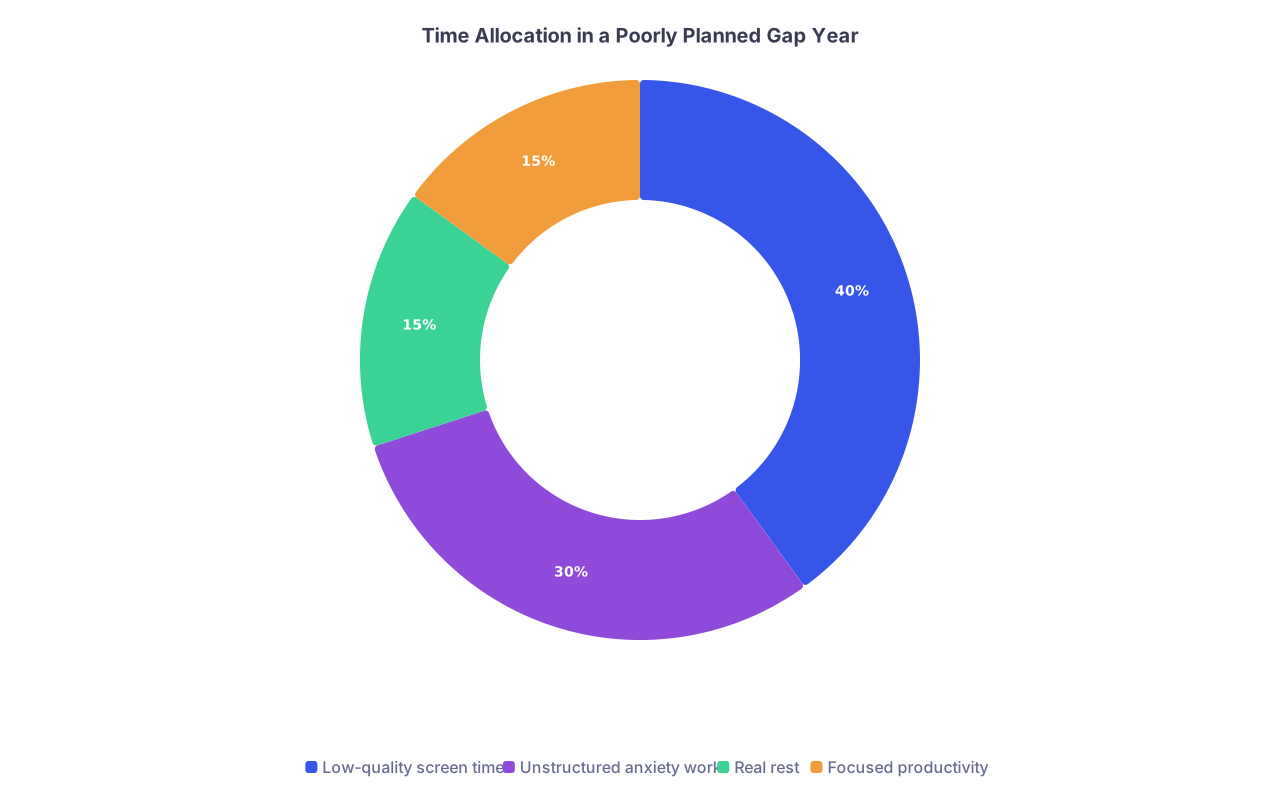
| Category | Value |
|---|---|
| Low-quality screen time | 40 |
| Unstructured anxiety work | 30 |
| Real rest | 15 |
| Focused productivity | 15 |
Most people enter a gap year with two competing scripts in their head:
- “I must use this year to become the perfect applicant.”
- “I need real rest or I will not survive residency.”
The mistake is trying to do both simultaneously, all the time, with no structure. So they end up with neither:
- Fake rest: Binge-watching, doom-scrolling, “just taking today off” that never actually feels restorative because there is a constant, low-grade guilt buzzing in the background.
- Fake productivity: Obsessively refreshing email for research responses, rewriting the same ERAS paragraph 30 times, reading Reddit threads for hours about “what PDs really want” and calling it “prep.”
You feel exhausted, but you are not actually recovering. You feel busy, but you are not actually making progress.
If your “rest” leaves you feeling ashamed and your “work” leaves you with nothing concrete to show, you are in this trap.
Avoid it by making a brutally clear distinction between:
- Deliberate rest (scheduled, protected, guilt-free)
- Deliberate productivity (time-limited, specific, output-focused)
Everything else is noise.
Mistake #1: Starting the Gap Year With No Actual Plan

| Step | Description |
|---|---|
| Step 1 | Graduate Med School |
| Step 2 | Take Gap Year |
| Step 3 | Random jobs & vague research |
| Step 4 | Anxiety, burnout, weak application |
| Step 5 | Defined goals & schedule |
| Step 6 | Balanced rest & productivity |
| Step 7 | Stronger application, less burnout |
| Step 8 | Have a concrete plan? |
I have seen this dozens of times: “I will just see what opportunities come up. Something will work out.” That is how students end up in unpaid “volunteer research,” random scribe jobs that are glorified data entry, and months of doing nothing structured while their anxiety climbs.
Common planning errors:
- No written goals for the year. Just vibes: “Improve my application,” “Get publications,” “Rest.”
- No clear timeline. ERAS opens, programs start downloading, and suddenly you realize you needed that LOR three months ago.
- No backup options. You pinned everything on one “maybe” research position or one attending who “might have something in the fall.”
You need a plan that addresses three buckets:
Application-critical tasks
- ERAS personal statement
- Program list strategy
- Getting fresh, relevant letters of recommendation
- US clinical experience if you are an IMG or have been out of school for a while
Career-building productivity
- Research with realistic output (poster, abstract, maybe a paper)
- Teaching, leadership, or clinical roles that are actually explainable to PDs
- Skills that will make you useful and interesting: QI, ultrasound, teaching, informatics
Structured rest and recovery
- Time off medicine
- Therapy or coaching if you were already burned out
- Physical health: sleep, basic fitness, and nutrition you have neglected for years
If your calendar only reflects #2 and you “hope” #1 and #3 will happen around it, you are setting yourself up for burnout and a messy application cycle.
Mistake #2: Treating Rest as a Reward You Never Deserve
A lot of high-achievers in medicine do not actually know how to rest. They only know how to stop working when they are so exhausted they cannot move. That habit does not magically disappear during a gap year.
Typical pattern:
- “I will rest after I finish my personal statement.”
- “I will take a vacation once I secure a research position.”
- “I will sleep better once interviews start rolling in.”
Those goals slide. Deadlines move. You never hit the “after.” So you never allow yourself to rest without guilt.
This is how you fast-track to burnout in a year when you technically have more “time off” than you have had in a decade.
Flip the model:
- Rest is scheduled first, not last.
- Rest is non-contingent on performance.
- Rest is time-bound and specific, not “I will just see how I feel.”
Practical rule:
- You should be able to point to at least 1–2 fully protected days per week where residency and applications are not allowed to occupy your working brain.
- If you are recovering from serious burnout or depression, that number may need to be higher for a few months.
If rest is always the thing you steal from to get “more done,” you are mismanaging your energy. Residency will punish that habit cruelly.
Mistake #3: Overloading on Low-Yield “Productivity Theater”

Gap year students love “productivity theater” because it feels like working without forcing any hard decisions or risking actual rejection. Some greatest hits:
- Spending hours “researching programs” without building a concrete list or spreadsheet.
- Rewriting the same sentence of your personal statement 40 times.
- Reading SDN / Reddit threads about competitiveness as if that is an intervention.
- Joining a “research group” where 12 students are “helping” on a single project that will never see publication.
This is how you burn out: pouring mental energy into tasks that:
- Do not move your application forward in measurable ways.
- Have no clear endpoint or deliverable.
- Keep reminding you how anxious and behind you feel.
You should aggressively prioritize tasks that produce clear outputs:
- A completed ERAS activities section with polished descriptions.
- One to three realistic research or QI products with defined roles: poster, abstract, case report.
- A program list saved in ERAS with tiers (reach / target / safety) based on something more rational than panic.
Look at your week and ask:
- “What did I create or complete that exists outside my head or browser history?”
If the answer is usually “nothing,” you are doing productivity theater. Fix that before you call yourself “burned out.”
Mistake #4: Letting Isolation Magnify Burnout

Gap years are socially weird. Your cohort is busy drowning in intern year. They text from call rooms; you answer from your parents’ house or a studio apartment. You start avoiding group messages because every “I survived my first code!” stings.
Isolation is not neutral. It actively worsens:
- Rumination: replaying every score, every failed attempt, every imagined judgment.
- Imposter syndrome: you are the one “who could not match” or “needed a break.”
- Decision paralysis: no one is around to sanity-check your spiraling.
The mistake is waiting until you feel really bad to seek support. By then you are already in deep.
You need three types of contact during a gap year:
Professional structure
- At least one attending or mentor who knows what you are doing this year, how you are framing it on ERAS, and is willing to vouch for you.
- Some form of regular clinical or academic touchpoint (clinic 1–2 days a week, research meetings, teaching sessions).
Peer accountability
- One or two trusted colleagues in similar phases (gap year, reapplication, or away rotations) you can be brutally honest with.
- Not just group chats full of interns complaining about scut; you need people whose lives are shaped like yours right now.
Non-medical humans
- Friends or family who do not care about your Step score and will talk about literally anything else.
- Burnout is much worse when medicine is the only lens there is.
If you spend an entire week with no in-person interaction and your only “connection” is scrolling residency drama online, do not be surprised when your energy and judgment tank.
Mistake #5: Creating a Narrative That Makes You Look Worse, Not Better
During residency applications, your gap year will be interrogated. Directly or indirectly.
Program directors want to know:
- Why you took it.
- What you did.
- What skills or insights you gained.
- Whether you will show up to July 1 ready to work.
Gap years absolutely can strengthen an application. I have seen it. I have also seen students sabotage themselves with messy, defensive, or incoherent narratives.
Red flags in how you talk about your year:
- “I was just really burned out and needed time off.” (True? Maybe. But incomplete and dangerous as a standalone answer.)
- “I could not match so I had to take a research year.” (You are leading with failure rather than growth or strategy.)
- “I traveled a lot and spent time with family.” (Fine as part of the story. Not enough as the whole story.)
You need a narrative that is:
- Honest, but framed around growth and intentionality, not collapse.
- Concrete: tied to specific projects, roles, or responsibilities.
- Forward-facing: clearly connects your gap year to being a better intern.
Example of a weak explanation:
“I was very burned out after medical school and felt I needed to step back, so I took a year to rest and think about my options.”
Better:
“After medical school I recognized I was running on fumes and not functioning at the level I expect from myself. I made a deliberate decision to take a year to both recover and strengthen my application. I worked part-time in clinic, completed two QI projects focused on [X], and used the space to address my burnout in a structured way through therapy and better routines. I am coming in with more self-awareness and better systems for sustainability than I had before.”
Same facts. Different framing. Much less likely to trigger concerns.
Mistake #6: Using the Gap Year to Avoid, Not Solve, Underlying Problems
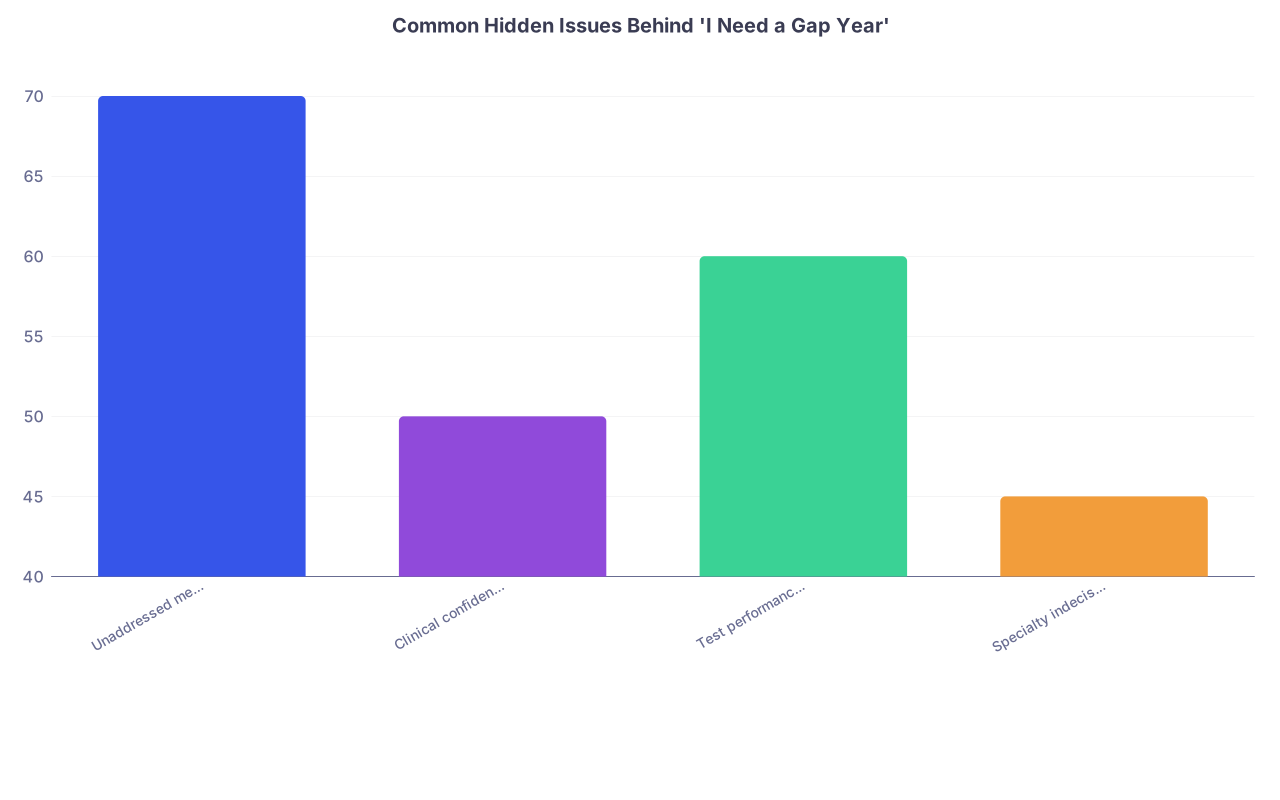
| Category | Value |
|---|---|
| Unaddressed mental health | 70 |
| Clinical confidence issues | 50 |
| Test performance gaps | 60 |
| Specialty indecision | 45 |
Many students justify a gap year with surface reasons:
- “I want more research.”
- “I want to be more competitive.”
- “I need to improve my application.”
Underneath, there is often something else:
- Untreated depression or anxiety.
- Serious test-taking issues that were never truly addressed.
- Clinical performance concerns that got hand-waved with “you passed eventually.”
- Complete uncertainty about which specialty actually fits.
The mistake is using a gap year as a delay button, then filling it with activities that dodge the real problem.
Examples:
- You “improve your application” with more research but never address the fact that you failed Step 2 because you cannot manage your anxiety during exams. So it happens again with in-training exams.
- You do a year of generic internal medicine research but still have no idea whether you want IM, EM, or anesthesia. So your ERAS is scattered and your interview answers are vague.
- You call it a “mental health year” but never actually see a therapist, get evaluated for ADHD, or change the systems that broke you in the first place.
Gap years only help if they change the trajectory of the underlying issue.
You need to identify, in unflinching language, what the real problem is:
- “I cannot regulate my anxiety under testing conditions.”
- “I am deeply ambivalent about clinical medicine.”
- “I do not know how to say no, so I drown in obligations.”
- “I am clinically slow and disorganized.”
Then you need an actual intervention, not vague intentions:
- Formal testing support / coaching.
- Career counseling with someone outside your echo chamber.
- Therapy or psychiatric care.
- Time in clinic with targeted feedback on efficiency and organization.
If you reach the end of your gap year and the underlying issue is untouched, you did not use the year well. Even if you have a couple more lines on your CV.
Mistake #7: Ignoring the Practicalities (Money, Visas, Logistics) Until They Break You
| Area | Common Mistake | Consequence |
|---|---|---|
| Finances | No budget or income plan | Stress, forced bad jobs |
| Visas | Not checking status timelines | Ineligibility to match |
| Licensure | Ignoring required paperwork | Delays in starting PGY1 |
| Housing | No stable plan for applications | Constant moves, burnout |
| Health | Losing insurance coverage | Skipped care, high bills |
Burnout is not just emotional. It is financial and logistical. I have watched otherwise promising applicants burn out because the life side of their gap year was a mess:
- They assumed they could “just pick up some shifts” and then got nothing.
- They moved three times in 12 months chasing short-term work.
- They lost health insurance and stopped necessary treatment.
Here is the mistake: treating the gap year like a one-year summer break instead of a 12–18 month project that needs boring adult planning.
At minimum:
- Build a budget for the entire year plus the application cycle. Include:
- Exam fees
- ERAS fees
- NRMP fees
- Travel (even with virtual interviews, some specialties still require in-person)
- Decide where you will live and why. “I will crash wherever” sounds flexible but usually means chaos.
- Know your visa and eligibility timelines if you are an IMG or on any non-citizen status.
- Keep your documentation and licensing status in check: immunizations, background checks, any state-specific forms for observerships or jobs.
Chronic financial or housing stress will completely drain whatever recovery your “rest” provides. You will not feel refreshed if you are constantly worried about rent.
Mistake #8: Pretending the Match Calendar Does Not Apply to You
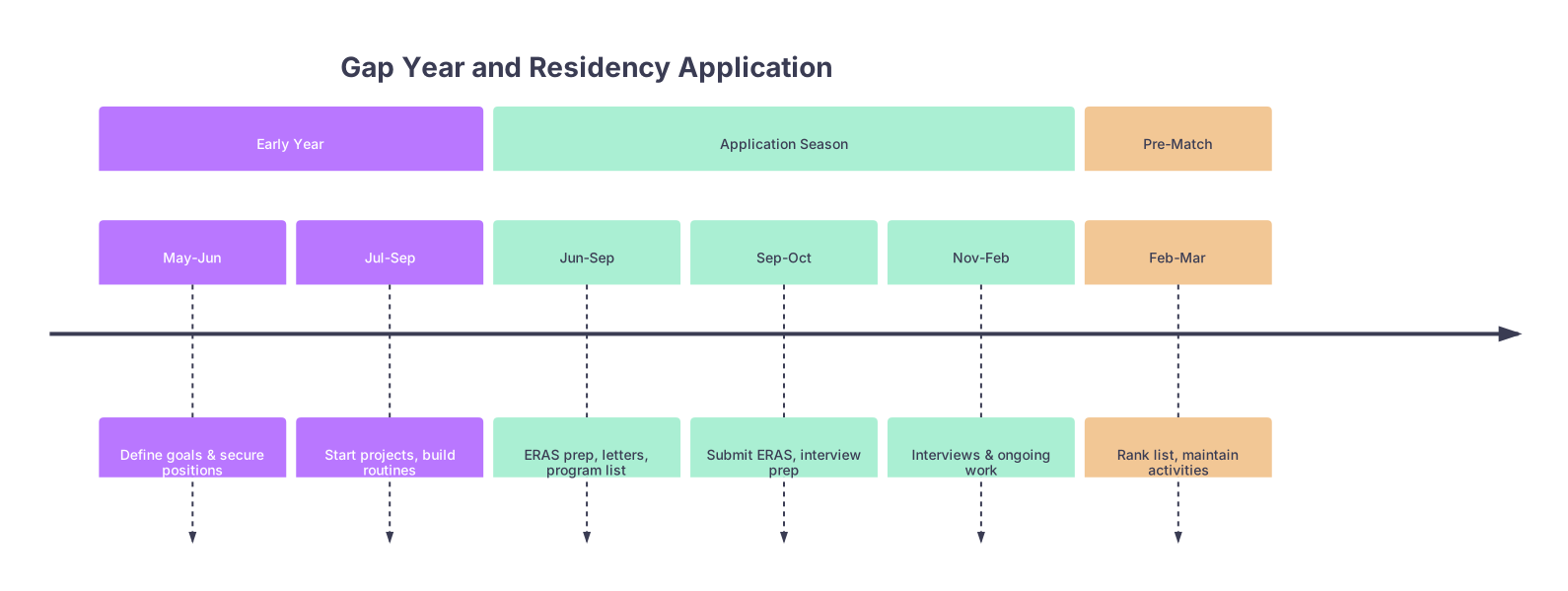
| Period | Event |
|---|---|
| Early Year - May-Jun | Define goals & secure positions |
| Early Year - Jul-Sep | Start projects, build routines |
| Application Season - Jun-Sep | ERAS prep, letters, program list |
| Application Season - Sep-Oct | Submit ERAS, interview prep |
| Application Season - Nov-Feb | Interviews & ongoing work |
| Pre-Match - Feb-Mar | Rank list, maintain activities |
A lot of gap year students act like they have “an extra year” and then cram everything into the same few months everyone else does. That is how you end up:
- Writing a rushed personal statement in August.
- Begging for letters in September from attendings who barely know you.
- Trying to spin up a research project in June and promising a “manuscript in preparation” that never materializes.
Your gap year must be mapped to the application calendar, not your mood.
Think in phases:
First 2–3 months (Immediately post-graduation or early gap year):
- Clarify specialty and target program profile.
- Secure at least one anchor activity (job, research, or structured observership).
- Identify 2–3 potential letter writers and clarify what you will do with them.
Middle of the year:
- Consistently show up in your anchor role(s).
- Collect stories, outcomes, and specifics you will use in ERAS and interviews.
- Draft personal statement and activity descriptions.
Application season:
- Tighten documentation—not start from scratch.
- Maintain your roles at a sustainable level.
- Use extra time strategically for:
- Interview practice
- Program research with actual decisions attached
If you only get serious about structure once ERAS opens, you will default to panic-mode productivity and guilt-ridden “rest.” That is the burnout recipe we are trying to avoid.
Frequently Asked Questions (FAQ)
1. How much “rest” is too much during a gap year before residency?
If months go by without:
- A clear primary role (clinic, research, teaching, job), and
- Concrete outputs you can list on ERAS or discuss in an interview,
then you are drifting, not resting. Real rest is time-bounded and surrounded by intentional activity. A vacation? Good. Six months of vague downtime with no narrative? Hard to defend and usually bad for your mental health.
2. Can I honestly say I took a gap year for burnout or mental health reasons?
Yes, but do not stop there. Program directors worry about unaddressed or ongoing impairment, not the fact that you struggled. You need to show:
- What specific supports or changes you put in place.
- How you function now (examples from current roles).
- What systems you have to prevent relapse (sleep, therapy, boundaries).
Vague “I was burned out” without concrete actions looks unstable. A clear story of recognition, intervention, and recovery can actually strengthen trust.
3. Do I need research during my gap year to be competitive?
Not automatically. Research helps most in:
- Highly competitive specialties (derm, ortho, plastics, ENT, etc.).
- Academic internal medicine or subspecialty-focused careers.
If your record is already research-heavy, another weak project that goes nowhere is not worth your energy. Clinical exposure, teaching, or solid work experience can be far more valuable than padding your CV with “manuscript in preparation” that no one believes.
4. How do I know if my gap year is hurting, not helping, my burnout?
Watch for these signs:
- You dread each week but cannot name clear responsibilities.
- You feel guilty both when you rest and when you work.
- You are increasingly isolated and spend more time online than with real people.
- The underlying issues (test anxiety, depression, indecision) look exactly the same as when you started.
If those describe you, you do not need more willpower. You need to restructure the year, probably with external help: mentor, therapist, advisor, or all three.
Key points to keep in your head:
- Gap years do not automatically fix burnout. Structure, honest problem-solving, and real rest do.
- Separate deliberate rest from deliberate productivity. Guilt-driven “in between” time is where burnout grows.
- Build a coherent, forward-facing narrative of your year—one that shows growth, not drift.


