

A gap year before residency is not the problem. How you use it—and how your application explains it—is.
The myth that “any gap year is a red flag” survives mostly in group chats and anxious Reddit threads, not in actual selection committee rooms. I’ve sat in those rooms, listened to real conversations, and watched how files with non‑linear timelines get handled. The reality is a lot less dramatic and a lot more nuanced than the folklore you hear in the student lounge.
Let me walk through what actually raises eyebrows, what program behavior really tells you, and when a gap year helps you more than a straight‑through application.
The Myth vs. The Data: Are Gaps Punished?
Programs don’t have a secret checkbox labeled “gap year = reject.” They do have constraints and biases—but they’re not as simple as “any time off is bad.”
Here’s what we actually know from NRMP, program surveys, and what PDs admit when the Zoom recording is off:
- Many programs prefer fresh grads for some specialties, but that’s primarily about years since graduation, not whether you took one structured year between MS4 and residency.
- Program directors care far more about USMLE/COMLEX performance, failed attempts, professionalism issues, and the pattern of your career than a single planned separation between med school and residency.
- “Red flags” in official PD surveys are things like repeated failures, unexplained leaves, disciplinary actions, or major professionalism concerns—not “spent a year doing research.”
The real filter is this: does your gap year make your story clearer and your value higher, or does it make your file murkier and your reliability questionable?
A one‑year research fellowship with publications and a strong letter? That helps. Two unaccounted years labeled “personal reasons” with no clinical contact and no letters? That hurts.
Let’s make this concrete.
| Type of Year | Typical Program Reaction |
|---|---|
| Funded research fellowship | Usually positive |
| Dedicated Step/COMLEX study year | Neutral to mildly negative |
| Clinical fellowship/externship | Positive if well-documented |
| Unexplained non‑clinical year | Clearly negative |
| Family/health leave, well explained | Mixed, but often acceptable |
None of that is “gap year = automatic red flag.” It’s “unexplained or unproductive = red flag.”
What Actually Triggers Red Flags
Most program directors won’t say “gap year” when you ask what worries them. They say: inconsistency, lack of reliability, and risk. And they use the timeline as a proxy for those.
The timeline questions they’re really asking are:
- Did this person drift, or did they decide?
- Were they still engaged with medicine?
- Can I trust them to show up, work hard, and finish the program?
So they scan your ERAS chronology looking for patterns that suggest trouble. Here’s what actually sets off alarms:
1. Unexplained blank space
Six to twelve months with nothing listed—no work, no research, no care for a sick relative, no anything—and then a vague one‑line sentence in the personal statement about “facing personal challenges.” That’s how files get placed in the “too much risk” pile.
Programs understand life happens. Illness. Immigration delays. Visa issues. Babies. Burnout. But if you do not own it and contextualize it, they’re forced to fill that vacuum with their worst‑case scenario.
2. Total break from medicine
This is what scares them more than the gap itself:
- No clinical work
- No research
- No academic activity
- No ongoing CME
- No letters during that period
If your last clinical exposure is three years back and your gap year looks like you were backpacking without any connection to patient care, they worry your skills are stale and your motivation is gone. Fair or not, that’s how they think.
3. Step/COMLEX damage control that never pays off
A “dedicated study year” after multiple failures is not, by itself, reassuring. Programs look for outcomes:
- Did the score actually improve?
- Did you demonstrate discipline and follow‑through?
- Did you do anything else productive while studying?
If you disappear for a year “to study,” still barely pass, and have no other activity, they don’t see a hard worker. They see someone who needs excessive time for minimal progress.
4. Compounding problems
Gap years don’t exist in isolation. They’re interpreted in the context of:
- Multiple exam failures
- Remediated courses
- Prior leaves of absence
- Professionalism write‑ups
A single, well‑explained gap can be fine. A gap stacked on top of leaves, failures, and weak letters becomes the straw that breaks your application.
That’s the real calculus behind the scenes: the gap isn’t the crime; it’s the multiplier.
Where a Gap Year Helps You
Here’s the part almost no one tells you: used well, a gap year can move you from “maybe” to “yes,” especially if you’re targeting competitive specialties or repairing weaknesses.
Program behavior gives this away if you know where to look.
Research‑heavy specialties quietly like gap years
Dermatology, plastics, ortho, radiation oncology, ENT—these fields are notorious for informal “extra year strongly encouraged” cultures. Programs may not say “required,” but they absolutely notice who shows up with:
- A research fellowship at a known institution
- Multiple abstracts and at least one publication
- A letter from a recognized PI in that specialty
In these fields, the missing year in your training timeline doesn’t look like a gap. It looks like commitment.
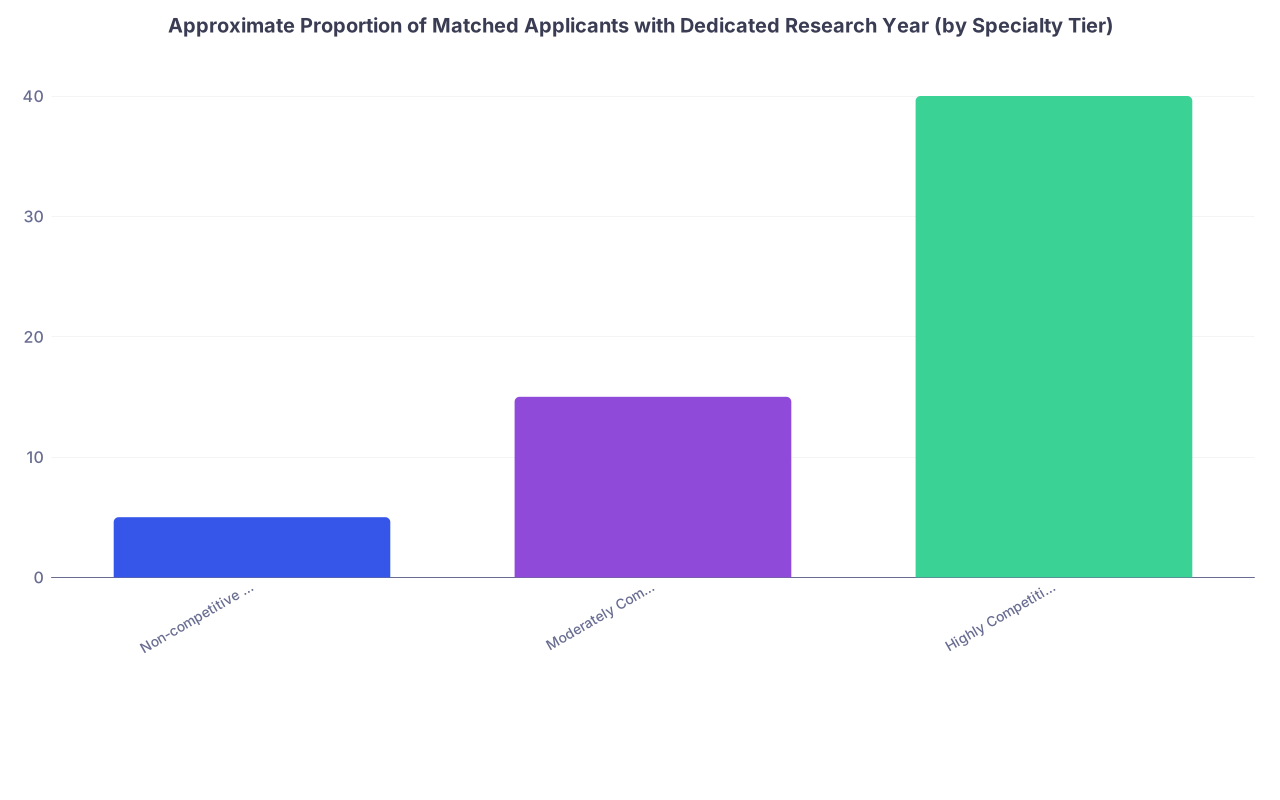
| Category | Value |
|---|---|
| Non-competitive IM/FM | 5 |
| Moderately Competitive (EM, Anes) | 15 |
| Highly Competitive (Derm, Plastics, ENT) | 40 |
Numbers vary by cycle and program, but the trend is real: in competitive fields, “nonlinear” often equals “strategic.”
Strategic reapplication
For some applicants, going straight through with a weak application is worse than stopping, fixing the weak spots, and reapplying stronger.
I’ve watched this play out:
- Applicant #1 applies to general surgery with a low Step 2 and mediocre letters, no research, no clear mentorship. Goes unmatched. Tries prelim. Struggles.
- Applicant #2 recognizes the same weaknesses before applying. Takes one structured year:
- Joins a busy academic lab
- Gets one first‑author and two co‑author papers
- Improves Step 2
- Earns a glowing letter from a division chief
- Gains clarity and switches to a more aligned specialty
Applicant #2 matches solid categorical the next year. Same starting point, different willingness to pause and rebuild.
Program directors tend to respect “I stepped back, got my act together, and came back stronger” way more than “I barreled ahead with a clearly weak application.”
Clarifying your story
Another under‑appreciated benefit: a gap year can make your narrative less chaotic.
Plenty of students jump into specialties they barely understand, then try to pivot late. That looks erratic.
A year spent in focused exposure—say, a clinical or research year in PM&R, palliative, or psych—can take you from “seems undecided” to “deeply committed and informed,” especially if your prior CV points in a totally different direction.
Programs don’t mind that you explored. They mind when you look confused.
How Programs Actually Process Gap Years
Let’s talk about what’s going on in the program office when they click your ERAS file and see dates that don’t line up perfectly.
First, the context: most screeners are doing quick triage. They may have 1000+ applications for 10–20 spots. They are not building psychological profiles. They’re asking rapid‑fire questions:
- Does this applicant meet our exam cutoffs?
- Any obvious professionalism red flags?
- Does their experience fit our program’s needs?
The timeline comes in during the “any red flags?” glance.
Here’s a simplified version of how that mental flowchart looks.

| Step | Description |
|---|---|
| Step 1 | See non-linear timeline |
| Step 2 | Flag for risk / likely screen out |
| Step 3 | Concern about skills/motivation |
| Step 4 | Neutral or mild concern |
| Step 5 | Viewed as positive or strategic |
| Step 6 | Is the gap explained? |
| Step 7 | Connected to medicine? |
| Step 8 | Added value? Letters, skills, output |
Nobody is saying, “This person took time, instant reject.” They’re saying, “Can I understand the reason? Did they stay engaged? Did this time improve or weaken their candidacy?”
You can shape those answers—explicitly—through:
- Clear entries in the Experiences section
- A straightforward, non‑dramatic explanation in your personal statement
- A program director or PI letter directly referencing the gap and your performance
Silence is what kills you, not the gap itself.
The Only Three Questions You Actually Need to Answer
Forget trying to anticipate every program’s secret rule. They’re all circling the same three questions about your gap year:
- Why did you step off the standard path?
- What did you do with that time?
- Are you now a safer, stronger bet because of it—or not?
If your application materials give satisfying, specific answers to those, you’ll survive the initial suspicion most gaps provoke.
Let’s break those down.
1. Why did you step off?
You don’t need a trauma memoir. You do need a clear, honest frame.
- “I realized late that I was truly interested in X specialty and took a year in a focused research fellowship to build experience and confirm the fit.”
- “After failing Step 1, I recognized I needed to strengthen my foundation. I took a structured year with a formal remediation plan and research work in the department.”
- “A family member developed serious illness, and I became their primary caregiver for six months. During that time I maintained CME and part‑time telemedicine scribing to stay close to clinical care.”
Soft, vague phrases—“personal circumstances,” “complex challenges,” “time to reflect”—sound like you’re hiding something. Be concrete without oversharing.
2. What did you do?
Programs don’t care about your abstract intention. They care about observable behavior.
Show:
- Positions with clear supervisors
- Time commitment (full‑time, part‑time)
- Specific outputs (posters, papers, presentations, quality projects)
- Any clinical duties (volunteer clinics, scribing in high‑acuity settings, externships)
You want the reader thinking, “Okay, this person was still in the game. Maybe more than before.”
3. Are you better now?
This is the litmus test.
If the year:
- Fixed a test score problem
- Gave you strong letters you lacked
- Clarified your specialty choice
- Demonstrated resilience and follow‑through
You highlight that.
If the year didn’t obviously help… you have more work to do in your explanation, or more work to do this year before applying.
When a Gap Year Is a Problem
Let’s be blunt: there are scenarios where a gap year makes your odds worse, not better. You should be honest with yourself about these.
Where it clearly hurts:
- You’re in a time‑sensitive specialty (surgery, EM) and take multiple years off from any hands‑on clinical exposure. Surgical skills and ED flow are very time‑dependent; programs are wary of re‑training from zero.
- You had marginal performance and used the “gap” to do nothing that clearly changes the story—no score improvement, no new letters, no new skills. That just looks like a stall.
- You’re already many years post‑graduation. A newly added gap pushes you beyond many programs’ informal “years since graduation” limits (often 3–5 years for categorical positions).
There’s also the “optics” side you can’t ignore. A year labeled “burnout and recovery” with no structure and no outputs makes people nervous—even if that’s exactly what happened. Unfair, but real.
The workaround is not faking productivity. It’s building some structured, documentable engagement with medicine even during recovery: part‑time research assistant, quality improvement projects, CME certificates, online teaching, anything that signals you didn’t just vanish.
Reading Program Behavior: What Their Actions Tell You
Programs reveal their values by what they actually do, not what they write in glossy brochures.
Some patterns that matter:
- Programs that routinely take physician‑scientist trainees, research fellows, or non‑traditional applicants are already comfortable with nonlinear timelines. Your gap year will get a much fairer read there.
- Community programs that emphasize “ready to work day one” tend to be more sensitive to long clinical gaps and older graduation years. Not hostile, just more cautious.
- Some specialties (FM, psych, IM) tend to be more forgiving of well‑explained personal or family gaps, especially if you can show empathy and maturity grew from it. That’s not wishful thinking; I’ve heard that stated explicitly in selection meetings.
If a program’s current residents include people who did research fellowships, were IMGs with long paths, or had career changes, that’s your proof: they will not automatically blacklist you for one year off.
How to Decide if You Should Take a Gap Year
The real question isn’t “Is a gap year bad?” It’s: “Given my current file, is staying on the assembly line worse than stepping off and fixing things?”
Brutally honest version:
- If your scores are decent, your letters are strong, your clinical grades are fine, and you’re aiming for a non‑hyper‑competitive specialty: a gap year may not help much. You’re fixing what isn’t broken.
- If you have clear, specific deficits—a failed exam, no specialty letters, zero research in a research‑heavy field, late specialty switch—a well‑planned gap year can absolutely save your match.
You’re not being judged for taking time. You’re being judged for whether you used time intelligently.
The Bottom Line
Three things to walk away with:
- A gap year by itself is not a red flag; an unexplained, unproductive, or clinically disconnected gap year is.
- Programs care less about chronological purity and more about whether your timeline shows growth, reliability, and engagement with medicine.
- If your year off clearly improves your scores, your letters, your clarity, or your skills—and you explain it like an adult—it can be an asset, not a liability.


