
The obsession with cranking out first‑author papers in a single gap year is one of the most misleading myths in the residency arms race.
You’ve probably heard some version of this: “Take a research year, get 3–5 first‑author publications, and you’ll be competitive for derm/ortho/plastics.” Sounds clean. Linear. Transactional. It is also, in the way most people imagine it, largely fantasy.
Let’s talk about what actually happens when med students try to brute‑force first‑author output in 12 months—and what the match data and publication timelines really show.
The Myth: “I’ll Take a Gap Year and Crank Out 3+ First‑Author Papers”
If you hang around any competitive specialty interest group long enough, you’ll hear variations of:
- “X took a research year at [famous institution] and got 7 pubs.”
- “You basically need multiple first‑author papers now.”
- “Program directors want to see productivity—so just work harder.”
You’ll also hear the warped success stories: the one student who did a prestigious research fellowship and came out with a monster CV, told at every interest meeting like a campfire legend.
Here’s the problem: those stories are the outliers, not the baseline expectation.
Let me be blunt: for most students, planning to secure multiple first‑author, PubMed‑indexed, peer‑reviewed papers from scratch in a single 12‑month research gap year is unrealistic. Not impossible. But unrealistic as a baseline plan.
Why? Because publication math and residency timelines do not care about your ambition.
What the Data Actually Shows About “Research Productivity”
Let’s anchor this in facts, not forum folklore.
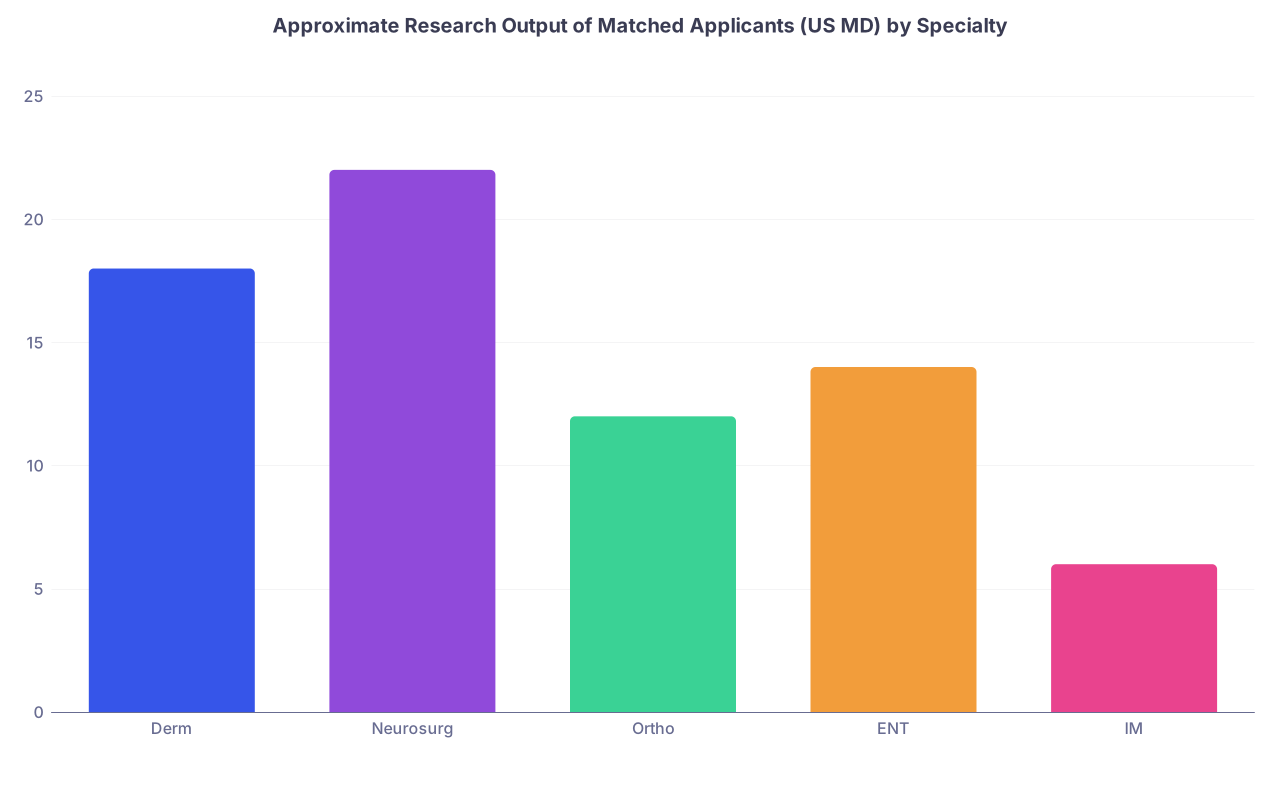
The NRMP Program Director Surveys are the best window into how research is really viewed. For competitive specialties (derm, plastics, ortho, ENT, neurosurgery, etc.), matched applicants often report double‑digit “publications, abstracts, and presentations.”
Notice the wording. Not “first‑author original research articles in high‑impact journals.” It’s:
- Case reports
- Retrospective chart reviews
- Conference abstracts
- Posters
- Oral presentations
- Middle‑author collaborative work
- Sometimes preprints or in‑press work
And yes, some first‑author original research. But not for everyone.
| Category | Value |
|---|---|
| Derm | 18 |
| Neurosurg | 22 |
| Ortho | 12 |
| ENT | 14 |
| IM | 6 |
Those numbers are rough but consistent with recent NRMP data trends. Now, ask yourself: does that look like 15 first‑author original articles per applicant? Obviously not.
You are competing with people who started stacking research from M1/M2, who have multi‑year projects, mentors feeding them cases, and collaborations across labs. A single gap year is not a magic printer that spits out first‑author manuscripts.
The Real Timeline: Papers Do Not Move at Med Student Speed
This is the part almost everyone underestimates.
From idea to PubMed, the realistic timeline for original clinical research often looks like:
- 1–3 months: Project design, IRB submission, revisions, approval
- 2–6 months: Data collection and cleaning (longer if prospective)
- 1–2 months: Analysis and figure generation
- 1–3 months: Writing, revisions with mentor(s)
- 1–3 months: Journal review time (if you’re lucky)
- +0–6 months: Rejection, resubmission, repeat
And you think this fits neatly into a 12‑month block, from cold start, multiple times?
For most students, no.
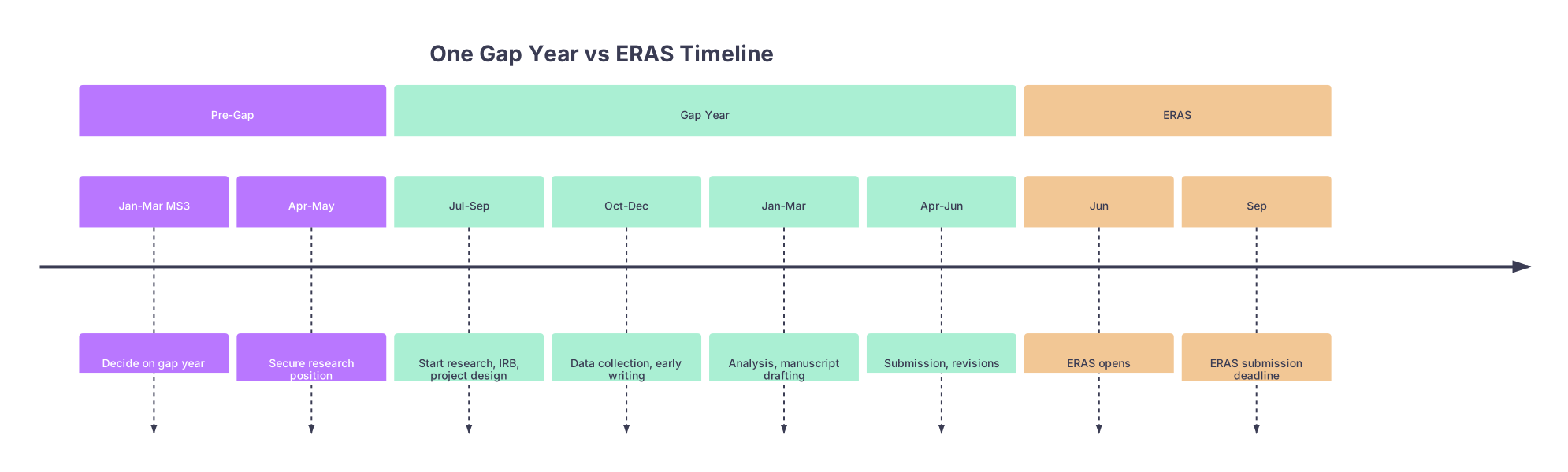
Now overlay residency application timelines on top of this.
| Period | Event |
|---|---|
| Pre-Gap - Jan-Mar MS3 | Decide on gap year |
| Pre-Gap - Apr-May | Secure research position |
| Gap Year - Jul-Sep | Start research, IRB, project design |
| Gap Year - Oct-Dec | Data collection, early writing |
| Gap Year - Jan-Mar | Analysis, manuscript drafting |
| Gap Year - Apr-Jun | Submission, revisions |
| ERAS - Jun | ERAS opens |
| ERAS - Sep | ERAS submission deadline |
Your ERAS application is essentially “frozen” in September of your application year. Anything accepted after that? You can update programs, but it’s not the centerpiece of your initial file. Anything submitted but not accepted? You’re listing it as “submitted” or “in preparation,” which is better than nothing—but not remotely the same as “published.”
The fantasy:
“I’ll take a gap year, generate 3–4 first‑author papers, and they’ll all be on my ERAS as published articles.”
The reality for typical students starting from scratch:
“You might get 0–1 true first‑author papers accepted in time, plus several co‑author items, abstracts, and in‑progress projects you can legitimately list.”
If you land in a hyper‑productive lab with easy‑IRB retrospective databases and a mentor who treats research like an assembly line? Different story. But that’s system advantage, not personal willpower.
First‑Author vs Total Scholarly Footprint: What Actually Matters
Here’s the inconvenient truth: many applicants massively overvalue the label “first author” and undervalue their overall scholarly footprint.
Program directors are not counting “first” vs “middle” authors with a ruler for most applicants. They’re looking for:
- Evidence you can see a project through
- Consistency of involvement across multiple projects
- Fit with their specialty’s academic profile
- Strong letters from people who can credibly say: “This person drove the project”
I’ve sat in rooms where applications are reviewed, and you know what comes up more than “how many first‑author papers?”:
- “They’ve clearly been producing for 2–3 years.”
- “Letter says they independently led a retrospective study.”
- “They presented at SSO/AAOS/ACR.”
- “This is real work in our field, not just random filler.”
First‑author status can be a signal—but content, continuity, and credibility matter more.
Here’s a more honest breakdown of what a strong research gap year might yield for a well‑positioned, hard‑working student:
| Output Type | Realistic Range | Fantasy Expectation |
|---|---|---|
| First‑author original articles | 0–2 | 3–5+ |
| Middle‑author articles | 2–6 | 0–2 (ignored) |
| Conference abstracts/posters | 2–8 | 1–3 |
| Case reports / brief reports | 1–4 | 0 (seen as “weak”) |
| In‑preparation / submitted papers | 2–6 | 0 (“only count pubs”) |
The “fantasy” column is how many students talk, especially in competitive fields. The “realistic” column is what I actually see over and over from students in busy, moderately productive labs who show up and put in work.
Where One Gap Year Can Change the Game
Now, let’s not swing to the other extreme. A research year is not useless. For some specialties and some profiles, it’s absolutely game‑changing.
A gap year can be high‑yield if:
- You’re switching into a research‑heavy, competitive specialty late (e.g., discover derm or neurosurg mid‑MS3).
- Your existing CV is thin on research and you need to show trajectory.
- You’re at a school without home programs or strong mentors in your target field.
- You can plug into an established, high‑volume research group where projects are already teed up.
In those scenarios, measuring success solely in “first‑author count” is just bad strategy. More useful success markers:
- You gain 1–2 mentors who will write top‑tier letters.
- You become the “go‑to” student for a PI or service.
- You get involved in 5–10+ projects at various levels (case series, database projects, QI, multi‑center retrospectives).
- You attend and present at at least one major specialty meeting.
- You walk away with a portfolio of ongoing work that continues after the gap year.
That last point is underrated: programs love seeing a research story that’s still in motion, not a one‑year spike that then dies.
The Hidden Variables Nobody Mentions
Another reason “just get first‑author papers” is such a useless mantra: it completely ignores the structural factors that decide your output more than your alarm clock does.
Things that matter far more than raw effort:
- Type of projects available: Retrospective database vs prospective clinical vs bench research. Retrospective = faster papers.
- PI’s track record: Some attendings have 40 papers a year and systems in place; others publish once every 2–3 years.
- Lab/department culture: Are students expected to publish? Are there templates, pipelines, shared datasets?
- IRB efficiency: Institutional bureaucracy can kill your timeline before you even start.
- Mentor’s bandwidth: If they’re a new attending drowning in clinical work, good luck getting quick manuscript edits.
I’ve seen two students, both bright and hard‑working:
- Student A: Joins a derm group with a giant photo database, existing IRB, and a senior PI who lives in PubMed. They get 2 first‑author retrospectives, 4 middle‑author, and 3 conference abstracts in one year.
- Student B: Joins a basic science lab “because it’s prestigious,” spends 9 months optimizing Western blots, and ends the year with “manuscript in preparation” and a nice letter. Zero pubs on ERAS.
Same effort. Wildly different output. Not because one “wanted it more,” but because the project structures were different.
Ambitious vs Unrealistic: How to Draw the Line
Ambitious is good. Fantasy is useless. Here’s how to tell which side of the line you’re on.
Ambitious but realistic gap year plan:
- You aim to be primary driver on 1–2 well‑defined projects that are already IRB‑approved or close.
- You intentionally join 3–5 additional projects where you can be a middle‑author but learn quickly and stack output.
- You accept that some work will show up as “submitted” or “in revision” on ERAS and that this is still valuable.
- You prioritize mentors and infrastructure over prestige of the lab name alone.
- You time your start early enough (spring of MS3) to have things in motion before July.
Delusional, unrealistic plan:
- You expect to design multiple projects from scratch, get IRB, collect data, analyze, write, submit, and publish all in 12 months.
- You ignore middle‑author opportunities as “not worth it.”
- You assume every submission will be accepted by the first journal quickly.
- You start in July and think all of it will be fully published by the next September.
- You think programs care more about “3 first‑author pubs” than a strong letter saying, “This student is the best researcher I’ve worked with in years.”
Ambition says: “I’ll maximize my output within the constraints of reality.”
Delusion says: “Constraints do not apply to me.”
How Programs Actually Read Your Research Year
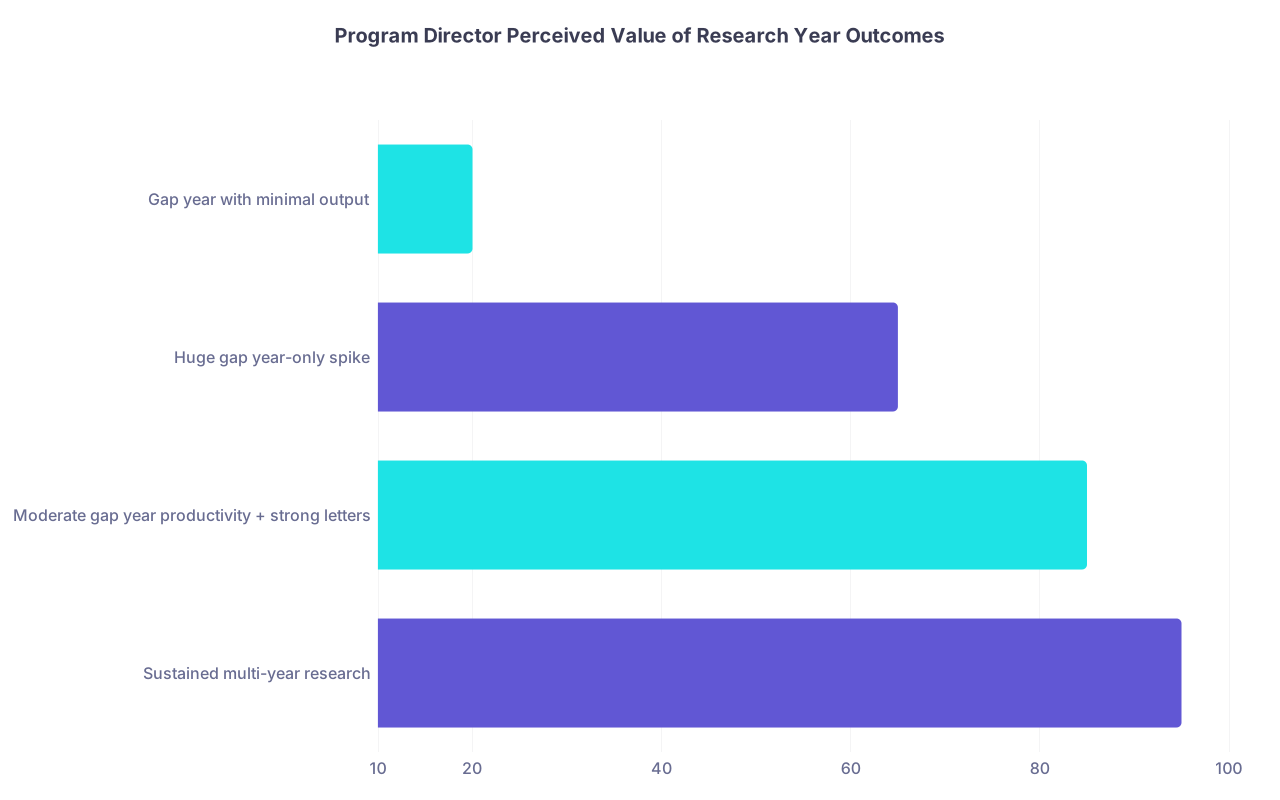
On the residency side, here’s how your gap year gets interpreted:
- If you have zero or almost zero output after a full research year: red flag. Either the environment was terrible, or you were.
- If you have modest but clear productivity (a few submitted/published works, posters, solid letters): positive signal, especially if your pre‑gap CV was thin.
- If you have huge output (10–20+ items, including some first‑author), but all in 12 months and nothing before: curiosity. Some will be impressed. Some will quietly wonder how much is “CV stuffing” or you being plugged into a machine.
- If you have sustained output (some work before, a strong bump during, and projects carrying forward after): best‑case narrative. You look like an actual future academic, not a one‑year mercenary.
| Category | Value |
|---|---|
| Sustained multi-year research | 95 |
| Moderate gap year productivity + strong letters | 85 |
| Huge gap year-only spike | 65 |
| Gap year with minimal output | 20 |
Are these exact numbers from a study? No. But they match what PDs say in surveys, podcasts, and behind closed doors: sustained trajectory and strong letters carry more weight than “I white‑knuckled 12 months and spammed journals.”
So, Is Chasing First‑Author Papers in One Gap Year Ambitious or Unrealistic?
Both. Depending on how you define “chasing” and what success looks like.
If by “chasing” you mean:
- Joining a strong research environment
- Owning one or two meaningful projects
- Accepting a mix of first‑, middle‑author, and in‑progress work
- Optimizing for letters, skills, and a coherent academic story
Then it’s ambitious and smart.
If by “chasing” you mean:
- Banking your entire competitiveness on stacking multiple new first‑author papers
- Ignoring all other forms of scholarly activity
- Treating the publication process like a vending machine you can brute‑force with 80‑hour weeks
Then it’s not ambition. It’s magical thinking dressed up as “grind.”
How to Use a Gap Year Without Lying to Yourself
If you’re considering a gap year for residency:
- Evaluate opportunities, not just “research” as a generic checkbox. Who will mentor you? What projects already exist? How fast does this group historically publish?
- Define success as a portfolio: some finished work, some in progress, some networking, some skills—rather than a specific number of first‑author papers.
- Be honest about timelines. If a project is starting IRB in September and needs fresh prospective data, it’s probably not making it to “published” by next September.
And be clear about this: the goal is not to impress strangers on Reddit. The goal is to present a credible, consistent, and evidence‑backed story to programs about why you belong in their specialty.
First‑author papers can help. They are not the whole story. And in one gap year, they definitely should not be the only metric you chase.

The Bottom Line
To wrap this up without sugar‑coating:
- A single gap year can absolutely boost your application, but expecting multiple clean, first‑author publications from scratch in that time is usually unrealistic.
- Programs care far more about sustained, credible scholarly activity plus strong research letters than they do about the exact number of first‑author papers.
- Use a research year to build a portfolio—projects, skills, mentors, and a narrative—not to chase a vanity metric that ignores how slowly academia actually moves.


