

The obsession with brand‑name gap years is wasting smart people’s time.
The cult of “Harvard fellowship or bust” before residency has gotten detached from reality, actual match data, and what program directors say when they’re not on a podium. You’re being sold a prestige narrative that often does not line up with who actually matches well or who thrives in training.
Let me be blunt: a big‑name hospital on your gap‑year line does less for you than you think, and what you actually do there (or anywhere) matters far more than the logo on the ID badge.
Let’s dismantle this properly.
Myth #1: “You need a brand‑name hospital gap year to match well”
You don’t. And the numbers back that up.
Residency program directors repeatedly rank the same top factors when they’re surveyed by NRMP: clinical grades, Step/COMLEX scores (or pass status + Step 2 score now), letters of recommendation, perceived fit, and interview performance. Where you spent a 1‑year research or clinical gap? It’s secondary at best.
Look at it this way: if brand‑name gap years were truly essential, you’d see a clear pattern—almost all residents at top programs would have some “Mass General” or “Mayo” fellowship or research year beforehand.
Go pull a few department websites for, say, internal medicine at UCSF, Brigham, Penn, Michigan. You’ll see:
- Plenty of people who went straight through with no gap year.
- Some who did research years at their home med school.
- A minority who did formal research fellowships at big places.
- A bunch who did MPH, MBA, global health, Teach for America, or literally non‑medical careers.
What you don’t see is “100% of them did a branded gap year.”
Here’s how program directors actually look at it, based on what they say in NRMP surveys, at APDIM/APGO meetings, and off the record over dinner:
- If your core metrics are already strong (solid scores, strong clerkship grades, good letters), a brand‑name gap year is not the thing that “unlocks” top programs. It’s just a nice‑to‑have, and only if you did something tangible.
- If your application is weak—low scores, shaky clinical comments—a fancy logo on a research position doesn’t “erase” that. They know what these positions look like from the inside.
- If you’re from a less well‑known med school, yes, a big‑name letter can help a bit with recognition and signaling. But only if the letter actually says you’re excellent. Not “pleasant and hardworking.” Excellent.
The gap isn’t “brand‑name vs nothing.” The real split is “substantive, well‑mentored experience with real output vs warm body in someone’s IRB spreadsheet.”
You can get the former at a big name or a smaller place. You can also fail to get it at either.
Myth #2: “Prestige of the institution matters more than what you actually do”
This one’s backwards.
When I talk to faculty who sit on residency selection committees, they say the same thing over and over: they scan for evidence of impact. Not tourism.
A “research fellow” title at a prestigious hospital doesn’t mean much by itself. They’ve all seen this move:
- You land a “prestigious” gap year at a brand‑name institution.
- You’re technically on 3–4 projects, but:
- You’re the data grunt.
- You attend a thousand lab meetings.
- You collect chart review data for months.
- The PI is too busy to mentor.
- Publications? Maybe a middle‑author abstract that gets presented without you.
Now compare that to someone at a less famous program or community‑based site who:
- Helps design a quality improvement project that actually changes a clinic workflow.
- Co‑authors a manuscript and presents it at a regional or national meeting.
- Gets a letter that says, “This student independently led X project from idea to implementation and presented to our department leadership.”
Guess which one program directors remember ten minutes after reading the application? The latter. Every time.
Here’s a rough comparison of what actually moves the needle versus what people think does:
| Factor | Applicants Think Impact | Program Directors’ Real Impact* |
|---|---|---|
| Big-name hospital logo | Very High | Low–Moderate |
| First/second-author publication | Moderate | High |
| Strong, detailed letter from mentor | Moderate | Very High |
| Clear narrative linking to specialty | Low | High |
| Middle-author on many projects | High | Low–Moderate |
| Concrete leadership / QI outcomes | Moderate | High |
*“Real impact” here is based on recurring themes in NRMP PD survey data and PD panel discussions—not formal percentages, but consistent patterns.
If you want your gap year to actually matter, reverse your priorities:
- Start with: Who will mentor me and invest in my development?
- Then: What projects can I own or significantly drive?
- Then: Is there realistic potential for a publication, presentation, or measurable improvement?
- Only then: Does the institution name add any bonus signal?
Brand comes last, not first.
Myth #3: “All brand‑name gap years are equal”
They’re absolutely not. The variation inside a single “prestigious” hospital is huge.
At the same famous institution, you can find:
- A structured, paid research fellowship with consistent mentorship, protected time, and clear expectations of manuscripts and conferences.
- A chaotic, grant‑funded limbo job where 3 PIs “share” you, no one owns your development, and your days disappear into data entry.
- A clinical research coordinator role where you gain actual patient interaction, workflow knowledge, and maybe strong letters.
- A glorified “RA” position where your name might not end up on anything.
From the outside, all of these look equally impressive on a line: “Research Fellow, [Prestige Hospital].” From the inside, they’re not even close.
That’s why you should interrogate the job, not the logo:
- Who exactly will supervise you?
- How often do they meet with mentees?
- What have previous gap‑year students in this role actually achieved? Not vague references—names and PubMed IDs.
- Are you first/second author potential on anything, or are you project number seventeen?
- Is the work aligned with your target specialty or at least clinically meaningful?
If the answers are hand‑wavy, the prestige is probably doing more work than the substance.
On the flip side, I’ve seen community‑based or “non‑brand” programs where the attending treats a gap‑year student like a junior collaborator: invites them to every meeting, puts them on IRB, teaches them statistics, and pushes hard to get them presenting. These people match extremely well because they show up to interviews with real stories and obvious growth.
Myth #4: “Community or lesser-known sites can’t compete”
This one is pure snobbery and frankly outdated.
There’s no monopoly on good projects, meaningful QI, or powerful letters. Smaller or non‑“elite” institutions often give you more real responsibility because they’re not drowning in post‑docs, PhDs, and armies of residents all fighting for the same “sexy” projects.
Typical advantages I’ve seen at less flashy sites:
- You can be first author on a QI or case series because you’re not competing with a dozen fellows.
- You might be allowed to co‑present to hospital leadership or even help implement a new protocol.
- Attendings actually have time and interest to mentor you because you are one of a handful of motivated learners, not one of fifty.
Program directors know this. Many of them trained or currently work at non‑Ivy places. They’ve built their careers on substance, not brand worship. So when they see a candidate from “County Hospital X” with a strong, specific letter and concrete outcomes, they believe that more than one more middle‑author paper from a prestige mill.
Where community or smaller places sometimes fall short is:
- Weaker national name recognition.
- Fewer big national conference abstracts or R01‑level PI names on letters.
That’s fine. You can mitigate that by:
- Targeting at least regional or national conferences.
- Making sure your mentor is known in your specialty’s circles, even if the institution isn’t.
- Framing your work in your application clearly: what problem you tackled, what changed, what impact you saw.
You can absolutely build a residency‑boosting gap year at a non‑famous institution. The ceiling is not the logo. It’s how ambitious and well‑structured your role is.
Myth #5: “More prestigious = better letters”
No. Better mentors = better letters.
Program directors are not hypnotized by big mastheads anymore. They’ve been burned enough by generic letters from world‑famous faculty who barely know the applicant.
A mediocre letter from a Very Famous Name often reads like this:
“I have known [Applicant] for several months, during which they have been a research assistant in my lab. They are hardworking, punctual, and pleasant to work with. I recommend them for residency.”
Translation to any halfway experienced reader: they showed up; I don’t know them; I’m not willing to stake my reputation.
Now look at a strong letter from a mid‑tier or smaller place:
“I supervised [Applicant] directly for a 12‑month clinical research fellowship. They independently designed a sub‑study, led data collection, did the initial analysis, and presented their work at our regional meeting, where they won the best abstract award. I would rank them in the top 5% of the students I’ve worked with over the last decade, including those who went on to residencies at [well‑known programs].”
That second letter moves committees. It answers the only real question they care about: “What will this person be like as my resident?”
Some of the best letters I’ve seen came from community hospitals, VA systems, or non‑“top 10” academic places where the writer actually knew the applicant and could compare them to dozens of prior students.
So if you’re choosing between:
- Thin contact with a superstar PI at a prestige shop, or
- Deep, year‑long contact with a solid, respected clinician‑educator at a smaller place,
the second is often the smarter choice for your actual match odds.
Myth #6: “Gap year = research year at a big hospital, by default”
Another narrow, over‑simplified idea.
A gap year before residency only has to do one of three things:
- Fix a real problem in your application (low scores, thin portfolio, red flags).
- Deepen and clarify your specialty commitment.
- Build a credible, coherent narrative of who you are and how you’ll function as a resident.
There are many ways to do that that don’t involve a name‑brand research fellowship:
- A structured QI or chief scribe year with clear leadership and metrics.
- A clinical trials coordinator role where you actually understand protocols, consent, and logistics.
- A rigorous MPH/MPH‑type degree with strong applied work, not just classroom time.
- A global health position with real responsibilities and supervision (not voluntourism tourism).
- A serious teaching or simulation‑based medical education year that produces curriculum, outcomes, and maybe scholarship.
Do program directors “ding” people for not using their gap year for research at a big hospital? No. They ding people for:
- Wasting the year on something that doesn’t teach them anything.
- Having nothing tangible to show (no letters, no projects, no narrative growth).
- Looking like they drifted, panicked, or followed prestige FOMO rather than intentional planning.
A quick reality check in data form
Let’s anchor all this “prestige vs impact” talk with the basic pattern program directors keep saying out loud:
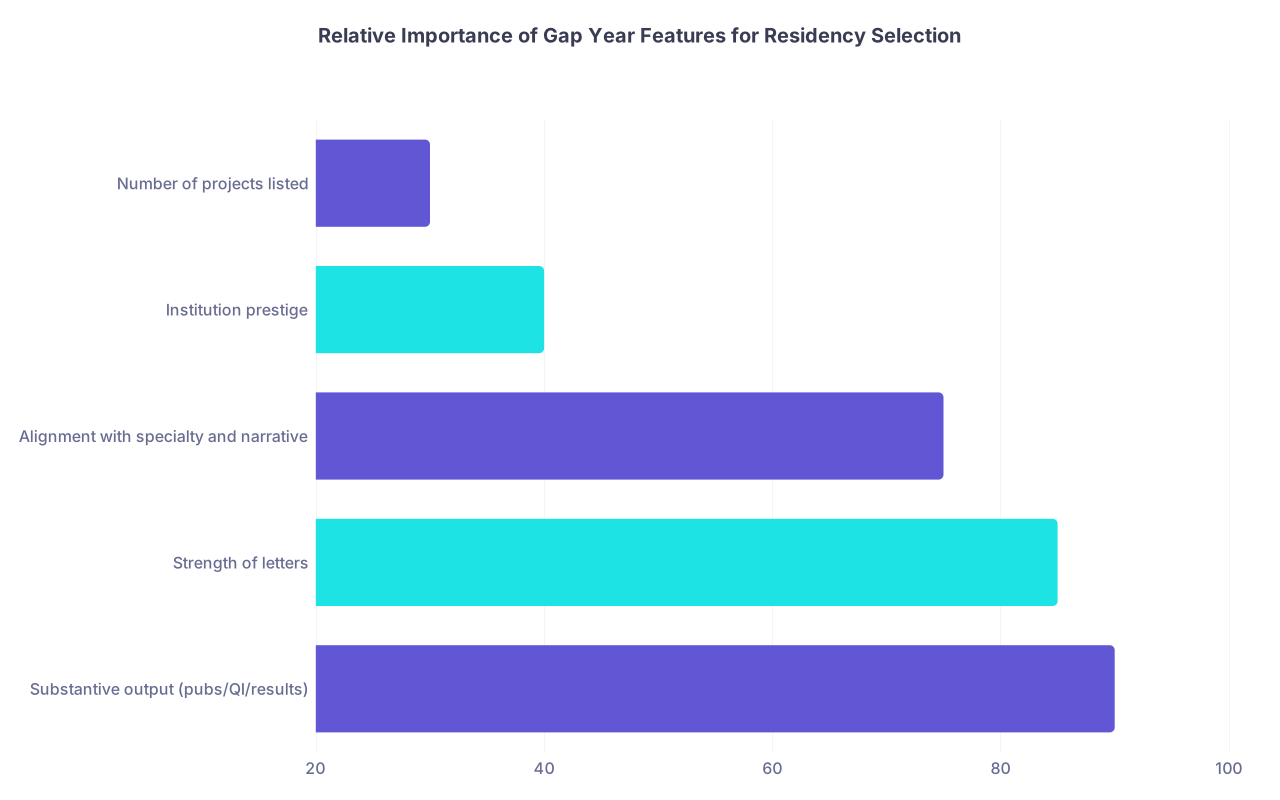
| Category | Value |
|---|---|
| Substantive output (pubs/QI/results) | 90 |
| Strength of letters | 85 |
| Alignment with specialty and narrative | 75 |
| Institution prestige | 40 |
| Number of projects listed | 30 |
Those are not literal NRMP percentages; they’re a rough conceptual map consistent with what PDs and faculty emphasize again and again. Notice where “institution prestige” sits. Not zero, but nowhere near the top.
How to actually choose a gap year that helps you match
Forget the slogans. Ask ruthless, concrete questions:
- What specific skills will I gain that make me a better intern? Reading EKGs? Managing data? Leading teams? Teaching?
- What measurable things will exist at the end of the year? Manuscript, poster, talk, new workflow, curriculum, awards?
- Who is going to advocate for me with a detailed letter?
- How cleanly does this connect to the specialty story I’m going to tell in my personal statement and interviews?
Then compare offers honestly. If a big‑name place can give you all that, great. If a less famous site can give you more ownership, stronger mentorship, and better output, take that instead and stop apologizing for it.
If you are still early and just considering options, map them like this:
That’s the logic most successful applicants end up following, whether they put it in a nice flowchart or not.
The bottom line
Three points, and then you can get back to actually planning your life:
- Brand‑name hospitals don’t magically fix a mediocre application; substantive work, strong letters, and a coherent specialty story do the heavy lifting.
- A smaller or lesser‑known site that gives you real responsibility, measurable outcomes, and a mentor who knows you beats a prestige logo with vague duties and a generic letter.
- The only “prestige” that survives the residency selection process is performance—what you actually did, what you can show, and who’s willing to go on record saying you’re one of the best they’ve worked with.


