

24% of U.S. residency applicants now have at least one “non‑traditional” year in their training path—and a growing chunk of them are matching better than classmates who rushed straight through.
So let’s kill the polite fiction right away: the idea that every gap year before residency is a scar on your record is lazy, outdated, and not backed by how programs actually behave.
You hear the same lines on rounds and in resident workrooms:
- “PDs hate gaps.”
- “Any time not in clinical training looks bad.”
- “You’ll forget your medicine and tank your Step 3.”
I’ve sat in on rank meetings where those myths die very quickly when real applications hit the table. Time “off” is often a net positive—when it has the right structure and story.
This isn’t about cheerleading “take time off, it’s great.” Some gap years absolutely do hurt you. But not for the reasons people think.
Let’s separate fiction from what the data and actual selection behavior show.
What Programs Actually See When They Look at a Gap Year
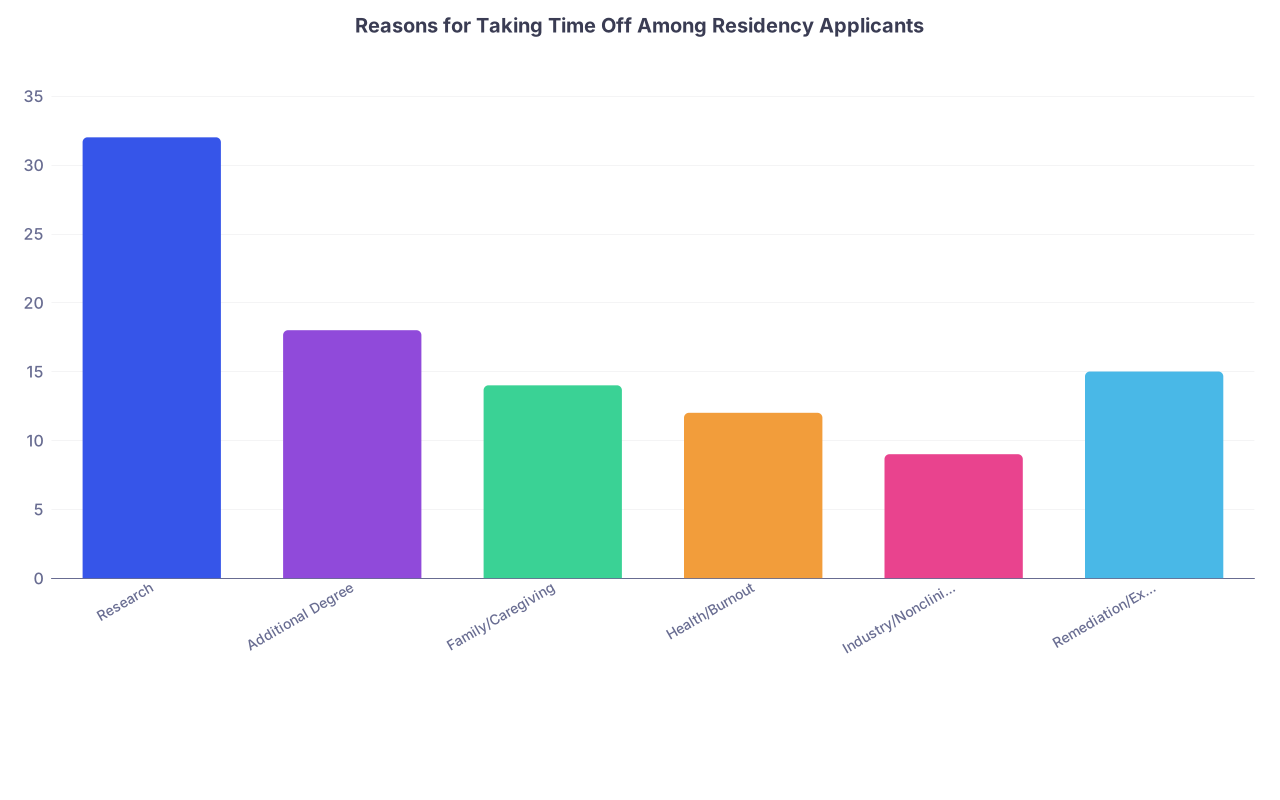
| Category | Value |
|---|---|
| Research | 32 |
| Additional Degree | 18 |
| Family/Caregiving | 14 |
| Health/Burnout | 12 |
| Industry/Nonclinical | 9 |
| Remediation/Exams | 15 |
When a program director (PD) and their selection committee see a gap year in ERAS, they aren’t thinking in moral terms—“good” student vs “lazy” student. They’re doing a very boring calculation:
- Are you clinically safe and up-to-date?
- Are you likely to finish our program?
- Does your trajectory suggest future value: research, leadership, teaching, reputation?
They don’t care if you worked 80 hours or 0 hours per week in that year in some abstract way. They care what the year signals.
That’s the part most residents and students get wrong. They think “continuous timeline = good; any break = bad.” But selection committees are pattern‑matching, not counting months.
Here’s the pattern that ages well:
- You paused.
- You did something coherent and non-chaotic.
- You earned some external validation (publication, leadership role, new degree, letter).
- You can explain the decision and the return to training like a rational adult.
That’s it. Not “cured cancer in a year.” Not “founded a startup and exited for 8 figures.” Just: consistency, growth, and a clean re-entry.
Compare that to the pattern that sets off alarms:
- Vague explanation (“personal reasons” with no specifics or outcomes).
- No clear structure or responsibility for 12+ months.
- No supervisor who can vouch for you.
- A sense that medicine is your last resort, not your main lane.
Time is not what scares PDs. Chaos is.
The Myth of Continuous Momentum: Why “Straight Through” Isn’t Always Better
Applicants love to imagine PDs as old-school drill sergeants who only respect “unbroken service.” That used to be closer to the truth. Before Step 1 went pass/fail. Before wellness became a real retention issue. Before attrition started to sting small programs.
Now PDs are spooked by something else: residents who crumble in PGY‑2 and bail.
So when they see a candidate who:
- Hit a wall in MS3 or early residency,
- Took a structured year for health, remediation, or recalibration,
- Came back with strong fresh letters and renewed performance,
they don’t think “weak.” They think “this person has already hit turbulence, done repair work, and still wants to be here.”
That’s risk reduction from their viewpoint.

What the limited data actually suggests
No, there isn’t a giant randomized trial of gap years vs no gap years. But we do have some useful signals:
- Specialty‑specific match data shows non‑traditional applicants (older, prior careers, breaks) still matching into competitive fields when other parts of the app are strong.
- Surveys of PDs (like NRMP Program Director Survey) consistently rank:
- Letters of recommendation,
- Clinical grades,
- Board scores, way above “no gaps in training” as decision points.
The “no breaks” obsession mostly lives in anxious student group chats, not in actual selection rubrics.
I’ve watched programs rank a candidate with a 2‑year research gap over a same‑year grad with slightly better scores. Why? Because the research year came with 4 pubs in that exact niche, a glowing letter from a big‑name PI, and a clear signal: this person is committed to our field, not applying to 7 different specialties in panic mode.
Momentum is not about an unbroken timestamp. It’s about showing you’re moving in a direction that makes sense for the program reading your file.
Gap Years That Age Shockingly Well
Let’s get concrete. Some pre‑residency gap years pay compound interest over your whole career. No exaggeration.
1. Research Years That Actually Produce Something
Not “hung out in a lab and learned a lot.” I mean:
- 1–3 first- or co‑author papers in the specialty you’re applying to
- Concrete outputs: abstracts, posters, quality projects with measurable change
- A PI or research director who can write a letter like:
“I would rank this applicant alongside my best categorical residents.”
In competitive fields—derm, ortho, ENT, rad onc, plastics—a research year can be the only reason some applicants get in the door. Programs know this. Many even have formal research tracks baked into residency.
Where it ages extremely well:
- You stay in academic medicine or subspecialize.
- You later go for fellowship in a research‑heavy niche.
- You want protected time, grants, or leadership roles down the line.
The person who spent that year learning how to ask good questions, manage data, and move a project from idea to publication ends up years ahead when everyone else is suddenly scrambling to “get a manuscript for fellowship.”
2. Formal Degree Years (MPH, MBA, MEd, MS)
Again, this isn’t about collecting letters after your name like Pokémon. Most dual-degree padding is transparent and unimpressive.
But when the degree aligns with your trajectory, it ages beautifully:
- MPH for someone serious about ID, heme/onc, EM, primary care, or global health.
- MBA for future admin, hospital leadership, or entrepreneurship (and they actually use it—QI, operations, startup work).
- MEd or education fellowships for people who actually want to be clinician‑educators.
| Degree | Best Fit Future Path | How Programs Read It |
|---|---|---|
| MPH | ID, Hem/Onc, IM, EM, Primary Care | Population thinking, research readiness |
| MBA | Admin, Hospitalist, EM, Anesthesia | Systems, leadership, operations interest |
| MEd | Academic IM/Peds, EM, Psychiatry | Teaching, curriculum, residency leadership |
Key is outcome, not enrollment. PDs do not care that you started an MPH. They care what you did with it:
- Did you complete it on time?
- Any tangible output: capstone, policy work, QI project?
- Did your letters reflect new skills and professionalism?
The year looks better and better as:
- You become chief resident.
- You join committees.
- You lead QI or curriculum projects.
That “lost” year keeps paying you in skills and credibility.
The “Red Flag” Gap Years That Are Overrated as Red Flags
Now let’s talk about the ones everyone whispers are career suicide. They’re not, when handled correctly.
1. Burnout / Health Recovery Years
This is the one nobody wants to describe honestly on ERAS, and PDs know that. So they read between the lines all the time.
Here’s the thing: a year off for mental or physical health is not kryptonite. But it’s high stakes in how you present it.
What ages well:
- Clear, bounded period (“I stepped away from clinical training from X to Y”).
- Evidence of treatment, support, and stabilization (they’ll infer this from how you perform on return and from fresh letters).
- Concrete activities once you stabilized: part‑time research, teaching, QI, nonclinical work.
- Strong letters from after that period that say explicitly or implicitly: “This person is reliable, professional, and thriving in clinical environments.”
What spooks PDs isn’t that you had a rough year. It’s the fear you’re still in it.
If your narrative is essentially: “Things were bad, so I left. That’s all,” with no arc of resolution, they will move on. Not because they lack empathy, but because they’re signing up for 3–7 years of responsibility and can’t gamble on wishful thinking.
Handled right, though? That “bad year” often becomes the reason you connect well with patients, set boundaries intelligently, and don’t implode as a PGY‑2. Seen it more than once.
2. Family or Caregiving Years
This one ages better than anyone tells you, especially as you move up the ladder.
You stepped away temporarily to:
- Care for a sick parent or partner,
- Manage a high‑risk pregnancy,
- Handle childcare when there was literally no other option.
Programs are not uniformly enlightened, but they’re not heartless either. Many PDs have gone through this themselves. What they watch for is the same triad:
- Bounded time period,
- Evidence of ongoing professional engagement if possible (CME, part‑time work, telemedicine, research),
- Strong re-entry performance.
The hidden upside: in leadership circles, people who’ve navigated heavy family responsibilities are often seen as more mature, less ego-driven, more realistic about work‑life boundaries. That pays off later when someone is picking division chiefs and program directors.
The Gap Years That Do Age Badly
Not all time off is secretly wise or noble. Some of it is dead weight on an application. The problem is mislabeling, not the calendar gap itself.
Patterns that consistently age poorly:
Aimless “figuring things out” with no output
“I just needed time to think” is not a professional‑grade answer unless it led to something tangible: clarity, structured volunteering, consistent work, or a clear specialty switch.Multiple short, unexplained job hops
Six months here, three months there, no supervisor letter from any of them. That reads as “couldn’t hold a job,” not “broad experience.”Unexplained academic suspension/remediation with inconsistent story
Programs will smell spin. If your record says leave of absence and you give a foggy, contradictory account, they assume the worst: professionalism issues, dishonesty, or both.
The throughline: lack of ownership. PDs don’t demand perfection. They demand that you own your story like an adult.
How to Make Your Gap Year Work For You in the Match
Here’s what actually moves the needle, regardless of why you took time off.
1. Nail the Story in One Clean Paragraph
You should be able to explain the gap year like this:
- Why you stepped away.
- What you did, concretely.
- What you learned or gained that you bring back to residency.
- How you’ve ensured you’re clinically ready again.
One paragraph. Not a three‑page confession. Not a coy half-explanation.
2. Get At Least One Strong Letter From the Gap Period
This is non‑negotiable if the year was for:
- Research,
- Another degree,
- Nonclinical work,
- Recovery plus structured activity.
That letter should answer the unstated PD questions:
- Are you reliable?
- Are you coachable?
- Would I trust you with patients and a pager?
A vague “they were nice to have around” letter is almost worse than nothing.
3. Prove Clinical Readiness Right Before You Apply
If your gap wasn’t clinical:
- Do a recent sub‑I or core rotation in the specialty.
- Get a letter that specifically addresses your current clinical skills and work ethic.
- Brush up with question banks so you don’t look rusty on interviews.
Programs are remarkably willing to forgive non‑clinical time if the most recent signals say: “This person is sharp right now.”
Why Some Gap Years Get More Valuable Over Time
The irony: a lot of what looks “off track” at 26 looks visionary at 45.
The former resident who:
- Took a year to get an MPH,
- Did serious QI work during residency,
- Then stepped into a hybrid clinical‑admin role—
is often the one calling the shots in a department while their “never took a break” classmates grind full‑time clinics with no leverage.
The person who:
- Stepped away for health,
- Got real help,
- Came back with boundaries and insight,
often avoids the mid‑career meltdown that nukes marriages, careers, or both.
And the one who:
- Took a research year early,
- Kept publishing at a sustainable cadence,
is often the only one with the CV to land the fellowship or leadership job everyone suddenly wants at 38.
The point: the “wasted” time narrative is anchored in a very short time horizon. Residency apps. Fellowship apps. That’s about 5–7 years. Your career is 30–40.
Not all gap years age well. But the right ones absolutely do.
The Short Version
- Programs don’t hate gap years; they hate unexplained and unstructured ones. Time itself is not the enemy—chaos is.
- Research, degrees, caregiving, and even health‑related breaks can become long‑term assets if they’re bounded, productive, and followed by strong performance.
- The only truly “wasted” pre‑residency years are the ones you refuse to own, explain, and convert into a coherent story about where you’re going and why a program should bet on you.
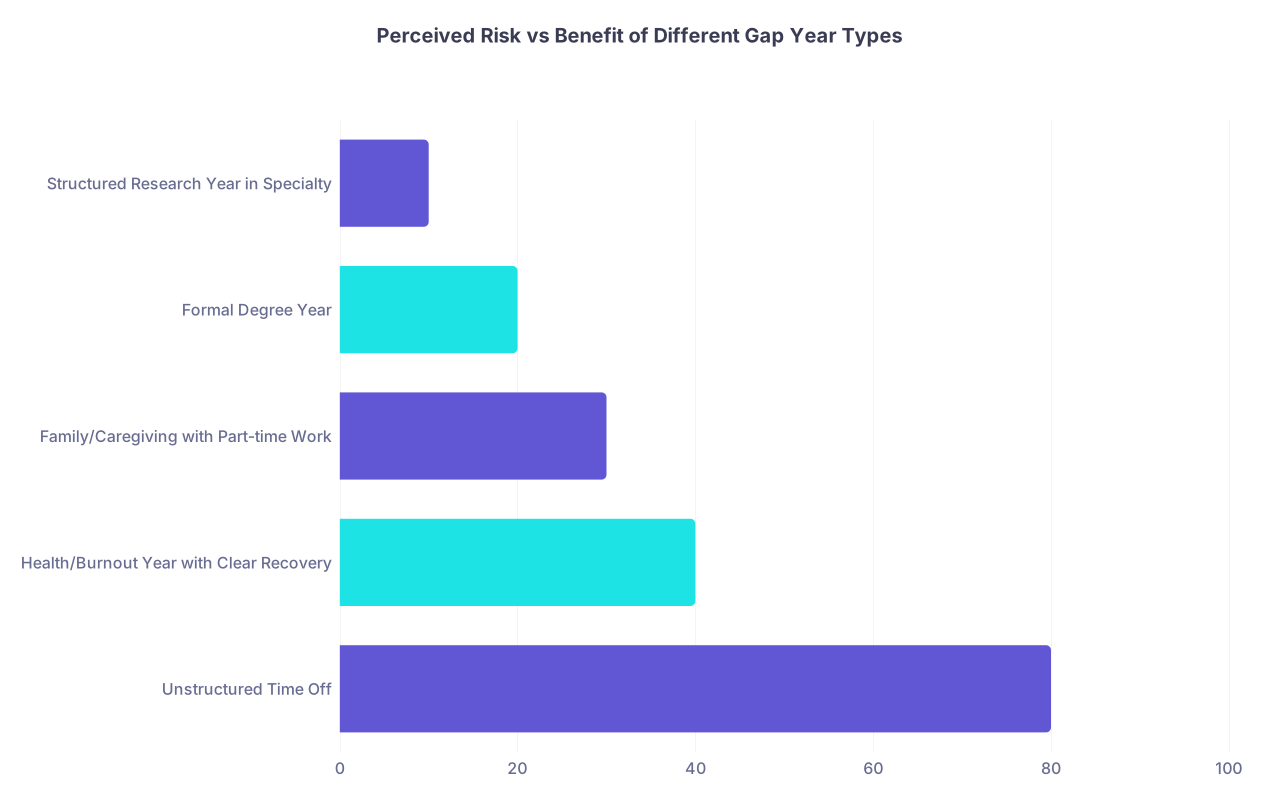
| Category | Value |
|---|---|
| Unstructured Time Off | 80 |
| Health/Burnout Year with Clear Recovery | 40 |
| Family/Caregiving with Part-time Work | 30 |
| Formal Degree Year | 20 |
| Structured Research Year in Specialty | 10 |


