Programs outside big-name academic centers care a lot more about research-focused gap years than most applicants realize. The idea that “only academic residencies value research” is lazy hallway advice that survives because few people ever look at what programs actually reward.
Let me be blunt: if you think a research year only helps at MGH/Brigham/UCSF-level programs, you’re leaving match equity on the table across the board—community, hybrid, and academic.
You’re not just “doing research.” You’re buying time to fix or enhance your application in a way that can map to multiple priorities: productivity, professionalism, letters, clinical judgment, and fit. Those translate everywhere.
Let’s dismantle this myth properly.
What Programs Actually Look For (And Where a Research Year Fits)
Residency programs, academic or not, are selection machines. They’re trying to predict:
- Will you be safe and competent?
- Will you make their lives easier, not harder?
- Will you help their program’s metrics (board pass, reputation, QI, publications, patient outcomes)?
A research-focused gap year contributes to exactly those levers in ways that are not “academic-only.”
Here’s how the same research year looks from different lenses:
Risk management
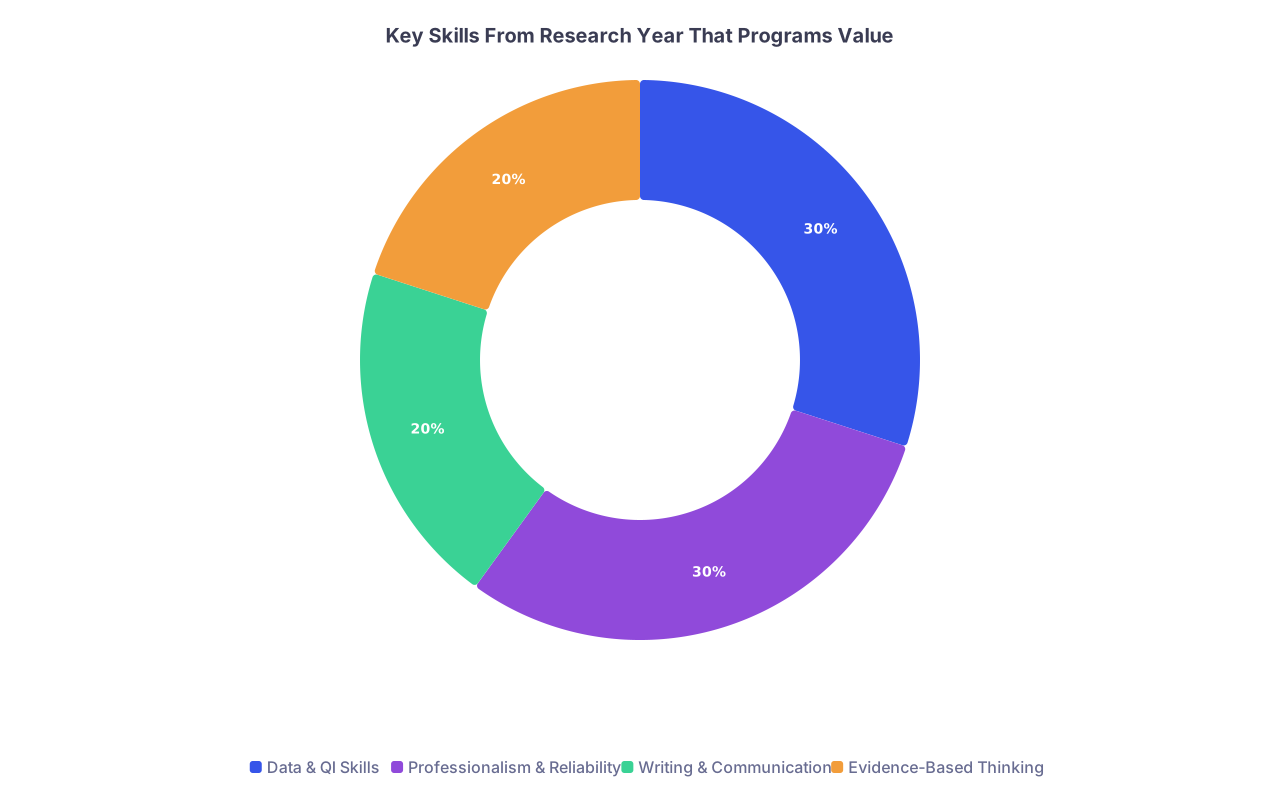
You took an extra year and did something structured, supervised, and productive. That’s a green flag for reliability and professionalism—even for a small community program that couldn’t care less about R01 grants.Evidence-based thinking
You’ve actually read full papers, dealt with messy data, and seen how flimsy some “truths” are. That translates into more skeptical, safer clinical decisions. Any program with patients (so…all of them) values that.Communication and writing
Manuscripts, abstracts, IRB applications—these are writing drills. Programs need residents who can write notes that make sense, craft QI proposals, and respond to regulators. They rarely say this out loud, but they feel it when a resident cannot write.Letters of recommendation
A research year puts you shoulder-to-shoulder with attendings for 12 months. That’s letter-writing gold, and programs of every flavor read those letters carefully.
So the real question isn’t “academic vs non-academic.” It’s: did your research year produce the kind of outputs that match what this program cares about?
Data Reality Check: Research Is Not Just an “Academic” Signal
Let’s look at broad trends. The NRMP Program Director Surveys (multiple cycles) consistently show:
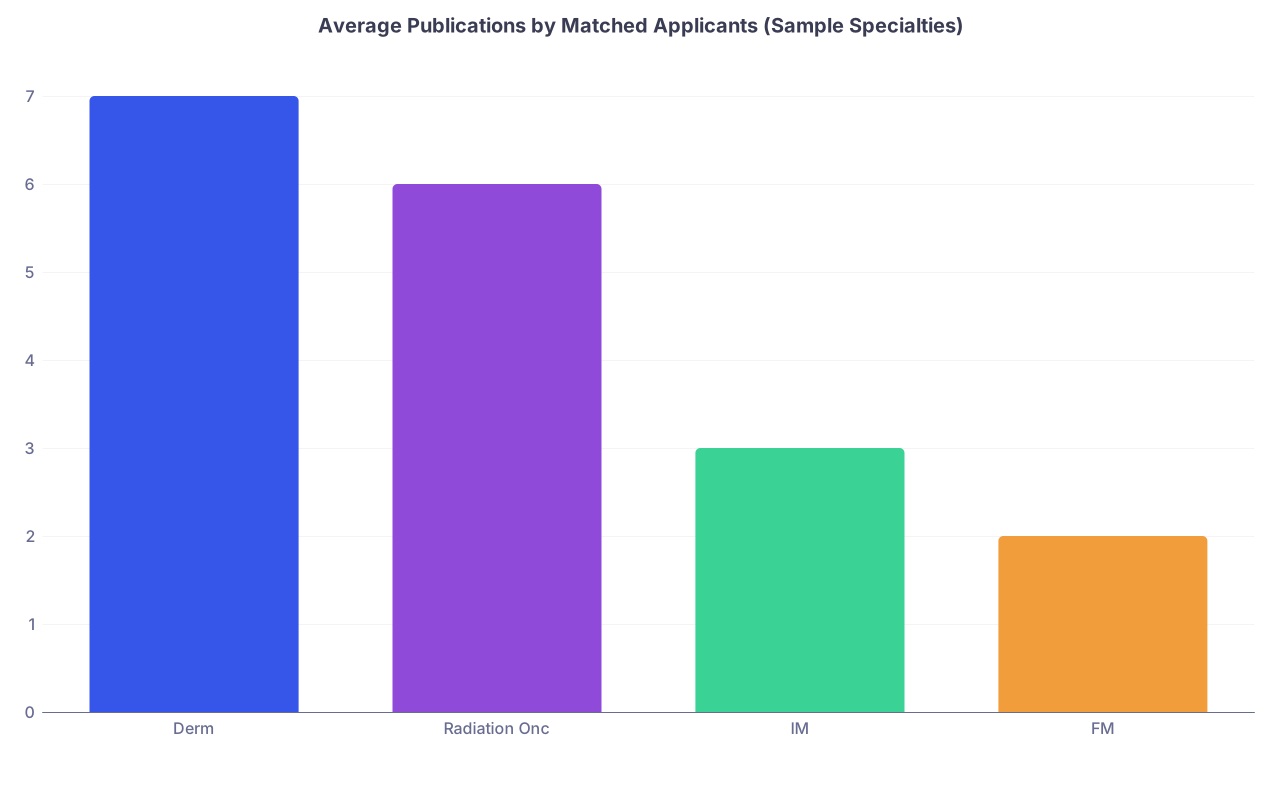
- “Demonstrated involvement and interest in research” is ranked as a meaningful factor not just in academic-leaning specialties like dermatology or radiation oncology, but even in more “community-heavy” ones like internal medicine and family medicine—particularly among more competitive programs within them.
- Publications, abstracts, and presentations correlate with higher match success in competitive specialties and competitive programs, not strictly “academic” institutions.
Here’s the part people miss: “community” does not mean “low standards” or “doesn’t care about academic metrics.” Many high-quality community or hybrid programs:
- Want residents who can lead QI projects
- Are pursuing accreditation milestones and recognition
- Need at least a handful of residents who can support scholarly output for reviews, CME talks, or local guideline development
They’re not building basic science labs, but they absolutely notice when an applicant has done structured scholarly work.
| Category | Value |
|---|---|
| Derm | 7 |
| Radiation Onc | 6 |
| IM | 3 |
| FM | 2 |
These numbers aren’t perfect and vary by year and dataset, but they show the basic pattern: research output correlates with competitiveness regardless of whether every program is “academic.”
How Community and Hybrid Programs Quietly Benefit from Your Research Year
This is the part residents in those programs will tell you off the record.
1. QI and outcomes pressure is everywhere now
Community hospitals are under the same regulatory microscope as academic centers:
- Readmission rates
- CLABSI/CAUTI/VTE rates
- Patient experience scores
- Board pass rates for residents
Your research gap year—if even slightly aligned with QI, outcomes, or implementation—makes you the kind of resident they can plug into:
- Sepsis order set revisions
- ER throughput or boarding reduction initiatives
- Antimicrobial stewardship improvements
I’ve watched “just a research person” become “the QI lead for our ICU initiatives” in a community program within six months. That resident wasn’t hired to be a scientist. They were hired because they understood data, process, and follow-through.
2. Accreditation boxes and “scholarly activity” requirements
ACGME does not exempt community programs from scholarship. Every program must show some form of:
- Resident scholarly activity
- Faculty scholarly productivity
A resident who shows up with:
- 1–2 prior publications
- Comfort using REDCap, SPSS/R, or even Excel
- Experience writing IRBs or case reports
…makes life easier for program leadership. You become the person who helps get the program over the bar for their next site visit. Again: not academic, but operational.
3. Professionalism and endurance signal
A year of research is not glamorous most of the time. It’s:
- Re-writing the same results section four times
- Manually cleaning data that’s obviously broken
- Waiting six months for peer review just to get a rejection
Programs, including community ones, read that as:
“This person can tolerate long, boring, detail-oriented work without melting down.”
That’s exactly what residency is sometimes. Night float on a slow service. Endless medication reconciliations. Prior auths. Safe discharges. All tedious, all critical.
When a Research Gap Year Does Not Help (And When It Backfires)
Now for the part most people gloss over: not all research years are equal, and not all programs care in the same way.
Here’s when a research-focused gap year does not impress non-academic programs:
Zero clinical contact for a clinically shaky applicant
If your main problem is poor clinical evaluations or weak sub-internship performance, disappearing into a lab for a year and not touching a patient is a red flag. Community programs especially want to know you can function on day one.
In that case, split the year: part clinical (per-diem, scribe, prelim, or extended sub-I roles), part research.No outputs, no structure, no story
“I did a research year” means nothing if:- No abstracts, posters, or at least in-progress manuscripts
- No clear PI or mentor who can write a strong letter
- You can’t explain what you actually did in concrete terms
That looks like you hid from clinical work, not that you made yourself better.
Completely misaligned field
Doing basic bench oncology research for a year then applying to a small community FM program in a rural area, with zero story tying your work to primary care, prevention, or population health? Weak.
You can still spin it, but you have to do the narrative work: emphasize transferable skills, team work, data skills, perseverance.
So no, a research year is not a magic ticket. It’s a multiplier. If your foundation is bad and you choose the wrong kind of year, it multiplies in the wrong direction.
Matching Strategy: How to Aim Your Research Year Across Program Types
You don’t need to choose between “academic” and “community only.” You need to choose between vague and deliberate.
Here’s how one well-designed research year can appeal to different program types:
| Program Type | What They Care About Most | How Your Research Year Helps |
|---|---|---|
| Big Academic Center | Publications, letters, niche fit | Abstracts, manuscripts, mentor letters |
| Hybrid / University-Affiliated | QI, teaching, some scholarship | Data skills, QI projects, presentations |
| Strong Community | Reliability, QI, accreditation | Organized year, measurable output, professionalism |
Notice what’s not in that table: “Only academic programs care.” Because they don’t.
If you’re designing or in the middle of a research year, structure your output so you hit all three:
- At least one poster/abstract at a regional or national meeting
- One or two case reports or review articles (faster wins, very usable by all programs)
- Concrete QI or outcomes tie-in, even if small: pre/post interventions, chart review on adherence, protocol implementation, etc.

| Step | Description |
|---|---|
| Step 1 | Start Research Year |
| Step 2 | Focus on pubs/abstracts |
| Step 3 | Mix QI + manuscripts |
| Step 4 | National meeting abstract |
| Step 5 | Original research manuscript |
| Step 6 | QI project with outcomes |
| Step 7 | Case reports/review papers |
| Step 8 | Stronger academic apps |
| Step 9 | Appeal to community/hybrid |
| Step 10 | Primary Goal? |
The Other Unspoken Benefit: Buying Time to Fix What Really Matters
Most students framing this as “research vs no research” are missing the bigger play: a research gap year buys you time and institutional cover to fix core liabilities.
You can use that year to:
- Retake Step 2/Level 2 and improve your score
- Gather much stronger letters from faculty who see you day in, day out
- Show personal growth after a failure, leave of absence, or weak clinical year
- Build a service or advocacy track record that matters to both academic and community programs
Academic vs non-academic isn’t the real division. High-bar vs low-bar is. Strong programs—of any flavor—notice when an applicant took a hard year, made a deliberate plan, and executed it.
How to Talk About Your Research Year to Non-Academic Programs
This is where many applicants blow it. They talk like they’re interviewing for a PhD instead of a residency.
If you’re talking to a community or hybrid program:
Lead with impact, not jargon
Bad: “We did a multivariable regression analysis on…”
Better: “We found that a simple protocol change cut CT overuse by about 20% without missing pathology.”Emphasize team and systems work
“I worked with nurses, pharmacists, and IT to change how we ordered XYZ. Coordinating all those players taught me more about how hospitals actually function than I learned in my entire third year.”Tie directly to residency life
“Spending a year combing through readmission data made me obsessive about discharge planning. I know that’s something you care a lot about in a community setting.”
| Category | Value |
|---|---|
| Data & QI Skills | 30 |
| Professionalism & Reliability | 30 |
| Writing & Communication | 20 |
| Evidence-Based Thinking | 20 |
You’re not selling yourself as an academic. You’re selling yourself as a resident who’s already practiced the exact skills that make programs safer and more efficient.
Redesigning Your Thinking: Not “Academic vs Community,” But “Generic vs Specific”
The myth you started with—“Only academic residencies value a research-focused gap year”—is a symptom of lazy categorization. The real axis that matters:
- Generic research year with no clear outputs, no story, no clinical linkage
- Versus
- Specific, outcomes-oriented year with clear productivity and a narrative that maps to program priorities
Strong programs, whether they’re a big-name academic center or an unassuming community site with a fantastic teaching culture, are all trying to filter for the second type of applicant.
Use your year to become that applicant.

FAQ (Exactly 4 Questions)
1. Will a research-focused gap year hurt me at community programs that emphasize “hands-on” clinical training?
Not by itself. It can hurt you if you already have weak clinical evaluations and spend a year with zero patient contact. If that’s your situation, balance the year: part research, part clinical (per-diem work, extended sub-Is, hospitalist assistant roles). In your application, explicitly connect how research made you better at clinical reasoning, discharge planning, or QI. Community programs don’t mind research; they mind clinical rust.
2. Do I need first-author publications for a research gap year to matter to non-academic programs?
No. First authorship is great, but it’s not the threshold. What matters more across program types is: Did you stick with projects long enough to finish something? Posters, middle-author papers, case reports, and local presentations all count as evidence of follow-through. Combine that with a strong mentor letter describing your work ethic and reliability, and it will matter even to non-academic programs.
3. Should I still do a research year if I know I want to end up in a community practice long-term?
Possibly, yes—if you need to strengthen your application or you’re aiming at competitive specialties or strong programs. A research year can help you match into a better training environment, regardless of your final practice setting. It also prepares you to lead QI, protocol development, and local guideline implementation in whatever community you end up serving. That’s not “academic”; that’s modern medicine.
4. How do I choose between a “pure research” year and a QI-heavy or outcomes-focused year?
Think about your weaknesses and your target programs. If you’re chasing ultra-competitive academic programs and already have good clinical strength, pure research with strong publication potential might be right. If your goal is a wider net—including hybrid and community programs—lean toward projects with clear clinical or system outcomes: QI, implementation, outcomes research, chart reviews tied to real patient care. Those translate better everywhere and are easier to talk about in interviews.
Key takeaways:
- Research-focused gap years are not just for academic residencies; strong programs of all types value structured productivity, data-minded thinking, and strong letters.
- What matters is not “research” in the abstract, but specific outputs and a clear story that map to clinical care, QI, and professionalism.
- A well-designed research year can upgrade your application across academic, hybrid, and community programs—if you plan it intentionally and explain it intelligently.