
Everyone repeating “you must do clinical work in your gap year or you’ll never match” is wrong. Not just slightly wrong—objectively, data-level wrong.
You do not need a cookie‑cutter “clinical experience” gap year to be a competitive residency applicant. In some cases, chasing generic clinical work actually makes your application worse.
Let’s pull this apart like an M&M conference.
Where This Myth Comes From (And Why It Sounds So Convincing)
You’ve heard some version of this in the hallways:
“If you’re not in a clinic or hospital that year, programs will think you’re not committed to medicine.”
Or the classic from older residents:
“Dude, just get a clinical job, you have to stay ‘clinical’ or you’re toast.”
This myth survives because of three half‑truths:
- Programs do care about gaps and continuity.
- Clinical competence does matter.
- Some PDs use lazy heuristics when skimming 800+ applications.
But then people take those partial truths and mutate them into a single, stupid conclusion:
“If you’re not working as a medical assistant / scribe / research coordinator in a hospital, you’re doing your gap year wrong.”
That’s not what the data—or program director surveys—actually show.
What Program Directors Actually Care About (Not Your Job Title)
The NRMP Program Director Survey is as close as you get to reading the minds of people deciding your fate. They literally list which factors matter and how much.
Across specialties, four themes show up over and over. Not “gap year clinical job,” but:
- Performance in medical school (grades/clinical evals/MSPE)
- Licensing exam scores (Step 2 CK especially now)
- Fit and commitment to the specialty
- Evidence you haven’t “checked out” of medicine
Gap years are not automatically toxic. Aimless gap years are.
The real questions PDs ask themselves when they see a gap or extra year aren’t:
- “Was this person a scribe?”
They’re asking:
- “Can this person still function clinically?”
- “Are they moving toward something or just drifting?”
- “Does this story make sense for this specialty?”
Clinical experience is one possible answer. It’s not the only one.
The Big Distinction: Continuity vs Clinical
You’re not actually being judged on whether you punched a clock in a hospital. You’re being judged on whether your activities show continuity with a coherent trajectory toward residency.
If your gap year:
- Builds skills that make you better at your chosen specialty
- Produces something tangible (publications, teaching portfolio, leadership outcomes)
- Is explained clearly, without hand‑waving or evasiveness
…then it can absolutely strengthen your application, even if it isn’t classically clinical.
On the flip side, a generic MA or scribe job with no clear connection to your story is not inherently impressive. PDs are not giving bonus points because you printed vitals for 12 months.
What The Data and Real‑World Patterns Actually Show
Let’s compare three common gap‑year archetypes I’ve seen over and over when sitting with faculty reviewing ERAS:
| Profile Type | Typical Activity | Match Impact (When Done Well) |
|---|---|---|
| Pure Clinical Job | MA, scribe, clinic work | Neutral to mildly positive |
| Research-Oriented | Research fellow, lab | Strong positive in many fields |
| Non-Clinical, Structured | Teaching, MPH, startup | Neutral to positive |
That “Neutral to mildly positive” under pure clinical job? That’s the part people do not want to admit.
Clinical Gap Year: Useful, But Overrated
A full‑time clinical job is helpful when:
- You had very limited hands‑on exposure in med school.
- You’re switching specialties and need fresh, targeted experience.
- You’re applying to fields that heavily value patient exposure (FM, psych, EM, etc.) and your application was thin there.
But here’s the catch: faculty skim ERAS at speed. A long line of:
“Medical Assistant, XYZ Clinic (took vitals, roomed patients, EMR entries)”
…does not fix mediocre clerkship comments or a weak Step 2. It’s a “good to have,” not a “this saves your application.”
I’ve literally watched PDs say:
“Okay, they worked as a scribe that year. Fine. What are their letters and clerkship comments like?”
That’s the hierarchy. Gap year clinical rarely overrides core performance.
Research or Academic Year: Often More Powerful
Especially in:
- Internal medicine (especially academic tracks)
- Radiation oncology
- Neurology
- Pathology
- Any competitive subspecialty‑pipeline field
A productive research year—poster(s), maybe a first‑author paper, strong letter from a known faculty name—moves the needle far more than generic clinical work.
For applicants with:
- Borderline scores but strong work ethic
- Interest in academic medicine
- A real story about curiosity and problem‑solving
…I’ve seen a research year completely change the caliber of programs that interviewed them.
Non‑Clinical but Structured: Surprisingly Fine (Sometimes Excellent)
Here’s the part almost no one tells you because it doesn’t fit the premed/med school script:
There are people who matched very solidly with gap years doing:
- A full‑time teaching fellowship, building a clear “educator” narrative
- An MPH with a thesis relevant to their specialty
- Health policy work, then matching into IM or EM with a health‑systems bent
- Even startup or tech work, when pitched as systems thinking / QI / workflow expertise
Did some PDs raise eyebrows? Sure. But if the rest of the app was strong and the explanation was coherent and honest, they matched.
The Risk Everyone Ignores: Bad Clinical Years
Let me be blunt: a poorly executed “clinical experience gap year” can harm you more than a well-structured, non‑clinical one.
I’ve seen:
- Letters from gap‑year clinical supervisors that were lukewarm or quietly negative.
- Applicants who were exhausted and cynical after a year of low‑autonomy grunt work.
- People who did a clinical job that had zero connection to their intended field, then tried to retrofit a fake narrative.
Programs can sniff out:
- “I just did this because someone told me to.”
- “I didn’t really grow, I just clocked hours.”
A mediocre clinical job with a generic letter is not better than:
- A well‑structured teaching year plus a killer letter from a director.
- A rigorous MPH plus a methodologically sharp capstone project.
- A research year with tangible outputs and enthusiastic letters.
International Grads vs U.S. Grads: Different Rules
Here’s where I’ll draw a hard line.
If you’re an IMG, especially non‑US, the expectations are different:
- Recent U.S. clinical experience is heavily emphasized.
- “Time since graduation” matters more, and time away from clinical care is scrutinized harder.
- Observerships, externships, and hands‑on roles can be critical.
For an IMG aiming for internal medicine, FM, neuro, etc., a year of U.S. clinical experience often is close to mandatory. For them, the “clinical or bust” line is closer to the truth.
But most med students repeating this myth in U.S. schools are not talking about that. They’re U.S. grads applying straight from LCME schools, being coached into low‑yield decisions because the nuance gets lost.
If you’re a U.S. grad, standard timeline, not taking 4+ years off: you have far more flexibility than the hallway chatter suggests.
How Programs Actually Read a Gap Year
PDs and selection committees are not asking “clinical or not?” first. They’re asking three things:
- Does this explain any red flags?
- Does this fit their specialty story?
- Did they do this well?
If you’re taking a gap year before applying, you need to be able to answer, concisely:
- Why you chose that activity
- What you actually did (concrete responsibilities, outcomes)
- How it changed you or prepared you for residency
That’s what goes into your ERAS descriptions, personal statement, and interviews.
A generic line like:
“This year allowed me to gain valuable clinical experience and reaffirm my commitment to medicine.”
…could be swapped onto 10,000 other applications. That’s the problem. PDs are bored of reading that sentence. They forget it 0.5 seconds after seeing it.
So What Should You Do With a Gap Year?
Let’s be very clear: this is not “do whatever you want and it’ll be fine.” That’s just the opposite flavor of bad advice.
If you want the highest yield, think in terms of one primary axis:
- Clinical axis: Direct patient care, ED tech, MA, scribe, clinical coordinator, hospitalist team assistant.
- Research axis: Full‑time research fellow, lab work, outcomes research, QI projects tied to a mentor.
- Education/Leadership axis: Teaching fellowships, curriculum design, organized leadership roles with measurable outcomes.
- Public health / Systems axis: MPH, health policy internships, QI/data roles in health systems.
Pick one axis that makes sense for:
- Your specialty
- Your weaknesses (what needs shoring up)
- Your actual interests (you have to survive this year without burning out further)
Then commit. Do it well enough that your letter writers can say specific, credible things about your work ethic, judgment, and growth.
Example: Who Actually Benefits From a Clinical Gap Year?
You’re a U.S. grad targeting EM.
- Limited EM rotations (one home, one away).
- Mostly okay evals, but a bit of feedback about communication and efficiency.
- Step 2 around specialty average.
Here, a clinical job in an ED as a scribe or tech can be high yield if:
- You get a strong letter from a well‑known EM faculty.
- You can speak concretely in interviews about workflow, communication with nurses, managing undifferentiated patients.
- You show up as “medicine is my daily oxygen,” not “I panicked and took a random job.”
That’s when the “clinical year” actually pays off.
Now change the scenario.
You’re IM‑bound, with:
- Good clerkship evals.
- A clear interest in academic medicine.
- Weak or absent research.
A well‑mentored research year in cardiology, heme/onc, or hospital medicine may do more for you than 12 months of MA work at a random clinic that will never talk to your future PD.
The One Thing You Cannot Do: Disappear
Here’s where I’ll concede a sliver of the myth holds:
You can’t vanish from medicine for a year with no coherent explanation and expect programs not to care.
If your gap year is:
- Unemployed, unfocused, and unstructured
- “Traveling and figuring things out” with nothing else
- Full of vague, unverifiable personal projects
…you will have a hard time in many specialties. Not because it wasn’t clinical, but because it signals drift and lack of reliability.
If you need a mental health break, family caregiving, or recovery from illness? That’s valid. But you still need a clean, honest, contained narrative and, when possible, some anchor activity showing you remained engaged with growth or responsibility.
Visualizing What PDs Actually Prioritize
Here’s how a lot of PDs mentally weight major domains when reviewing applications (varies by specialty, but the pattern is real):
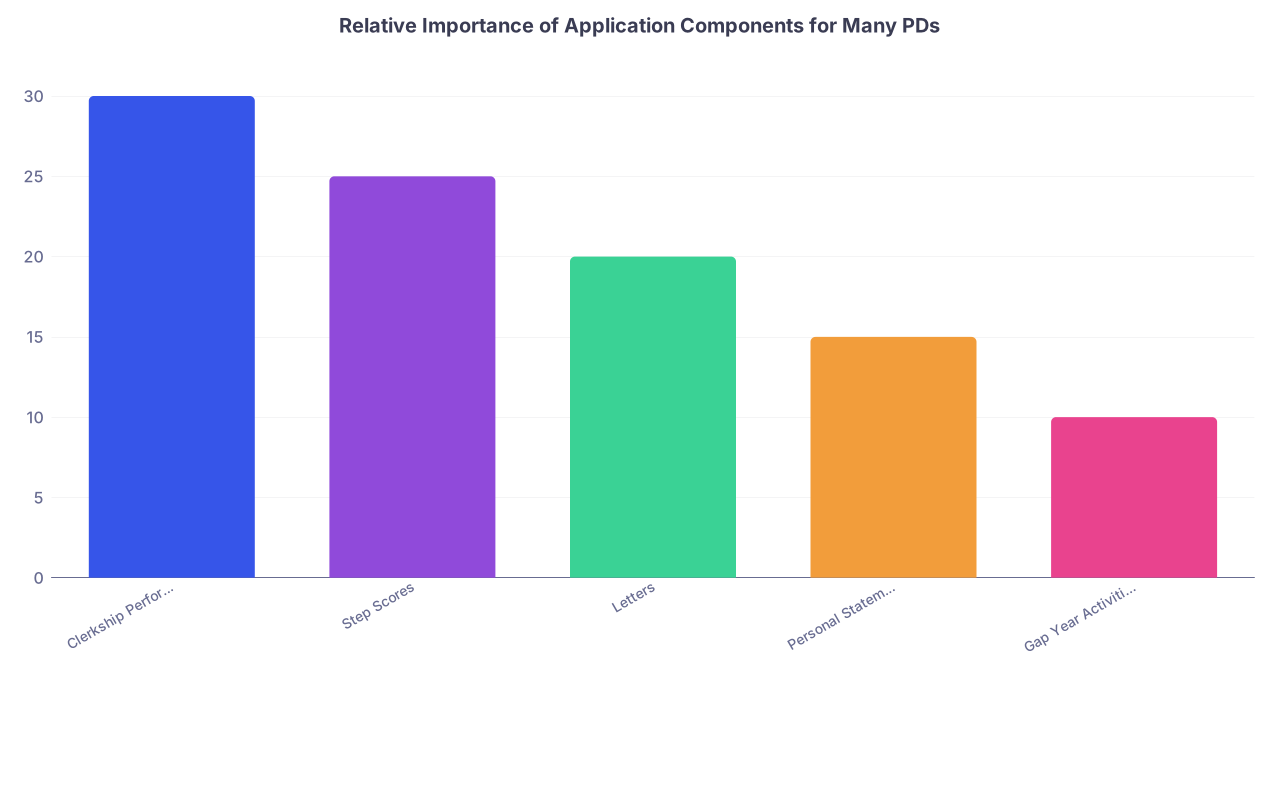
| Category | Value |
|---|---|
| Clerkship Performance | 30 |
| Step Scores | 25 |
| Letters | 20 |
| Personal Statement/Interview | 15 |
| Gap Year Activities | 10 |
Your gap year sits in that last bar. Notice it is not 0. Notice it’s also not 50.
You can absolutely help yourself or hurt yourself with that 10%. But it’s not the entire game, and “clinical or bust” makes it sound like it is.
How to Explain a Non‑Clinical Gap Year Without Sounding Flaky
You’ll need a tight script. Something like:
- “I took a dedicated year to do X because Y was a gap in my development as a future [specialty].”
- “During that time, I did A, B, and C, which taught me [specific skills] that I’ve already applied in [clinical context].”
- “That year confirmed my desire to pursue [specialty] and gave me tools in [research/teaching/systems] that I want to bring to residency.”
If your story is coherent and the rest of your app is strong, most PDs will shrug and move on to the more important parts: your evals, letters, and fit.
To make that story real, not fake, build your year so those sentences are literally true. That’s the actual work.

| Step | Description |
|---|---|
| Step 1 | Identify Specialty & Weaknesses |
| Step 2 | Consider Clinical-Focused Year |
| Step 3 | Consider Research/MPH Year |
| Step 4 | Consider Education/Leadership Year |
| Step 5 | Plan Structured, Honest Partial Year |
| Step 6 | Secure Strong Mentor & Letter |
| Step 7 | Craft Clear Narrative for ERAS & Interviews |
| Step 8 | Biggest Gap? |
The Bottom Line: The Myth, Rewritten
The myth says:
“If your gap year isn’t 100% clinical, you’re screwed.”
The evidence says something much less dramatic and far more annoying, because it requires actual thinking:
“If your gap year is unstructured, purposeless, or badly framed, you’re in trouble.
If it’s structured, mentored, and aligned with your specialty story—clinical or not—you’re fine.”
So no, it’s not “clinical experience or bust.”
It’s: coherent trajectory or bust.