

A non-medical gap year job can absolutely help your residency match—sometimes more than a mediocre “clinical” box-checking job. The idea that anything outside a hospital or lab is wasted time is lazy thinking, and the data and real match outcomes do not back it up.
You are not a pair of hands. You are a risk–benefit calculation for a program. And a year in “the real world” can shift that calculation in your favor—if you understand what actually matters.
Let’s tear this apart properly.
What Program Directors Actually Care About (Spoiler: Not Your Job Title)
Residency programs are not scanning ERAS looking for “scribe” versus “consultant” versus “teacher” like some magical keyword unlock. They care about three buckets:
- Can you do the work?
- Are you safe to put in front of patients (and nurses) at 3 a.m.?
- Are you going to be a headache—or a stabilizer—for the team?
Now look at the 2024 NRMP Program Director Survey. Here’s the reality:
| Factor | % PDs Citing as Important | Mean Importance Rating* |
|---|---|---|
| USMLE/COMLEX Scores | >85% | Very High |
| MSPE (Dean’s Letter) | ~80% | High |
| Letters of Recommendation in Specialty | ~75% | High |
| Personal Statement | ~70% | Moderate–High |
| Continuity/Consistency in Training | ~65% | Moderate–High |
*Relative, based on NRMP’s 1–5 scale across specialties.
Notice what’s missing? There is no line item for “Gap year job must be clinical or you’re doomed.”
What does matter that your non-medical job can heavily influence:
- How your MSPE and letters describe professionalism, reliability, teamwork, and maturity
- What stories you tell in your personal statement and interviews
- How you explain any academic “dips,” delays, or career pivots
- Whether you come across as someone who understands work, accountability, and feedback
I’ve seen applicants with corporate or teaching backgrounds absolutely steamroll interviews because they had sharp, concrete stories about conflict resolution, systems thinking, managing chaos, and owning their mistakes. While the fifth scribe who says, “I learned how to write a good chart” fades into static.
The Myth: “If It’s Not Clinical, It’s Useless”
You’ve probably heard some version of this:
- “If you take a consulting / tech / teaching job, programs will think you’re not committed to medicine.”
- “You must fill your gap year with research or you’ll look weak.”
- “Non-medical work will be seen as a red flag.”
This is repeated so often it sounds like gospel. It’s not.
What program directors actually react to are three things:
- Unexplained time.
- Obvious fluff or resume-padding.
- A story that doesn’t hang together.
A non-medical job is not the problem. A non-explained job is.
I’ve watched the same attending read two ERAS applications:
- Applicant A: “Gap year – self-study, travel, some tutoring.” No specifics. No outcomes.
- Applicant B: “Gap year – full-time high school math teacher in underserved district; led after-school tutoring; coordinated with school nurse/social worker on at-risk students.”
Guess who got the “this person knows how to show up” comment?
The content of the job matters less than what it lets you prove.
The Evidence: Outcomes Don’t Punish Non-Clinical Time
Let’s talk about the fear baked into this myth: “If I step out of the clinical lane, I’ll never match.”
Look at what actually shows up in match data and PD behavior:
- The NRMP data consistently shows that failed exams, major professionalism flags, and long unexplained gaps are the real killers. Not “had a corporate job.”
- International grads who spend years outside pure clinical work doing public health, pharma, or analytics still match—when their story, scores, and letters line up.
- Non-traditional applicants (career-changers from engineering, business, teaching) match into competitive specialties every single year. They did not erase their past to do that. They weaponized it.
Programs care a lot more about:
- How long you’ve been completely out of clinical contact (not employment)
- Whether you have some recent clinical exposure before residency (shadowing, per diem, volunteering, sub-I)
- Whether your non-clinical time explains something (finances, immigration, exploration) or hides something (discipline, burnout, failure)
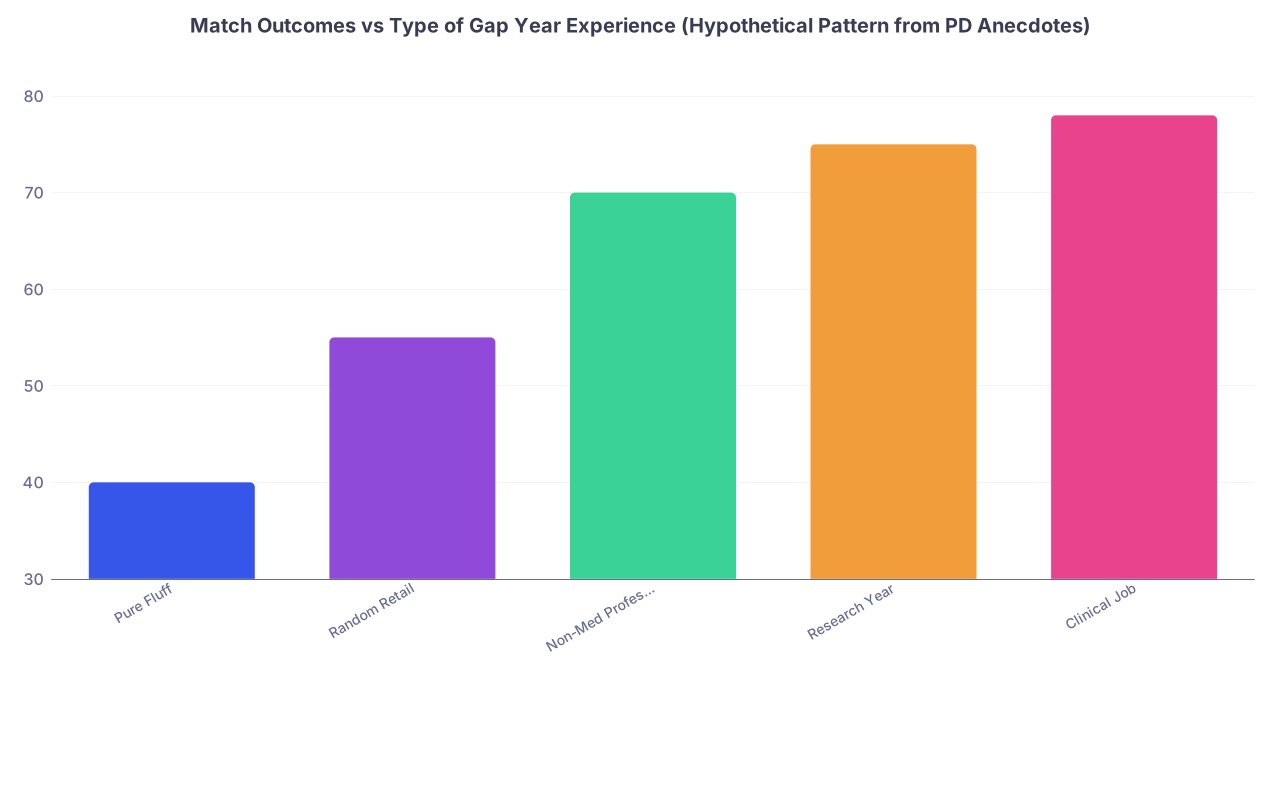
Here’s the pattern I’ve seen:
| Category | Value |
|---|---|
| Pure Fluff | 40 |
| Random Retail | 55 |
| Non-Med Professional Job | 70 |
| Research Year | 75 |
| Clinical Job | 78 |
This is a stylized summary of how PDs talk, not an official NRMP table. But it tracks their behavior:
- Pure fluff with no clear responsibilities? Weak.
- Low-responsibility job with no story attached? Slightly better, but still meh.
- Serious, structured professional role—medical or not—that clearly demonstrates responsibility? Now we’re in useful territory.
The mistake is assuming “non-medical = fluff.” It does not.
How a “Non-Medical” Job Signals Things PDs Actually Like
Let’s be blunt. A lot of “clinical” gap year jobs are glorified premed roles: scribing, MA-ing, basic research assistant. They can be fine. They can also be forgettable.
A strong non-medical job can give you something many pre-residency applicants lack: adult-level responsibility.
Think about what your role might show:
A year in consulting or analytics:
- You learned to handle high-pressure deadlines, conflicting priorities, and critical feedback.
- You have real experience with data, systems, and process improvement—gold in quality-improvement-obsessed hospitals.
- You can talk about “why processes fail” without defaulting to emotional anecdotes.
A year as a teacher:
- You know how to break down complex concepts for confused human beings. That is literally patient care and intern teaching.
- You’ve dealt with “difficult families,” conflict, burnout, and limited resources.
- You’ve had to show up every single morning whether you felt like it or not.
A year in tech or startups:
- You get documentation, communication tools, and maybe informatics.
- You probably have stories of failure, iteration, pivots—all of which map well to residency adaptation.
- You understand what “shipping” looks like: delivering on something, not just preparing forever.
Program directors don’t sit there thinking, “Ah yes, Goldman Sachs, how unhelpful.” They think, “Can I trust this person on nights? Are they going to crumble when the system fails them? Have they ever had a real job before?”
Your non-medical job can answer “yes” to those questions more convincingly than another six months of shadowing.
Where This Can Go Wrong (And How to Avoid That)
There are ways to screw this up and reinforce the myth.
The pitfalls look like this:
- You disconnect entirely from medicine for multiple years with no effort at clinical re-entry.
- You cannot articulate why you took the job or what you gained.
- Your narrative sounds like “I was trying to escape medicine” instead of “I was exploring / surviving / learning.”
- You show up to interviews obviously rusty on basic clinical thinking.
So if you’re going to do a non-medical job, do not be naive. You need to hedge:
- Maintain some clinical exposure: a half-day free clinic twice a month, volunteering, per diem shifts if you’re licensed for anything.
- Keep your knowledge alive: question banks, reading, case discussions.
- Line up at least one solid recent clinical letter before you apply. Not from three years ago.
Here’s the timeline I push people toward:
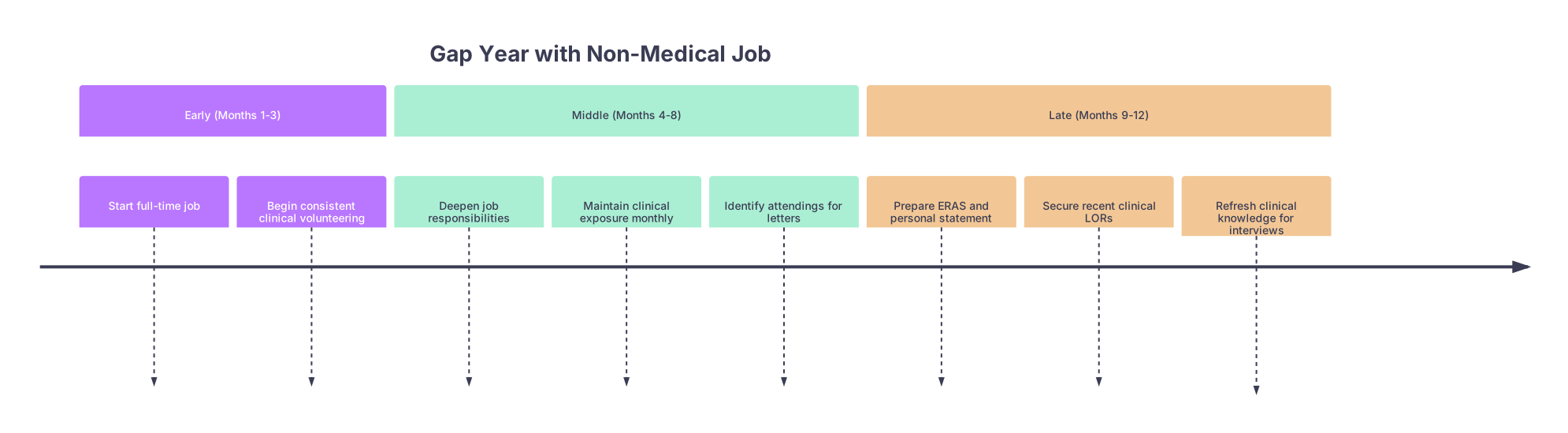
The difference between “red flag” and “interesting asset” is not the job. It is structure, continuity, and how you frame it.
Turning Your Non-Medical Year into Match Leverage
Here’s how you make this work for you instead of against you.
1. Build a coherent story, not a random resume line
You need to answer, concisely and convincingly: “Why did you do this, and what did you learn that will make you a better intern in this specialty?”
A shallow answer:
“I needed money and I was interested in business.”
A useful answer:
“I took a full-time role in health analytics because I was frustrated seeing how quality metrics were applied on the wards without any resident input. That year taught me how hospital systems actually make decisions—and how data can be misused. In residency, I want to be the person who can translate clinical reality to the people designing these dashboards.”
Same job. Different signal.
2. Extract clinical-adjacent skills
Do not just say “teamwork, communication, leadership.” Everyone says that.
Say:
- “I had to give weekly progress updates to senior partners who gave brutal feedback, so I’m used to rapid course-correction.”
- “I managed a classroom of 32 ninth-graders with IEPs and language barriers—I learned to de-escalate, reframe, and stay calm in chaos.”
- “I led root-cause analyses on failed software deployments, which feels very similar to M&M-style thinking.”
Those are the skills attendings want on call. Show the connection.
3. Make your letters work for you
The ideal setup is this:
- At least one strong recent clinical letter that says: “I have seen this person work with patients, and they’re solid.”
- One letter from your non-medical supervisor that screams: “This is one of the most reliable, mature, accountable people I’ve supervised.”
That second letter can be extremely persuasive, especially in community or smaller programs where they care less about your h-index and more about whether you’ll show up.
But What About “Competitive Specialties”?
This is where people usually panic. “Sure, maybe for family medicine, but what about derm / ortho / ENT / plastics?”
Reality check:
- Competitive specialties care heavily about research, scores, and connections. True.
- They also love people who can operate at a high level in complex systems and get things done.
If you’re aiming high-competition, a completely non-medical year with zero research or specialty exposure is risky. Not because the job is bad, but because you’re ignoring the specialty’s known priorities.
So you adapt, not abandon the idea:
- You work a demanding corporate or tech job…
- AND you do 1–2 dedicated research projects with a PI in your specialty (nights/weekends/remote).
- AND you secure at least one letter from that PI or a specialty mentor.
- AND you keep up shadowing or some clinical exposure in that field.
That combination—serious research + serious job + coherent story—is far more compelling than another year of aimless lab time where your name barely makes the middle of an authorship list.
The Real Red Flags (They’re Not What You Think)
Let me spell out what actually freaks programs out:
- You cannot explain your trajectory without sounding evasive or resentful.
- You talk about your non-medical job like it’s “real life” and medicine like it’s a temporary detour.
- Your clinical skills feel stale during interviews, and your answers show it.
- Your letters hint at inconsistency or poor follow-through.
What doesn’t scare them:
- “I worked as a data analyst at a startup.”
- “I taught high school science for a year.”
- “I helped run my family business while volunteering at a clinic one day a week.”
As long as there’s a through-line: you kept one foot in the medical world, you grew as a professional, and you are coming back with clearer purpose—not less.
How to Talk About This in Interviews Without Apologizing
Stop acting like you committed a crime by stepping outside medicine.
A clean answer usually has four pieces:
- Why you did it – financial need, curiosity about systems, family situation, burnout recovery with structure.
- What you actually did – concrete responsibilities and outcomes, not buzzwords.
- What you learned that maps to residency – specific, visible behaviors, not generic virtues.
- Why you’re sure about medicine now – not “I always loved science,” but “here’s what pulled me back and how I prepared to re-enter.”
If your explanation feels like an apology, you’re doing it wrong. It should sound like a deliberate, adult choice that made you a better future resident.
Core Takeaways
- Non-medical gap year jobs are not inherently harmful to your residency match; incoherent narratives and loss of clinical contact are.
- Serious, structured non-medical work can actually strengthen your application by proving maturity, reliability, and real-world skills that programs crave.
- If you maintain some clinical exposure, secure strong recent clinical letters, and frame your job as deliberate growth—not escape—you can turn that “non-medical” year into a clear advantage, not a liability.


