

The way program directors think about industry gap years is not what your classmates are telling you.
Most students either romanticize it (“Program directors love ‘real world’ experience!”) or catastrophize it (“If you leave clinical medicine for even a year, they’ll think you’re not committed.”). Both are wrong. The truth is messier, more political, and far more dependent on how your story lands in a 3‑minute file review and a 15‑minute interview than on the actual job you did.
Let me walk you through how this really plays behind closed doors.
What PDs Actually See When They Open Your File
Forget what you think they notice first. It is not your “industry fellowship” or your fancy job title. On first pass, three things matter:
- Are you safe?
- Are you committed to the specialty?
- Will you make the program look good or cause me headaches?
Your industry gap year hits all three screens.
Program directors don’t sit there reading every line of your job description. They look at a grid or summary that shows: med school, YOG (year of graduation), scores/Pass–Fail status, gaps, and current activity. Anything that interrupts the clean “M3 → M4 → residency” pipeline gets mentally flagged.
You did a gap year in industry? That flag goes up. The question in their heads is not “What cool things did they do?” It’s:
- “Why did they leave the clinical path?”
- “Did they have to, or did they choose to?”
- “Did this make them better or softer?”
- “Are they coming back because they love medicine or because industry didn’t work?”
If your file does not clearly answer those questions, you get put into the “maybe” pile, which is where applicants quietly die.
The 5 Unspoken Categories of Industry Gap Years
Every PD I’ve worked with mentally sorts industry gap-year people into buckets. They don’t announce this, but they do it. Here’s the taxonomy you are actually being ranked within.

1. “Strategic Career Builder” – The Gold Standard
This is the applicant who:
- Chose industry for a defined reason (research, policy, clinical trials, health tech).
- Stayed close to patient-centered work or their specialty.
- Can show concrete outputs: publications, products, measurable impact, leadership.
Example that scores well:
- IM applicant, Step 2 solid, did a year at Genentech working on phase II/III trials in oncology. Co-authored a couple of abstracts. Still volunteered in a free clinic twice a month. Strong letters from an MD PI and a faculty mentor.
How PDs talk about this person in rank meetings:
“Yes, they did industry, but look at this — trials, publications, and still doing clinic. This person is going to be a beast for QI and research.”
This category almost always helps you, assuming the rest of your app isn’t shaky.
2. “Financial/Personal Reality” – Neutral but Understandable
These are the people who had to work. Visa issues. Family illness. Debt. Supporting kids. Burnout recovery. They took industry roles because it paid better than a research assistant or scribe while still being medically adjacent.
If the story is honest, focused, and you clearly maintained a link to medicine, PDs respect this more than students think.
Do they love it? Not necessarily. But it doesn’t hurt you if you:
- Are transparent about the reason.
- Still show specialty-related engagement somewhere: courses, conferences, volunteering, research.
- Don’t sound bitter or disengaged from clinical work.
The ranking conversation usually sounds like:
“Gap year in med affairs at Lilly. Looks like they needed the money, still did some clinical volunteering. Letters are strong. I’m fine with this.”
This is where most normal human beings land. It’s survivable.
3. “Escaped to Industry and Came Back” – High Risk, Needs Damage Control
PDs can smell when someone tried to bail on medicine.
- You did a cushy, high-paying role (consulting, FAANG health vertical, non-clinical strategy) with zero clinical involvement.
- You never mention patients, teaching, or clinical curiosity.
- Your story in the interview is vague: “I wanted to explore other options… but I realized I missed medicine.”
We’ve all heard that line 100 times. It doesn’t convince anyone by itself.
How PDs interpret this:
“This person will bounce the first time residency gets hard or a recruiter waves a 300k package at them.”
Here’s the twist: you can still recover from this category if your narrative is specific and self-aware. But you’re starting from a lower trust level.
4. “The Prestige Tourist” – Mixed, Specialty‑Dependent
This is the person who goes to McKinsey, BCG, Google Health, or some big-name biotech lab for a “leadership” or “innovation” year.
Competitive surgical or procedural specialties may like this if:
- You’re already numerically strong (Step scores, class rank, letters).
- The role aligns tightly with your chosen field (orthopedics + device design; IR + imaging AI).
Primary care fields can go either way. Some PDs love the systems/innovation exposure. Others think it’s fluff and would rather see another year of research or clinical work.
The cynical conversation in the ranking meeting:
“So they did a year at McKinsey. Great. Are they going to be okay doing 28-hour calls on our wards, or are they just here to add another line before they head back to consulting?”
You need to prove you’re not just collecting logos.
5. “Mysterious Industry Black Box” – The Quiet Kiss of Death
This is the worst situation: your gap year is vaguely described, poorly documented, and clinically irrelevant.
Things that kill you:
- Vague ERAS entries: “Medical consultant in healthcare startup. Worked on various projects.”
- No letter from anyone there.
- No concrete achievements, no sustained clinical activity.
- You dodge specifics in the interview.
When PDs smell BS, they back away. You might still match, but probably not at the level your paper stats suggest.
How Different Specialties Really Judge Your Industry Year
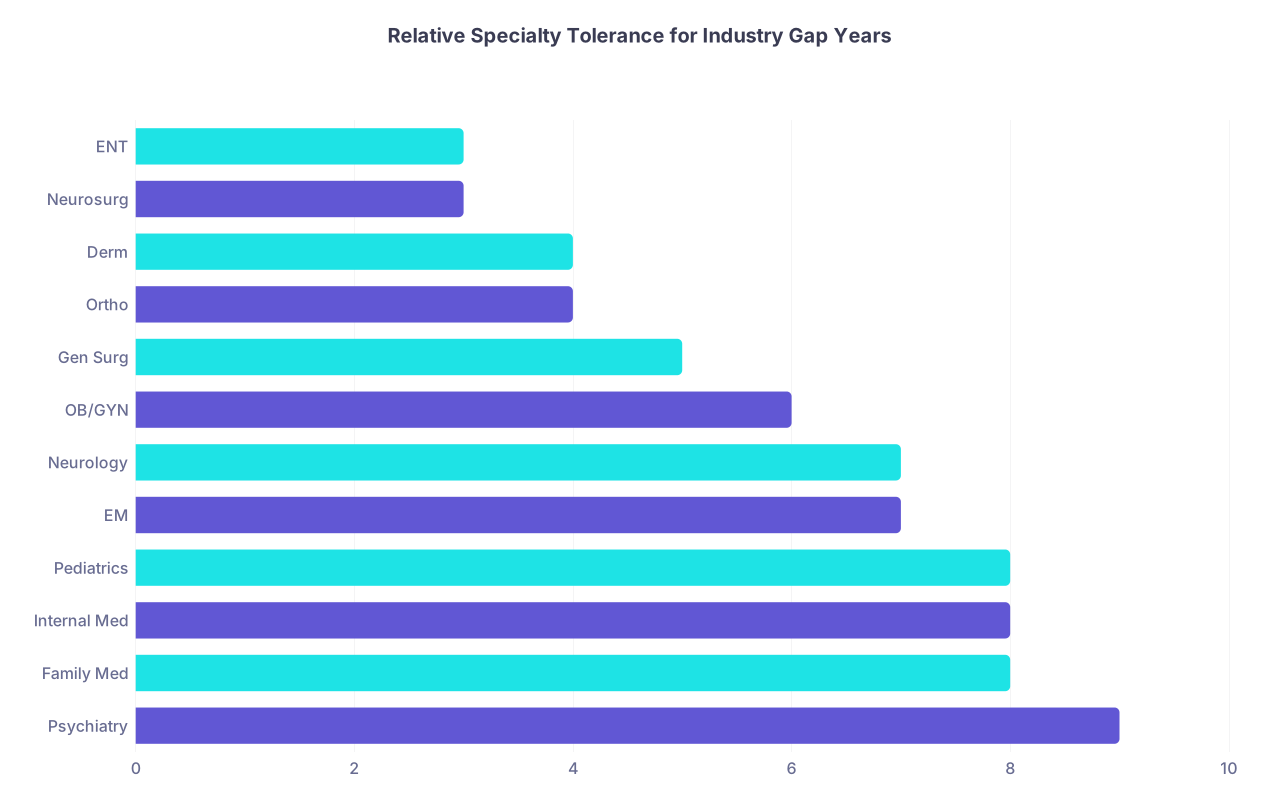
Let’s be blunt. An industry gap year doesn’t mean the same thing in psychiatry as it does in neurosurgery.
| Category | Value |
|---|---|
| Psychiatry | 9 |
| Family Med | 8 |
| Internal Med | 8 |
| Pediatrics | 8 |
| EM | 7 |
| Neurology | 7 |
| OB/GYN | 6 |
| Gen Surg | 5 |
| Ortho | 4 |
| Derm | 4 |
| Neurosurg | 3 |
| ENT | 3 |
Scale: 1 = very skeptical, 10 = very open, assuming your story is coherent.
Psych, FM, IM, peds? Generally more tolerant as long as you show enduring clinical commitment. They see value in policy, med ed, digital health, quality improvement, clinical trials.
Surgery, ortho, neurosurg, ENT, derm? They care more about continuity of hands-on clinical training, technical focus, and raw competitiveness. Industry can help if it’s elite and tightly aligned with the specialty (derm + pharma trials, ortho + device R&D), but a generic health-tech PM job doesn’t impress them much. It reads as distraction.
The more competitive the field, the less patience they have for any sign you weren’t laser-focused.
What PDs Actually Ask Themselves About Your Industry Year
Let me translate the internal monologue of a PD when they see “industry” on your CV. They’re not thinking about the brand; they’re thinking in risk calculus.
Here’s the rough checklist going through their head, whether they say it out loud or not:
Did this fix a weakness or create one?
- If you had weaker research and went to Amgen clinical trials and now have 3 abstracts? Good.
- If you had no clear weakness and disappeared into a startup doing market analysis? Questionable.
Is this applicant rusty clinically?
- Have they touched patients in 12–24 months?
- Any clerkship-like experiences, telemedicine, volunteering, shadowing with substance?
- Or have they been living in PowerPoint and Zoom?
How clear is their specialty commitment?
- Did they use the year to dive deeper into their chosen field, or did they float around “healthcare adjacent” stuff?
- Do their personal statement and letters line up with a coherent story?
Will they leave residency early for industry again?
This one is big. Programs hate attrition.
Anesthesia PDs talk about this all the time with people eyeing industry or informatics. Surgery PDs fear losing residents to consulting or device companies.Would I trust this person on night float, at 3 a.m., with a crashing patient?
Industry polish is nice. Residency is not polished. They need to believe you still think and act like a clinician.
Every ranking decision ultimately ties back to those questions.
How to Turn an Industry Gap Year into a Net Positive
This is where most of you screw it up. You treat the job title as the selling point. PDs care much more about framing and continuity.

| Step | Description |
|---|---|
| Step 1 | Industry Gap Year |
| Step 2 | Align with Specialty |
| Step 3 | Define Narrative Now |
| Step 4 | Show Clinical Continuity |
| Step 5 | Secure Strong Letters |
| Step 6 | Integrate Story in PS |
| Step 7 | Rehearse Interview Answers |
| Step 8 | Clear Purpose? |
1. Make Your “Why Industry?” Story Ruthlessly Specific
Vague: “I was interested in understanding healthcare from a systems perspective.”
Everyone says that.
Specific:
“I wanted to understand how oncologic therapies move from trials into clinical practice. At [Company], I worked on phase III lung cancer trials, which gave me a front-row seat to protocol design, toxicity management, and regulatory constraints. It also made me realize I missed being at the bedside implementing these therapies, not just analyzing them.”
That lands. It ties directly back to patient care.
2. Maintain a Clinical Pulse—Document It
If you did a full-time industry role, you needed to intentionally keep a hand in clinical medicine. If you didn’t, you need to start now and make it clear in ERAS.
Examples PDs respect:
- Regular free clinic shifts (not once every 3 months).
- Longitudinal telehealth/remote triage with physician supervision.
- Shadowing in your chosen specialty with some structure (QI project, case discussions).
Weak: “Occasional shadowing when schedule allowed.”
Stronger: “Weekly evening continuity clinic at X for one year, following my own panel under supervision.”
PDs aren’t counting your hours with a stopwatch, but they read between the lines.
3. Squeeze Output from Your Industry Work
Pure experience without output reads soft. You want at least one of:
- Abstracts/posters, especially if your name is on something recognizable.
- White papers, internal reports you can summarize in terms of impact.
- A process you designed, a tool you helped build, a metric you improved.
Translate corporate nonsense into outcomes that make sense to physicians:
- “Reduced adverse event reporting lag time by 30%.”
- “Helped design a decision-support tool now used in X clinics.”
- “Coordinated data for a study that’s now submitted to [journal].”
Don’t overinflate, but don’t undersell. Program directors are used to reading research fluff; they know how to parse claims.
4. Get at Least One Strong Letter from Industry—But Not Only Industry
You want one person from your industry role who can speak to:
- How you think.
- How you work in teams.
- How you handle responsibility and feedback.
But you cannot replace all clinical letters with corporate ones. I’ve seen PDs trash otherwise strong applicants because their letters were “two pharma people and one med school clerkship from 3 years ago.”
Ideal mix:
- 2–3 clinical faculty (recent and relevant).
- 1 from industry that actually adds dimension.
5. Clean Up the Timeline and Gaps Before They See It
Do not make PDs play detective.
If your timeline has gaps, address them now. Use ERAS entries strategically. If there was downtime between roles, explain it in a short, matter-of-fact way. Not dramatic. Just clear.
PDs hate surprises. If they discover something confusing or contradictory mid-interview, they start wondering what else you’re not telling them.
How This Actually Plays out in Rank Meetings
Here’s the scene no one shows you on social media.
It’s February. The committee is tired. They’re going through 200+ names for 15–30 spots. Your gap year comes up on the projector.
Someone says:
“This is the one who did a year at [Biotech] after graduation.”
Then you live or die by the next 60 seconds of discussion.
If your file is well-constructed, someone who interviewed you will say something like:
“Yeah, but they were very clear about why. Still did weekly clinic. Had strong insight into clinical trials, and their story tied directly to why they want heme/onc. Great letters. I’d rank them in the top third.”
If you were vague, defensive, or your story wasn’t coherent:
“I wasn’t totally convinced they’re coming back to stay. Smart, but I’m not sure how they’ll handle the grind.”
And that’s it. You slide up or down the list. Not because you did industry. Because you didn’t control the narrative around it.

Common Misconceptions You Need to Drop Now
Let me clear out some bad advice I keep seeing students repeat to each other.
“Industry will automatically make me stand out.”
No. Everyone is “standing out” now. PDs see research years, chief years, MBAs, PhDs, startups. Being different is not inherently good. Being coherent is.“I’ll just say I missed patient care; that’ll be enough.”
It isn’t. You need examples. What did you miss? What specifically pulled you back? How did that show up in your industry work?“PDs don’t understand industry.”
Some don’t, true. But more and more attendings do consulting, trials, advisory boards, informatics. They understand the temptation. Which means they also understand how easy it is to drift away from the bedside.“If I don’t mention certain parts of the year, they won’t care.”
Wrong. Anything unexplained or glossed over sets off alarms. Better to own it directly and concisely.
Quick Comparison: When Industry Helps vs Hurts
| Scenario Type | PD Interpretation |
|---|---|
| Clinical-trials role + outputs + ongoing clinic | Strong positive, especially for IM, heme/onc, neuro |
| Health-tech product role + clear impact + specialty tie-in | Positive to neutral, depends on narrative |
| Generic consulting/strategy + no clinical activity | Negative unless story is compelling and self-aware |
| Financially-driven job + honest explanation + sustained volunteering | Neutral, rarely fatal |
| Vague startup role + no letters + undefined responsibilities | Strong negative, often a ranking anchor |
FAQs
1. I’m currently in an industry gap year and did not maintain much clinical involvement. Is it already too late to fix this for the upcoming cycle?
It’s not ideal, but it’s not hopeless. Start now. Get structured clinical exposure in any form you can: free clinics, shadowing with responsibilities (case discussions, small QI tasks), telehealth. Document it in ERAS as a current activity with clear dates, hours, and responsibilities. Then your narrative becomes: “For the first part of my year I was fully immersed in X, then I realized I needed to intentionally maintain my clinical skills and began doing Y.” That’s far better than pretending the gap doesn’t exist.
2. Should I take a pay cut or reduce hours in my industry job to add more clinical work if I’m applying next year?
If you’re serious about residency, yes, you should seriously consider it. PDs care about continuity. If you can shift to 0.8 FTE and add a half-day clinic and a meaningful academic project, that trade is worth more to your application than the extra salary you’re clinging to. No one will ever tell you this explicitly, but I’ve seen borderline applicants cross the line into “rankable” purely because they could demonstrate they were still living in a clinical world part-time.
3. How do I handle a PD who directly questions whether I’ll just go back to industry after residency?
You do not win that moment with fluffy lines about “lifelong learning.” You win it with specifics and self-awareness. For example: “I saw the impact I could have on systems at scale, but I was too far from the bedside. I realized the physicians I most admired in those rooms were the ones who still practiced clinically and brought that credibility to the table. My long-term goal is to be that person: a clinician first, with the option to interface with industry or systems later. Residency is not a stepping stone for me; it’s the foundation I didn’t have when I was in those meetings.” Then back it up with concrete choices you’ve already made—turning down a return offer, picking clinical mentors, taking on clinical projects—so it’s not just words.
Key things to walk away with:
- Industry itself is not the problem; an incoherent or lazy story is.
- PDs are running a risk assessment, not a fan club. Show continuity, output, and credible commitment to the specialty.
- If you control the narrative—on paper and in the room—an industry gap year can move you up the rank list, not down.


