

27% of U.S. MD seniors in 2023 took at least one extra year during medical school—and most of them still matched into the same tier of programs they could’ve gotten without it.
So no, a “gap year” before residency is not the magical career accelerator people talk about on Reddit. Sometimes it helps. Sometimes it does absolutely nothing. And sometimes it quietly makes your application worse.
Let’s strip the mythology and talk about what program directors actually see, care about, and say out loud in rooms where there are zero applicants present.
The Heroic Gap Year Narrative (And Why It’s Overblown)
You’ve heard the script:
- “Everyone takes a research year now.”
- “You basically have to* for competitive specialties.”
- “If you don’t have pubs, just do a gap year and fix it.”
Reality is a lot messier.
The NRMP Program Director Survey (2022) gives you a better picture. For most core specialties, the things directors rank highest are:
- USMLE/COMLEX scores (or pass + prior numeric scores)
- Clerkship grades / MSPE
- Letters of recommendation in the specialty
- How you performed on away/audition rotations
- Class ranking / AOA
A research or “gap” year? It doesn’t even show up as a primary filter for most programs.
Here’s how some specialties actually weigh research output and related “gap year fuel” compared to other factors:
| Specialty | Research Importance* | Letters Importance* | Clerkships Importance* |
|---|---|---|---|
| Dermatology | 4.2 / 5 | 4.6 / 5 | 4.4 / 5 |
| Plastic Surg | 4.4 / 5 | 4.7 / 5 | 4.5 / 5 |
| Internal Med | 2.8 / 5 | 4.5 / 5 | 4.3 / 5 |
| Family Med | 1.8 / 5 | 4.3 / 5 | 4.4 / 5 |
| Pediatrics | 2.1 / 5 | 4.4 / 5 | 4.5 / 5 |
*Approximate, based on PD ranking of “importance” on a 1–5 scale.
Notice something? Outside of a few hyper-academic or ultra-competitive fields, research is nice-to-have, not “if you don’t have 12 pubs and a K award, don’t bother applying.”
So when students parrot “a gap year will make me competitive,” they’re skipping a crucial question:
Competitive for what? And compared to whom?
When a Gap Year Actually Moves the Needle
Let me be clear: I’m not anti–gap year. I’m anti–lazy reasoning.
There are situations where taking an extra year before residency is not only reasonable, it’s smart strategy.
1. You’re Switching into a Highly Competitive Specialty Late
Scenario I’ve actually seen:
- M3 starts med school thinking primary care.
- Falls in love with dermatology halfway through M3.
- Has zero derm research, no derm letters, no derm electives scheduled.
- Step 2 is strong, but application would be paper-thin for derm specifically.
For specialties like:
- Dermatology
- Plastic surgery
- Neurosurgery
- Ortho
- ENT
- IR (from certain pathways)
a dedicated research year at a strong academic department can:
- Give you multiple specialty-specific letters
- Put you in front of faculty who can actually pick up the phone for you
- Net you several abstracts/posters and maybe a couple of publications
- Let you do away rotations at the same institution and prove you’re not a liability in the OR or clinic
In this narrow lane, a gap year can turn a no-chance shot into a credible, though still uphill, application.
But that’s not “gap years are good.” That’s “you started aiming at a completely different target, late, and you need time to build a real file.”
2. You Had a Major Disruption or Red Flag
If your med school timeline includes:
- A leave of absence for serious illness
- A failed Step/COMLEX attempt
- Repeated course/clerkship failures
- Disciplinary issues (yes, programs do read the MSPE carefully)
Then an additional structured year can be useful—if it shows sustained, consistent performance.
Not just “I existed for 12 more months.”
I’ve watched applicants with a prior Step 1 fail do this right:
- Retook and passed Step 1
- Crushed Step 2
- Spent a year in a structured research or clinical role with clear supervision
- Got fresh letters from that year explicitly describing reliability, growth, and strong clinical performance
That’s how you convert a “we’re worried” into “they’ve clearly turned it around.”
Notice the pattern: the value isn’t the time. It’s the evidence you generate that you’re now safe, reliable, and ready.
3. Your Application Is Solid but Misaligned with Your Goals
This is more subtle and more honest than what people usually admit.
Let’s say your realistic outcomes this year are:
- No gap year: decent shot at mid-tier university or strong community IM programs
- With a well-structured extra research year in a big-name IM department: strong shot at university programs with heavier research, pathways to cards/GI/onc, etc.
If you want a highly academic career and you’re currently at a mid-tier school with modest research, that extra year with 5–10 pubs and true mentorship might convert into:
- Better-quality IM programs
- Earlier access to serious mentors
- Easier fellowship placement down the line
This is not about “will I match vs not match.” It’s about “what tier and trajectory am I aiming for.”
But you need to be honest about two things:
- You’re gambling an extra year of your life and income on a modest probability boost.
- You actually have to turn that year into tangible output—not “I helped on some projects that haven’t submitted yet.”
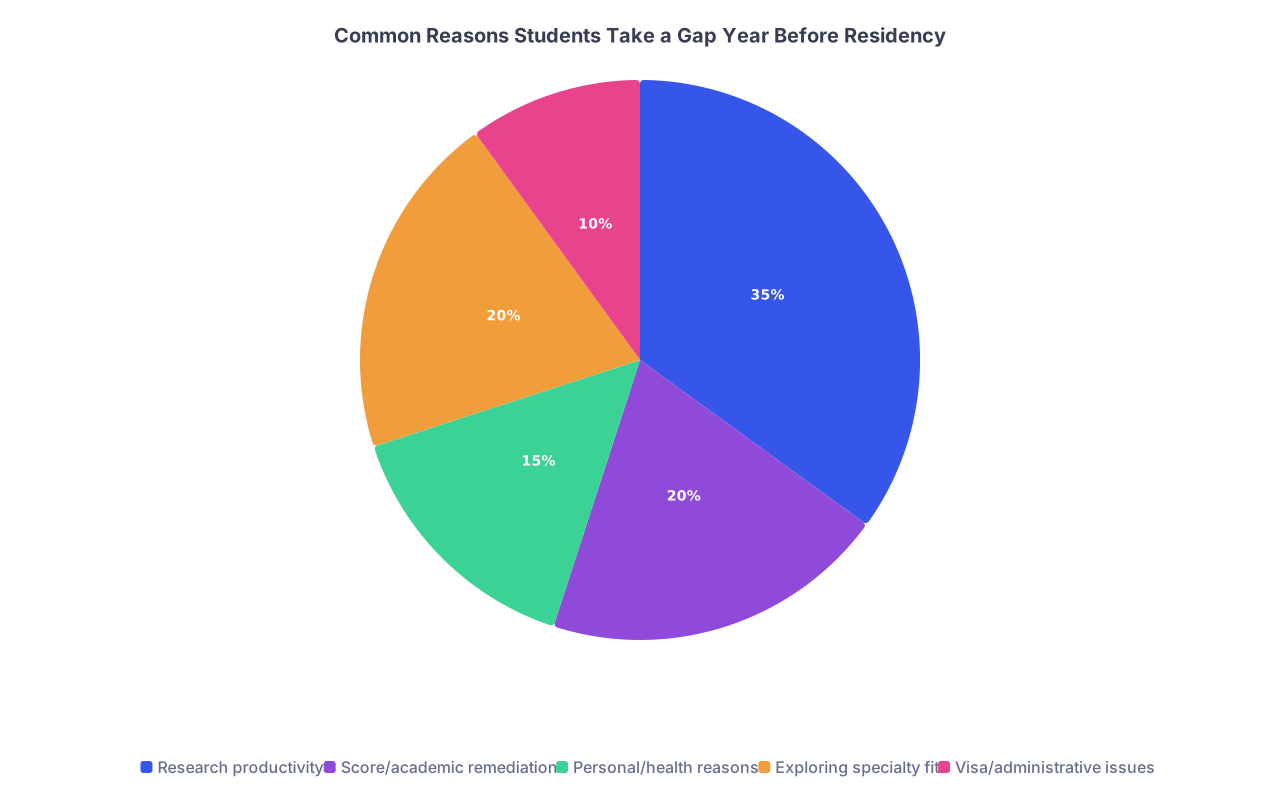
| Category | Value |
|---|---|
| Research productivity | 35 |
| Score/academic remediation | 20 |
| Personal/health reasons | 15 |
| Exploring specialty fit | 20 |
| Visa/administrative issues | 10 |
When a Gap Year Does Basically Nothing (or Hurts You)
Now the part people don’t like hearing.
There are plenty of scenarios where a gap year is, bluntly, cosmetic. A year of career cosplay that doesn’t change how PDs rank you.
1. You’re Going into a Less-Competitive, Clinically Focused Specialty
Family medicine, psych, peds, EM (outside certain destinations), PM&R in many regions, community-focused IM—most of these do not care that you took a research year unless you were working with their own department or in their niche.
Program directors in these fields are looking for:
- You passed boards (preferably on first attempt)
- You functioned well on rotations
- Faculty liked working with you
- You’re not a professionalism disaster
- You communicate like a normal human
Spending 12 extra months generating 3 case reports and 1 retrospective chart review in an unrelated field is not moving your application from “maybe” to “definitely.”
What it might do, though, is raise questions:
- “Why didn’t they just apply earlier?”
- “Why is there this much delay without a compelling reason?”
I’ve heard PDs in community programs literally say, “If they took an extra year just to eke out a couple of papers, I’d rather take the person who went straight through and looks hungry to work.”
They’re hiring a resident, not a future tenure-track PI.
2. The “Fuzzy” Gap Year With No Hard Outcomes
This one’s common and deadly.
Student says: “I’ll take a year, do research, maybe moonlight as a scribe, find myself, and then apply strong.”
Translation on paper one year later:
- 1–2 abstracts as middle author that never turned into papers
- A vague line about “assistant in ongoing projects” with no measurable results
- No new letters better than what you already had
- Nothing that shows improved academic strength or clinical competence
Directors aren’t dumb. They can see that you added “noise” but not “signal.”
Gap years that work usually have:
- Clear structure (formal research fellowship, chief year, post-doc-like role, fellowship, advanced degree)
- A supervising PI or faculty member who knows your work well
- Specific, documented achievements: accepted papers, funded projects, leadership roles
- New letters from that year that are clearly stronger than your prior ones
If you can’t point to what will be on your ERAS before you start the gap, you’re already in fuzzy territory.
3. You’re Using a Gap Year to Avoid Fixing the Real Problem
The common illusion: “My scores/grades are mediocre, but a gap year with research will compensate.”
Usually false.
If your issues are:
- Marginal Step 1 + 2
- Weak clinical evaluations
- Mediocre or generic letters
Research productivity doesn’t erase that. It just tags on “works hard on projects” to “struggles clinically” or “average test taker.”
For procedural or cognitively intense specialties, PDs fear residents who:
- Struggle with boards (they’re judged on your board pass rates)
- Struggle with workload and responsibility
- Struggle in the OR or on busy inpatient services
No number of posters compensates for “will struggle to pass their in-training exams.”
I’ve watched applicants sink a year into “research” when they really should’ve spent that time:
- Retaking and optimizing Step 2/COMLEX 2 if allowed
- Getting rock-solid Sub-I evals and letters
- Doing an away rotation in their target specialty
- Fixing professionalism or communication issues that keep showing up
Gap years are a terrible substitute for confronting your actual weak points.

What Programs Actually Think When They See a Gap Year
Let me translate how this lands in real selection meetings.
Someone’s reviewing an application:
“MD, 4 years, then a 1-year research fellowship in cardiology. Good letters from the PI. 5 pubs, 3 first-author. Step 2 strong. Clinical comments solid.”
Reaction: “Serious academic interest. Time well used. Moves them up, especially for research-heavy IM programs.”
Another file:
“Graduated in 4 years, then ‘Research Assistant – Oncology’ for 1 year. No publications listed, just ‘worked on multiple projects.’ Step scores average. Clinical comments fine.”
Reaction: “Basically same candidate as if they’d applied straight through, with an extra year. Doesn’t hurt much, doesn’t help much. Unless their letter from that year is a standout.”
Third file:
“Took 2 years off between M3 and M4 for personal reasons. No structured role, no publications. Applied late. Letters mostly pre-gap. Step 2 barely passed.”
Reaction: “Where’s the evidence of readiness now? What have they done recently that shows they’ll handle residency?”
The type of gap matters more than the mere presence of a gap.
And yes—unexplained or weakly explained gaps (especially multiple or very long ones) are a red flag. Not an auto-reject, but a “we need a really good story and recent performance.”
The Financial Reality Everyone Hand-Waves Away
One more myth: “It’s just one extra year.”
No. It’s one year of lost attending salary on the back end plus one more year of low or zero income now.
Let’s be conservative:
- Average new attending in IM or peds: ~$220–250k/year
- More procedural or lucrative fields: $350k+ easily
If you delay everything by one year:
- You start earning attending money one year later
- That’s not just $220–350k delayed—it’s one fewer lifetime year at that income
- Compounded over a career, that’s easily mid–six figures of opportunity cost
Does that mean a gap year is always financially stupid? No.
If that year increases the odds you match at:
- A program that lets you get into a higher-paying subspecialty you actually want
- A program that doesn’t destroy your mental health
- A field where you’ll practice for 30 years instead of burning out in 5
Then the trade might absolutely be worth it.
But you should treat it like a serious financial decision, not a free extra year of “buffing your app.”

| Step | Description |
|---|---|
| Step 1 | Considering Gap Year |
| Step 2 | Structured Research Year at Strong Dept |
| Step 3 | Apply Now with Focused Aways/Letters |
| Step 4 | Use Year for Clear Remediation + Strong Letters |
| Step 5 | Apply Now |
| Step 6 | Only Take Year if Outcomes Clearly Improve Odds |
| Step 7 | Target Specialty Highly Competitive? |
| Step 8 | Need Specialty-Specific Research/Letters? |
| Step 9 | Major Red Flags or Disruptions? |
| Step 10 | Can You Define Concrete Outcomes for the Year? |
How to Decide Without Lying to Yourself
Ask yourself five blunt questions. If you cannot answer these clearly, you’re not ready to commit to a gap year.
What exactly will be new and better on my ERAS because of this year?
Name the outcomes: X rotations, Y letters from Z faculty, N submissions/pubs, improved score, new degree.Would I likely match somewhere decent if I applied this cycle?
If the honest answer is yes, you’re not asking “can I match?” You’re asking “is the marginal improvement worth a year of my life?”Am I doing this year to chase a fantasy or to fix a realistic gap?
“Harvard derm or bust” with a 230 and no derm letters is fantasy. “I want a solid IM program with research tracks, and I’m close but underbuilt” is reality.Who will be supervising me, and what will they say in a letter?
If you cannot name a mentor right now who’d likely write you a strong letter at the end, be suspicious.If this year doesn’t go perfectly—projects delayed, pubs slow—does it still help? Or does it just pad my CV with fluff?
Many “research years” end with delays and projects not yet accepted. You need value even in that scenario.
If your answers are hand-wavy, that’s your sign.
The Nuanced Truths (Without the Fluff)
Three things to walk away with:
- A gap year is not inherently “good” or “bad.” It’s only as valuable as the concrete, application-strengthening outcomes you can reliably produce during it.
- For most non-ultra-competitive, clinically oriented specialties, a gap year rarely transforms your trajectory. Solid scores, strong clinical performance, and good letters matter much more.
- The real mistake isn’t skipping a gap year—it’s using one as a substitute for facing your actual weaknesses, or treating an extra 12 months like a magic spell rather than a calculated, high-stakes trade.


