

The usual advice about “needing a clinical job” in your gap year before residency is lazy and often wrong. You can turn a non-clinical job into a seriously strong residency narrative—if you stop apologizing for it and start engineering the story.
You are not stuck. You are just one structured plan away from making this gap year work for you instead of against you.
Step 1: Stop Defending. Start Positioning.
The worst thing applicants with non-clinical jobs do? They sound guilty.
“I know it’s not clinical but…”
“I had to take this job because…”
Program directors hear that and mentally downgrade you. Not because of the job. Because of how you talk about it.
Here is the mindset shift:
- You are not “off track.”
- You are not “behind.”
- You are building specific skills and perspectives that many straight-through applicants do not have.
Your job is to:
- Define what your non-clinical job actually proves about you.
- Connect those proofs directly to residency-level behaviors.
- Fill in clinical and academic gaps surgically, not desperately.
Let me walk you through that.
Step 2: Break Down Your Non-Clinical Job into Residency-Ready Skills
I do not care what the job is—consulting, scribing-adjacent admin work, pharma, start-up, tutoring, retail pharmacy, tech analyst, barista. There is a way to extract residency-relevant skills if you are disciplined.
Start here: write down your role and break it into concrete actions, not titles.
Examples:
“Project coordinator at a health tech startup”
- Coordinated weekly cross-functional meetings
- Managed timelines and deliverables for 3–5 active projects
- Communicated feature changes to clinicians and developers
- Tracked and summarized user feedback (including providers)
“Medical content writer for an education company”
- Translated complex topics into clear explanations
- Reviewed and edited materials for accuracy
- Met tight deadlines with multiple parallel projects
- Took feedback from editors and subject leads
Now map those into residency domains. Use this as a translation key.
| Non-Clinical Task | Residency-Relevant Skill |
|---|---|
| Managing timelines / deadlines | Reliability, time management |
| Leading / coordinating meetings | Teamwork, leadership |
| Handling unhappy customers/clients | Difficult patient/family encounters |
| Writing reports / content | Documentation, communication |
| Data analysis / dashboards | Clinical reasoning, QI mindset |
| Teaching / training others | Resident-as-teacher role |
You must say the quiet part out loud in your application materials:
- Not: “I worked as a project coordinator.”
- Do: “In my project coordinator role, I led multidisciplinary teams, managed time-critical tasks, and learned to communicate clearly with people who had very different priorities—much like the team dynamics on a busy inpatient service.”
You are training the reader how to interpret your gap year. Do not assume they will connect the dots. You connect them.
Step 3: Patch the Three Red Flag Areas—Clinicals, Academics, Commitment
Non-clinical job by itself is not the problem. The problem is what it might signal:
- You are disconnected from patient care.
- You walked away from academics.
- You are not fully committed to the specialty.
Your job is to aggressively neutralize those suspicions.
3.1 Clinical Contact: Minimum Viable Presence
You need at least one live thread connecting you to direct patient care. It does not need to be a full-time job.
Here are realistic options while keeping your non-clinical role:
1–2 shifts per month:
- Hospital volunteer (ED, inpatient unit, discharge navigator)
- Free clinic volunteer (ideal for FM, IM, EM, peds)
- Hospice volunteer
- Clinic medical assistant / tech (if you can get trained)
Shadowing that actually counts:
- Longitudinal shadowing with 1–2 physicians, same specialty you are applying to
- Aim for: 4–8 hours per month, consistently over several months
- Ask to join team rounds, not just sit in the corner
Your target: enough clinical continuity that you can say in an interview, calmly and specifically:
- “I continued seeing patients monthly at the X free clinic.”
- “I joined Dr. Y’s inpatient team twice a month to maintain clinical exposure.”
If you currently have zero, here is a blunt 4-week fix:
Week 1:
- Email 15–20 attendings (alumni, past rotation sites, faculty you vaguely know).
- Template: short, specific, respectful, with a clear ask for longitudinal shadowing or volunteering.
Week 2–4:
- Take whatever says “yes” and lock in a repeating schedule, even if it is only a few hours a month.
- Get your hospital/clinic onboarding done immediately.
Stop aiming for perfect. You just need credible continuity.
3.2 Academic / CV Momentum
A non-clinical job plus no academic activity looks like you took a year off mentally.
You do not need a Nature paper. You do need to show you are still sharpening some edge:
Options, ranked by impact:
Research or QI tied to your specialty
- Attach yourself to a faculty project; offer to help with data collection or chart review.
- Ask specifically: “Do you have any ongoing projects where you need help with data extraction or simple analyses?”
Case report or small retrospective
- Especially powerful if tied to your previous clinical school / program.
- Partner with a resident who wants academic output.
Structured online coursework / certificate
- Examples: Coursera / edX in biostatistics, QI, leadership, medical education.
- Only list it if you complete it and can actually discuss it.
Teaching / tutoring with structure
- MCAT/USMLE tutoring, structured TA role, OSCE/pre-clinical tutoring.
- Turn “I tutored” into “I developed a small curriculum for X.”
Your goal is to be able to truthfully say:
- “During this gap year I continued clinical exposure and completed [X project / course] that improved my understanding of [relevant topic].”
Even one concrete, finished thing beats five vague “in progress” items.
3.3 Commitment to the Specialty
Here is what programs silently worry about:
- “You did a consulting / industry / tech job. Are you going to bail again?”
- “Do you actually want this specialty, or are we your backup plan?”
You counter that by building a specialty-specific story that threads through:
- Past clinical experiences
- Your gap year job
- Your future goals
Example for internal medicine with a health-tech job:
- Past: “On my IM sub-I, I saw how poorly chronic disease management systems supported physicians.”
- Gap job: “At the startup, I worked on tools to close that gap. Sitting in design meetings with both engineers and clinicians reinforced how central internists are to building realistic solutions.”
- Future: “I want to train in a program where I can be both an excellent clinician and contribute to system-level improvements in chronic care.”
Same pattern works for EM + operations job, FM + community outreach role, psych + behavioral health startup, etc.
If your job is not health-related at all (banking, software engineering, hospitality), then you:
- Emphasize durable skills:
- High-stakes decision-making
- Customer conflict management
- Long hours
- Dealing with uncertainty and pressure
- Anchor your “why this specialty” primarily in prior medical school rotations, not the gap job.
Do not oversell the connection if it is fake. But do not under-sell the skills either.
Step 4: Build a Coherent Story Across CV, Personal Statement, and Interviews
You cannot afford contradictions. One of the fastest ways to tank your application is to sound like three different people in:
- ERAS CV
- Personal statement
- Interview answers
You need a single through-line: “This is what I did. This is what I learned. This is how it makes me a better intern.”
4.1 Structure Your Personal Statement Around the Gap Year (Without Making It the Star)
You do not write a “gap year apology” essay.
You write a “trajectory” essay where the gap year is one logical chapter.
Simple structure:
- Anchor in clinical motivation
- Short, grounded story from med school or earlier patient care. Not your childhood.
- Show development through rotations
- 1–2 clear experiences that led you to this specialty.
- Integrate your gap year non-clinical job
- What you did
- 2–3 specific skills learned
- One or two concrete moments that tie back to patient care or system understanding
- Look forward explicitly to residency
- What you want in training and how your gap year prepared you to contribute from day one.
Example paragraph skeleton for the job section:
“After graduation, I worked as [role] at [organization], where I [1 line what the organization does]. My primary responsibility was [clear description]. Managing [X] and coordinating with [Y] taught me [skill 1] and [skill 2]. I saw direct parallels with residency: balancing competing priorities under time pressure, communicating clearly with people who have different levels of expertise, and owning tasks to completion. To stay close to patient care, I [clinical continuity], which reinforced that while I value system-level work, I am most motivated when I am directly responsible for patients.”
That is the tone: confident, specific, non-defensive.
4.2 Use Your CV to Highlight Intentionally Selected Items
On your ERAS:
- Do not list every random part-time gig or one-hour webinar.
- Prioritize:
- Non-clinical job (well-described duties)
- Clinical continuity role(s)
- One or two strongest academic or leadership activities
In the description for your non-clinical job:
- Avoid fluff like “improved communication skills.”
- Use concrete language: “Led weekly 8–10 person meetings,” “Handled 40–60 customer emails per week,” “Created process that reduced X by Y%” (if you have numbers, use them).
If your job has a bland title (“Analyst”), use the description to make it understandable in medicine terms:
- “Functioned as project manager for X…”
- “Served as primary liaison between Y and Z…”
4.3 Prepare Interview Answers Like a Scripted Playbook
You will get variations of the same 5 questions in 80% of interviews. You should have tight answers to these, especially with a non-clinical year:
- “Tell me about yourself.”
- “What did you do during your gap year?”
- “Why did you choose to work in [non-clinical job]?”
- “How did you stay connected to medicine?”
- “Why this specialty / program?”
Your answers need:
- 20–40 seconds each, clear, without rambling.
- 1–2 specific examples per answer.
Example: “What did you do during your gap year?”
Bad: “I worked in a startup. It was not clinical but I learned a lot.”
Strong:
“I worked full-time as an operations coordinator at a health tech startup developing tools for outpatient clinics. I managed timelines for three concurrent projects, ran weekly cross-functional meetings with clinicians and engineers, and analyzed feedback from front-line users. The pace and responsibility felt very similar to a busy inpatient month. Alongside that, I volunteered twice a month at a free clinic, which kept me grounded in direct patient care and reminded me why I want to be at the bedside.”
Practice this out loud. Record yourself once. You will hear where you ramble.
Step 5: Build a 6–12 Month Action Plan From Where You Are Right Now
Let us translate all of this into an actual blueprint.
Scenario A: You Have 9–12 Months Before Applying
You can do a lot. Here is a simple monthly structure.
Month 1–2:
- Lock in:
- Non-clinical job responsibilities (clarify your role, take on one leadership-type task)
- Clinical continuity (volunteering / shadowing)
- One academic or structured learning activity
- Start a simple “experience log”:
- 2–3 bullet points per week:
- One meaningful work interaction
- One example of conflict / challenge
- One patient-related or clinic-related experience
- 2–3 bullet points per week:
Month 3–6:
- Push responsibility at work:
- Volunteer to own a small project, process, or metric.
- Ask your supervisor for one stretch assignment.
- Advance academic / CV project:
- Get to at least “submitted abstract” or “draft manuscript” or “completed course with project.”
- Deepen clinical connection:
- Aim for continuity with the same team / clinic.
Month 7–9:
- Draft personal statement.
- Ask for letters:
- At least:
- One from a core clinical attending in your specialty.
- One from someone who supervised you in your non-clinical job who can speak to work ethic and behavior.
- At least:
- Start practicing interview answers.
Month 10–12:
- Polish ERAS.
- Do a mock interview or two.
- Keep all activities going; do not drop clinic or academic work as soon as apps go in.
Scenario B: You Have 3–6 Months Before Application
You cannot do everything. So you triage.
Non-negotiables:
- Get any consistent clinical thread ASAP.
- Frame your non-clinical job sharply on your CV and in your story.
- Add one academic or structured learning piece that you can actually finish.
Forget the rest. Deep beats broad.
Step 6: Common Pitfalls That Ruin a Good Non-Clinical Year
You can do all the right activities and still sabotage yourself with how you present them.
Avoid these:
Sounding apologetic
- “I know it’s not ideal…”
- “I had to do this because…”
- Stop. You chose a path, you maximized it, and you learned a lot. Own it.
Overcompensating
- Do not pretend your job was “basically like being a resident.”
- Draw parallels, yes. But keep perspective.
Disorganized explanations
- Jumping between random jobs, projects, and short-term gigs sounds chaotic.
- Pick 3–5 core things and build around them.
Blaming circumstances
- “The job market was bad.”
- “My school did not help me.”
- Program directors tune out. Focus on what you did with what you had.
Zero reflection
- Listing tasks without meaning:
- “I did X, Y, Z.”
- You need one layer deeper: what changed in how you think, act, or plan to practice.
- Listing tasks without meaning:
Step 7: Quick Specialty-Specific Angles
Your non-clinical job should tilt your narrative in the direction of your chosen field.
Here is how to angle it fast.
Internal Medicine
- Emphasize:
- Complex problem solving
- Longitudinal thinking
- Systems-level process work
- Connect job tasks to coordinating moving parts, data-heavy decisions.
- Emphasize:
Family Medicine
- Emphasize:
- Community relationships
- Communication with people of different backgrounds
- Conflict de-escalation
- Tie customer-facing or team-facing jobs to trust-building and continuity.
- Emphasize:
Emergency Medicine
- Emphasize:
- Crisis management
- Rapid decision-making
- Handling high-volume, high-stress workloads
- Any job with time pressure or unpredictable workload is relevant.
- Emphasize:
Psychiatry
- Emphasize:
- Active listening
- Conflict negotiation
- Behavior change in groups or clients
- If your role involved coaching, customer escalations, or HR processes, use that.
- Emphasize:
Surgery / Surgical Subspecialties
- Emphasize:
- Discipline
- Ownership of outcomes
- Comfort with hierarchy and structured teams
- Any long-hours, high-expectation environment translates well.
- Emphasize:
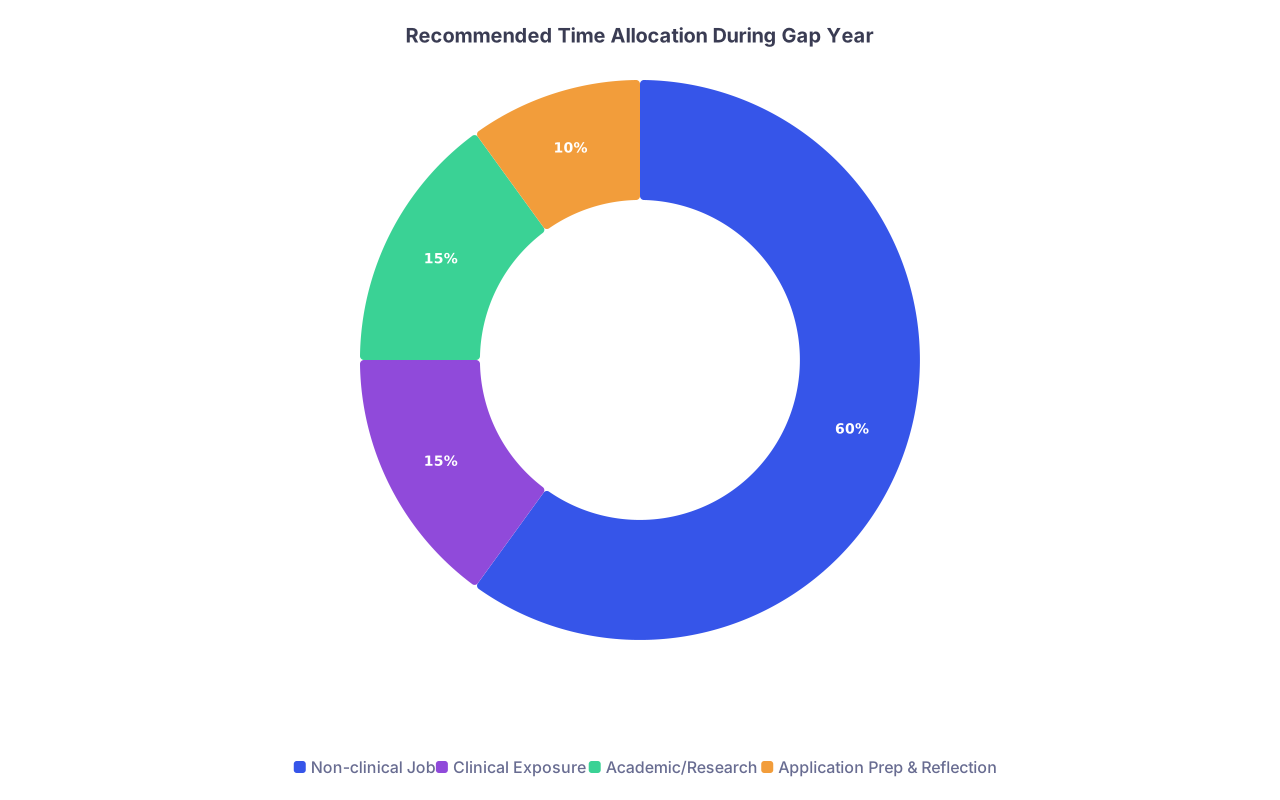
| Category | Value |
|---|---|
| Non-clinical Job | 60 |
| Clinical Exposure | 15 |
| Academic/Research | 15 |
| Application Prep & Reflection | 10 |
Step 8: Example Narrative Transformations
Let me show you how this actually reads when done right.
Example 1: Business Analyst → Internal Medicine
Raw reality:
- Full-time business analyst at a logistics company.
- No health angle.
- Occasional weekend volunteer at a food bank.
Transformed narrative:
- “I chose to work as a business analyst in a logistics firm because I wanted structured experience managing complex systems under time pressure before residency. I started with small data-cleaning tasks and progressed to owning weekly performance reports for a region handling thousands of shipments. When constraints hit—weather, staffing shortages—I had to anticipate downstream problems and re-allocate resources quickly. It was the same mindset I valued on my IM rotation: seeing the whole patient and anticipating complications. To remain clinically connected, I volunteered monthly at a community clinic’s outreach events, where we screened patients for chronic disease and connected them to care. Residency in internal medicine is the next step: I want to apply this systems mindset to complex, real patients, not just data points.”
That is not apology. That is positioning.
Example 2: Customer Support Rep → Emergency Medicine
Raw reality:
- Call center support for a telecom company.
- Stressful, low control, angry customers.
Transformed narrative:
- “My gap year job was in a telecom call center, taking 40–60 calls daily from customers whose service had failed at inconvenient moments. I often met them at their worst. The constraints were real: fixed policies, limited time, and incomplete information. I learned to listen fast, de-escalate emotion, and extract the key problem from long, emotional stories. I also learned to accept that sometimes I could only partially fix things, but I could always control how heard the person felt. Those skills match what drew me to emergency medicine during my rotations: rapid triage, difficult conversations, and stabilizing chaos. To keep my clinical skills active, I shadowed twice monthly in our local ED and helped with a small QI project on triage documentation.”
Readable. Coherent. Strong.

| Step | Description |
|---|---|
| Step 1 | Non-Clinical Job |
| Step 2 | Extract Concrete Tasks |
| Step 3 | Map to Residency Skills |
| Step 4 | Add Clinical Continuity |
| Step 5 | Add Academic/CV Element |
| Step 6 | Integrate into Personal Statement |
| Step 7 | Prepare Interview Answers |
| Step 8 | Coherent, Strong Narrative |
FAQ (Exactly 4 Questions)
1. Do I need to quit my non-clinical job and get something clinical to match?
No. You do not need to quit. You need to layer clinical exposure on top of your current job. Even 4–8 hours a month of consistent volunteering or shadowing, tied to your target specialty, is enough to prove you stayed connected. Quitting a stable job 6 months before application to chase a “perfect” clinical role often creates more chaos than benefit.
2. Will programs judge me for working in industry / business / tech instead of something clinical?
They will judge you based on two things: (1) whether you have any ongoing clinical thread, and (2) how you explain your choices. If you sound intentional—“I chose this role to build X skills, and I maintained Y clinical connection”—most reasonable programs will see it as a plus. If you sound apologetic or scattered, they will assume you drifted away from medicine.
3. How much academic activity do I actually need during a non-clinical gap year?
For most specialties, one solid, finished thing is enough: a completed QI project, a submitted abstract, a finished certificate course, or a clearly defined teaching role. You are not trying to rebuild your entire CV; you are showing that your academic brain has not been idle. Depth over breadth. A single project you can discuss in detail beats five bullet points of vague “ongoing research.”
4. Should I center my entire personal statement on my non-clinical job?
No. The spine of your statement must still be your clinical motivation and specialty choice. Your non-clinical job should be a chapter, not the book. One structured paragraph that explains what you did, what you learned, and how it sharpens you for residency is ideal. If the essay reads like you are applying for a promotion at your current company, you missed the mark.
Key takeaways:
- Stop apologizing for your non-clinical job; dissect it for concrete, residency-ready skills and state them plainly.
- Patch the three risk areas—clinical continuity, academic momentum, and specialty commitment—with targeted, realistic actions.
- Build one coherent story across CV, statement, and interviews so programs see a deliberate trajectory, not a detour.


