

The match will not forgive a bad third-year evaluation record. But a smartly executed gap year can.
If your MS3 evaluations are weak, you are not “doomed.” You are on a steeper hill. That is different. The question is whether you are going to spend your gap year passively “gaining experience” or aggressively rebuilding your application narrative.
Here is how you fix it.
Step 1: Diagnose Exactly What Is Broken (Not Just “I Had Bad Evals”)
Before you design a gap year, you need a working diagnosis. Vague self-blame is useless. You want a precise list of problems that a PD (program director) will see when they pull up your file.
Pull every MS3 eval and your dean’s office performance summaries. Then, very deliberately, do this:
Classify each problem into hard categories:
- Clinical performance / work ethic
- Professionalism / reliability
- Communication / teamwork
- Knowledge base / test performance (shelf exams, Step 1/2)
- Attitude / “fit” comments
- Outright red flags (probation, professionalism report, failed rotation)
Map what PDs will actually read:
- Have your school’s MSPE (Dean’s Letter) draft or template? Look at how they summarize:
- “Below expectations” comments
- “Needs improvement” in professionalism
- Shelf failures or remediation
- Ask your dean or advisor plainly:
“If you were a PD reading my MSPE, what are the top 3 concerns you would have?”
- Have your school’s MSPE (Dean’s Letter) draft or template? Look at how they summarize:
Write a one-sentence problem statement for each category. Examples:
- “Multiple evaluations mention disorganization and late notes.”
- “Two core rotations flagged unprofessional behavior (late, missed pages).”
- “Comments describe me as quiet, disengaged, passive in team discussions.”
- “One failed surgery rotation, remediated on repeat.”
You are not doing this for self-flagellation. You are building a target list of issues your gap year must attack head-on.
Step 2: Decide Which Narrative You Need to Build
A gap year does not erase MS3. PDs are not stupid; they know exactly what a year of “research” or “chief scribe” can and cannot prove.
Your job is to build a counter-narrative that is:
- Credible
- Documented by others (letters, titles, deliverables)
- Directly responsive to the weaknesses in your record
Broadly, there are four narratives that work when you are repairing a shaky clinical track record:
“I grew up and became reliable.”
For students with professionalism / reliability issues, lack of accountability, poor follow-through.“I can function at a high clinical level.”
For students criticized as slow, disorganized, or weak clinically.“I am a strong team player and easy to work with.”
For those with interpersonal, communication, or “attitude” comments.“My trajectory is sharply upward.”
For those with early stumbles but clear later improvement and strong Step 2, sub‑Is, or PGY‑1‑equivalent work.
You might need more than one of these. Fine. But pick a primary narrative and a secondary one. Then design your gap year as evidence for those two stories.
Step 3: Choose a Gap Year Path That Directly Addresses Your Weaknesses
This is where many students blow it. They pick the “prestige” gap year (big-name research lab, MPH, etc.) that does nothing to fix the actual reason they are not matching.
Your choice must be surgical. You are not just buying 12 months. You are buying:
- One or two powerful letters from people who can say, in specific language, that the problems in your MS3 record are no longer true.
- A body of work that shows consistency, reliability, and skill.
- A clean narrative you can explain in your personal statement and interviews.
Here are the main categories, who they help, and how.
| Gap Year Type | Best For |
|---|---|
| Full-time clinical job | Reliability, professionalism, teamwork |
| Research year | Academic goals, knowledge, persistence, Step bump |
| Preliminary/intern yr* | Major MS3 concerns, prove real-world performance |
| Degree (MPH/MS) | Long-term academic interest, structured growth |
| Teaching/tutoring | Communication, leadership, mastery of basics |
*Preliminary/intern year options depend heavily on your school and region; not always realistic.
Option 1: Full-time Clinical Job (High-yield for Professionalism and Clinical Function)
Examples:
- Hospitalist service clinical coordinator
- Full-time ED scribe (senior / lead scribe)
- Medical assistant in a busy clinic
- Clinical research coordinator with heavy patient interaction
Who this helps most:
- You had comments like “often late,” “needs closer supervision,” “not proactive,” “slow to complete tasks,” “missed pages.”
- You need someone to say, “This person carries real responsibility now and does it well.”
How to structure this year:
Choose settings where:
- You work closely with attendings or fellows who can write strong letters.
- Your reliability is visible: you manage schedules, track patients, coordinate labs, handle pages.
- There is a clear hierarchy, and you can be formally evaluated.
From Day 1, act like your entire match depends on this job. Because it does.
- Never be late. Not once.
- Over-communicate. Confirm tasks. Summarize plans. Ask for feedback.
- Volunteer for extra responsibilities that give you ownership (orientation of new staff, QI projects, protocol updates).
Midway through your gap year (around 6 months):
- Sit down with your supervisor/attending and say this literally:
“My third-year record had issues with reliability and organization. I am working very hard to correct that.
I would really value honest feedback on whether you see improvement and what I should still work on.”
That conversation does two things:
- Signals maturity.
- Plants the seed for a letter that speaks directly to those problems.
- Sit down with your supervisor/attending and say this literally:
Option 2: Dedicated Research Year (High-yield for Academic / Cognitive Concerns)
This is not “I hang around a lab and maybe get on a poster.” That is useless here. You are using research to show:
- You can execute complex, long-term projects.
- You can handle data, literature, and structured thinking.
- You can generate tangible output (papers, abstracts, presentations).
Best for:
- You had mediocre shelf scores, borderline Step 1/2, or “knowledge base” comments.
- You aim for an academic residency or competitive specialty, and MS3 undercut your file.
How to do research year right:
Pick the right mentor, not just the fanciest institution:
- Someone active in your target specialty.
- History of placing students into residency.
- Track record of writing detailed, supportive letters.
Make your role as full-time and central as possible:
- Lead data collection.
- Be first author on at least one project if feasible.
- Present at a regional or national conference.
Ask your PI early:
- “My MS3 record raised concerns about consistency and clinical reasoning. I want this year to demonstrate that I can work hard, think clearly, and finish projects. Can you give me feedback periodically on whether I am meeting that bar?”
At year’s end, your PI’s letter must not be generic. You want language like:
- “Shows up early, stays late, takes ownership of projects.”
- “Grew into a role where fellows and residents relied on her to keep studies on track.”
- “Attention to detail and follow-through were excellent.”
If your weaknesses are behavioral/professional, research alone is not enough. Pair it with at least some clinical exposure (per diem scribing, weekly clinic, etc.) so you can also obtain a clinically oriented letter.
Option 3: Preliminary Year or Transitional Internship (When Damage Is Significant)
For some students—especially with:
- Failed rotations
- Formal professionalism sanctions
- Severe MS3 problems in multiple cores
—doing an actual intern year (prelim medicine, surgical prelim, transitional) before reapplying is sometimes the only way to truly reset the narrative.
This route is complex and not always feasible, but here is the logic:
- PDs trust real-world PGY‑1 performance more than MS3.
- A strong year with no issues + supportive PD letter can outweigh prior student-level mistakes.
This is advanced strategy, often requiring:
- Honest sit-down with your dean and specialty advisor.
- Possibly applying more broadly or changing specialty.
- Willingness to stomach a non-categorical spot first.
If you are in this territory, you need a custom plan with advisors, not generic online advice. But know that this path exists and can work.
Option 4: Degree Programs (MPH, MS, MBA, etc.)
On their own, degrees do not fix a weak MS3 record. A shiny MPH with the same old professionalism issues is a waste of tuition.
When are degree programs useful?
- You are targeting fields where they are valued (e.g., IM with health policy interest, EM with admin focus, public health heavy programs).
- You have time and structure to also do:
- Clinical shadowing or part-time work
- Research with strong mentorship
- Leadership roles (TA, course coordinator)
Use the degree to show:
- Consistent performance in graded coursework.
- Leadership and initiative (like organizing a community project).
- Improved communication and professionalism in group projects.
Again: the value is in the letters and the story, not the diploma.
Step 4: Engineer Letters of Recommendation That Directly Address Your MS3 Issues
This is the core of your gap year. You are not just collecting generic “hardworking” letters. You are deliberately engineering rebuttals.
Here is the formula.
1. Pick letter writers in these categories:
- One clinical supervisor (attending, fellow) who saw you work closely, regularly.
- One project/academic supervisor (PI, course director, program leader).
- Optional: A third letter from someone who can speak to leadership or long-term growth.
Do not overvalue titles alone. A detailed letter from a community hospitalist who watched you grind for a year is more powerful than a one-paragraph note from a famous department chair who barely knows you.
2. Give them targeted context (without oversharing or whining)
When you ask for the letter, say something like:
“I am applying to internal medicine. In third year I struggled with [reliability / communication / organization], and that is reflected in my MSPE. Over the past year here, I have worked very hard to improve those areas.
If you feel you can comment on my growth in reliability, work ethic, and ability to function on a team, that would be extremely helpful.”
You are not telling them what to write. You are framing your narrative.
What you want them to cover:
- Concrete examples: showed up early, stayed late, took ownership of X.
- Evidence of managing increasing responsibility without dropping balls.
- Explicit comparison to peers: “functions at or above the level of a PGY‑1” or “among the top students I have supervised.”
Step 5: Rewrite Your Personal Statement and Application Around Growth, Not Excuses
You cannot pretend your MS3 record did not happen. PDs will see it in two clicks. If you do not address it at all, they will invent their own explanation. That is dangerous.
Your job is to own it without drowning in it.
How to address a weak MS3 record in your narrative:
Brief acknowledgment.
2–3 sentences. No drama. No self-pity.Example:
“Early in my clinical training, I struggled with time management and communication. I was slow to adjust to the pace and expectations of inpatient care, and my third-year evaluations reflect that.”
Clear pivot to action.
What you did with your gap year, in concrete terms.“This year, working full time as a clinical coordinator on a busy hospitalist service, I have been responsible for managing admissions logistics, tracking labs and imaging, and ensuring daily plans are communicated to patients and families.”
Evidence of change.
Numbers, roles, outcomes.“I routinely coordinate care for 15–20 inpatients per day, pre-round with the team, and communicate updates to consultants. I have never missed a shift and have repeatedly been trusted to train new hires.”
Forward-looking close.
How this growth positions you for residency.“These responsibilities have forced me to develop the organizational systems and communication habits I lacked earlier, and they have made me eager to bring this more mature version of myself to residency training.”
No paragraph-long explanations. No blaming others. Short, precise, then move on.
Step 6: Make Step 2 CK and Later Rotations Your Co‑Headliners
If your MS3 record is weak, you need other anchors on your application:
- Strong Step 2 CK score
- Strong performance on fourth-year sub-internships
- Clean, upward-trending MS4 evals
If Step 2 is still ahead of you during gap year:
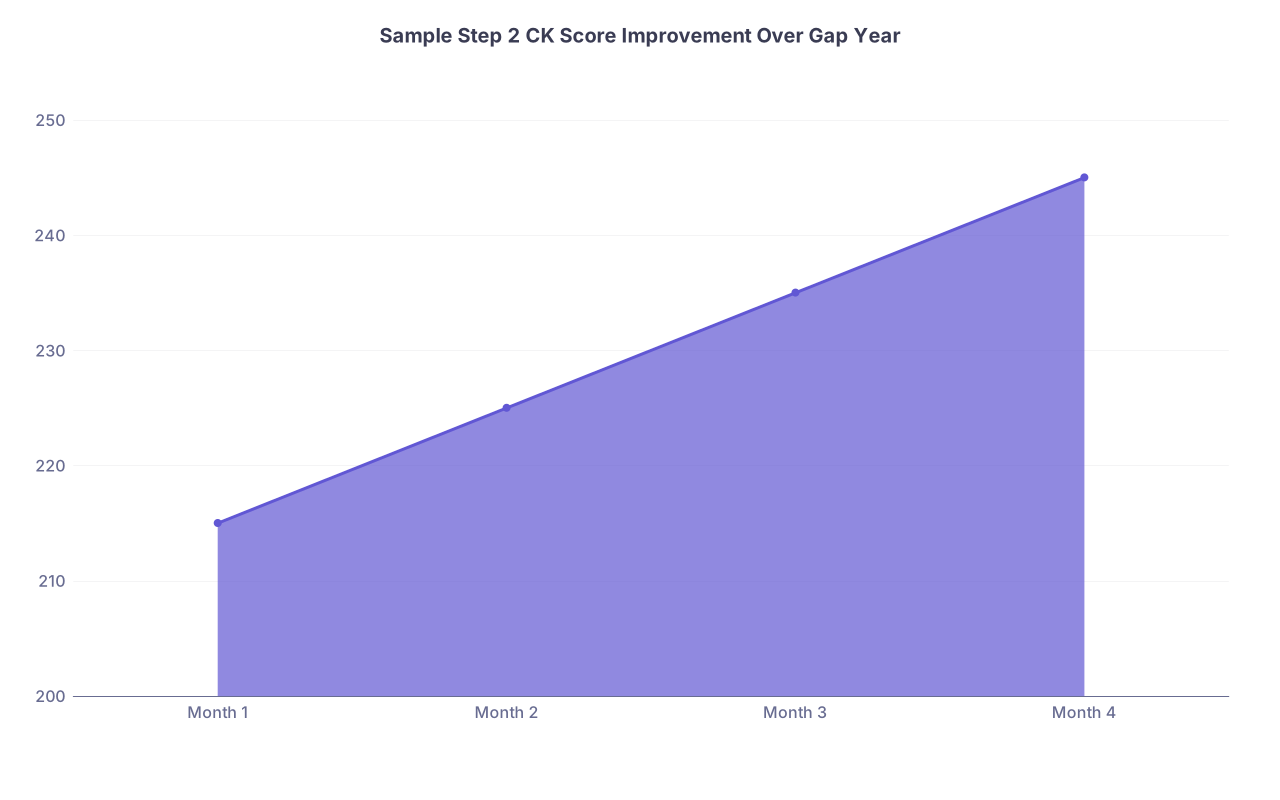
- Treat it like a rescue rope. You want a score that screams “trajectory up,” not “same problems.”
- Build a tight study schedule around your work:
- 2–3 blocks of UWORLD per day.
- Anki or equivalent 5–6 days a week.
- NBME practice exams every 2–3 weeks to track improvement.
| Category | Value |
|---|---|
| Month 1 | 215 |
| Month 2 | 225 |
| Month 3 | 235 |
| Month 4 | 245 |
If you have remaining fourth-year rotations or sub‑Is:
- Plan them after you have started your gap-year work, so you can use your improved habits immediately.
- Treat sub‑Is as an audition:
- Show up before interns.
- Pre-round like your life depends on it.
- Anticipate orders.
Ask your sub‑I attendings to:
- Comment on “readiness for internship”
- Compare you favorably to other students / early interns
Those evals become crucial supporting evidence that your MS3 performance was not your ceiling.
Step 7: Build a Simple, Disciplined Weekly System During Your Gap Year
Gap years drift. People start strong, then drift into “I am busy at work, that is enough.” It is not.
You need a lightweight system that keeps you honest.
Weekly checklist (keep it on a one-page doc):
- Showed up early to every shift / meeting
- Asked for and wrote down at least one piece of constructive feedback
- Documented one concrete example of responsibility I handled well
- Spent X hours on Step 2 / boards study (if applicable)
- Touched my application planning (ERAS, CV, personal statement) at least once
- Checked in with at least one mentor / advisor this week
Print it. Stick it next to your desk. Start each week by filling in the dates. End the week by checking what you actually did.
This is not about being “organized.” It is about building the habits you will need as an intern and having proof that you did.
Step 8: Prepare to Talk About Your Gap Year in Interviews Like an Adult
If your MS3 record is weak and you took a gap year, you should expect versions of this question:
- “Tell me about your third-year performance.”
- “I see some concerning comments in your MSPE. What was going on then?”
- “What have you done in your gap year to address these issues?”
Here is a simple 3-part script structure that works.
Own it.
“I struggled with [specific issue: time management / communication / professionalism] during my third year. At the time, I did not fully appreciate how quickly I needed to adapt to the inpatient environment.”
Describe concrete change.
“In my gap year, working as a [role] on [service], I have been responsible for [specific tasks]. I made deliberate changes in how I organize my day—using checklists, setting alarms for follow-ups—and I asked for regular feedback from my supervisor about reliability and communication.”
Show outcome + reflection.
“As a result, I have consistently [example: handled 15–20 patients, never missed a shift, been asked to train new staff], and my supervisors have told me they see a very different level of dependability. I am actually grateful those MS3 challenges forced me to address these weaknesses before residency.”
You are not trying to sound perfect. You are trying to sound like someone who learns, adapts, and does not repeat mistakes.
Step 9: Match Your Specialty Choice to Reality, Not Ego
Some specialties are more forgiving of a rocky MS3 record. Others are brutal.
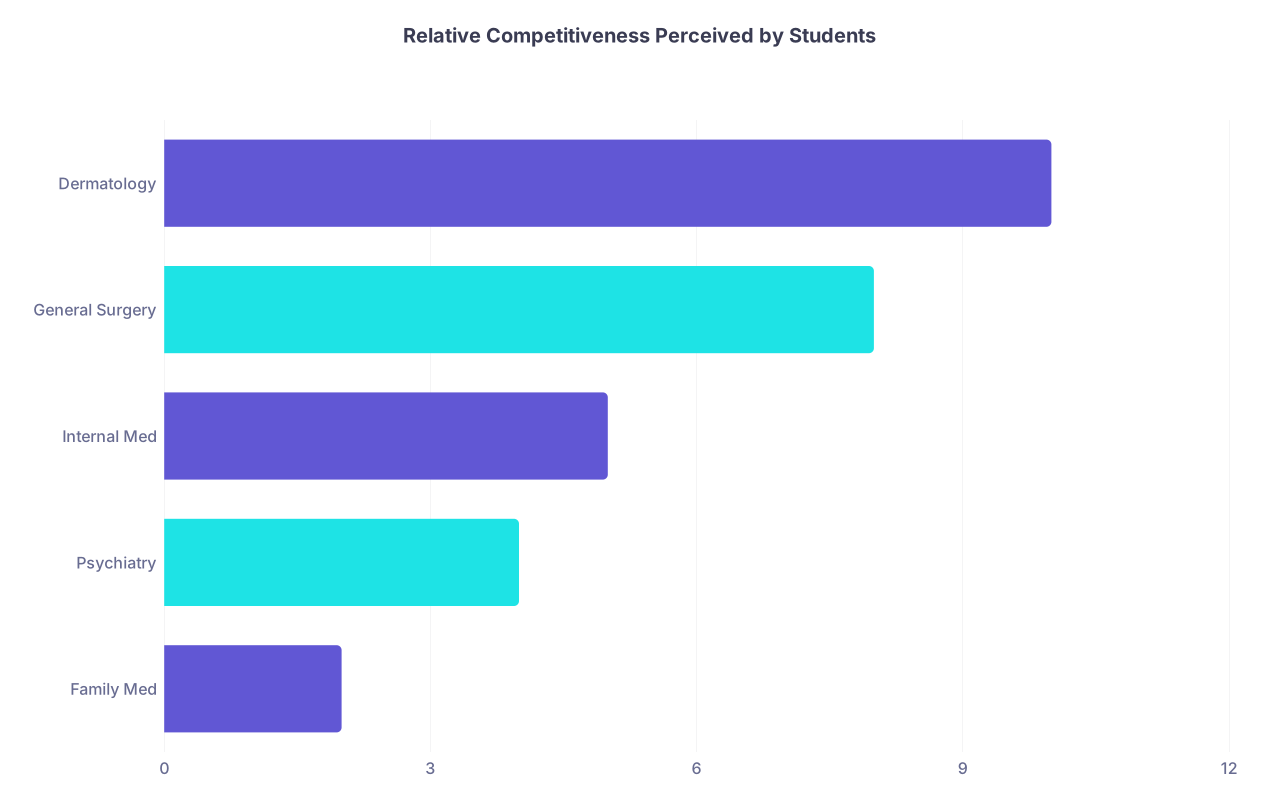
You might love dermatology with your whole heart. But if you have:
- Mediocre Step scores
- Weak MS3 evals
- No powerhouse research
…a one-year gap is not going to fix that. You need brutal honesty about competitiveness.
| Category | Value |
|---|---|
| Family Med | 2 |
| Psychiatry | 4 |
| Internal Med | 5 |
| General Surgery | 8 |
| Dermatology | 10 |
Use your gap year to:
- Talk to PDs and residents in your target field.
- Ask: “With my record, what would you realistically advise?”
- Be open to pivot:
- From surgical to medicine prelim + later EM/critical care
- From highly competitive to mid-range fields where your story of growth is enough
Trading a dream specialty for a satisfying, realistic career is smarter than chasing a brick wall for three application cycles.
Step 10: Timeline Your Year So It Feeds Directly Into Application Season
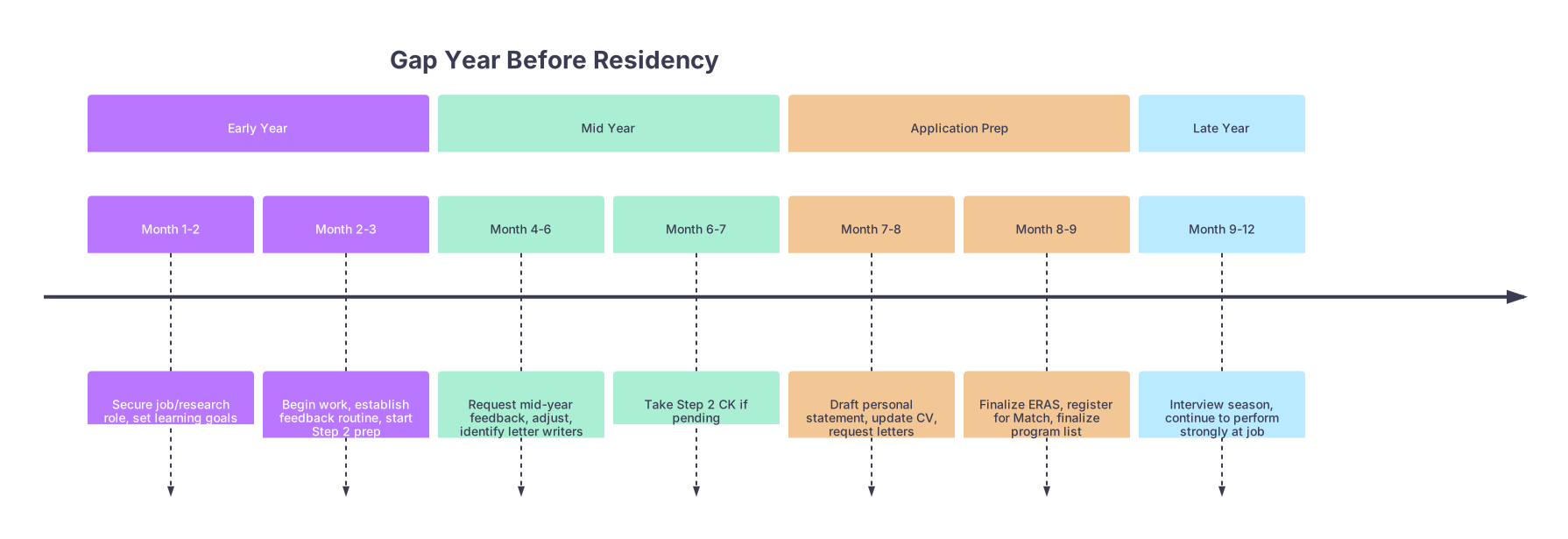
You cannot just “work for a year” and hope it magically shows up in ERAS. You need a deliberate timeline.
Use this rough template (adjust months to your reality):
| Period | Event |
|---|---|
| Early Year - Month 1-2 | Secure job/research role, set learning goals |
| Early Year - Month 2-3 | Begin work, establish feedback routine, start Step 2 prep |
| Mid Year - Month 4-6 | Request mid-year feedback, adjust, identify letter writers |
| Mid Year - Month 6-7 | Take Step 2 CK if pending |
| Application Prep - Month 7-8 | Draft personal statement, update CV, request letters |
| Application Prep - Month 8-9 | Finalize ERAS, register for Match, finalize program list |
| Late Year - Month 9-12 | Interview season, continue to perform strongly at job |
Key points:
- Letters requested by late summer so writers can submit before ERAS opens.
- Step 2 taken early enough that your improved score is on your initial application.
- Keep performing well at your gap-year job during interview season; PDs sometimes call your supervisors during the season.
What You Should Do Today
Do not “research gap years” for three weeks and call that progress. Here is your immediate next step:
- Open your MS3 evaluations and MSPE (or draft) right now.
- Write down the three most damaging phrases that appear about you. Exact quotes.
- Under each, write one concrete type of gap-year role that would let a supervisor truthfully write, “That is no longer the case.”
Then send one email today—to a potential job contact, a research mentor, or your dean—starting the process of getting into that role.
One honest look at your record and one deliberate email today can be the difference between a wasted gap year and a rebuilt application.


