

Low Step scores plus a gap year is not a death sentence. It is a project. Projects can be managed and fixed.
If you are sitting with a disappointing Step 1/Step 2 and staring at an unplanned gap year, you do not need pep talks. You need a battle plan that programs will respect.
Let me be very clear about your situation:
- Programs hate unknowns more than they hate low scores.
- A gap with no structure is worse than a single low exam.
- A weak application can become a strong one in 12–18 months if you treat this like a full‑time job, not a waiting period.
This article gives you exactly that: a concrete, month‑by‑month framework to rebuild your profile so that, when a PD sees “low Step + gap year,” their next thought is, “But look what they did about it.”
1. Get Real About Where You Stand (Week 1–2)
You cannot fix what you refuse to quantify.
Step 1: Inventory your application
Pull up your CV and ERAS draft. Score yourself—brutally—across five domains:
- Scores
- USMLE Step 1: pass / low / fail
- Step 2 CK: numeric score and date
- Any failures or repeats?
- Clinical performance
- Clerkship grades (Honors/HP/P)
- Any failed rotations?
- Letters of recommendation
- How many strong, specialty‑specific letters do you truly have?
- Research / scholarly work
- Publications, posters, QI projects, case reports
- Work/leadership/volunteering
- Longitudinal involvement vs. a pile of random short‑term things
Then label each area: strength, neutral, or liability.
Your low Step is already one liability. If you have three or four other “liabilities,” you need a more aggressive plan (research + formal role + retake, etc.). If everything else is solid, your gap strategy can be more focused and surgical.
| Domain | Status | Priority (1=highest) |
|---|---|---|
| Step Scores | Liability | 1 |
| Clinical | Neutral | 3 |
| LORs | Liability | 2 |
| Research | Neutral | 4 |
| Volunteering/Work | Strength | 5 |
Use a table like this and force yourself to assign priorities. Then build your year around fixing priority 1–3 first.
Step 2: Define your target specialty realistically
Harsh truth: some specialties will be extremely difficult with low scores and a gap, particularly if you do not have a home program or strong connections.
Roughly:
- Still viable with low scores + strong gap year:
- Internal medicine
- Family medicine
- Pediatrics
- Psychiatry
- Neurology
- Pathology
- Possible but uphill:
- General surgery
- OB/GYN
- EM (depending on region and SLOEs)
- Very difficult:
- Derm, Ortho, Plastics, ENT, NSGY, Rad Onc, Urology, Ophtho, IR
I am not saying “give up” on a competitive field. I am saying: plan like an adult. If you insist on a highly competitive specialty, your gap year cannot be casual. You will need:
- Multi‑author publications with that department
- Multiple aways / audition rotations
- Strong faculty champions making direct calls for you
If that type of heavy lift is not on the table, you adjust the target or expect to reapply more than once.
2. Choose a Gap Year Model That Actually Fixes Problems
A gap year that is “Netflix, random PRN MA job, and vague research volunteering” does not fix anything. You need structure.
There are four main gap‑year “archetypes” that work.
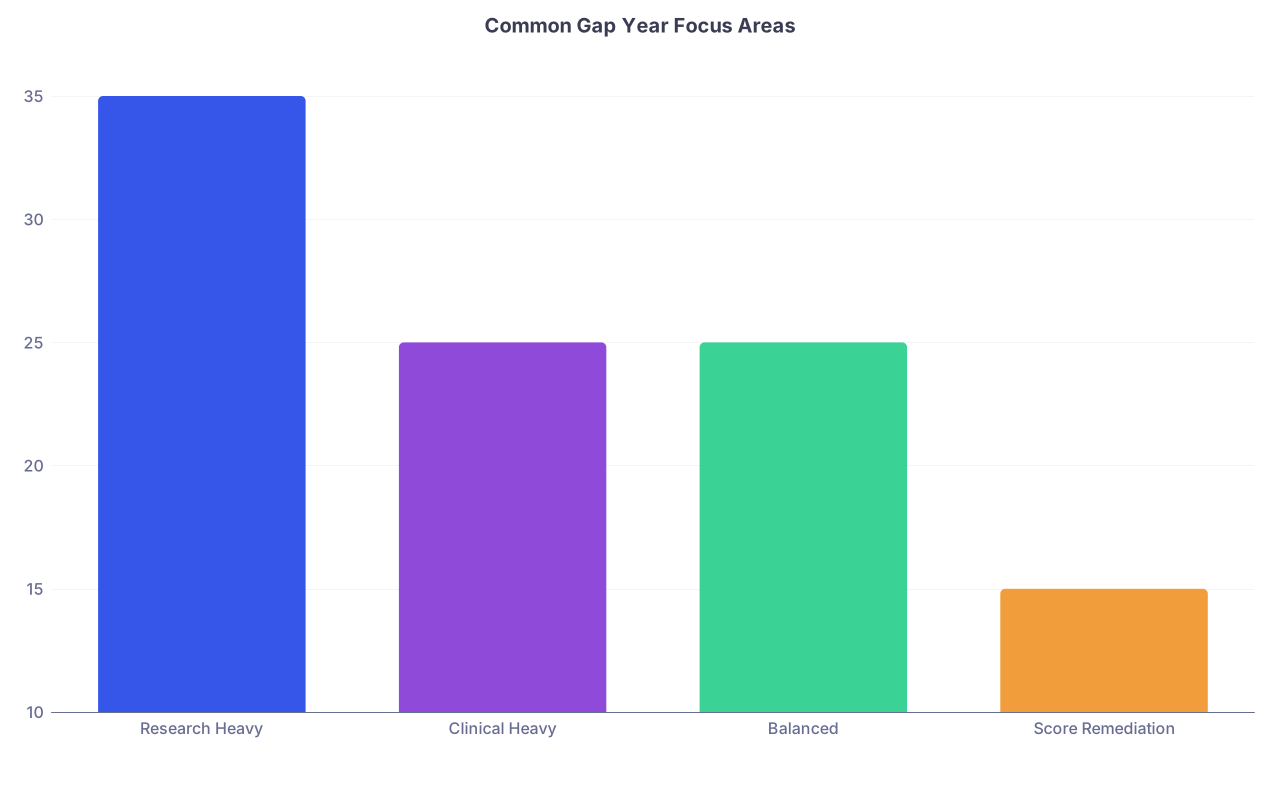
| Category | Value |
|---|---|
| Research Heavy | 35 |
| Clinical Heavy | 25 |
| Balanced | 25 |
| Score Remediation | 15 |
Model A: Research + Department Integration
Best for:
- Low Step but good clinicals
- Targeting academic programs or competitive specialties
Core elements:
- Title: Research fellow, research associate, postdoctoral fellow (for MD/PhD), clinical research coordinator.
- Location: Ideally at your target specialty’s department in your target region.
- Output goals (minimum):
- 1–2 first‑ or second‑author abstracts submitted
- 1–3 posters (regional / national meetings)
- 1 co‑authored manuscript submitted or in late draft
- Strong letter from research PI who knows your work well
Red flags to avoid:
- “Volunteer research” with no timeline, no assigned mentor, no clear expected outputs. That usually produces nothing.
Model B: Clinical‑Heavy + US System Immersion
Best for:
- IMG / FMG needing US clinical experience
- Applicants with weak clinical exposure or long time since graduation
- People without a home program who need department champions
Options:
- Paid roles:
- Clinical research coordinator with heavy patient contact
- Hospitalist scribe, ED scribe
- Clinical assistant / patient care tech (if feasible with your visa/degree)
- Unpaid but structured:
- Formal observerships with defined schedules
- “Prelim year” or non‑ACGME fellowship (if you can secure one)
Goal: accumulate sustained, meaningful clinical exposure in the U.S. system with supervisors willing to write specific letters: “They function like an intern. Reliable. Shows up early. Owns their patients.”
Model C: Balanced Clinical + Research + Teaching
Best for:
- Low Step but decent profile otherwise
- Applicants aiming for community programs that like well‑rounded people
- Those unsure if research or community‑heavy careers fit best
Example mix:
- 2–3 days/week: research assistant in your specialty
- 1–2 days/week: clinical role or observership
- 0.5–1 day/week: tutoring or teaching (USMLE/MCAT/med school courses)
Balanced is fine only if you avoid being mediocre at everything. You must still hit concrete deliverables: at least one tangible research product, at least one strong letter from a clinical supervisor.
Model D: Score Remediation + Limited Work
Best for:
- Step failure(s) on record
- Very low Step 2 CK in fields where that is lethal
- Students who have not actually fixed their test‑taking problem
If Step 2 or Step 3 is still ahead, this is serious business. Plan like you are training for a marathon, not squeezing in a weekly jog.
Structure:
- 20–30 hours/week dedicated study (yes, really)
- 10–20 hours/week part‑time research or clinical role
- Formal test prep support if you can afford it or access it:
- Dedicated USMLE course
- One‑on‑one tutoring for pattern recognition, timing, and question approach
- Regular self‑assessments with clear score targets
Mistake I see constantly: people “kind of” study while working 50+ hours and wonder why they plateau.
3. Build a 12‑Month Concrete Timeline
Here is the skeleton you should adapt. Assume you are taking one gap year and applying in the next cycle.
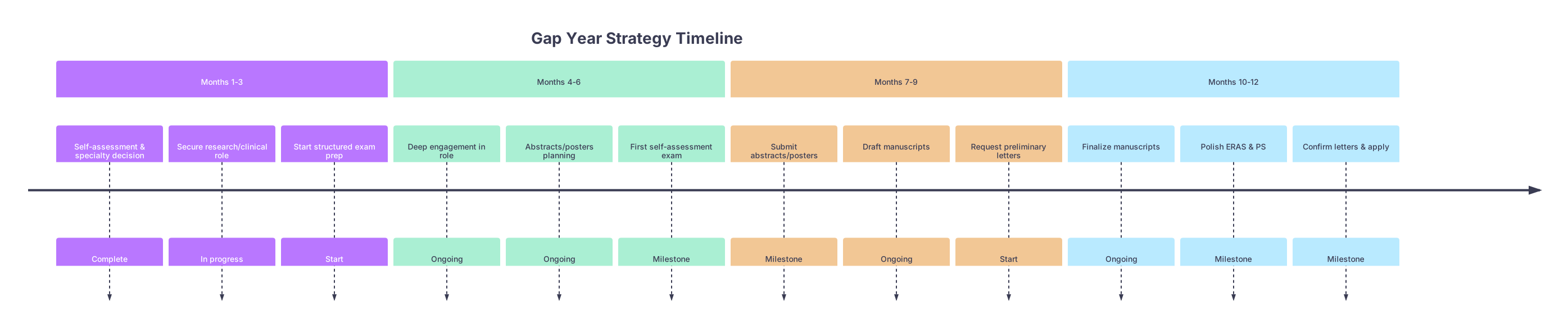
| Period | Event |
|---|---|
| Months 1-3 - Self-assessment & specialty decision | Complete |
| Months 1-3 - Secure research/clinical role | In progress |
| Months 1-3 - Start structured exam prep | Start |
| Months 4-6 - Deep engagement in role | Ongoing |
| Months 4-6 - Abstracts/posters planning | Ongoing |
| Months 4-6 - First self-assessment exam | Milestone |
| Months 7-9 - Submit abstracts/posters | Milestone |
| Months 7-9 - Draft manuscripts | Ongoing |
| Months 7-9 - Request preliminary letters | Start |
| Months 10-12 - Finalize manuscripts | Ongoing |
| Months 10-12 - Polish ERAS & PS | Milestone |
| Months 10-12 - Confirm letters & apply | Milestone |
Months 1–3: Stabilize and Commit
Your priorities:
Secure a primary role
- Research position, scribe role, observership, or a hybrid.
- Send 50–100 targeted emails if you have to. Faculty are busy; volume matters.
Clarify your exam plan
- If Step 2 or Step 3 is pending:
- Pick an exam date range (not a fantasy month—realistic target).
- Buy a single QBank and commit. UWorld, AMBOSS, or similar. No hopping between five resources.
- Schedule NBME self‑assessments every 4–6 weeks.
- If Step 2 or Step 3 is pending:
Have the “I had a low Step” conversation with a mentor
- Find one honest attending or senior resident in your field.
- Show them your scores, transcripts, and a rough plan.
- Ask them two things:
- “If you were me, what specialty and program tier would you realistically target?”
- “What could I do in the next 12 months that would make you comfortable advocating for me?”
Write down their answers. They will be more candid than any Reddit thread.
Months 4–6: Deep Work and Visible Progress
Now you are in the meat of the year.
Your non‑negotiables:
In your role:
- For research:
- Take ownership of 1–2 concrete projects: IRB submission, data collection, chart review, etc.
- Show up early. Anticipate. Send draft emails that make your PI’s life easier.
- For clinical:
- Learn the EMR shortcuts. Be the reliable one who does not disappear.
- For research:
Academically (if exam pending):
- 40–60 UWorld questions per day, reviewed properly.
- One NBME or equivalent every 4–6 weeks:
- Track your scores. If you are not improving by 8–10 points over 2–3 months, your approach is broken.
Start lining up letters
- Ask for feedback first, letter second:
- “Can you give me some feedback on how I am doing and what I can improve?”
- If they are positive and specific, follow up:
“Would you feel comfortable writing me a strong letter of recommendation for [specialty] when the time comes?”
- Ask for feedback first, letter second:
Months 7–9: Convert Work into Products and Letters
Three things matter here:
Tangible scholarly output
- Abstracts / posters:
- Target realistic meetings: regional ACP, specialty chapter meetings, hospital QI day.
- Do not chase ‘prestige’ at the cost of actually submitting something.
- Manuscripts:
- Aim for at least one case report or brief communication where you are first or second author.
- Set internal deadlines with your PI. They will not magically appear.
- Abstracts / posters:
Letters of recommendation
- Confirm your primary letter writers:
- 1–2 from your gap‑year supervisors (research PI, clinical supervisor)
- 1–2 from prior rotations / medical school who truly know you
- Provide a letter packet:
- Updated CV
- Draft personal statement
- Brief bullet list of projects / cases you worked on with them
- Your scores (yes, be transparent) and your specialty target
- Confirm your primary letter writers:
-
- Your story cannot be “I had low scores and then did some random stuff.”
- It needs to be:
- “I realized my gaps in [X, Y]. I took a structured year to address them by [A, B, C]. Here is what changed.”
Start drafting your personal statement and “gap year explanation” paragraph now. You will refine it repeatedly.
Months 10–12: Package and Apply
Here is where most people get lazy. You will not.
Your tasks:
Finalize all projects:
- Abstracts submitted?
- Posters accepted? Put them on your CV even as “accepted, upcoming.”
- Manuscripts at least submitted somewhere (even if “under review”).
Lock in letters:
- Confirm via ERAS that all letters have been uploaded.
- If someone is late, send one polite reminder. Then move on and adjust.
Polish ERAS:
- Experiences: emphasize impact not generic duties.
- Gap year entries should read like this:
- “Full‑time clinical research fellow in [specialty]; led [n] projects, co‑authored [n] abstracts, [n] manuscripts; weekly [x] hours in clinic with [attending name] observing and assisting in patient care.”
No vague “volunteered in clinic.” That sounds like fluff.
4. Fixing the Step Story: How to Talk About Low Scores
Programs are suspicious of two things:
- People who blame everyone else.
- People who pretend the low score never happened.
You need a short, direct, unemotional explanation with a clear arc of improvement.
Step failures or very low Step 1
If Step 2 is stronger, you lean hard on that.
Example framing (adjust to your reality):
- “I struggled with standardized exams early in medical school and underperformed on Step 1. I realized my preparation was overly focused on content memorization rather than timed questions and pattern recognition. I changed my approach for clinical clerkships and Step 2 CK: I used NBME‑style practice exams, daily UWorld blocks under timed conditions, and weekly review sessions with peers. This led to a [x]-point improvement on Step 2 CK. The gap year strengthened this further as I used the same disciplined approach to [research/clinical work], and my supervisors can speak to the reliability and organization I now bring to my work.”
Notice:
- Owns the problem.
- Describes a specific change in behavior.
- Shows a measurable different outcome.
- Connects the exam story to the rest of your professional behavior.
If Step 2 is also low
You do not have the luxury of pretending this is solved. You emphasize:
- Concrete remediation steps:
- Formal test prep course
- Tutoring or learning center involvement
- Neuropsych testing if there was an unrecognized learning issue
- Evidence you can handle complexity:
- Strong clinical evaluations
- Strong performance in demanding research / QI roles
- Any later exams (Step 3, in‑training exam) with improvement
You are telling programs: “Yes, my scores are a liability. Here is why that happened. Here is exactly what I have changed. Here is evidence that I function well in real clinical work.”
5. Making Programs Stop Worrying About the Gap Itself
Programs see three types of gaps:
- Structured, medically relevant, documented – Good
- Partially structured, somewhat related – Neutral
- Vague, unexplained, non‑medical – Red flag
You want to be firmly in category 1.
Design your gap year like a job, not a pause
Minimum expectations for a “respectable” gap year:
- 30–40 hours/week of clearly defined responsibilities
- At least one supervisor who:
- Meets you regularly
- Sees your work product
- Is willing to document your performance in a letter
Document everything:
- Keep a running log:
- Projects, tasks, data collection milestones
- Posters / abstracts with dates, authors, roles
- Teaching sessions you led or assisted with
When you write ERAS entries or answer in interviews, you should be able to say: “From July to June, I worked 40 hours per week as a research fellow in the cardiology department. I managed [n] patients’ data, coordinated [x] trials, produced [y] abstracts and [z] manuscripts, and spent one half‑day per week in clinic.”
Not: “I did some research and some observerships during my gap.”
What if you must work outside medicine?
Real life happens. Family responsibility. Financial need. Immigration nonsense. You might have to do non‑medical work.
If so:
- Be honest, but pair it with at least some structured medical engagement:
- 1 day/week clinic volunteering
- Weekend call research responsibilities
- Participation in a QI project
And frame it like this:
- “Due to [family financial responsibilities], I worked [job] full‑time during this year. To remain clinically engaged, I also [observed/worked] in [clinic/hospital] [x] hours per week and completed [research/QI] projects with [department]. My supervisors from that work can speak to my reliability and clinical engagement.”
Programs do not hate people with real‑world obligations. They hate unexplained absences.
6. Targeting the Right Programs and Crafting Your Application Strategy
You can do everything above perfectly and still crash if you apply stupidly.
Be strategic, not delusional, with your list
With low scores + gap, your program list should be:
- Broad geographically
- Heavy on community programs, newer programs, and mid‑tier academic centers
- Anchored by programs where you have real ties:
- Your med school / home institution
- Places you did research or observerships
- Regions where you have family or long‑term residence
| Program Type | % of List | Example Count (80 apps) |
|---|---|---|
| Top academic | 5–10% | 4–8 |
| Mid-tier academic | 20–30% | 16–24 |
| Strong community | 30–40% | 24–32 |
| Newer / smaller | 20–30% | 16–24 |
Yes, that is a lot of applications. You gave programs reasons to doubt you. Volume is part of the price.
Tailor your materials intelligently
You do not need a different personal statement for 80 programs. But you do need:
- 1 core personal statement tailored to your specialty, emphasizing:
- Growth
- Resilience
- Concrete improvements and outcomes
- 1–2 alternate versions for:
- Community‑focused programs (emphasize continuity, underserved care, long‑term relationships)
- Academic‑focused programs (emphasize research, teaching, QI)
If a program gave you a gap‑year opportunity (research, observership, employment), they go high on the rank list and they get a custom paragraph in your PS or a note in ERAS.
7. Day‑to‑Day Protocol: What Your Weeks Should Actually Look Like
Let me be very literal. A strong gap year does not “feel” like a vacation. It feels like residency lite.
Example week for a research‑heavy rebuild with pending Step 3:
Monday–Thursday
- 8:00–4:30 – Research office
- Morning: data collection, patient calls, EMR review
- Afternoon: meetings with PI, manuscript drafting, IRB paperwork
- 5:00–7:00 – Step 3 prep
- 40 questions + review
- 8:00–4:30 – Research office
Friday
- 8:00–2:00 – Clinic / rounding with attending
- 3:00–5:00 – Research admin work
- Evening – light review or off
Saturday
- 3–4 hours – Deep exam review or project writing
Sunday
- Off (seriously, you need one day)
Example week for a clinical‑heavy rebuild (scribing / clinical assistant) with Step exams done:
Monday–Friday
- 7:00–5:00 – Clinic / hospital work
- 5:30–6:30 – Reading / self‑study on common cases seen that day
- 1 evening – prepare presentation for team or journal club
Saturday
- 3–4 hours – Research / QI project work (data entry, literature review, poster prep)
This is what convinces letter writers to say: “They work like an intern already.”
8. The Non‑Negotiable Mindset Shift
You are not “on hold.” You are in active repair.
People who succeed after low Steps and a gap year have three things in common:
Radical ownership
- They stop telling the Step 1 sob story to everyone who will listen.
- They start talking about what they are building now.
Boring consistency
- They do not change their plan every week.
- They pick a path (research fellow, scribe + Step prep, etc.) and execute for months.
Relentless documentation
- They collect emails, evaluations, project logs, and proof of productivity.
- When it is time to write ERAS, they are not guessing what they did last November.
You are not trying to impress everyone. You are trying to convince a handful of program directors that:
- You know exactly where you fell short.
- You have already done the work to fix it.
- You will be one of the most reliable interns they have.
Key Takeaways
- Low Step scores plus a gap year is a fixable problem if you treat the year like a structured, full‑time job aimed at clear deliverables: better exam performance, concrete research/clinical output, and strong letters.
- Choose a focused gap‑year model (research‑heavy, clinical‑heavy, balanced, or score remediation), build a 12‑month timeline, and document everything so the gap reads as “professional growth,” not “aimless delay.”
- Own the low scores with a short, specific explanation, show measurable change, and apply broadly and strategically to programs where your rebuilt profile and new advocates actually give you a shot.


