

The biggest mistake people make in a gap year before residency is drifting instead of training. You are about to fix that.
You do not need a mentor to design a serious, structured gap year curriculum. Would a mentor help? Of course. But waiting around for one is how people burn 12 months and then wonder why their application still looks weak. You are going to act like your own program director and build a year that actually moves the needle on your Match prospects.
Below is a step‑by‑step system I have seen work for:
- Graduates who failed to match and needed a hard reset
- International grads with no U.S. connections
- People changing specialties who had to rebuild their narrative
Use it as a template. Adjust the knobs for your specialty and your reality.
Step 1: Define the Gap Year “Job Description”
Treat your gap year like a one‑year fellowship you are designing for yourself.
Your goal is not “stay productive.” Your goal is: “Finish the year obviously more competitive for residency X, with clear proof.”
Your curriculum must answer three questions clearly:
- What problem are you fixing in your application?
- What story will you tell about this year in your personal statement and interviews?
- What concrete outputs will you have by the end?
Start with a brutally honest audit.
1.1 Do a 1‑Hour Application Autopsy
Open your last ERAS application (or draft) and ask:
- Scores:
- Did you fail or barely pass any Steps?
- Do you lack Step 2 if your Step 1 was weak?
- Clinical:
- Any recent U.S. clinical experience?
- Any letters from people who actually know you? Or just “fine” generic ones?
- CV:
- Any research? Posters? QI projects?
- Any leadership or meaningful continuity work (more than a 2‑week volunteer event)?
- Narrative:
- Could someone read your personal statement and understand why this specialty and why now?
Rank your biggest deficits from 1–5. You are not allowed to pick all 5 as #1. Force a ranking.
Example ranking for someone who did not match IM:
- Weak letters / no strong advocates
- No recent U.S. clinical experience
- No research or scholarly output
- Step 2 is decent but late
- Little leadership or sustained activities
Your gap year curriculum will be built around your top two or three deficits. Everything else is secondary.
Step 2: Choose 3–4 Pillars for Your Year
You cannot do everything. You should not try. You want 3–4 main “pillars” that show up clearly on your CV and that you can talk about forever in interviews.
Think in categories:
| Pillar Type | Examples (Residency-Relevant) |
|---|---|
| Clinical Experience | Observerships, externships, hospitalist assistant, scribe |
| Exam / Knowledge | Step 2/3 prep, specialty board basics, key textbooks |
| Research / Scholarly | Retrospective studies, QI projects, case reports, systematic reviews |
| Teaching / Leadership | Tutoring, small-group teaching, curriculum development, project lead |
| Service / Continuity | Free clinic, long-term volunteering, telehealth triage |
Pick one primary pillar and 2–3 secondary pillars.
Example for someone reapplying to Internal Medicine:
- Primary: Clinical – 20–30 hours/week of U.S. inpatient or outpatient experience
- Secondary: Research – 10–15 hours/week on 1–2 realistic projects
- Secondary: Exam – Focused Step 3 prep (if IM and Step 2 already done)
For Psych:
- Primary: Clinical in psych settings (inpatient unit, IOP, community clinic)
- Secondary: Longitudinal psychotherapy-related volunteering or hotline work
- Secondary: One psych‑relevant research or quality improvement project
Commit these pillars in writing. This is your “fellowship description.”
Step 3: Turn Your Year into a Quarterly Syllabus
You need structure. You will not magically “stay productive” for 12 months without it. You build it like a syllabus.
Break the year into four quarters of roughly 3 months each.
3.1 Example High‑Level Quarterly Plan
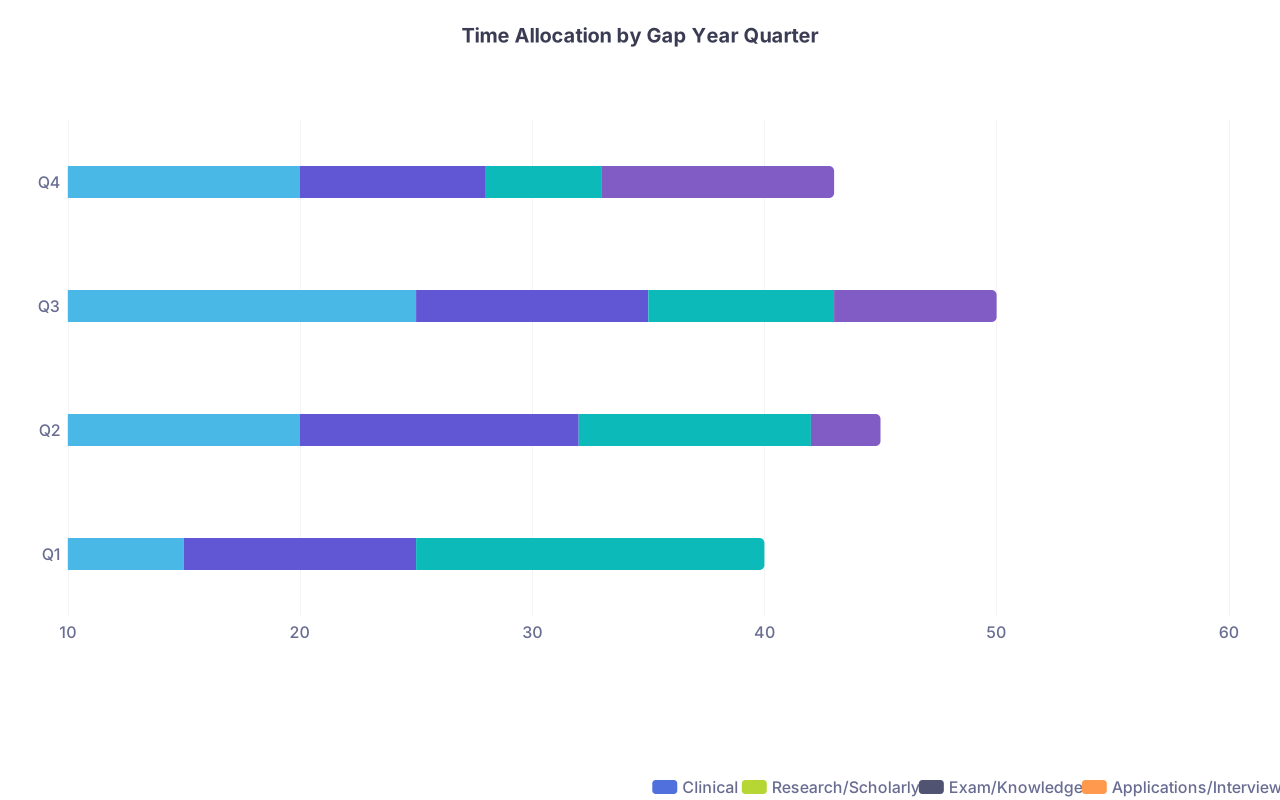
| Category | Clinical | Research/Scholarly | Exam/Knowledge | Applications/Interviews |
|---|---|---|---|---|
| Q1 | 15 | 10 | 15 | 0 |
| Q2 | 20 | 12 | 10 | 3 |
| Q3 | 25 | 10 | 8 | 7 |
| Q4 | 20 | 8 | 5 | 10 |
Interpretation (hours/week):
- Q1: Build foundation – exams + start clinical + set research up
- Q2: Ramping – heavier clinical, research moving, start drafting ERAS
- Q3: Peak – strong clinical + finalizing products + applications and interviews
- Q4: Maintain – keep your hands in clinical and research, maximize interview performance
Now convert this into something concrete.
3.2 Example Weekly Template (No Mentor Required)
Assume you are not working full‑time for income. If you are, we will adjust later.
Target 40–50 structured hours per week:
- 20–25 hrs: Clinical (observership/externship/scribe/assistant role)
- 10–15 hrs: Research / scholarly work
- 5–10 hrs: Exam prep / reading / board‑style questions
- 2–5 hrs: ERAS / personal statement / residency targeting
Block your week like this:
- Mon–Fri mornings: Clinical (e.g., 8:00–13:00)
- Mon/Wed/Fri afternoons: Research (2–3 hours)
- Tue/Thu afternoons: Exam prep (2–3 hours)
- Sat: 3–4 hours catch‑up + long study block or writing
- Sun: Off or light reading / planning
You can tighten or loosen this, but the point is clear: calendar blocks, not vibes.
Step 4: Secure Clinical Experience Without a Mentor
This is where most people stall. They send three emails, get ignored, and conclude “there are no opportunities.” That is wrong.
You will be systematic.
4.1 Build a Simple Clinical Outreach List
You need a spreadsheet with:
- Institution / practice name
- Department or clinic type
- Contact person (if you can find one)
- Email / phone
- Type of opportunity you are asking for (observer / volunteer / scribe / assistant)
- Date contacted and response
Target options:
- Community hospitals (less bureaucracy than big academic centers)
- Hospitalist groups
- FQHCs and community health centers
- Private practices in your specialty (outpatient IM, FM, psych, etc.)
- Telehealth groups (for research/QA, not direct care)
You are aiming for dozens of contacts, not five.
4.2 Use a Tight, Professional Email Template
Subject line matters. Keep it boring and clear:
- “Observer request – [Your Name], MD”
- “Prospective volunteer – gap year prior to residency”
Email skeleton:
- Who you are (degree, grad year, location)
- What you are doing (gap year prior to residency in X)
- What you are asking for (specific type of exposure)
- What you offer (reliability, schedule, any language skills, EHR familiarity)
- Attach: CV + short 1‑paragraph “mini‑PS” in the body, not as a separate doc
Then you follow up once in 7–10 days. If silence, move on. Do not obsess over any single site.
4.3 If You Truly Cannot Find Clinical
Then you shift harder into:
- Remote chart review or outcomes research with hospital groups
- Free clinics, even if not your exact specialty
- Strong simulation/skills plus knowledge work (e.g., ultrasound courses, ACLS/BLS, basic procedure workshops if available)
You still structure it. “Clinical” can be broad: patient‑facing, system‑facing, or data‑facing.
Step 5: Build a Self‑Directed Research Track
No mentor? Fine. You still need scholarly output. You will use two strategies:
- Plug yourself into somebody else’s pipeline
- Design tiny, realistic projects you can control
5.1 Plug Into Existing Projects
Places to look:
- Department websites listing ongoing studies – find study coordinators, not just PIs
- Hospital QI departments – they always have unfinished documentation projects
- Large multi‑specialty groups that track outcomes and love free help
Your email angle is simple: “I can help with data extraction, chart review, literature review, and drafting subsections of manuscripts. I am not asking for immediate authorship; I want to contribute and earn it.”
Be the person who actually does what they promise. That alone puts you in the top 10%.
5.2 Design Micro‑Projects You Control
If you cannot get plugged into a big project, design minimalistic ones.
Examples:
- Case reports: One interesting admission, well written, submitted to a lower‑tier but peer‑reviewed journal
- Case series: “Ten consecutive patients with X” in a specific setting
- Retrospective chart review: 100–300 patients on some common problem with a simple question
Set clear, small milestones:
- Week 1–2: Define research question, confirm it is not already overdone, outline methods
- Week 3–4: IRB / ethics or exempt determination if needed
- Week 5–8: Data collection
- Week 9–12: Analysis (basic stats are fine if question is tight)
- Week 13–16: Draft manuscript or abstract
Do not aim for NEJM. Aim for something real that you finish.
Step 6: Knowledge and Exam Curriculum
If your exams are a weakness, your year must include a disciplined plan around them. No mentor needed. Just structure and honesty.
6.1 Decide Your Exam Target
Common realistic targets:
- Step 2 CK: If not taken or low score and you are still eligible
- Step 3: For IM/FM/Psych reapplicants, particularly IMGs
- Specialty‑adjacent content: e.g., MKSAP for IM, PREP for Peds, Anki decks, standard textbooks
Pick a realistic exam date in the first half of your gap year if possible. You want your score in hand before interview season.
6.2 Build a 12–16 Week Study Block
Basic structure:
- 5–6 days per week
- 40–60 questions per day from one major Qbank
- Weekly full‑length blocks (e.g., 2–3 blocks back‑to‑back)
- One half day per week to review errors in depth
Do not spread across five resources. One Qbank + one central text / notes set is enough.
For non‑exam knowledge:
- Assign yourself “blocks” like you would in residency:
- 2 weeks: Cardiology core topics
- 2 weeks: Pulmonary
- 2 weeks: ID
- Use standard references (UpToDate, specialty texts) and create a one‑page summary for each topic.
This is not busywork. These become your personal “handbook” you can reference in interviews and on the wards.
Step 7: Build a No‑Mentor Accountability System
The reason people want mentors is not always for wisdom. It is for accountability. You can simulate that.
7.1 Weekly Review Ritual (Non‑Negotiable)
Pick a fixed time each week (Sunday afternoon, for example):
You review:
- Planned vs. actual hours in each pillar
- Concrete outputs: patients seen, pages read, questions completed, data points collected
- One thing that went well, one thing that was a waste of time
Then you rewrite your next week’s plan in your calendar. Not in your head.
7.2 Self‑Imposed Deliverables Every 4–6 Weeks
You must have deadlines. Examples:
- End of Month 1: Draft of revised CV
- End of Month 2: Completed literature review for your main project
- End of Month 3: Completed first manuscript draft or abstract
- End of Month 4: Draft 1 of personal statement
- End of Month 6: Finalized clinical letter requests (with talking points you provide to letter writers)
You should be constantly moving paper forward, not just “learning” in some vague way.
Step 8: Turn People You Meet Into De‑Facto Mentors
You said you have no mentor. Understood. That does not mean you keep it that way.
You are not looking for a “career parent.” You are looking for adults in the system who:
- See you work consistently
- Can answer one or two questions a month
- Might eventually write you a letter
8.1 Use the “Micro‑Ask” Technique
Residents, fellows, attendings hate vague, heavy asks like “Can you mentor me?” But most will agree to:
- “Can I email you 2–3 questions once a month about my application plan?”
- “Would it be alright if I send you an updated CV and ask if there are any obvious gaps?”
- “Could you take a quick look at my personal statement at some point?”
You keep your asks small and specific. If they respond well and repeatedly, that is your de‑facto mentor. If not, move on without drama.
8.2 Document Your Work for Them
You make it easy for someone to advocate for you. Keep a one‑page “brag sheet”:
- Key activities this year
- Concrete outcomes (papers, abstracts, exam scores, roles)
- Short bullets about what you did in their clinic / project
When you eventually ask for a letter, you send this. People remember effort, not vague “hard work.”
Step 9: Align Everything With the Match Timeline
Your gap year is not an abstract 12‑month growth journey. It is attached to an application cycle with deadlines. If you ignore this, you will waste good work.
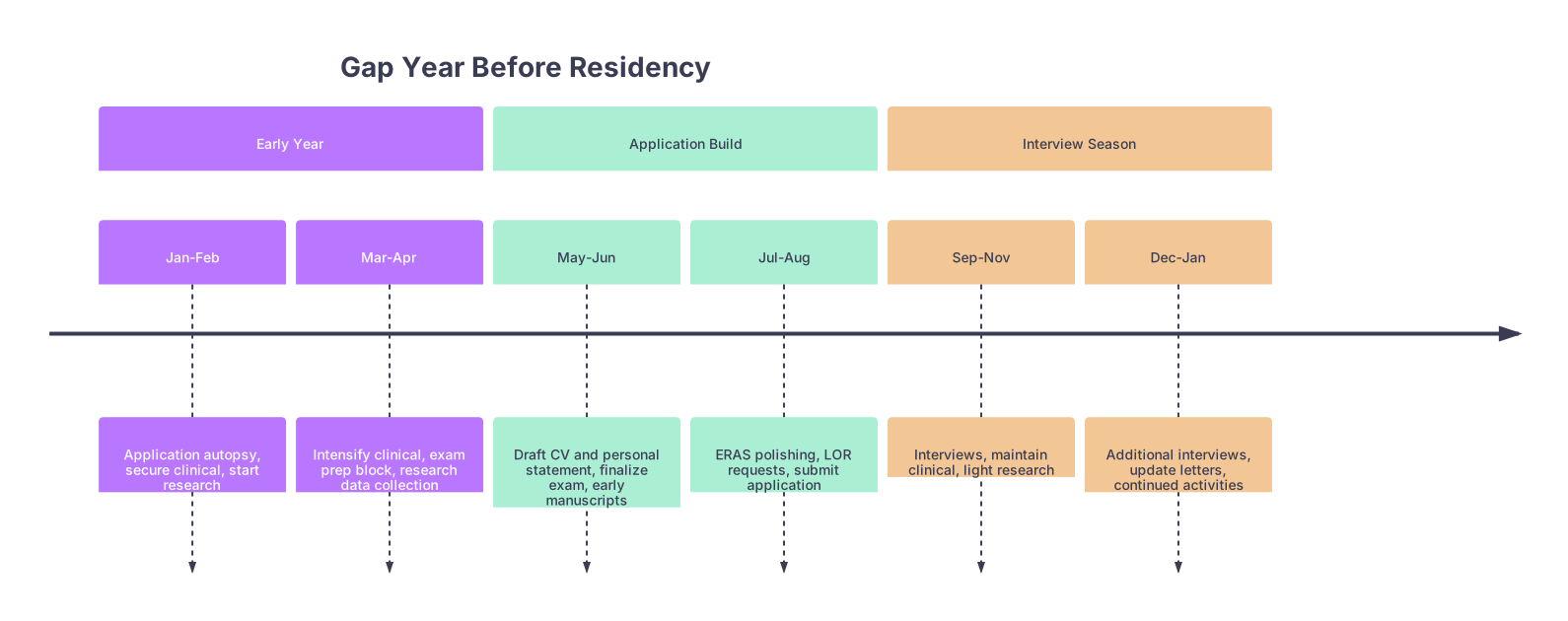
9.1 Visualize the Timeline
| Period | Event |
|---|---|
| Early Year - Jan-Feb | Application autopsy, secure clinical, start research |
| Early Year - Mar-Apr | Intensify clinical, exam prep block, research data collection |
| Application Build - May-Jun | Draft CV and personal statement, finalize exam, early manuscripts |
| Application Build - Jul-Aug | ERAS polishing, LOR requests, submit application |
| Interview Season - Sep-Nov | Interviews, maintain clinical, light research |
| Interview Season - Dec-Jan | Additional interviews, update letters, continued activities |
Your curriculum should be front‑loaded:
- Heavy exam prep and research early
- ERAS/personal statement tightening by late spring / early summer
- During interviews: maintain some structured activity so you do not go “dead” clinically
Programs like to see that you did not disappear during interview season.
Step 10: Income, Burnout, and Reality Checks
Not everyone can treat a gap year like an unpaid fellowship. Maybe you need money. Maybe you have family obligations. So you adapt without blowing up the structure.
10.1 If You Need a Job
Prefer jobs that are:
- Clinical‑adjacent: scribe, medical assistant, research coordinator, telehealth support
- Predictable schedule: 32–40 hours/week that leave some early mornings/evenings for structured activities
- In or near your target specialty if possible
Then you shrink but do not delete your pillars:
- 30–40 hrs: Paid work (counts as clinical or research pillar if relevant)
- 5–8 hrs: Exam/knowledge per week
- 3–5 hrs: Additional research or scholarly work
- 2 hrs: ERAS / writing / outreach
Even at 10–15 non‑work hours per week, if they are structured, you can get meaningful output.
10.2 Burnout Safeguards
You are not a machine. But you also do not need a spa year.
Bare minimum rules:
- One real day off per week (no Qbank, no data entry, nothing)
- Sleep 6–8 hours; if you are regularly below 6, your productivity is fake
- A 2–3 day “reset” every 2–3 months to clear your head and reassess your plan
If you find yourself doom‑scrolling and calling it “rest” for more than an hour a day, that is not rest. It is avoidance. Fix your schedule, do not give yourself a character diagnosis.
Step 11: How to Know if Your Curriculum Is Actually Working
You need feedback loops that do not depend on a mentor.
Ask yourself every 6–8 weeks:
- Can I describe, in two sentences, what I am doing this year and why it makes me a better candidate for [specialty]?
- Have I created at least one tangible output: abstract, poster, submitted paper, exam booked/taken, new letter secured?
- If a program director scanned my CV for 30 seconds, would they clearly see:
- Recent clinical exposure
- Evidence of effort beyond the minimum
- Some sign of reliability (longitudinal anything)
If the answer is “no” three cycles in a row, your “curriculum” is just activity, not training. Cut what is not producing outputs and double down on what is.
Quick Recap: What You Actually Need to Do
Strip all the theory away, and your no‑mentor gap year curriculum boils down to:
- Define the problem you are fixing (weak scores, no clinical, no research, vague story).
- Pick 3–4 pillars and write out a quarterly and weekly plan. On paper. With hours.
- Secure some form of clinical and some form of scholarly work, even if both are modest.
- Schedule exam/knowledge time like a real course, not “when I have energy.”
- Create self‑accountability with weekly reviews and 4–6 week deliverables.
- Convert supervisors into de‑facto mentors with micro‑asks and clear documentation of your work.
- Align everything to the application calendar so your efforts show up in ERAS, not just in your journal.
You do not need a mentor to start. You need a plan, a calendar, and the discipline to treat this year like the most important job you have ever had. Because for your residency future, it is.


