

It is 10:59 a.m. on Match Day. Your heart is pounding. At 11:00, you refresh your email and see it:
“We are sorry to inform you that you did not match to any position.”
Your stomach drops. You read it again, hoping you misread. You did not. Suddenly you are not thinking about residency, you are thinking:
What do I do now?
How do I explain this to my family?
Am I done?
You are not done. But you do need a real plan. Not “I’ll just try again and hope it goes better.” That is how people repeat the same mistakes and do not match a second time.
Let me walk you through a concrete, step-by-step gap year recovery plan aimed at one thing: turning “didn’t match” into “matched, and stronger” next cycle.
We are going to treat this like a quality improvement project on your career. Root cause analysis. Targeted interventions. Measurable milestones.
Step 1: Stabilize the First 7–10 Days
You cannot rebuild your application from a place of panic. The first week after an unmatched result is about:
- Containing emotional damage
- Getting key information
- Preserving future options
1. Immediate damage control (days 1–3)
Do this first.
Tell your key people directly
- Your family / partner
- Your medical school advisor
- Your research mentor (if you have one)
A simple script works:
“I did not match this cycle. I am disappointed, but I plan to reapply. I would like your help reviewing what went wrong and what I should do over the next year.”
If SOAP is still ongoing – decide fast
- If you are in the US: SOAP is your one-shot emergency option.
- If any SOAP-eligible spots fit your minimum standards for safety and future options, you submit.
- Do not obsess about prestige during SOAP. Focus on:
- Getting any categorical position in your chosen field
- Or a prelim/TY year that keeps you in the system
- If SOAP is over, skip this. Move on.
Get your documents in one place
Make a folder (cloud-based, not just your laptop) with:- ERAS application PDF from this cycle
- CV (latest version)
- Personal statement(s) used
- Program list you applied to (with notes if you have them)
- Score reports, transcripts
We will dissect all this later. Right now, just collect.
2. Book your “post-mortem” meetings (days 3–7)
You need brutally honest feedback, not vague sympathy.
Schedule:
- 1–2 meetings with faculty who know you well
- A meeting with your Dean’s office / career advisor
- If possible, a conversation with a program director who interviewed you (or your home PD in that specialty)
Ask them directly:
- “If you were on a rank committee, what would keep you from ranking me?”
- “Was I aiming at the wrong tier of programs?”
- “If I change nothing, do you think I am likely to match next year?”
You are not looking for comfort. You are looking for causes.
Step 2: Diagnose Why You Didn’t Match – With Precision
People love to blame “bad luck.” Sometimes that is true. More often, it is lazy thinking.
Your job is to turn “I didn’t match” into:
“I applied to 110 programs in internal medicine with a 209 Step 2, late ERAS, very weak letters, and generic personal statements. I got 6 interviews. I ranked 6. Statistically, my unmatched risk was high. I need to fix A, B, and C.”
The five main failure categories
Almost every unmatched story falls into one or more of these buckets:
- Insufficient interviews
- Weak academic metrics
- Red flags
- Poor program targeting / strategy
- Weak presentation (letters, PS, interviews)
Let us break this down.
| Pattern | Main Issue | Primary Fix During Gap Year |
|---|---|---|
| 0–3 interviews | Application not competitive / misaligned | Improve metrics + broaden program list |
| 4–8 interviews, no rankable offers | Interview skills / fit concerns | Intensive interview coaching + honest feedback |
| Good scores, no interviews | Poor letters / PS / targeting | Replace letters, rewrite PS, retarget programs |
| Mid-200s scores, competitive specialty | Overreached specialty choice | Consider backup specialty or 2-specialty strategy |
| Significant gap / fail / professionalism concern | Red flag | Directly address with remediation and strong narrative |
1. Count your interviews and outcomes
Look at the hard numbers:
- How many applications did you send?
- How many interview invites did you get?
- How many interviews did you attend?
Here is the brutal rule of thumb:
- 0–3 interviews: This is an application strength / screening problem. Programs are rejecting you on paper.
- 4–8 interviews, unmatched: You may have borderline credentials plus interview or letters problems.
- 9+ interviews, unmatched: Something is very off: interview performance, letters, or a serious red flag.
If you got 1–2 interviews in a hyper-competitive specialty (derm, ortho, plastics) and have mid-tier scores and minimal research, the diagnosis is obvious: you aimed wrong. That is fixable, but it might require rethinking your specialty strategy.
2. Audit your metrics realistically
Be honest where you sit:
USMLE / COMLEX scores
- Below average Step 2/Level 2? You cannot pretend this is fine, especially in competitive fields.
- Any fails? That is a red flag that requires direct addressing and compensatory strengths.
Grades / Class rank / AOA
- Lots of low marks in core rotations?
- No honor/high pass in the specialty you applied to?
Research (for research-heavy specialties: derm, rad onc, neurosurg, plastics, ENT, ophtho, some IM subspecialty pathways)
- No publications or projects in the field? That hurts more than most applicants admit.
You are not trying to feel bad. You are building a problem list just like a patient chart.
Problem list goes on a piece of paper. Literally write it out.
Step 3: Build a Gap Year Strategy That Actually Changes Your Odds
The gap year is not a “pause button.” Done right, it is an aggressive rehab program.
You are choosing one of three main tracks (sometimes blended):
- Research-heavy track – for competitive specialties or low scholarly output
- Clinical work / hands-on track – for weaker clinical CV, gaps, or need for new letters
- Hybrid + strategic pivot – for those who may need to change specialty or create a credible backup
Let us compare them cleanly.
| Track | Best For | Core Activities |
|---|---|---|
| Research-heavy | Competitive specialties, low research | Full-time research fellowship, abstracts, manuscripts |
| Clinical work | Need fresh letters, clinical gaps | Hospitalist scribe, clinical instructor, non-ACGME fellow |
| Hybrid / Pivot | Considering specialty change, multiple weaknesses | Part-time research + part-time clinical + intensive prep |
Track 1: Research-heavy Gap Year
Who this fits:
- You applied to derm, ortho, plastics, ENT, neurosurg, IR, rad onc, etc.
- Your research was thin or non-existent.
- You are committed enough to the field to grind for a year.
What it looks like:
- Full-time research fellowship in your specialty (ideal)
- Or a paid/unpaid research coordinator role with strong mentorship
- Aggressive focus on:
- Abstracts at national meetings (e.g., AAD, AAOS, RSNA, etc.)
- Manuscripts (even case reports and small series count)
- Becoming “the person who always gets things done” on the team
How to get it:
- Email 20–50 faculty in your specialty at various institutions. Yes, that many.
- Subject: “Prospective Research Fellow – [Specialty], Unmatched Applicant Seeking Position”
- Attach: CV + short paragraph on your situation + what you are willing to do (full-time, 1-year commitment).
- Look for structured positions:
- “Dermatology research fellowship”
- “Orthopaedic clinical research fellow”
- “Transplant surgery research fellow”
Programs know exactly why unmatched applicants reach out. This is not a secret. The good ones respect those who handle it head-on.
Track 2: Clinical / Hands-On Gap Year
Who this fits:
- You had weak letters, limited US clinical experience, or a long gap in clinical work.
- You are an IMG / FMG needing stronger US-based clinical anchors.
- Your research is “fine,” but people have doubts about your clinical performance or reliability.
Options that actually help:
- Non-ACGME fellowships (e.g., research + clinical fellow in cardiology, stroke, etc.) where you see patients under supervision.
- Full-time clinical roles:
- Hospitalist team scribe with one attending who will actually know your work
- Clinical instructor roles (more common in some systems)
- For IMGs: paid positions in affiliated clinics, if available, or structured observerships that lead to strong letters
Minimum bar:
By the time you reapply, you want:
- At least 2 new, strong letters from this year
- Clear documentation that you have been clinically active, not idle
- Someone in the US system willing to call a PD and say: “This person will work hard and not make me regret this.”
This track is particularly important if you have any perceived professionalism concerns, “not a team player” comments, or inconsistent performance.
Track 3: Hybrid + Strategic Pivot
Sometimes the real answer is this: your specialty choice was misaligned with your application.
Example patterns I see often:
- 220–230 Step 2, moderate research, average letters, applying to orthopedics at 60 programs and nothing else.
- Average metrics, zero research, applying to dermatology only.
- Non-US IMG with limited US experience, aiming exclusively for university neurology or radiology.
You can absolutely still pursue your dream field. But you may need a two-path strategy:
- Build a strong parallel application for a more attainable specialty (IM, FM, psych, peds, neurology in some cases)
- While making your dream specialty application as strong as possible.
Hybrid gap year for this person:
- Part-time research in their dream field
- Part-time clinical work or coursework that clearly supports a parallel specialty
- Honest conversations with mentors in both specialties
If everyone serious in your dream field tells you: “Your chances are extremely low, even after a research year,” you have to decide whether you are willing to bet another full year and possible second unmatched outcome. Sometimes the right move is to pivot early and build a strong identity in the new field now.
Step 4: Fix the Core Weaknesses One by One
Let us be methodical. Assume you have a 10–12 month gap year. Here is how you use it.
A. Academic metrics (scores, fails, transcripts)
You cannot retake Step 2 just because you do not like the number. But you can:
Crush Step 3 / Level 3
For US grads or IMGs who are eligible:- Take Step 3 during your gap year and aim for a clearly higher performance than Step 2.
- This signals upward trajectory and reassures PDs: “This person will probably pass boards.”
Own your fail / low score in your narrative
- Short, direct paragraph in your PS or an addendum:
- “I failed Step 1 on my first attempt due to poor planning and test-taking strategy. I changed my approach, sought help from [X], and passed on my second attempt. Since then, I have [clinical performance, Step 2 performance, etc.].”
- Then back it up with excellent performance elsewhere.
- Short, direct paragraph in your PS or an addendum:
If your academic metrics are far below the usual range for your dream specialty, that is not a narrative problem. It is a strategy problem. You probably need to expand specialties, not just add paragraphs.
B. Letters of recommendation
Weak or lukewarm letters kill more applications than people realize.
During this gap year, your goal is:
- Replace at least half of your letters with:
- People who know your work deeply
- Can compare you favorably to peers
- Are respected in the specialty
How to engineer that:
- Choose a role where you work closely with 1–3 attendings.
- Tell them early:
- “I hope to reapply for residency this fall. If I work with you consistently and earn your trust, I would be grateful if you could consider writing a strong letter on my behalf.”
- Then behave like a senior resident trying to make partner:
- Early, reliable, over-prepared, pleasant to work with.
If you suspect a prior letter was actively harmful (e.g., very lukewarm, or from someone who did not like you), it is perfectly acceptable to not reuse it and replace with new ones. You do not have to announce that decision.
C. Personal statement and application narrative
Your old personal statement probably reads just like everyone else’s.
This time, your statement must answer two big, unspoken questions:
- Why should we believe in you after an unmatched year?
- Why you, specifically, for this specialty and this kind of program?
Concrete approach:
One short paragraph early that acknowledges the gap year head-on. Example:
- “After not matching in the 2025 cycle, I spent a dedicated year in [research/clinical role] at [institution]. Working under [mentor], I [specific contributions]. This experience reinforced my commitment to [specialty] and gave me the chance to strengthen the areas in which my application was previously weaker.”
Then spend the rest of the statement showing growth, not apologizing:
- Specific stories from your gap year where you took ownership
- Outcomes you affected (better workflow, published paper, quality project)
Loose rule: if your personal statement has more generic “I want to help people” language than specific “Here is what I did and learned this year” content, throw it out.
D. Interview skills
If you had 8–10 interviews and still did not match, I am suspicious of your interview performance or letters.
You fix that with reps and feedback, not by reading yet another list of “Top 50 Interview Questions.”
Do the following:
Record 3–4 mock interviews (video) with:
- A trusted faculty member
- A resident friend in the specialty
- Career services
Ask for unfiltered feedback:
- “If you were a PD, would you rank me?”
- “What would give you pause?”
- “Do I sound too rehearsed / too vague / too negative?”
Fix common errors:
- Rambling answers longer than 90 seconds
- Defensive explanations of failures
- No clear reason for that specialty or that program
- Lack of insight into your own weaknesses
Then schedule real conversations through your gap year:
- Any time you give a talk, treat it as interview practice.
- Any time a new attending asks: “So, what is your plan?” — answer like it is an interview.
Step 5: Rebuild Your Program List and Application Strategy
You will not do all this work just to send the same ERAS list again.
This next application cycle must be:
- Broader
- Smarter
- Less ego-driven
Right-sizing your target list
General guidance for a reapplicant:
- Primary care / less competitive fields (FM, psych, peds):
- 40–70 programs, more if you have multiple risk factors
- IM, OB/GYN, neurology, pathology:
- 60–100 programs depending on competitiveness and red flags
- Competitive specialties:
- Often 80–120+ programs, plus a credible backup plan
Use last year’s list as data:
- Where did you get interviews?
- Where did you get auto-rejects fast?
- Were you applying mostly to big-name university programs with low odds?
You should end up with a tiered list:
- ~20–30 “reach” programs
- ~40–60 realistic programs (based on past interview patterns for applicants like you)
- ~20–30 safety programs where your metrics and experiences are near the top of their usual pool
Geographic flexibility
If you applied only to the coasts last time because you “cannot live in the Midwest,” you made a strategic error.
This time:
- Add community and smaller university programs in regions that typically get fewer apps: Midwest, South, some rural areas.
- If you have real geographic constraints (family, immigration), explain them clearly but do not invent fake ones.
Timing and completeness
Non-negotiables this cycle:
- ERAS submitted on day 1 (with complete, polished content)
- Letters uploaded early (do not let them dribble in late October).
- Personal statements and CV reviewed by at least two people who will tell you the truth, not your nicest friend.
Step 6: Month-by-Month Gap Year Timeline
Let us put structure on this. Assume Match Day just passed and you are starting your gap year now.
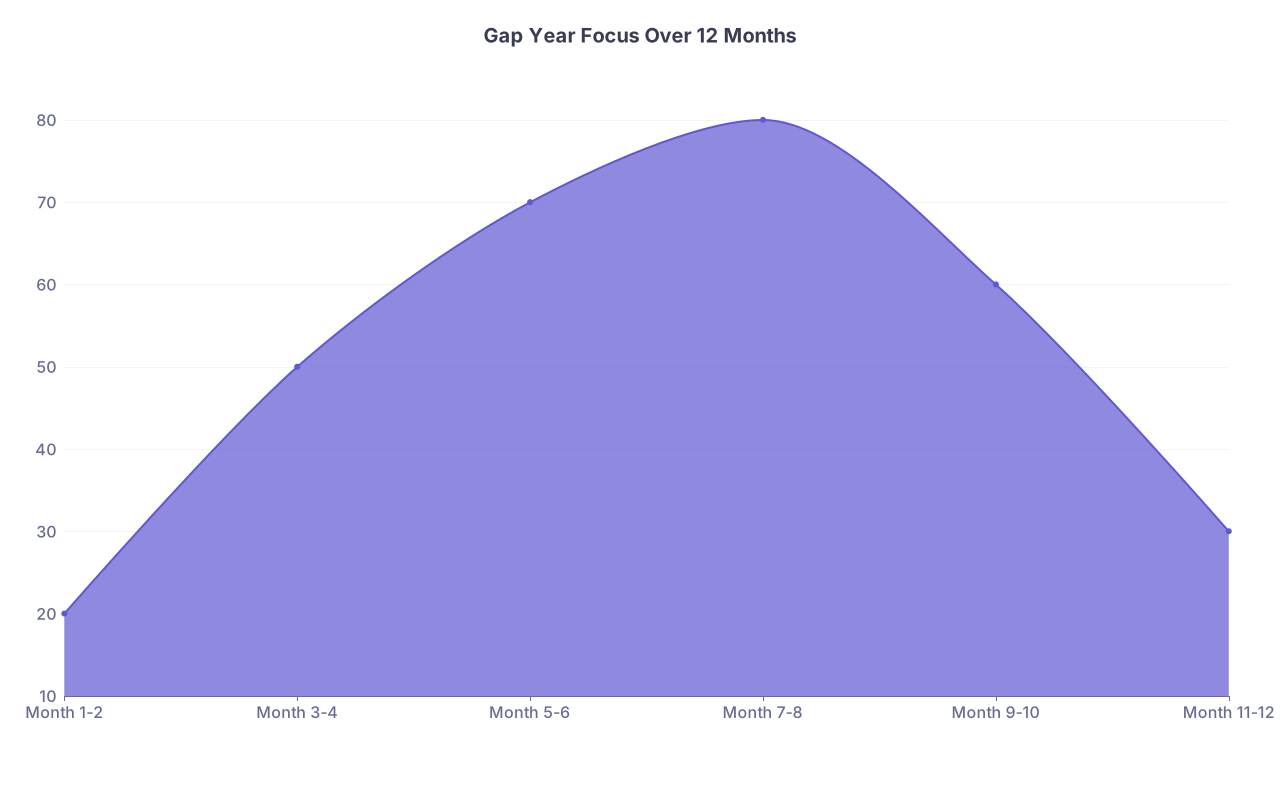
| Category | Value |
|---|---|
| Month 1-2 | 20 |
| Month 3-4 | 50 |
| Month 5-6 | 70 |
| Month 7-8 | 80 |
| Month 9-10 | 60 |
| Month 11-12 | 30 |
Interpretation: relative intensity of residency prep efforts.
Months 1–2: Assessment and Positioning
- Finish meetings with advisors and mentors
- Decide on your primary gap year track
- Aggressively apply to research or clinical positions
- Resolve logistics: visas, location, financial planning
- If eligible, set a target window for Step 3
Months 3–5: Deep Work and Early Wins
- Start full-time in your research/clinical role
- Identify 1–2 concrete projects you can own (paper, QI, clinic revamp)
- Begin Step 3 studying if applicable
- Update CV with new role and early responsibilities
- Start modest networking with residents and attendings – not begging, just being visible and helpful
Months 6–8: Application Build Phase
- Take Step 3 (ideally before ERAS opens or early fall)
- Draft and refine new personal statements
- Finalize your revised program list with mentors
- Confirm which attendings will write letters (and give them your updated CV + talking points)
- Do mock interviews
Months 9–10: Application and Interview Season
- Submit ERAS early and correctly
- Monitor interview invites; track them in a simple spreadsheet
- Keep working hard in your gap-year role; do not “mentally resign”
- Continue mock interviews as needed
- Ask mentors or letter writers if they are willing to email or call a few PDs for you
Months 11–12: Finishing Strong
- Attend interviews with full effort, even at programs you are lukewarm on
- Adjust strategy in real time (if invitations are lower than expected, ask mentors what they are hearing)
- Keep collecting experiences and outcomes from your gap year to discuss in interviews
- Finalize your rank list with realism and humility
Step 7: Managing the Psychological Side Without Going Numb
Let me be blunt: being unmatched feels like a public referendum on your worth. It is not, but it feels that way.
You will perform worse on all of the above if you let shame run the show.
Basic psychological hygiene:
- Pick 2–3 people you can be absolutely honest with about how much this hurts.
- Set limits on rumination: no re-reading the NRMP email five times a day.
- Use structure:
- Workblock for residency prep each weekday (even 30–60 minutes)
- Exercise or some physical outlet
- At least one thing that has nothing to do with medicine weekly
And remember this: every year, thousands of people go unmatched. Many of them match the following year. The difference is not luck. It is who treats the gap year like a serious corrective action, not a vague “do some research and hope.”
What You Should Do Today
You do not need a 20-step Trello board right now. You need movement.
Do this today:
- Open your ERAS PDF from this cycle.
- On a blank page, write three headings:
- “On-paper weaknesses”
- “Likely hidden problems (letters/interviews)”
- “Specialty/strategy issues”
- Force yourself to list at least two items under each heading, even if they hurt to admit.
Once you have that one-page problem list, you have something to work with. From there you can decide: research track, clinical track, or hybrid. You can start emailing for positions. You can schedule that meeting with your advisor.
But it starts with that page. Go write it.


