

Designing a publication‑ready chart review project during a gap year is the fastest way to waste 12 months—or to transform your residency application. The difference is whether you treat it like a hobby or like a serious clinical study from day one.
Let me be blunt: most “chart reviews” I see from applicants are unpublishable the moment they are conceived. Vague questions, no data dictionary, no sample size logic, no IRB plan, and a half-baked Excel sheet. That kind of project will give you a line on your CV and zero influence on a PD reading your file.
You can do this properly. And you can absolutely get a manuscript under review—or accepted—within a gap year if you design it right upfront.
Let me break this down specifically.
1. Start With the End: A Gap-Year Strategy, Not Just a Project
A chart review during a pre-residency gap year is not just “research experience.” It is:
- A narrative tool for your personal statement and interviews
- A signal to program directors that you can complete projects
- A way to show specialty commitment and basic scholarly skills
You need to reverse-engineer the project from those goals.
Clarify your target specialty and what “counts”
If you are aiming at:
- Internal Medicine → outcomes, quality metrics, readmissions, risk scores, prognostic tools
- General Surgery → complications, operative approaches, length of stay, reoperation, ERAS protocols
- EM → time-sensitive metrics, diagnostic yield, imaging appropriateness, disposition patterns
- Neurology → stroke timelines, seizure management, diagnostic workup yield
- OB/GYN → maternal/fetal outcomes, surgical complications, prenatal care gaps
Your chart review should clearly live in that world.
If you are undecided but know it is something competitive (derm, ortho, ENT): pick a field adjacent to one of your serious interests and design a methodologically solid project there. Low-quality “derm case series” will not help you. A clean, serious IM or EM outcomes paper absolutely will.
Scope for a 12-month window
From day zero of your gap year to “manuscript submitted” you realistically have:
- 1–2 months: protocol, IRB, data tool build
- 3–6 months: data abstraction and cleaning
- 2–3 months: analysis + drafting + revisions
You are looking at a project that requires:
- 150–800 charts, depending on complexity and number of data points, and
- 1–3 abstractors max (often just you + maybe 1 student/colleague)
Oversized “we will review 5000 charts” is amateur hour. You do not have a funded team and a full-time biostatistician. Design for what a single motivated person can do.
2. Choosing a Question That Is Actually Publishable
Most chart review ideas die because the question is either trivial or already answered 50 times.
You want a question that is:
- Clinically specific
- Under‑studied or context‑specific
- Feasible with existing EHR data
- Narrow enough to analyze with basic stats
Good vs bad chart review questions
Bad examples:
- “Describe all patients admitted with pneumonia at our hospital between 2015–2023.” (So what?)
- “Assess outcomes of diabetes management in our clinic.” (Which outcomes? Which patients?)
Better examples:
- “Among adults admitted with community-acquired pneumonia, is admission procalcitonin level associated with 30‑day readmission?”
- “Association between pre‑op hemoglobin and same‑day discharge failure after elective laparoscopic cholecystectomy.”
- “Diagnostic yield of CT pulmonary angiography ordered from the ED for suspected PE after implementation of a clinical decision rule.”
Those better questions share a structure:
- Clear population
- Defined predictor or intervention
- Concrete outcome and time horizon
Where to find a question if you have no idea
Sit in on services and listen to what attendings complain about:
- “We scan everyone for PE and they are all negative.”
- “Our readmissions for CHF are killing us.”
- “I feel like we overuse vancomycin in uncomplicated cellulitis.”
Translate that into a testable question.
Also: read the last 6–12 months of your target specialty’s major journal supplements and resident‑friendly journals (e.g., JCHIMP for IM, Western JEM for EM, Journal of Surgical Research for surgery). Look at areas that have thin literature or only single‑center data from very different systems.
3. Designing the Project Properly: From Idea to Protocol
Now the nuts and bolts. This is where most gap-year projects go to die.
Define the PICO—then over‑specify it
Write your PICO like you are already drafting the Methods section.
Example (IM, pneumonia):
- Population: Adults ≥18 years admitted to Hospital X from 2019–2023 with a principal discharge diagnosis of community‑acquired pneumonia, identified by ICD‑10 codes J13–J18, excluding immunocompromised patients and transfers from other acute‑care hospitals.
- Exposure: First measured procalcitonin level within 24 hours of admission, categorized into quartiles.
- Comparison: Lowest procalcitonin quartile vs higher quartiles, or quartile‑by‑quartile.
- Outcome: 30‑day all‑cause readmission, as defined by any inpatient readmission to Hospital X or within our health system within 30 days of index discharge.
If you cannot get that specific, you do not have a study yet. You have an idea.
Inclusion/exclusion rules that real humans can apply
You need rules that a tired person at 10 p.m. can apply the same way as you at 9 a.m.
- Inclusion: ICD codes, procedure codes, time windows, age cutoffs, minimum lab data available.
- Exclusion: Very clearly operationalized (e.g., “HIV infection based on ICD‑10 B20 or positive HIV antibody documented,” “transfer from another acute‑care facility indicated in admission source field.”)
Ambiguous criteria like “immunocompromised” without specific definitions will destroy your inter‑rater reliability.
Outcome definition: lock it down
Define exactly how you will capture outcomes:
- “30‑day mortality” → date of death field, plus cross‑check with state registry if available
- “Readmission” → any inpatient encounter with admission date ≤30 days from index discharge date
- “Complication” → using NSQIP definition X, or clearly stating coding and clinical triggers
Future you, 8 months from now, will bless you for being OCD about this now.
4. Sample Size and Feasibility: Basic, But Not Optional
No one expects a gap-year chart review to have textbook power calculations, but “we used all available charts” is lazy.
You should at least rough‑calculate:
- For a binary outcome with logistic regression: minimum ~10 outcome events per predictor variable (EPV) in your model. Many statisticians prefer ≥15.
- For simple comparisons (e.g., complication rate before vs after intervention): you can use any online power calculator (difference in proportions) to see if your expected N is at least in the right ballpark.
If you expect 15% readmission in pneumonia and want to examine 5 predictors in a multivariable model:
- Need at least 5 × 10–15 = 50–75 readmission events
- With 15% rate → total N ~ 333–500 patients
That is a very reasonable chart review sample for one gap‑year student.
| Scenario | Approximate Total N Needed |
|---|---|
| Single predictor, 10% outcome rate | 100–150 |
| 3 predictors, 20% outcome rate | 150–250 |
| 5 predictors, 15% outcome rate | 333–500 |
| Pre/Post comparison, moderate effect | 150–400 total |
Run this kind of sanity check before you promise anyone a paper. If your health system sees 40 cases a year of your condition and you want 500 patients, your project is dead before it starts.
5. IRB, Ethics, and Making It Actually Legal
Chart reviews are not exempt from regulation just because “it is retrospective.”
You need to:
- Identify a faculty PI with institutional appointment.
- Confirm the local IRB process for retrospective minimal‑risk research.
- Draft a protocol and data collection plan that fits their templates.
Typical chart review IRB category
Most chart reviews end up as:
- Retrospective cohort or cross‑sectional study
- Using existing records
- Minimal risk
- Almost always with a waiver of informed consent
Your IRB application must clearly describe:
- Data source (EHR system, time window, sites)
- Variables to be collected (attach your data dictionary)
- Plan for de‑identification and storage (REDCap, encrypted drive, etc.)
- Who will have access to the raw data
- How you will link and then de‑link patient identifiers
If your project is “quality improvement” only, some institutions push it to a QI committee instead of IRB. The trap: you then cannot publish in many journals without IRB approval or at least formal IRB “not human subjects research” determination. In a gap year, you are aiming for publication, so push for formal IRB review or a formal exemption letter.
6. Data Collection Tool: Where Most People Cut Corners
Excel is not a database. You can use it, but you are making your life harder.
If your institution has REDCap, use it. If not, you can still mimic the structure.
Build a real data dictionary first
On paper or in a doc, list:
- Variable name (short, no spaces):
age,sex,pcrx_dose,icu_admit - Description: “Age at admission (years), as integer”, “ICU admission during index hospitalization (0/1)”
- Type: continuous, categorical (with category list), binary
- Allowed values: e.g., sex = 1 Male, 2 Female, 3 Other/Unknown
Once you have that, you design the entry form.
Use structured fields, not free‑text
If an outcome can be represented as:
- 0/1
- Multiple choice from a finite, clinically meaningful list
- A date, an integer, a decimal
Then it should be exactly that in your tool. Every free‑text field you create is future misery for analysis.
Example: instead of “Complication description (free text)”, create:
complication_any(0/1)complication_type(1 = bleed, 2 = infection, 3 = reoperation, 4 = other)complication_other_text(free text only if type = other)
You then have something you can analyze without spending weeks recoding.
7. Training and Calibration: Inter‑rater Reliability the Right Way
If it is just you abstracting data, IRR is less critical for reviewers, but calibration still matters. If you have 2+ abstractors, you need to prove they agree.
Do a pilot abstraction
- Select 20–30 charts at random from your eligible set
- All abstractors independently enter data
- Compare key variables (primary exposure, primary outcome, major covariates)
Calculate:
- For categorical/binary: Cohen’s kappa for 2 raters; Fleiss’ kappa if >2
- For continuous: intra‑class correlation (ICC) or at least Pearson correlation and Bland‑Altman style check
You want kappa ≥0.6 for key variables at minimum, preferably ≥0.8.
If agreement is poor, your definitions are ambiguous. Refine the data dictionary and repeat a smaller pilot until it is acceptable.
Explain this process in your Methods. It screams “we took this seriously” to reviewers.
8. The Abstraction Workflow: Designing for Speed and Sanity
You are on a one‑year clock. The way you structure your work matters.
Build a reproducible record list
Get your IT or data warehouse team (or your PI’s contact there) to:
- Generate a list of unique encounter IDs / MRNs that meet your inclusion based on structured data (ICD codes, dates, etc.)
- Include core fields: MRN, encounter ID, admission/discharge dates, age, sex
Export this list to your database as your “master list” with a unique study ID per patient/encounter.
Never use MRNs as your main key in your analysis dataset. Always have a study ID that can be separated from the PHI.
Normalize your chart review day
People underestimate the grind. Reviewing 10–20 charts per day is realistic if:
- Each chart requires 15–30 minutes
- Your variables are reasonably streamlined
If you need to collect every lab at 8 time points, you have designed a labored project that will stall. Try to simplify:
- Baseline values
- Peak/lowest values
- Time to threshold if that is the point of your study
Set specific weekly targets: “75 charts this week,” not “I will try to do some every day.”
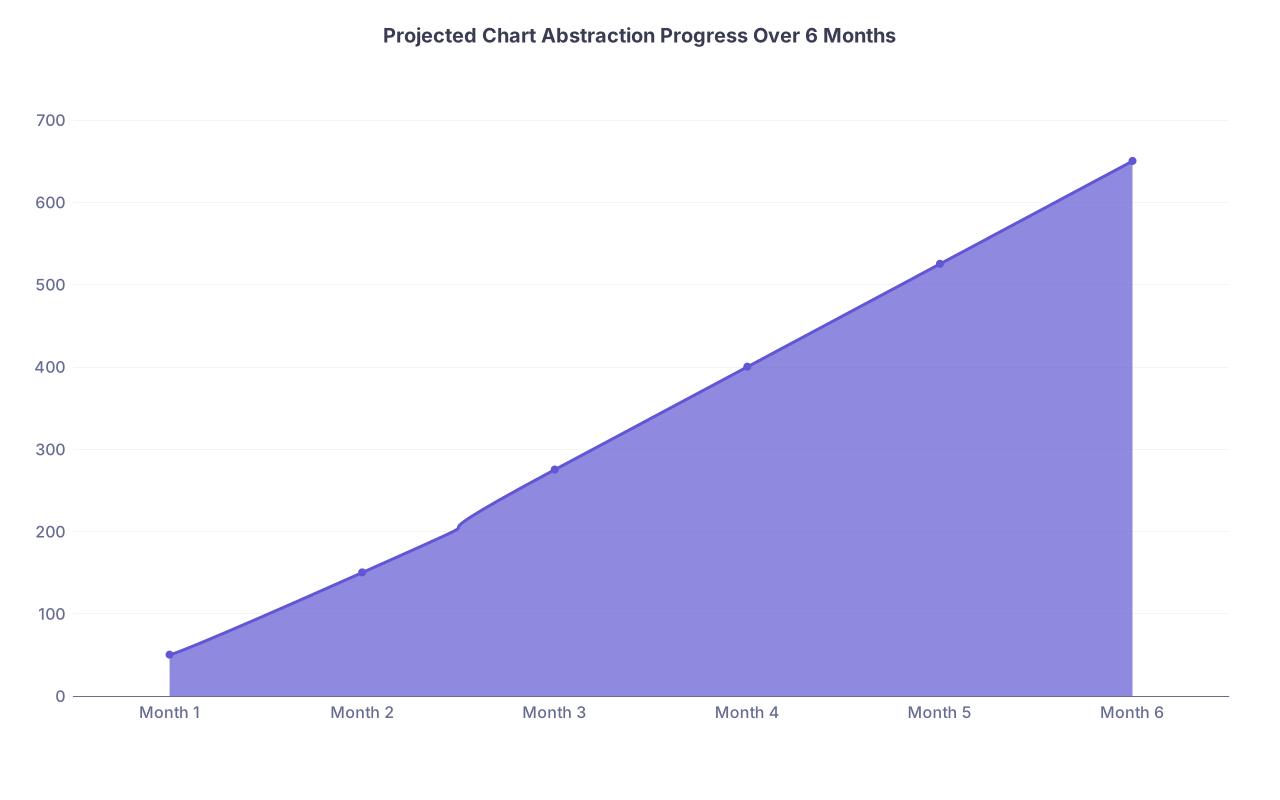
| Category | Value |
|---|---|
| Month 1 | 50 |
| Month 2 | 150 |
| Month 3 | 275 |
| Month 4 | 400 |
| Month 5 | 525 |
| Month 6 | 650 |
A simple progress chart like this (even sketched for yourself) keeps you honest.
9. Cleaning and Analysis: Keep It Simple, Not Primitive
You are not writing an RCT. But you are also not allowed to run a few t‑tests in Excel and call it a day.
Data cleaning steps you should not skip
- Export a raw dataset and keep it untouched as a backup.
- Work on a copy for cleaning.
- Check ranges and impossible values: negative ages, dates in the future, ICU stays shorter than zero days, etc.
- Handle missingness explicitly:
- Code missing as NA, not 9999 or “-1” unless very clearly defined
- Examine how much missingness each variable has
- Consider not using variables with >20–30% missingness as core predictors in multivariable models unless you use proper methods (e.g., multiple imputation with help)
Basic analytic structure for many chart reviews
A standard retrospective cohort analysis might look like:
- Descriptive stats of the cohort
- Univariate comparison of exposure groups (e.g., quartiles of procalcitonin)
- Multivariable logistic regression for binary outcome (readmission, complication)
- Possibly Cox regression for time‑to‑event (time to readmission, time to death)
You want support from a biostatistician if at all possible. Many academic departments have someone who will provide a few hours of consultation if your PI asks.
Be honest about limitations
You are doing retrospective, observational work with all associated biases:
- Confounding by indication
- Misclassification (diagnosis coding, outcome misclassification)
- Single‑center or limited generalizability
Articulate these clearly. Do not oversell causal conclusions. PDs and reviewers can smell overreach.
10. Writing With Publication in Mind From the Start
Your goal is not “we wrote something.” Your goal is a manuscript that can survive peer review at a reasonable specialty journal before your ERAS goes in.
Choose your target journal early
Look for:
- Specialty‑appropriate scope
- Prior similar retrospective studies published there
- Reasonable impact but not absurd (you are not aiming for NEJM with your first chart review)
For an IM project, realistic options might include:
- Journal of Community Hospital Internal Medicine Perspectives
- BMC Pulmonary Medicine
- Cureus (if quality is decent but not groundbreaking; yes, PDs know what Cureus is)
For surgery:
- Journal of Surgical Research
- American Journal of Surgery (ambitious but possible)
- Specialty‑specific: e.g., Journal of Pediatric Surgery, etc.
Study the format of 2–3 chart reviews in your target journal. Copy the structure ruthlessly: headings, length, table style.
Draft backwards
Write:
- Tables first: baseline characteristics, main outcomes, regression table
- Then Results section around those tables
- Then Methods, cementing exactly what you actually did (not what you wish you had done)
- Then Introduction (short, targeted: 3–4 paragraphs)
- Discussion last, focused and honest
Do not leave the Methods until the end of the year. You can draft 80% of Methods once IRB is approved and data collection has started.
11. Timelines and Milestones Across the Gap Year
If your gap year is, say, July–June, you need a timeline that aligns with ERAS (September submission, interviews through winter).
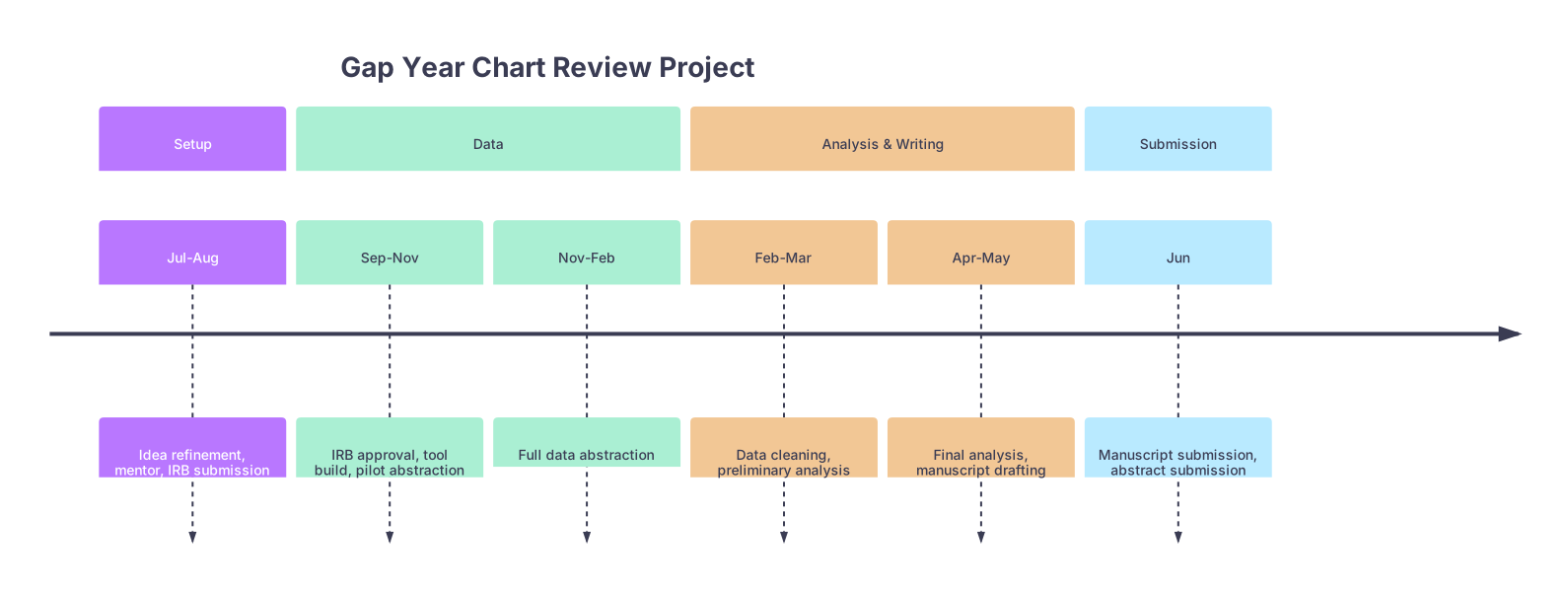
| Period | Event |
|---|---|
| Setup - Jul-Aug | Idea refinement, mentor, IRB submission |
| Data - Sep-Nov | IRB approval, tool build, pilot abstraction |
| Data - Nov-Feb | Full data abstraction |
| Analysis & Writing - Feb-Mar | Data cleaning, preliminary analysis |
| Analysis & Writing - Apr-May | Final analysis, manuscript drafting |
| Submission - Jun | Manuscript submission, abstract submission |
If you keep to something like this:
- By ERAS submission: you can legitimately write “Manuscript in preparation/submitted” and have concrete preliminary results to discuss in interviews.
- By interview season: you may already have an “under review” or even “accepted” status.
12. Positioning the Project for Residency Applications
Here is where most people underuse their work.
On your CV
List it in three places if appropriate:
Research experience:
- “Clinical research fellow, Department of X, Institution Y – Led retrospective cohort study on [topic]. Designed protocol, obtained IRB approval, supervised data abstraction, conducted primary analysis.”
Publications/Manuscripts:
- If accepted: standard citation.
- If under review: “Author A, You B, et al. Title. Journal (under review).”
- If in preparation but with a full draft and analysis: “(manuscript in preparation)”—but do not list five of these. One serious project is enough.
Presentations:
- Submit an abstract to at least one regional or national meeting (ACP, ACS, ACEP, etc.) as soon as you have results.
In your personal statement
Do not just say, “I did a chart review on pneumonia.” Useless.
Instead:
- Briefly describe the clinical question and what bothered you about the status quo.
- Mention one or two specific challenges (e.g., defining readmissions, dealing with missing data, nights spent reconciling ICU admission criteria).
- Close the loop with what you learned about your specialty’s evidence base and your role as a future clinician who can question practice patterns.
Program directors want to see that you can think beyond “I clicked checkboxes.”
In interviews
Be ready to answer:
- Why this question, in this population?
- One thing you would do differently with unlimited resources (e.g., prospective design, addition of patient‑reported outcomes).
- The biggest limitation of your study and how it affects interpretation.
- What concrete change in clinical practice your findings might support—or why they do not.
This is where a serious chart review beats a dozen weak case reports every time. You can talk like someone who has actually done a project from IRB to draft.
13. Common Failure Modes and How to Avoid Them
Let me be direct about where I have seen gap‑year students blow it.

Failure mode 1: No committed mentor
You need a PI who:
- Cares even a little about the question
- Has actual authorship track record
- Will answer emails when you get stuck
If you are doing this “alone” with a nominal PI who never meets you, your chances of navigating IRB, data access, and analysis on time drop dramatically.
Failure mode 2: Overcomplicated variable list
I have seen data dictionaries with 180 variables for N=120 patients. That is not ambitious. It is naïve.
Prune ruthlessly:
- Core demographics
- Key exposure(s)
- Key confounders (a dozen or two, tops)
- 1–3 outcomes
Every extra variable costs you time and increases missingness and error. You are not building an EHR registry.
Failure mode 3: No clear stopping rule
People drift. They keep adding a “few more patients” or “maybe another year of data.” Meanwhile, the gap year ends and nothing is finished.
Set a priori:
- Data window: e.g., Jan 2019–Dec 2022
- Minimum N: based on your feasibility check
- Lock it once IRB is approved and abstraction starts
You can always do a follow‑up study later, as a resident.
Failure mode 4: Perfectionism in the wrong place
You do not need:
- Fancy machine learning models
- 17 sensitivity analyses
- Five different subgroup analyses because you are worried the effect will “look weak”
You do need:
- Clean data
- Coherent, defensible definitions
- Straightforward, interpretable analysis
One solid paper beats zero “perfect” ones.
14. Two Example Project Blueprints
To make this concrete, here are two fully plausible gap-year chart review structures.

Example 1: Internal Medicine – Heart Failure Readmissions
- Question: Among adults admitted with acute decompensated heart failure, is early outpatient follow‑up (≤7 days) associated with lower 30‑day readmission rates?
- Population: Adults ≥18 with ICD‑10 heart failure codes, admissions 2018–2022, excluding hospice and transfers.
- Exposure: Outpatient visit with cardiology or primary care within 7 days of discharge vs >7 days or none.
- Outcome: 30‑day readmission.
- Key covariates: Age, sex, ejection fraction, baseline creatinine, comorbidities (Charlson index), discharge meds, length of stay.
- N target: 400–600 patients (assuming 20–25% readmission).
- Analysis: Descriptive, unadjusted comparison, multivariable logistic regression.
Example 2: General Surgery – Post‑op ERAS Compliance
- Question: Is adherence to an ERAS bundle for elective colorectal surgery associated with reduced length of stay and complications in a community hospital?
- Population: Adults undergoing elective colorectal resections 2017–2022 (CPT codes).
- Exposure: High vs low ERAS compliance score (sum of adherence to predefined elements: pre‑op education, carb loading, early feeding, limited opioids, etc.).
- Outcomes: Post‑op complications (Clavien–Dindo ≥II), length of stay, readmission.
- Covariates: Age, BMI, ASA class, procedure type, open vs laparoscopic, emergent vs elective (exclude emergent).
- N target: 250–400 operations.
- Analysis: Compare groups, multivariable regression for outcomes.
Both of these can be executed by a gap-year researcher with a modest team and yield a publishable manuscript if done correctly.
15. Using Visualization Smartly (and not as Decoration)
A lot of trainees either cram their paper with gratuitous figures or include none at all.
You want 1–2 high‑yield figures at most:
- A flow diagram of patient selection (CONSORT‑style for observational studies)
- Possibly a simple outcome chart (e.g., readmission rate by exposure group)
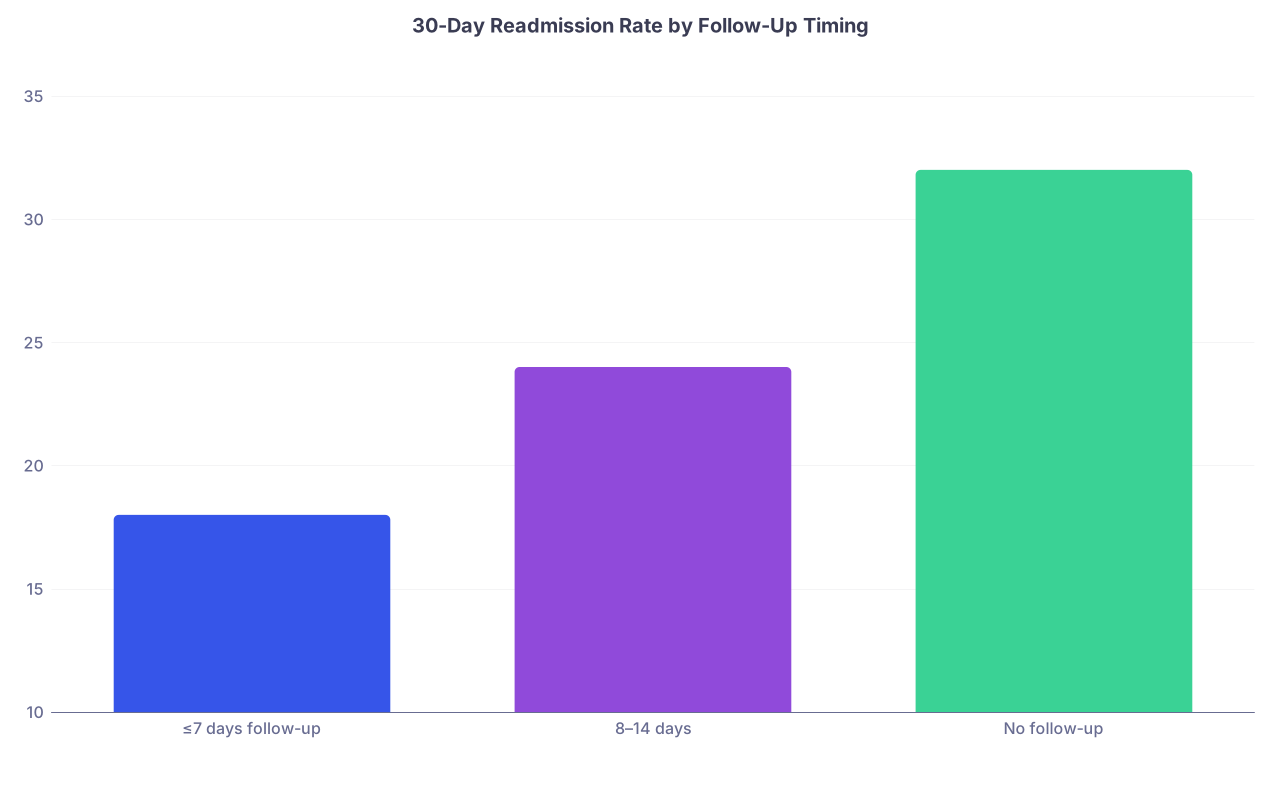
| Category | Value |
|---|---|
| ≤7 days follow-up | 18 |
| 8–14 days | 24 |
| No follow-up | 32 |
A figure like this (in a real paper, with CIs) can summarize your key clinical message in half a second.
16. Final Tightening for a Publication-Ready Product
Right before submission:
- Run your entire dataset creation pipeline from scratch once (if scripted) or at least re‑export and re‑analyze from the cleaned file to make sure your tables match.
- Have someone not involved in the study read just the Methods + Tables and tell you if they can understand what you did. If they cannot, reviewers will not either.
- Check journal formatting: reference style, word count, table/figure limits. Do not give reviewers easy reasons to be annoyed.
- Make sure your name and your PI’s name are cleanly associated with the work—ORCID, institutional emails, etc. You are building a track record.

Key Takeaways
- A gap‑year chart review can absolutely produce a real, citable publication—but only if you treat it like a serious observational study from day one: specific question, clear PICO, proper IRB, clean data structure.
- Design for feasibility: reasonable sample size, limited but meaningful variables, disciplined timeline. Overbuilt projects and vague objectives are what leave you with nothing by ERAS.
- Use the project strategically for your residency application—on your CV, in your personal statement, and in interviews—to demonstrate not just “research exposure” but that you can identify a clinical problem, structure an answer, and see a scholarly project through to completion.


