

It is July 1st. Your classmates are posting white coat photos with “PGY‑1” in the caption. You are…not. You are on a gap year before residency, staring at an empty CV section labeled “Quality Improvement / Patient Safety,” and you know program directors care about that line a lot more than they did five years ago.
You have time. But time without structure is how gap years vanish. Let me walk you, step by step, through building a real, high-yield QI project that actually matters for your Match application—not the fake “we changed a poster in the lounge” stuff that interviewers see right through.
We will go from zero idea → designed project → implemented intervention → measurable results → residency-ready product.
Step 1: Define Your Endgame Before You Touch a Project
Do not start with “what project can I do?” Start with “what do I want this project to do for me by ERAS submission?”
You are aiming for concrete outcomes by August–September of your Match year:
- A completed QI project with pre- and post-intervention data
- At least one poster or abstract submitted (preferably accepted)
- A coherent story you can explain in 90 seconds on interview day
- A strong letter of recommendation from a QI-engaged faculty member
Backward planning matters. From ERAS submission, work backwards 12 months:
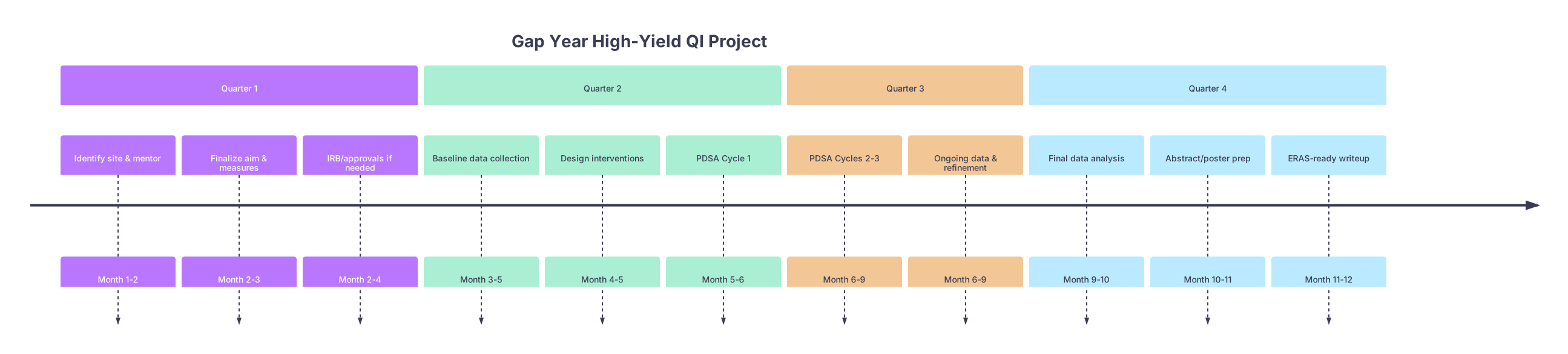
| Period | Event |
|---|---|
| Quarter 1 - Identify site & mentor | Month 1-2 |
| Quarter 1 - Finalize aim & measures | Month 2-3 |
| Quarter 1 - IRB/approvals if needed | Month 2-4 |
| Quarter 2 - Baseline data collection | Month 3-5 |
| Quarter 2 - Design interventions | Month 4-5 |
| Quarter 2 - PDSA Cycle 1 | Month 5-6 |
| Quarter 3 - PDSA Cycles 2-3 | Month 6-9 |
| Quarter 3 - Ongoing data & refinement | Month 6-9 |
| Quarter 4 - Final data analysis | Month 9-10 |
| Quarter 4 - Abstract/poster prep | Month 10-11 |
| Quarter 4 - ERAS-ready writeup | Month 11-12 |
If you are starting later, you compress the cycles, but the structure is the same: design → baseline → intervention → re-measure → dissemination.
Step 2: Choose the Right Setting and Mentor (This Makes or Breaks You)
You can design the best QI project in the world. Without institutional access and a mentor, it dies in your Google Drive.
You need three things from a site:
- Patients or processes you can actually influence
- Accessible data (EMR, pharmacy, lab, or manual collection that will not destroy you)
- A sponsor who can unlock people/resources
Good places to look:
- Academic medical center QI departments (often under “Value, Safety, and Quality”)
- VA hospitals (heavy QI infrastructure, residents + fellows, lots of data)
- Large community hospitals with a Chief Quality Officer or QI nurse
- Patient safety offices, infection prevention teams, or hospitalist groups
Your first task in Month 1: identify a mentor who already does QI. Not just “likes QI,” not “has an interest,” but someone who actually sits in QI meetings or has QI in their job description.
Email should be short and pointed:
- One paragraph on who you are and what gap year you are in
- One sentence on the specialty you are targeting
- One sentence saying you want to do a completed QI project with measurable outcomes before next summer
- One direct ask: “Would you be willing to meet briefly to discuss possible projects and QI needs on your service?”
During that meeting, ask them two questions that matter:
- “What keeps showing up on your QI dashboard that nobody has really fixed?”
- “What projects have residents or students done in the past that actually became posters or publications?”
You are looking for a project with clear institutional pain and a track record of scholarship potential.
Step 3: Pick a Problem That Is Fixable, Measurable, and Boring (Yes, Boring)
Flashy is overrated. Boring is reproducible.
The best high-yield QI topics have:
- Clear guidelines or standards (so you can measure deviation)
- Frequent events (you can get data quickly)
- Relatively simple process changes
Think in terms of domains programs care about:
| Specialty Target | Example QI Focus Area |
|---|---|
| Internal Med | Readmissions, handoff quality |
| Surgery | SSI prevention, timeouts |
| EM | Door-to-needle times |
| Pediatrics | Vaccine rates, asthma plans |
| OB/Gyn | Hemorrhage protocols |
Examples of good student-level QI problems:
- Post-op antibiotic prophylaxis duration non-compliant with guidelines
- Low pneumococcal vaccine rates in eligible inpatients
- Poor documentation of discharge medication reconciliation
- Delays in stat lab result acknowledgment in the ED
- Inconsistent use of a standardized sepsis bundle
Examples of bad projects you want to avoid:
- “We will improve professionalism by putting up posters about respect”
- “We will increase resident wellness” with no defined measure
- Ultra-rare events (wrong-site surgery, etc.—you will not get enough events)
- Anything that requires massive IT build or changing the EHR vendor
If it cannot be measured monthly at minimum, it is a poor gap-year project.
Step 4: Write a Real SMART Aim Statement and Measures
You know the buzzwords. Most students still write garbage aim statements. Fix that.
A strong SMART aim:
- Has a baseline
- Names the unit or location
- Sets a percentage change
- Gives a timeline
Example of a weak aim:
“We aim to improve discharge summary quality for medical inpatients.”
Strong version:
“By June 30, 2026, we will increase the percentage of medicine inpatients discharged from Unit 6A with a complete discharge summary (including diagnosis, medication changes, follow-up, and pending results) from 45% to 80%.”
Now define three things:
- Outcome measure – the thing that matters (e.g., 30-day readmission rate, completion rate of a bundle).
- Process measure – how reliably you are doing the steps (e.g., percent of charts where a checklist is used).
- Balancing measure – ensuring you are not causing collateral damage (e.g., time to discharge, clinic throughput).
Example set:
- Outcome: 30-day HF readmissions per 100 discharges from the HF service
- Process: Percent of HF discharges with documented low-sodium diet and weight monitoring education
- Balancing: Average time from “discharge order placed” to “patient leaves unit”
If you cannot write these cleanly, the project is not ready.
Step 5: Map the Current Process and Collect Baseline Data
You are about to “intervene” on a process you probably do not fully understand. That is how QI projects fail.
Two tasks here:
- Process mapping
Sit with the people who actually do the work: bedside nurses, residents, unit secretaries. Use a whiteboard and draw the full path: from trigger → to action → to documentation → to follow-up.
Example: For “stat labs in the ED,” your map might include:
- Provider orders “STAT lactate”
- Order hits lab queue
- Tube drawn by nurse / phlebotomy
- Specimen sent to lab
- Result posted in EMR
- Provider notified (or not)
- Action taken / documented
You will find hidden steps, handoffs, and failure points. That is your gold.
- Baseline data
You need enough pre-intervention data to see a real change later. Often this means 30–50 events minimum, or several weeks/months, depending on frequency.
Use this period for:
- Testing your data extraction method (EMR query, manual chart review)
- Defining exactly what qualifies as “success” or “failure”
- Piloting your data collection form (yes, make a simple Excel or REDCap form)
You want your baseline data to be clean because you are going to show it in your application and at conferences.
Step 6: Design Interventions That Humans Will Actually Do
Intervention design is where students drift into fantasy. You do not need a perfect fix. You need an implementable fix.
Interventions fall roughly into a few categories:
- Education (teaching sessions, emails, laminated cards)
- Process changes (adding a checklist, standardized order set, default option)
- Workflow redesign (who does what, when)
- EMR nudges (best practice alerts, required fields, auto-populated templates)
- Environment changes (placement of supplies, signage, standardized forms)
Education alone almost never sustains improvement. Use it, but do not rely on it.
High-yield combination: simple process change + light education + measurement and feedback.
Example: Improving DVT prophylaxis ordering on a general medicine ward.
Instead of “Let us give a talk on DVT prophylaxis,” you:
- Add a required VTE risk assessment field to the admission order set
- Create a default prophylaxis recommendation based on the risk score
- Give a 10-minute lunch talk to residents about the new process
- Send a weekly email with unit-level compliance percentages and anonymous “top performer” shout-out
Design your intervention with frontline staff in the room. If they tell you it is annoying or unrealistic, believe them.
Step 7: Run Real PDSA Cycles (and Document Them)
A high-yield QI project will clearly show at least two to three PDSA cycles. Not “we planned to do a PDSA cycle.” You actually do them.
PDSA 1 is usually small and crude:
- Plan: “On Unit 6A, for one week, night shift nurses will use a new standardized night-shift handoff template.”
- Do: Implement template for that week on just one shift.
- Study: Measure percent of handoffs using the template and ask nurses what broke.
- Act: Modify template based on feedback and barriers.
PDSA 2 scales up:
- Expand to more shifts or another unit.
- Fix issues from the first attempt.
- Continue measuring your primary process measure.
Document your PDSA cycles in a simple, reproducible way: dates, what changed, what you measured, and what you learned.
By the time you hit PDSA 3, you want your intervention to resemble what you will ultimately “standardize” as usual practice.
Step 8: Collect and Display Data Like Someone Who Has Been to a QI Conference
Sloppy data kills otherwise good projects. You need three things:
- Consistent data definition (what counts, what doesn’t)
- Reasonable frequency (weekly or monthly at minimum)
- Clear visual display of change over time
Use run charts or control charts, not just pre/post bar graphs if you can manage it.
For a gap-year project, this is often enough:
- Monthly percentage of compliance with your process measure
- A vertical line showing when the intervention started
- A simple table with baseline vs. post-intervention outcome measure
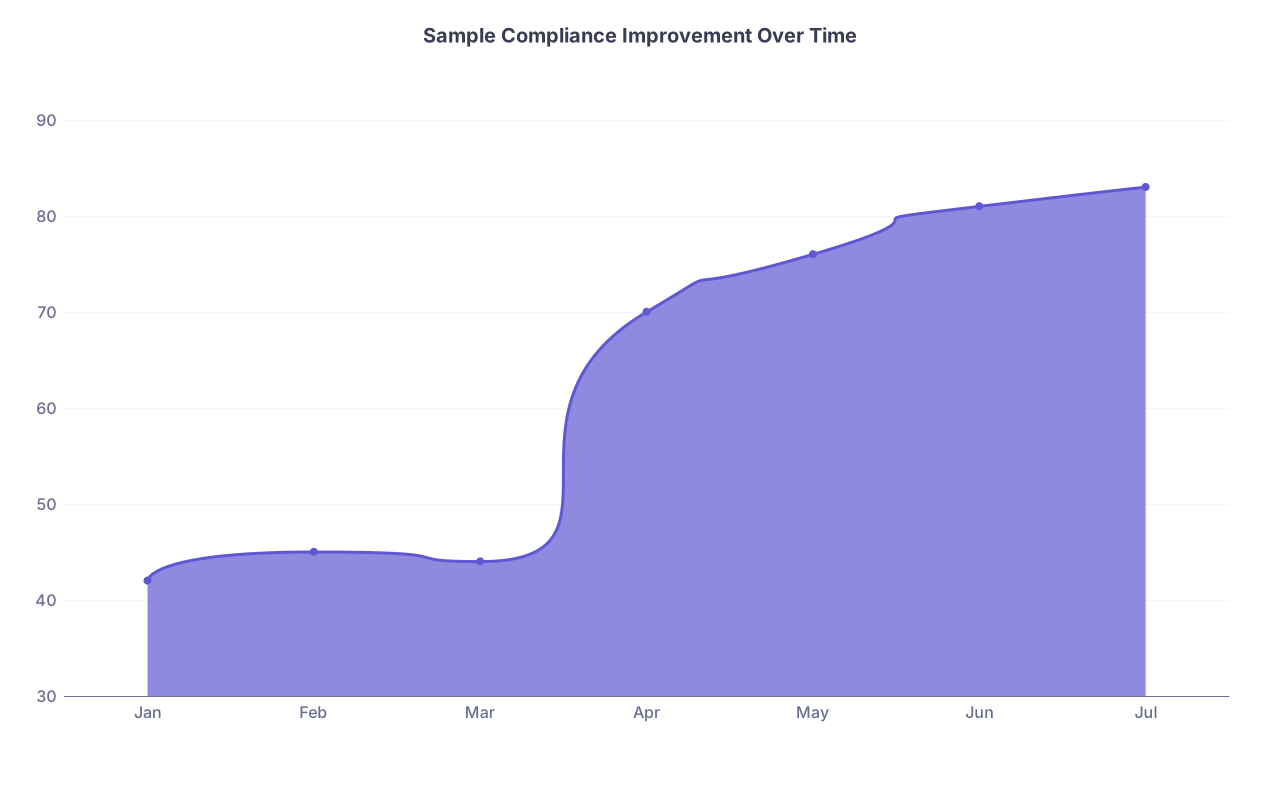
| Category | Value |
|---|---|
| Jan | 42 |
| Feb | 45 |
| Mar | 44 |
| Apr | 70 |
| May | 76 |
| Jun | 81 |
| Jul | 83 |
You do not need advanced statistics to impress residency programs. But you do need to show trend over time and be able to say:
- “Baseline was X over Y months.”
- “After PDSA cycles 1–3, compliance increased to Z and sustained for three months.”
If you have access to someone in your QI department who knows control charts, fantastic. If not, do not fake it. Clean run charts + pre/post comparison are enough.
Step 9: Handle Approvals and IRB the Right Way (This Can Trip You)
You are in QI land, not classic human subjects research. The rules are different.
Most institutional QI projects fall into one of three buckets:
- Operational QI only – internal use, no IRB, but you may need departmental or QI office sign-off.
- QI with scholarly intent – you plan to publish or present; many institutions want an IRB exemption letter or QI determination.
- Borderline research – if you are randomizing units, testing experimental processes, or collecting identifiable data for non-QI purposes, IRB more likely.
Ask your mentor or QI office explicitly:
“I plan to submit this as an abstract. Do we need a QI determination letter or IRB exemption?”
Get whatever determination in writing (email, letter). You will use this later when journals or conferences ask.
Do not start complex data collection without knowing what is required. Retrospective data pulls from the EMR often have strict rules—even for QI.
Step 10: Convert the Project to Residency-Ready Scholarship
This is where many students drop the ball. They do the work, then show up to ERAS with one vague line about “participated in a QI project.” No.
You are going to turn your project into tangible products before September:
Pick 1–2 QI-friendly meetings with deadlines that fit your timeline:
- IHI National Forum / IHI poster calls
- Society of Hospital Medicine (SHM) for IM / hospitalist-oriented QI
- Specialty-specific meetings: e.g., Society of General Internal Medicine, American College of Emergency Physicians, American College of Surgeons, etc.
Your abstract should be structured something like:
- Background / Problem
- Aim
- Methods (setting, population, measure definitions, PDSA summary)
- Results (with actual numbers and at least one time-series result)
- Conclusions (what changed, what remains challenging)
- Local presentation
Most hospitals have some combo of:
- QI or M&M conference
- Departmental grand rounds
- Resident noon conference slots
Volunteer to present your project at one of these. You get practice explaining it, and it signals to your mentor that you are serious.
- Polished ERAS entry
Your ERAS “Experience” entry for this project should not read like a random volunteer activity. Structure it clearly:
- Title: “Improving Discharge Summary Completion on Internal Medicine Service via Standardized Template and PDSA Cycles”
- Role: “Project Lead” or “Co-lead,” not just “Participant”
- Description: 3–4 bullets emphasizing scale, methods, and impact
Examples of strong bullets:
- “Led design and implementation of a QI project on a 32-bed medicine ward to increase complete discharge summaries from 45% to 82% over 6 months using three PDSA cycles.”
- “Developed and tested a standardized discharge template integrated into the EMR; collaborated with residents, nurses, and IT analysts to refine workflow.”
- “Performed manual review of 200 charts for pre/post implementation comparison; created run charts and presented results at department QI conference.”
Be precise with numbers and your actual role. Interviewers will drill into this.
Step 11: Prepare to Talk About the Project Like a Resident, Not a Student
On interview day, your QI project is not just a line on your CV. It is a test of whether you understand systems-based practice.
You need to be ready to answer, concisely:
- “What was the problem you addressed?”
- “What exactly did you change?”
- “How did you measure improvement?”
- “What were your results?”
- “What did not work or surprised you?”
- “How would you scale or sustain this intervention?”
Have a 90-second summary basically memorized:
“On our medicine service, only 45% of discharge summaries included diagnosis, med changes, follow-up, and pending results. We wanted 80% by June. We created a standardized EMR template, ran three PDSA cycles on one unit, and trained residents and nurses using brief in-service sessions. Over six months, complete summaries improved from 45% to 82% and time to discharge did not increase. Biggest barrier was resident buy-in during changeover; sustaining it required embedding the template as the default in the EMR. I presented this at our department QI conference and we are now scaling it to a second unit.”
That sounds like someone I would trust with a real QI project as a PGY‑1.
Step 12: Use the Project To Build Relationships and Letters
A gap year QI project is not just about the project. It is leverage for mentorship and letters.
You want at least one letter writer who can say, credibly:
- You took ownership of a complex, multi-stakeholder project.
- You handled data, meetings, and frontline engagement like a junior resident.
- You persisted through political and practical barriers.
To get that kind of letter:
- Be the person who sends agendas and follow-up emails after QI meetings.
- Show your mentor a draft of your abstract/poster and revise based on feedback.
- Offer to help with related QI work—often your project fits into a broader institutional priority.
Then ask directly, 2–3 months before ERAS opens:
“Would you be comfortable writing a strong letter of recommendation for my residency applications that highlights my QI project leadership and systems-based practice?”
If they hesitate, you have your answer. If they say yes, provide:
- Your updated CV
- One-page summary of your project with key metrics
- Draft of your personal statement if you have it
This is how you turn a “gap year project” into a recognizable professional identity.
Common Pitfalls I See Gap-Year Applicants Make
Let me be blunt about the dumb stuff that derails people:
- Starting a project that depends entirely on IT/EHR changes controlled by a committee that meets every 3 months. You will be waiting the whole year.
- Choosing a problem that occurs once a week and then wondering why you have no statistical power.
- Collecting a mountain of baseline data…then changing the measure definition halfway through.
- Doing “QI theater”: giving one lecture, handing out pocket cards, calling it a project, and never measuring anything.
- Ignoring nursing and frontline staff, then being shocked when your intervention disappears the moment you stop watching it.
If you avoid those and stick to the steps above, your project will almost certainly be more robust than what many interns list.
Quick Reality Check: How “Big” Does This Need To Be?
Programs are not expecting a multi-center randomized QI trial. They want evidence that you:
- Can see system problems, not just individual ones
- Can work with a team to design, test, and measure a fix
- Understand basic QI vocabulary (PDSA, process vs outcome, run charts)
- Have enough stamina to take a project from idea to measurable result
A single-unit project with 50–200 patients/events, one clear intervention, and sustained improvement over 3–6 months is more than enough to separate you from the pack.
If your project ends up feeding into a larger hospital-wide initiative, great. If it just lives on your ward and in a poster, that is still a win for the Match.
FAQs
1. How late in my gap year can I start a QI project and still have it help for residency applications?
If you want real pre/post data and at least one abstract, you need 6–9 months from “no idea” to “presentable project.” If you are already in a QI-rich environment and can plug into an existing project with baseline data, you can probably compress that to 4–6 months. Starting something from scratch in March with a September ERAS deadline is possible but everything has to go perfectly and the project will likely look shallow.
2. Do I need publications from my QI project, or are posters and local presentations enough?
For gap-year purposes, posters and strong ERAS descriptions are enough. A publication is nice, but timelines are brutal: many journals take 6–12 months from submission to publication. If the data are clean, absolutely aim to write a manuscript, but do not wait for acceptance before listing the project or using it as an interview talking point. “Manuscript in preparation” is fine when honest.
3. How much stats / methodologic rigor do programs expect in a QI project?
They do not expect you to be a biostatistician. They do expect you to understand basic measurement and not do something obviously wrong. At minimum you should: use consistent denominators, show change over time (not just one pre and one post number), mention limitations, and avoid overclaiming causality, especially if multiple changes happened at once. If your hospital has a QI analyst, get them to sanity-check your analysis; one 30-minute meeting with them can save you from embarrassing errors.
4. What if my project “fails” and I do not see improvement in my main outcome?
That is still usable—if you can explain it intelligently. Many excellent QI projects show improved process measures but no detectable change in the clinical outcome within the study period. On interviews, you should be able to say: what you tried, what did and did not change, your interpretation of why, and what you would do differently with more time. Programs are more impressed by honest, thoughtful analysis of a “failed” project than by someone who clearly massaged numbers to manufacture success.
Key takeaways:
Pick a boring, measurable, guideline-anchored problem with a mentor who actually does QI. Write a real SMART aim, collect solid baseline data, and run multiple documented PDSA cycles with time-series measurement. Then convert the work into concrete posters, ERAS entries, and a letter that show you understand systems-based practice better than the average applicant.


