

Most “research gap years” are wasted. The difference is data.
If you spend your gap year just entering data and “helping with charts,” you will have almost nothing impressive to show on your CV. If you walk out with real, demonstrable biostatistics and R skills, you suddenly look like someone programs actually need.
Let me break this down specifically: what practical data skills are worth your time, which R projects actually move the needle for residency applications, and how to structure that year so you finish with concrete outputs, not vague “exposure to research.”
Why Data Skills Matter More Than Another Generic Poster
Programs are drowning in applicants with “3 posters, 1 paper under review.” That line is wallpaper. What stands out is the person who can say:
- “I cleaned and analyzed a 10,000-patient EMR dataset in R, including logistic regression and survival analysis.”
- “I built a reproducible pipeline for our lab’s database and trained two junior students to use it.”
- “I automated weekly outcome reports for our QI initiative in RMarkdown.”
That is a different level.
Here is what data skills do for you in the residency match:
Make your research believable.
When you can explain your own methods (why you chose logistic vs Poisson, how you handled missingness, what variance inflation factor means), faculty immediately know you actually did the work.Signal future value.
Attendings are tired of begging statisticians to help on every paper. A resident who can run a clean analysis and send a reproducible R script is gold.Create interview talking points.
A specific project with R, data wrangling, and a bit of stats gives you something concrete to discuss beyond “I learned a lot about teamwork.”Build an identity.
“The resident who does global health” is common. “The intern who can fix broken datasets and get publications out of them” is rare. That reputation travels.
So your goal during the gap year: leave with proof that you can handle basic to intermediate biostatistics and R in real clinical datasets.
Core Biostatistics You Actually Need (Not the Whole Textbook)
You do not need to become a full biostatistician. But you must be dangerous with the fundamentals. These are the skills that show up again and again in resident-level projects.
1. Study Design Fundamentals
If you cannot classify a study design, your stats fall apart immediately. You must be comfortable with:
- Cross-sectional vs cohort vs case-control vs RCT
- Prospective vs retrospective
- Observational vs experimental
- Basic bias: selection bias, information bias, confounding
Practical expectation: Given a paper abstract, you should be able to say, out loud:
“This is a retrospective cohort study using EHR data from 2016–2021, with 3,500 patients, assessing association between X and Y.”
You will use that framing every time you write a methods section.
2. Descriptive Statistics and Basic Comparisons
You must be fluent in what I call “Table 1 stats.” If you cannot build Table 1 for a paper, you are not yet useful.
Core tools:
- Continuous data: mean ± SD, median [IQR]
- Categorical data: counts and percentages
- Comparisons:
- t-test vs Wilcoxon rank-sum
- ANOVA vs Kruskal-Wallis
- Chi-square vs Fisher’s exact
You should know the typical rules:
- When n is small or expected cell counts < 5 → Fisher’s exact instead of chi-square
- Skewed continuous variables → median and IQR, and maybe Wilcoxon instead of t-test
In R, that translates to knowing how to:
- Summarize by group (
dplyr::group_by()+summarise()) - Run the core tests (
t.test(),wilcox.test(),chisq.test(),fisher.test())
These alone get you through at least half of resident research.
3. Regression You Will Actually Use
For a gap year, you should aim to be genuinely comfortable with:
- Linear regression – continuous outcomes (e.g., blood pressure change)
- Logistic regression – binary outcomes (e.g., mortality, readmission)
- Cox proportional hazards regression – time-to-event (e.g., survival, time to complication)
You must understand conceptually:
- What an odds ratio is vs risk ratio
- What an adjusted odds ratio is
- What a confidence interval tells you that a P-value does not
- Why you cannot throw in 30 covariates on 80 events
And you should be able to say something like:
“We built a multivariable logistic regression model with hospital mortality as the outcome, adjusting for age, sex, baseline comorbidities, and severity of illness. We checked model assumptions using linearity of the logit and multicollinearity diagnostics.”
If that sentence sounds like gibberish now, fix that during your gap year.
4. Survival Analysis
If you do anything with oncology, cardiology, surgery, ICU, transplant—time-to-event is everywhere.
Bare minimum survival toolkit:
- Kaplan-Meier curves
- Log-rank test
- Cox proportional hazards regression
- Interpretation of hazard ratios
In R, that means being comfortable with the survival and survminer packages. You do not need to do frailty models or time-dependent covariates in your gap year. Basic Cox models, well done, are already an asset.
5. “Messy Real-World” Concepts
This is where residents fall apart, because textbooks gloss over it. You need to have at least seen:
- Missing data: complete case vs simple imputation vs multiple imputation (you do not need to run MI solo initially, but you should know it exists and why it matters)
- Confounding vs mediation
- Collinearity / multicollinearity
- Overfitting in small datasets
You do not have to solve all of these alone. But when you hear a statistician mention them, you should not be lost.
R Skills That Actually Belong on a Medical CV
If “R” is going on your CV, you must be able to defend it. Being able to change one line in someone else’s script does not count.
Here is what I would expect from a resident who honestly lists R as a skill:
| Skill Area | Minimum Competence for CV-Worthy Level |
|---|---|
| Data Import | Read CSV/Excel, merge multiple files, basic QC |
| Data Wrangling | Filter, mutate, group_by, summarize, joins |
| Visualization | Basic ggplot2 figures, facets, themes |
| Stats Functions | t-test, chi-square, regression, Cox models |
| Reproducibility | RMarkdown reports, set seeds, document code |
1. Data I/O and Cleaning
You should be able to:
- Import data from CSV, Excel, or an SQL export (after the data manager hands it to you)
- Inspect the structure: types, missingness, ranges
- Recode variables:
- Turn “Yes/No” into 1/0
- Categorize age groups
- Create derived variables (BMI, delta creatinine, etc.)
- Merge datasets by an ID
If you can take a raw extract with 80 variables and turn it into an analysis-ready dataframe with 30 cleaned variables, you are already ahead of many early residents.
2. Core tidyverse Skills
Whether you like tidy or base R, programs recognize the tidyverse pipeline style now. You want to be comfortable with:
select(),filter(),mutate(),arrange()group_by()+summarise()left_join(),inner_join()%>%or the newer|>pipe
Concrete expectation: given a dataset, you should be able to answer:
“What is the average LOS by ICU vs floor, stratified by age group, excluding patients who died?”
in a single tidyverse pipeline and then put it into a publication-quality figure or table.
3. Basic ggplot2 Visualization
You do not need to be an artist. But you must be able to code:
- Histograms and density plots
- Boxplots and violin plots
- Bar charts (counts or proportions)
- Scatterplots with regression lines
- Kaplan-Meier curves with risk tables (using
survminer)
And crucially, you should know how to:
- Change axis labels and titles
- Adjust themes to look clean (theme_bw(), theme_classic())
- Save figures with specified DPI and dimensions for journals
4. Running and Interpreting Models in R
You should be comfortable running:
lm()– linear regressionglm(family = binomial)– logistic regressioncoxph()fromsurvival– Cox models
And then:
- Extracting coefficients, confidence intervals, and P-values
- Presenting them in a tidy table format (e.g., with
broom::tidy()orgtsummary) - Explaining what the numbers actually mean in clinical language
5. Reproducibility: RMarkdown and Versioning
This is where you turn “I know some R” into “I am a serious contributor.”
Learn to:
- Create an RMarkdown document (.Rmd) that:
- Loads data
- Runs all cleaning and analysis
- Outputs your tables and figures
- Knit it to PDF or Word for your PI
- Use simple GitHub or at least systematic versioned folders to track changes
A PI who gets a single RMarkdown that regenerates the entire analysis when the dataset updates will remember you. That is the person they email first for the next project.
Gap Year Project Types That Show Real Data Skills
You do not need 10 random projects. You need 2–3 substantial ones where your role is clear and your contribution is technical, not just “data entry.”
Let me walk through realistic project archetypes and how to structure them.
1. EMR-Based Retrospective Cohort
Bread and butter. Think: “Outcomes of patients with X characteristic admitted to Y service.”
Typical pattern:
- Data source: EHR extract (Epic/Cerner), data warehouse
- N: 500–20,000 patients
- Outcome: mortality, LOS, readmission, complication, etc.
- Exposure: medication, lab level, comorbidity, score, etc.
Your role using R:
- Clean the raw extract (dates, duplicates, impossible values)
- Define cohort (inclusion/exclusion criteria)
- Derive exposure and outcome variables
- Build Table 1: demographics and baseline characteristics
- Run unadjusted tests and multivariable logistic regression or Cox models
- Generate 2–4 figures: distributions, KM curves, forest plot
On your CV, this becomes:
“Conducted data cleaning, statistical analysis (logistic regression, survival analysis), and figure generation in R for a 5,200-patient retrospective cohort study on [topic].”
2. Predictive Model or Risk Score Project
These take more supervision, but even a basic version is powerful.
Typical structure:
- Data source: institutional registry or EMR
- Goal: predict outcome Y from baseline clinical variables at admission
- Methods: train/test split, logistic regression, possibly random forest or gradient boosting
Your role with R:
- Split data into training and testing sets
- Fit logistic regression and one machine learning model (with supervision)
- Evaluate performance: ROC curve, AUC, calibration plot
- Create risk groups (low/moderate/high) and describe outcomes
You must not pretend to be a machine learning expert. But you can honestly say:
“Implemented and evaluated predictive models in R (logistic regression, random forest) with cross-validation and ROC analysis for [clinical outcome].”
That phrase alone lights up some PDs, especially in fields like EM, ICU, cards, surgery.
3. Survival Analysis Project (Onc, Cardio, Surgery, ICU)
Example:
- “Time to recurrent MI in patients discharged after PCI and started on X vs Y therapy.”
Structure:
- Define index event and start of follow-up
- Define event and censoring
- Use
Surv()+survfit()+coxph()in R
Your deliverables:
- KM curves stratified by key exposure
- Log-rank P-value
- Adjusted hazard ratios with 95% CI
- Sensitivity analyses (maybe stratified by age or comorbidity)
This is exactly the sort of thing that gives you deep talking points in interviews:
- “We realized that censoring due to loss to follow-up was not random and had to think carefully about how this might bias our estimates.”
4. QI / Operational Data Project With Automation
Often overlooked but extremely practical.
Example:
- Monthly CLABSI rates in an ICU before and after an intervention
- Median ED door-to-needle times before and after a protocol change
Your role in R:
- Pull or receive monthly/weekly data
- Clean and reshape
- Build run charts or control charts
- Automate a monthly RMarkdown report emailed to the QI team
This is a different flavor of skill: workflows and automation. That matters for hospitalist programs, EM, IM, anesthesia, essentially everywhere.
How to Structure the Gap Year So You Actually Learn This
Here is where many people fail. They sit in a lab, someone hands them REDCap passwords, and suddenly a year has passed with nothing concrete.
You need a structure.
Step 1: Acquire Minimum Biostats Foundation (First 4–6 Weeks)
Use a focused, applied biostatistics source. Do not drown in pure math. Good options (varies by region):
- “Fundamentals of Clinical Trials” (for trial thinking)
- “Medical Statistics: A Textbook for the Health Sciences” (Bland)
- Many institutions have an in-house “Introduction to Clinical Research Methods” course. Take it.
Reject courses that are 90% formulas and 10% examples. You want ones built around real clinical papers and R or Stata code.
Parallel: start a structured R course. Something that covers:
- Data import
- Data wrangling (tidyverse)
- Basic plots
- Regression
- Survival (even briefly)
If you can, pick a course that uses real clinical or epidemiologic datasets, not cars and iris flowers.
Step 2: Lock in 1–2 Strong Mentors and Clarify Your Role
You want at least:
- One content expert (attending in your field of interest)
- One data/stats person (biostatistician, data scientist, methodologist, or experienced fellow)
Clarify expectations explicitly. Say something like:
“I want to leave the year being able to independently clean a dataset and run basic regression/survival analyses in R. Can I take the lead on 1–2 projects where I handle the data and coding, with your supervision on methods?”
If a lab only wants you doing REDCap entry and chart review, be polite but strategic. That cannot be your entire year.
Step 3: Start With a Contained Project, Not a Monster
Your first project should:
- Have a clear dataset and outcome
- Be doable in 3–4 months from raw data to draft manuscript
- Use straightforward methods: logistic regression, linear regression, or Cox
Use this first project as your end-to-end learning lab:
Write the data cleaning code cleanly and annotate heavily
Build Table 1 yourself
Draft the statistical methods paragraph under supervision:
“We compared baseline characteristics using chi-square and Wilcoxon rank-sum tests, as appropriate. We used multivariable logistic regression to estimate adjusted odds ratios (OR) and 95% confidence intervals (CI) for the association between [exposure] and [outcome], adjusting a priori for age, sex, and baseline comorbidities.”
When you can write that from memory, you are starting to internalize the work.
Step 4: Layer in a More Advanced or Distinctive Project
Once the first project is in manuscript form, add something distinctive:
- Time-to-event project with survival analysis
- Simple predictive model with train/test split
- QI project with automated RMarkdown reports
Do not chase complexity for its own sake. The goal is to reliably execute one or two intermediate-level workflows, not dabble in 10 buzzwords.
Step 5: Capture and Package Your Skills for the CV
Do not bury your data skills under “Other skills: R, Excel.”
You want explicit, concrete bullets under research experiences, for example:
- “Cleaned and analyzed a 7,800-patient EMR dataset in R, including multivariable logistic regression and Cox proportional hazards modeling, for a study of [topic].”
- “Developed reproducible RMarkdown pipelines for monthly QI reports on ICU CLABSI rates, including automated trend visualization and summary statistics.”
- “Created publication-quality figures in ggplot2 for multiple abstracts and manuscripts, including Kaplan-Meier survival curves and regression coefficient plots.”
That is how a PD skimming your application realizes you are not exaggerating.
How This Plays in Different Specialties
Not all fields value data skills equally, but none dislike them. Here is how it usually lands.
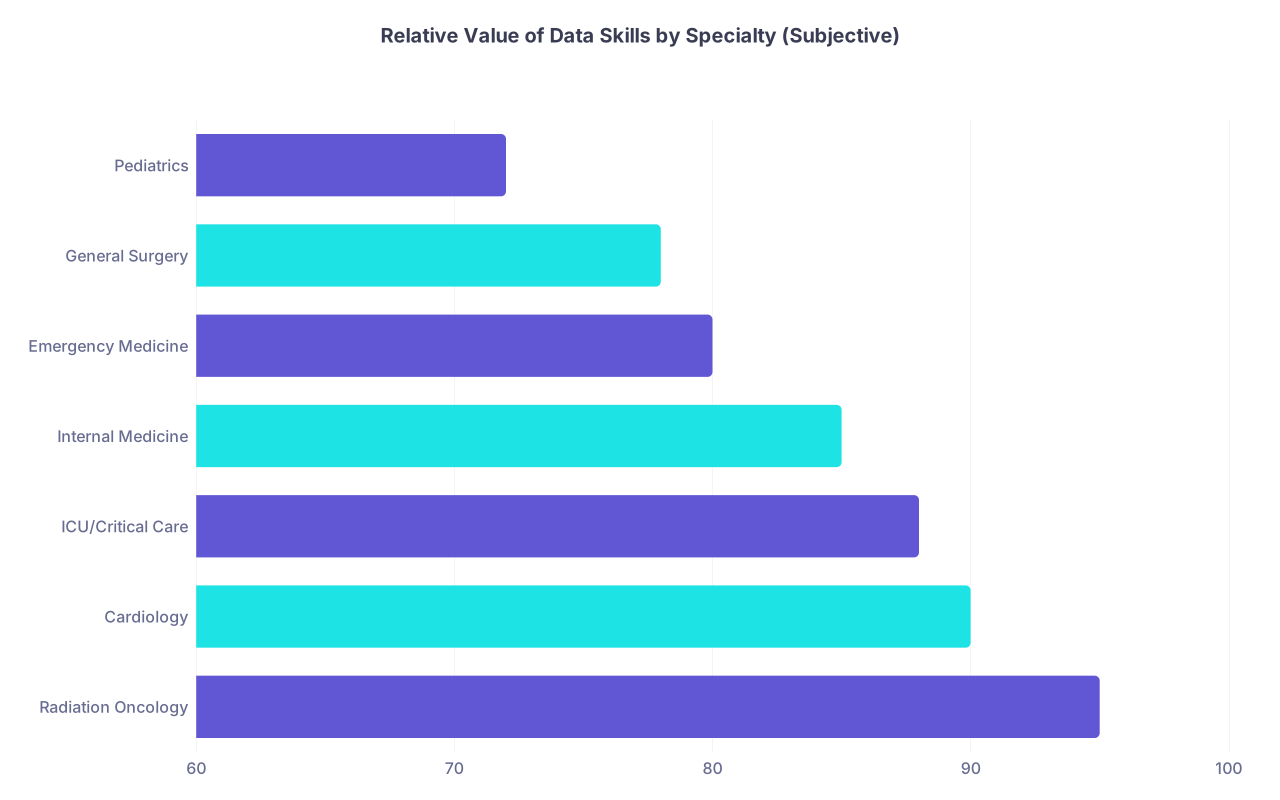
| Category | Value |
|---|---|
| Radiation Oncology | 95 |
| Cardiology | 90 |
| ICU/Critical Care | 88 |
| Internal Medicine | 85 |
| Emergency Medicine | 80 |
| General Surgery | 78 |
| Pediatrics | 72 |
Rough interpretation:
Radiation Oncology / Cards / ICU / Academic IM
Strong bump. Data-heavy fields, lots of registry/EMR work, outcomes research, quality metrics.EM / Surgery / Anesthesia
Moderately strong bump. Predictive modeling, workflow/QI projects, trauma registries.Pediatrics, Psych, FM
Still helpful, especially at academic or research-heavy programs, but maybe not the standout factor unless tied to specific niche areas (e.g., child psych outcomes, population health).
But in every specialty, a resident who can get a dataset from messy to publishable is a force multiplier for that department.
Concrete Examples of CV-Ready R Projects
To make this less abstract, here are 3 project blurbs that read well on ERAS or a CV and are 100% realistic for a gap year.
Example 1 – Retrospective Cohort in Cardiology
“Primary analyst for retrospective cohort study of 6,200 patients undergoing PCI from 2015–2021 at [Institution]. Cleaned and merged EMR and cath lab registry data in R, constructed derived variables (SYNTAX score categories, composite outcomes), and performed multivariable logistic regression and Cox proportional hazards modeling. Generated Kaplan-Meier survival curves and adjusted hazard ratio plots using
survivalandsurvminerpackages. Manuscript under review at [Journal].”
Example 2 – QI Project in Emergency Medicine
“Led data analysis for ED throughput quality improvement initiative at [Hospital]. Used R to clean and analyze >50,000 ED visits pre- and post-implementation of a fast-track protocol. Produced automated RMarkdown reports with run charts and summary statistics by shift, service line, and triage category. Findings presented at [Conference] and used to inform hospital-wide process changes.”
Example 3 – Predictive Modeling in ICU
“Collaborated with ICU team and biostatistics core to develop a predictive model for 30-day readmission among 3,500 medical ICU survivors. Implemented data preprocessing, train/test splits, logistic regression, and random forest models in R. Evaluated discrimination (AUC) and calibration, and summarized model performance in publication-ready figures. Contributed model section and methods to manuscript currently in revision.”
Any PD reading those knows: this applicant can ship real work.
How to Talk About These Skills in Interviews
You will be asked some version of, “Tell me about your research” or “What did you do in your gap year?” Do not waste that answer.
Aim for something like:
“I spent my gap year embedded with the cardiology outcomes group. I realized early on that if I only did chart review, I would not grow much. So I worked closely with our biostatistician to learn R and take ownership of the data pipeline. For one study of 6,000 PCI patients, I handled the entire cleaning process, built the analysis dataset, and ran our logistic regression and survival models in R.
That experience completely changed how I read the literature. Now, when I see a paper claiming a certain odds ratio, I immediately look for how they defined their cohort, what they adjusted for, and whether the modeling makes sense. I want to bring that same critical and data-driven mindset to residency, especially as programs move toward more outcomes-based quality metrics.”
This shows initiative, technical growth, and maturity about evidence. No fluff. No fake buzzwords.

| Step | Description |
|---|---|
| Step 1 | Start Gap Year |
| Step 2 | 4-6 weeks: Biostats + R basics |
| Step 3 | Find content mentor + stats mentor |
| Step 4 | Project 1: Simple cohort or QI |
| Step 5 | Deliverable: Draft manuscript + RMarkdown pipeline |
| Step 6 | Project 2: Survival or predictive modeling |
| Step 7 | Package work: CV bullets, figures, code |
| Step 8 | Use as talking points in interviews |
FAQ (Exactly 6 Questions)
1. Is it better to learn R or stick with SPSS/Stata for a gap year before residency?
If you have zero constraints, learn R. Stata is friendlier at the start, SPSS is ubiquitous, but R gives you three advantages: it is free (important for later), it scales well to more complex methods, and it is rapidly becoming the default among serious clinical researchers and data scientists. If your mentor already has everything built in Stata, you can learn basic Stata commands but still invest in R on your own time. For your CV and long-term growth, R wins.
2. How good at R do I need to be before I can honestly list it on my residency application?
You should be able to independently: import and clean a moderate-sized dataset; perform standard descriptive statistics; run at least one type of regression model (linear or logistic) and interpret it; and generate basic ggplot2 figures, all in scripts you understand line by line. If “using R” means you clicked “Run All” in someone else’s script without knowing what group_by() does, do not list it. Programs will occasionally probe this, and you do not want to be exposed.
3. Do I need formal coursework in biostatistics, or is self-study plus projects enough?
Self-study plus well-supervised projects is absolutely enough for residency. A formal course helps with structure and vocabulary and may look cleaner on paper, but it is not mandatory. What matters more: can you explain your project’s methods clearly, defend why you used a particular analysis, and show you understand limitations? If you can, nobody cares if you learned it from a Coursera course, a local workshop, or a textbook next to your laptop at 1 a.m.
4. How many R-based projects should I aim for in a single gap year?
Two to three solid projects are ideal. One simpler, end-to-end cohort or QI study to learn the workflow, then one or two more advanced or distinctive analyses (survival analysis, predictive model, or complex QI). Ten half-baked abstracts with no manuscript, no real methods ownership, and no reproducible code are much less impressive than two well-executed projects you understand deeply.
5. What if my current mentor only wants me for data collection and not analysis?
That is common. You have three options. First, be excellent at the job you have, then ask directly for a chance to be involved in analysis on at least one project; some mentors will say yes if you show reliability. Second, find a secondary mentor (often a biostatistician, data scientist, or method-savvy fellow) and attach yourself to their projects. Third, if your environment is absolutely closed to you doing analysis, seriously consider switching labs or adding a parallel data-heavy experience (e.g., QI team, hospital analytics group). You cannot learn analysis by wishful thinking.
6. How do I show programs I was more than “just the stats person” and actually understand the clinical side too?
Two ways. First, make sure you can discuss clinical implications and limitations, not just P-values. When you present your project, talk about why the question mattered, how your findings might change practice, and what biases or unmeasured factors remain. Second, get at least one mentor letter that explicitly says you contributed both clinically and analytically: “She drove the clinical question, designed the study with our team, and then independently handled the R-based analysis under my supervision.” That combination—clinical reasoning plus analytic skill—is what programs crave.
Key takeaways:
- A gap year spent building real biostatistics and R skills will differentiate you far more than another generic “research assistant” line.
- Focus on mastering a narrow but powerful toolkit: study design, Table 1 stats, basic regression/survival, tidyverse wrangling, ggplot2, and reproducible RMarkdown workflows.
- Aim for 2–3 substantial projects where you own the data and code, then package that work clearly on your CV and in your interview stories.


