

The Power of Networking During Your Gap Year: Building Connections That Shape Your Medical Career
Transitioning into a medical career is demanding, uncertain, and often overwhelming. A gap year—whether between college and medical school, during medical school, or before residency—can feel like a pause in that momentum. In reality, it can be one of the most strategically powerful phases for your professional development.
Used well, a gap year gives you time and space to invest intentionally in Networking, mentorship, and long‑term Medical Career planning. The connections you build now can influence where you match, which specialties you discover, the mentors who advocate for you, and the opportunities you receive years later.
This guide expands on the core idea of the original article: how to use your gap year to build meaningful professional relationships that support residency applications and lifelong growth in medicine.
Understanding Networking in Medicine
Networking is often misunderstood as superficial socializing or collecting business cards. In medicine, effective networking is much deeper and more purposeful.
What Networking Really Means in a Medical Context
Networking in health care is the process of:
- Creating genuine professional relationships
- Sharing information, experiences, and opportunities
- Building long-term, mutually supportive connections
These connections can evolve into:
- Mentorship and sponsorship
- Research collaborations
- Clinical and quality-improvement projects
- Teaching and leadership opportunities
- Long-standing collegial friendships
Importantly, networking is not about “using people” for short-term gain. It is about building a community around your emerging professional identity.
Why Networking Matters for Your Medical Career
Thoughtful networking during a gap year can meaningfully change your trajectory. Key benefits include:
Access to Hidden Opportunities
Many of the best roles—research positions, quality-improvement projects, advocacy roles, clinical internships, or observerships—are never widely advertised. Instead, they’re filled through:
- Word-of-mouth recommendations
- Faculty or resident referrals
- “We know someone who might be perfect for this” conversations
A strong network helps you get invited into those conversations.
Guidance, Mentorship, and Sponsorship
Mentorship is critical in medicine. A mentor might:
- Help you explore specialty choices
- Provide feedback on your CV and personal statement
- Offer honest insight into residency competitiveness
- Coach you through interviews and rank list decisions
Sponsors go a step further: they use their own reputation to actively advocate for you (e.g., emailing program directors, inviting you onto committees, highlighting your work at conferences). Networking is how you find—and earn the trust of—these people.
Building a Support System for a Demanding Career
Medical training is emotionally demanding. A robust professional network becomes:
- A source of encouragement when you face setbacks (e.g., exam failures, reapplications, visa challenges)
- A sounding board for difficult decisions
- A space to normalize stress and burnout concerns
Accelerated Learning and Broader Perspectives
Networking widens your view of medicine beyond your immediate environment. Through your connections, you can:
- Learn about different practice settings (academic vs. community, rural vs. urban)
- Hear how people navigated non-linear paths (career changes, second careers, reapplications)
- See how clinicians integrate research, teaching, advocacy, and leadership into their careers
Future Referrals, Recommendations, and Collaborations
Over time, relationships you build during a gap year can lead to:
- Strong letters of recommendation for medical school or residency
- Introductions to residency program leadership
- Research collaborations that continue through residency and beyond
- Job opportunities once you complete training
Why a Gap Year Is a Prime Time for Professional Development
A gap year is not “lost time” unless you allow it to be. It is a period where you may have:
- More control over your schedule
- Fewer formal academic obligations
- Flexibility to explore interests and locations
- Room to think strategically about your Medical Career
These features make it an ideal moment to prioritize Networking and mentorship.
Common Gap Year Paths and Their Networking Potential
Whatever you choose to do, you can intentionally layer Professional Development into that experience.
Clinical or Non-Clinical Volunteering
Volunteering in clinics, hospitals, hospice care, public health projects, or free clinics can help you:
- Work alongside physicians, nurses, social workers, and administrators
- Demonstrate reliability and professionalism
- Discover mentors naturally over time
To maximize networking:
- Ask supervisors for feedback on your performance
- Express your interest in medicine and long-term goals
- Ask if they’re open to meeting briefly to discuss career paths
Research or Clinical Internships
Gap year positions in research labs, clinical trials, or health systems are high-yield for networking if you:
- Work closely with investigators or clinicians
- Take ownership of parts of a project
- Present posters or co-author abstracts or manuscripts
These settings are ideal for:
- Building relationships with potential letter writers
- Finding mentors in specialties you’re considering
- Learning how academic medicine works from the inside
Public Health and Community Health Initiatives
Working with NGOs, local health departments, or global health projects connects you with:
- Public health physicians and epidemiologists
- Policy experts and community leaders
- Interdisciplinary teams (social work, law, education, etc.)
This is especially valuable if you’re drawn to:
- Preventive medicine
- Family medicine, pediatrics, internal medicine
- Health policy, advocacy, or population health
Conferences, Workshops, and Short Courses
Even if your primary gap-year activity is non-clinical (e.g., working in another industry, caring for family), you can still:
- Attend regional or national medical conferences
- Join workshops on research methods, QI, or leadership
- Engage in virtual medical education sessions and webinars
These events are potent networking environments if you approach them intentionally.
Online Communities and Professional Social Media
Especially during a gap year, you can double down on digital networking:
- LinkedIn: For a polished professional presence, job search, and connecting with alumni
- X (Twitter): For academic discussions, journal clubs, and following physicians in your field
- Specialty-specific forums or Slack communities
Used correctly, these platforms extend your network far beyond your geographic location.
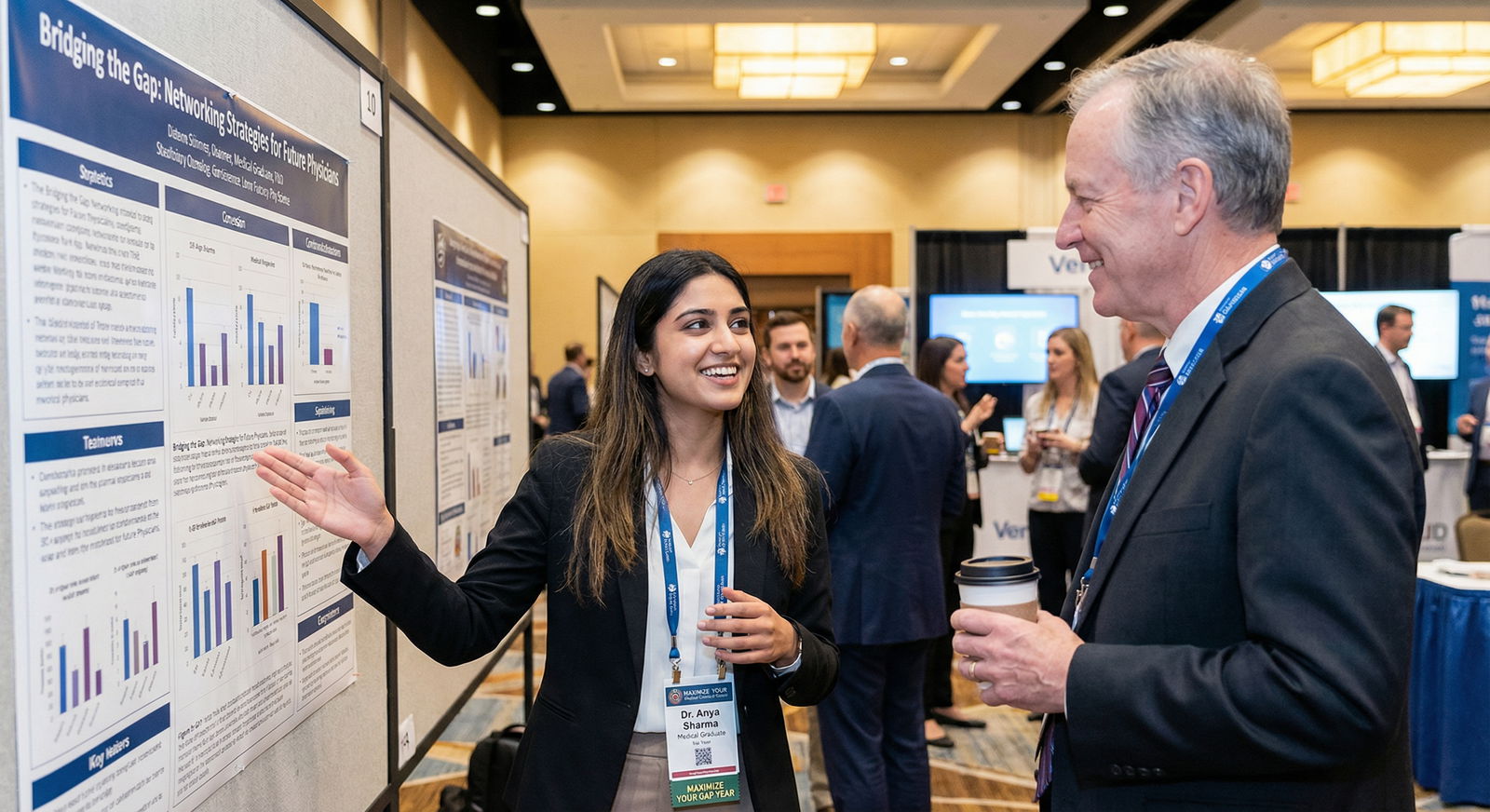
Core Strategies for Effective Networking During a Gap Year
Networking does not have to be forced or uncomfortable. With some structure and practice, it can feel natural and even energizing.
1. Craft a Clear, Authentic Elevator Pitch
An elevator pitch is your concise self-introduction used in professional settings—conferences, emails, LinkedIn messages, or casual encounters.
Include three elements:
- Who you are
- “My name is [Name], and I’m a [pre-med graduate/medical student/recent graduate] currently in a gap year.”
- What you’re doing now
- “I’m working on [clinical research in cardiology / volunteering in a community clinic / public health data analysis].”
- Where you’re heading and what you’re exploring
- “I’m very interested in [specialty or topic] and I’m hoping to learn more about [X] and connect with mentors in this area.”
Example:
“Hi Dr. Lee, my name is Maya. I recently graduated and I’m in a gap year working as a research assistant in an emergency medicine outcomes study. I’m strongly considering EM or critical care and would love to learn how you decided on your career path and what you wish you’d known as a trainee.”
Practice your pitch out loud so it feels natural, and adapt it for different contexts.
2. Use Informational Interviews Strategically
Informational interviews are structured conversations (often 20–30 minutes) where you learn about someone’s:
- Career path and decisions
- Day-to-day work and lifestyle
- Advice for students and trainees
They are not about asking for a job; they are about building relationships and gathering insight.
How to request one:
- Identify potential contacts:
- Alumni from your school
- Faculty at institutions you’re interested in
- Physicians you’ve met while volunteering or at conferences
- Send a concise, respectful email or message:
- Introduce yourself
- Mention any shared connection or context
- State specifically what you’d like (e.g., “a brief 20-minute call to ask about your path into pediatrics”)
- Offer flexible scheduling
During the conversation:
- Prepare 4–6 thoughtful questions, such as:
- “How did you decide on your specialty?”
- “What do you find most fulfilling and most challenging about your work?”
- “How would you advise someone in a gap year who is considering this path?”
- Listen more than you talk
- Ask if there’s anyone else they recommend you speak with
Always send a brief thank-you message afterward and consider updating them on how their advice helped you later on. That’s how one-off conversations become ongoing mentorship.
3. Be Intentional at Conferences, Seminars, and Workshops
Conferences can be overwhelming, but they are some of the richest environments for high-yield Networking.
Before the event:
- Review the program and identify:
- Sessions relevant to your interests
- Speakers you’d like to meet
- Institutions or programs you’re curious about
- Connect on LinkedIn or X with presenters you admire:
- “Looking forward to your talk on [topic] at [conference]. I’m a gap year student interested in [field].”
During the event:
- Attend smaller sessions, poster sessions, or breakout groups where conversations are easier
- Introduce yourself to speakers at the end of talks with your elevator pitch
- Ask specific questions rather than generic compliments
Afterward:
- Follow up within a few days:
- Reference something specific you discussed
- Thank them again
- Optionally, ask for brief future guidance if appropriate
These follow-ups are what transform quick encounters into sustained professional relationships.
4. Build a Strategic Presence on Social Media
Online platforms can magnify your Professional Development if you approach them deliberately.
LinkedIn:
- Use a professional photo and clear headline:
- “Gap Year Research Assistant | Aspiring Internal Medicine Physician”
- Fill out:
- Education
- Experiences (volunteering, research, leadership)
- Skills and certifications
- Post or share:
- Reflections on your gap year work
- Articles related to your interests
- Conference takeaways
X (Twitter) for academic networking:
- Follow:
- Physician leaders and educators
- Journals and professional societies
- Residency programs of interest
- Engage:
- Comment thoughtfully on threads
- Join virtual journal clubs or tweet chats
- Share:
- Lessons you’re learning
- Questions about specialty choices or research methods (respecting professionalism and confidentiality)
Always maintain a professional tone. Assume program directors and future colleagues might see anything you post.
5. Join Professional Associations and Organized Medicine
Membership in relevant organizations connects you with physicians, residents, and medical students dedicated to the same field or issue.
Examples:
- Specialty-specific societies (e.g., ACP, AAFP, ACEP, AAP, ACOG, etc.)
- Student or trainee sections of national associations
- Local medical societies
- Interest-based groups (global health, health equity, medical education)
How to use them for networking:
- Attend local chapter meetings or virtual town halls
- Volunteer on a committee (advocacy, education, diversity, etc.)
- Participate in mentorship programs or “speed mentoring” events
This kind of involvement often stands out positively in residency applications and interviews, as it shows early engagement in the professional community.
6. Offer Value and Be Generous
Networking becomes more comfortable when you stop asking “What can I get?” and instead ask “What can I contribute?”
As a gap year student, you might:
- Help with data collection or abstract formatting
- Volunteer to proofread a manuscript or create slides
- Share resources or opportunities with peers
- Organize a small study group or journal club
People are more likely to invest in you if they see you are proactive, dependable, and generous with your time and effort.
Real-World Examples: How Gap Year Networking Changes Trajectories
Stories help illustrate how these principles play out in real life.
Case Study 1: The Volunteer Who Found a Mentor
Sarah, a pre-med on a gap year, volunteered three days a week at a community health clinic. Initially, she focused only on fulfilling her hours. After a few weeks, she shifted her approach:
- She began asking physicians about their paths into primary care.
- She stayed a few minutes after her shift to debrief with the clinic director about what she was learning.
- She asked if the director would be open to a brief meeting about medical school applications and specialty choice.
The clinic director became a mentor, reviewing her personal statement and giving honest feedback on her school list. Over months of consistent work and relationship-building, Sarah earned a strong, detailed letter of recommendation that highlighted not just her work ethic but also her growth, empathy, and initiative—qualities that significantly strengthened her application.
Case Study 2: Turning Social Media Engagement into an Internship
Mike, taking a gap year after his Step exams, was unsure how to connect with academic physicians. He created a professional LinkedIn profile and began:
- Following several hospital departments and physicians in his area of interest
- Commenting thoughtfully on posts about research articles and clinical cases (without giving medical advice)
- Sharing brief reflections on public health issues and evidence-based medicine
One cardiologist noticed his consistent, insightful engagement and saw on his profile that he lived in the same city. She messaged him, asking about his interests. That conversation turned into:
- An invitation to join a quality-improvement project
- A structured research internship during his gap year
- A first-author abstract that Mike presented at a regional conference
When he applied for residency, that cardiologist wrote a detailed letter, and her colleagues in other programs recognized his name from the conference presentation.
Case Study 3: Conference Connections That Paid Off at Match Time
Kelly, between third and fourth year of medical school due to a leave, treated that year as a structured gap. She attended a national conference in the specialty she was considering:
- She identified three programs she was highly interested in and attended all sessions led by their faculty.
- After one particularly compelling talk, she introduced herself to the speaker with a brief, clear elevator pitch.
- They had an impromptu 10-minute conversation that led to a scheduled follow-up Zoom call.
Over the next year, Kelly:
- Collaborated on a small education project with that faculty member
- Stayed in touch via email and occasional virtual check-ins
- Met several of that professor’s residents and colleagues at subsequent virtual events
When Kelly applied for residency, she received interview invitations from all three of those programs. During one interview, a faculty member mentioned, “We’ve heard great things about you from Dr. [Name].” Her network—the relationships she built intentionally during her gap year—directly impacted her application’s reception.

Putting It All Together: Making a Networking Plan for Your Gap Year
To ensure your gap year meaningfully advances your Medical Career, create a simple, written networking and Professional Development plan.
Step 1: Clarify Your Goals
Ask yourself:
- What do I want to understand better by the end of this gap year?
- A specialty?
- The residency application process?
- Academic vs. community practice?
- What types of roles am I hoping to secure?
- Research assistant?
- Clinical volunteer?
- Public health work?
- What kind of mentors do I need?
- Someone in my specialty of interest?
- Someone with a similar background (e.g., IMG, non-traditional, first-generation)?
- Someone who is strong in research, teaching, or leadership?
Step 2: Map Your Opportunities
Based on your main gap-year activity, list:
- 5–10 people you could request informational interviews with
- 1–3 conferences, webinars, or workshops you can realistically attend
- 2–3 professional associations or online communities to join
- 1–2 social media platforms you’ll use intentionally
Step 3: Set Concrete Actions and Timelines
Examples:
- Schedule one informational interview every 2–3 weeks
- Reach out to one new potential mentor per month
- Post or engage thoughtfully on LinkedIn or X at least once per week
- Attend at least one networking event (virtual or in-person) every 1–2 months
Track your outreach and follow-ups in a simple spreadsheet or notebook.
Step 4: Maintain and Nurture Relationships
Networking is not a one-time task; it’s an ongoing process. To keep relationships alive:
- Send periodic updates:
- “I wanted to share that I was accepted to [X], and your advice on [Y] was very helpful.”
- Share relevant articles or opportunities with contacts
- Express authentic gratitude when their guidance impacts your decisions
Over time, you’ll build a small but powerful network of people who know you, trust you, and are invested in your success.
Frequently Asked Questions (FAQ)
1. What is the best way to start networking during a gap year if I feel shy or inexperienced?
Start small and structured:
- Begin with people you already know or have some connection to—professors, advisors, supervisors, or alumni.
- Request brief, time-limited conversations (15–20 minutes) with a clear purpose.
- Use email templates and a prepared list of questions so you’re not improvising under pressure.
You don’t have to be outgoing to be effective at networking—consistency, professionalism, and genuine curiosity matter more than charisma.
2. Should I prioritize quantity or quality when building my network?
Quality matters far more than quantity. A handful of strong relationships—with mentors who know you well and are willing to advocate for you—are more valuable than dozens of superficial contacts.
Aim for:
- A small core group of 3–6 mentors or close contacts
- A broader circle of 10–20 professional acquaintances you can reach out to for specific advice or collaboration
Depth of relationship is especially important when you eventually need letters of recommendation or specialty-specific guidance.
3. How do I follow up effectively without feeling like I’m bothering people?
Thoughtful follow-up is usually appreciated when it is:
- Brief
- Specific
- Infrequent (every few months, unless you’re actively collaborating)
Examples of good reasons to follow up:
- Thanking them for advice and sharing how you applied it
- Letting them know about a milestone (publication, acceptance, match)
- Asking 1–2 focused questions related to a prior conversation
Most busy professionals are more than willing to support students who respect their time and show initiative and follow-through.
4. Can I still build a strong network if my gap year isn’t in a hospital or research setting?
Yes. Even if your primary gap-year activity is outside medicine (e.g., non-healthcare work, caregiving, financial necessity), you can still:
- Attend local or virtual grand rounds and lectures
- Join online communities and professional associations
- Reach out to alumni or physicians for informational interviews
- Volunteer occasionally in clinical or community health settings when possible
Programs often value applicants who balanced responsibilities while still demonstrating sustained interest and curiosity about medicine.
5. How does networking during my gap year actually influence my residency applications?
Effective gap-year networking can:
- Lead to meaningful clinical, research, or leadership experiences to highlight in your CV, personal statement, and interviews
- Provide strong, detailed letters of recommendation
- Connect you with residents and faculty in programs you’re targeting, which can:
- Improve your understanding of program culture
- Give you insight for tailoring your application
- Occasionally generate internal advocacy or referrals
Residency selection is not purely numerical; your relationships, reputation, and demonstrated engagement in the field matter significantly.
By intentionally investing in Networking during your gap year—through volunteering, research, conferences, online platforms, and mentorship—you turn a potentially uncertain “in-between” time into a powerful accelerator for your Medical Career and long-term Professional Development.


