

The riskiest way to spend a gap year before a couples match is to just “see how things go.”
If you and your partner are taking a gap year before applying to residency together, you are not on a normal track anymore. You’re on a higher‑variance path. You can win big—better programs, same city, stronger applications—or crash hard—no match, forced long‑distance, or scrambling into prelim spots you don’t want.
Let’s treat this like what it actually is: a one‑year project with two stakeholders, a hard deadline, and a lot of moving parts.
Below is how to run that project so you come out with jobs, in the same place, and not burned out or broke.
1. Get painfully clear on your starting point as a couple
Before you “optimize” the year, you need to know what you’re optimizing from. You and your partner need one blunt, no‑BS conversation with laptops open, old score reports up, and CVs in front of you.
You should each know, in writing:
- Your Step/COMLEX scores, any fails, exam gaps
- Your clinical performance (honors, passes, any remediation)
- Research output (real lines on a CV, not “helped in a lab once”)
- Specialty interests and competitiveness
- Geographic constraints (family, visas, kids, mortgages)
Now put those pieces together.
| Aspect | Partner A (IM) | Partner B (Peds) |
|---|---|---|
| Step 2 CK | 247 | 233 |
| Research Pubs | 1 pub, 2 posters | 0 pubs, 1 poster |
| Clerkship Honors | 4/7 | 2/7 |
| Visa Needed | No | Yes (J-1) |
| Geographic Priority | Northeast | Northeast |
You’re not doing this to beat yourselves up. You’re doing it to answer:
- Who is the “limiting factor” in terms of competitiveness?
- Is there a specialty that might be unrealistic in this couples match?
- Which one of you must look stronger by ERAS submission for this to work?
Here’s the harsh truth: couples match outcomes tend to track the weaker application, not the stronger one. Programs need two spots in the same region. If one partner is extremely competitive and the other is borderline, the borderline partner drives the bus.
So in your gap-year planning, you prioritize shoring up the weaker application first. Not because it’s “fair,” but because it’s how you both end up in the same city.
2. Design your gap year around the match calendar, not the other way around
Too many people build their gap year like a normal job search: “I’ll find a research/post‑grad job and figure out ERAS later.” That’s backward.
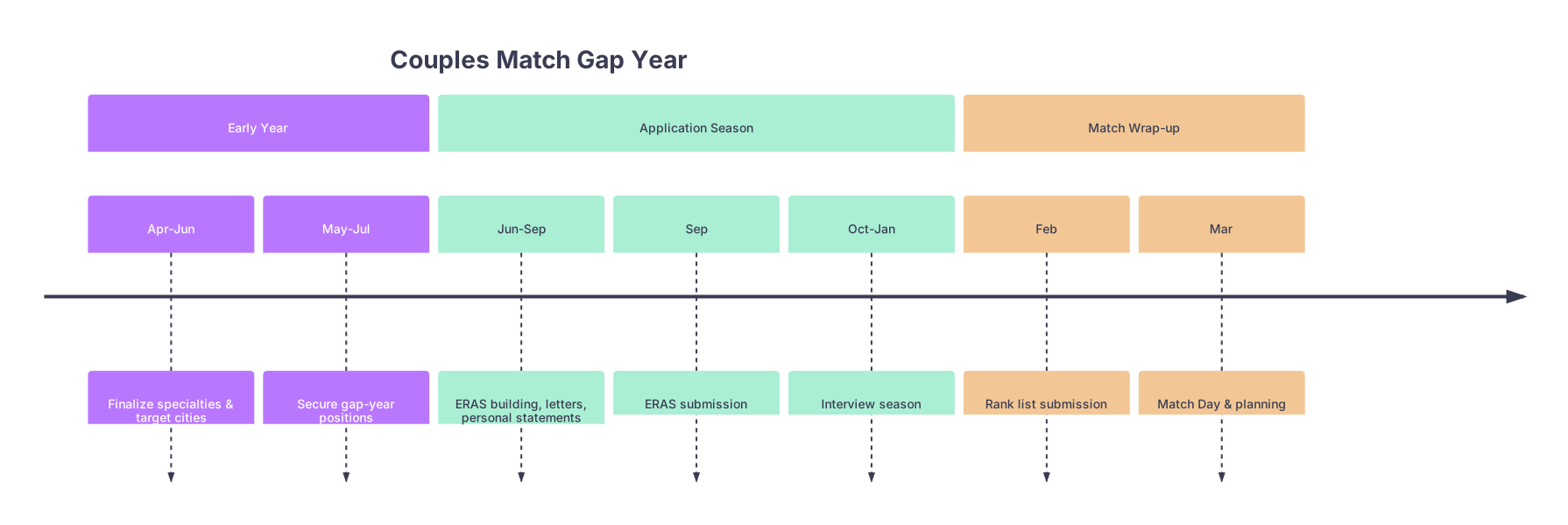
You build your year around this fixed skeleton:
| Period | Event |
|---|---|
| Early Year - Apr-Jun | Finalize specialties & target cities |
| Early Year - May-Jul | Secure gap-year positions |
| Application Season - Jun-Sep | ERAS building, letters, personal statements |
| Application Season - Sep | ERAS submission |
| Application Season - Oct-Jan | Interview season |
| Match Wrap-up - Feb | Rank list submission |
| Match Wrap-up - Mar | Match Day & planning |
Everything you take on—research, clinical work, moonlighting, teaching—has to bend around:
- Letter‑writing cycles (attendings need 2–3 months of seeing you)
- ERAS build time (June–August)
- Interview flexibility (October–January, you need schedule control)
That means:
- Avoid jobs that lock you into rigid, inflexible schedules in Oct–Jan.
- Prioritize roles where supervisors are academic and actually write residency letters.
- Be wary of positions that look good on paper but give you zero meaningful mentorship or responsibility.
If you accept a “perfect” research job that will not let you leave for 10 interviews, you just traded a line on your CV for fewer chances to match. That’s bad math.
3. Choose the right gap-year roles for each of you
You and your partner do not need the same type of job. You need complementary choices that fix each person’s specific weaknesses while protecting your shared time and flexibility.
Here’s how I’d think about it by situation.
If your scores are mediocre / you had a red flag
You need proximity to faculty who can say, “I work with this person regularly, they are excellent, and their test scores do not reflect their current capability.”
You look for:
- Clinical research coordinator roles in your specialty (ideally at an academic hospital)
- Junior clinical instructor positions (for people with MD/DO already)
- Inpatient service extender type roles where attendings see you doing real work
Targets:
- 1–2 new strong letters that directly address any red flags
- Evidence of reliability and professionalism over 6–12 months
- Maybe a publication or abstract, but letters > pubs if you have a score issue
If you’re pivoting specialties
Example: you did all your research in neurology, realized you love psych, and now you’re couples matching IM + psych.
You need:
- A job fully embedded in the new specialty (psych clinic, addiction program, inpatient psych research)
- At least one letter, preferably two, from people clearly anchored in that field
- A coherent story of “why this switch and why now” built through actual work and not just vibes
Do not stay in your old specialty for convenience. Programs are tired of “I liked X but realized my passion was Y last month.” Your gap year is proof that the switch was thoughtful, not impulsive.
If you’re already a strong applicant
Your risk is complacency and time sink.
You look for:
- Roles that keep you clinically fresh (per diem clinical work if allowed, telehealth, scribing with high decision‑exposure)
- Light research with senior author who is already a known letter writer
- Teaching roles (MCAT, Step tutor, OSCE coach) that show leadership and communication
Goal here: don’t screw up your trajectory. Stay sharp, generate maybe one extra letter, and give yourself flexibility for interviews.
4. Money, visas, and logistics: the unsexy stuff that ruins plans if ignored
You’re a couple. Which means:
- Two sets of loans
- Possibly two visas
- Just one geographic outcome (ideally)
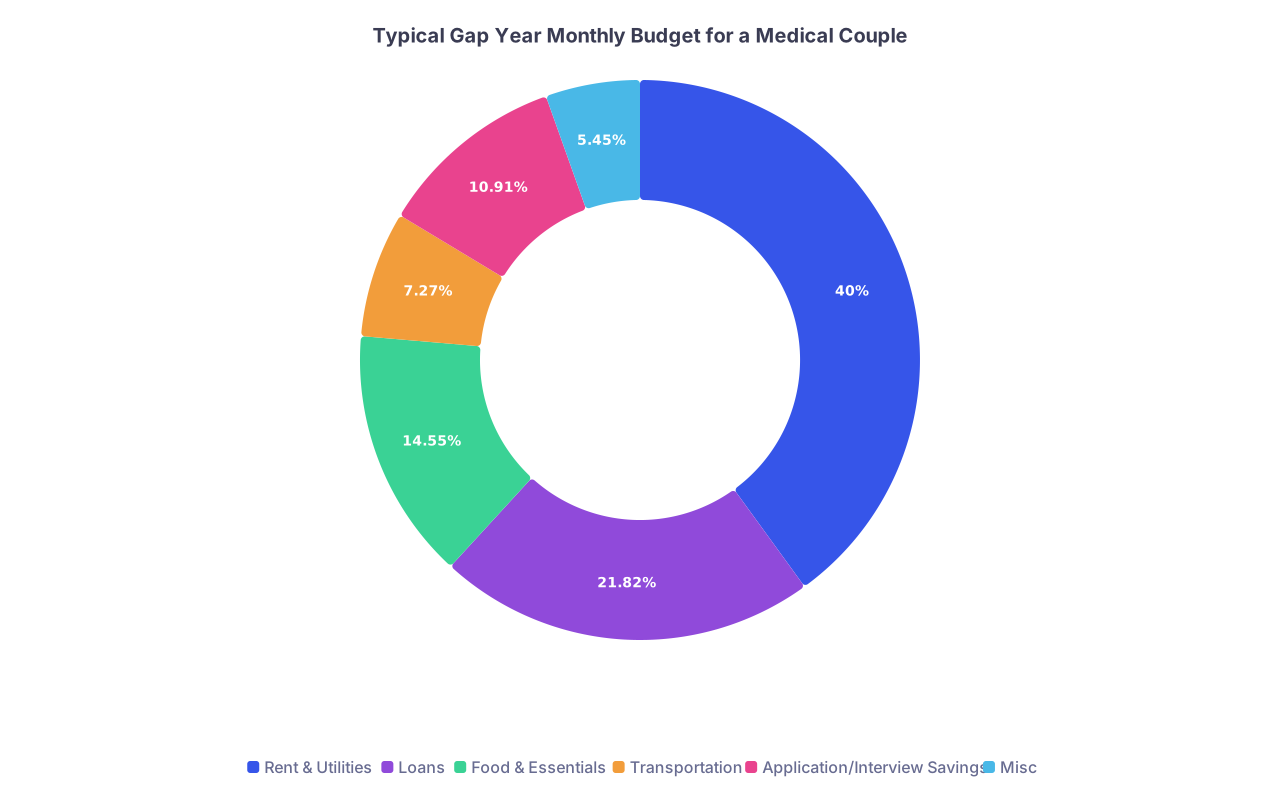
Sit down and actually run numbers. Not vibes. Real dollars.
| Category | Value |
|---|---|
| Rent & Utilities | 2200 |
| Loans | 1200 |
| Food & Essentials | 800 |
| Transportation | 400 |
| Application/Interview Savings | 600 |
| Misc | 300 |
If neither of you is earning much, you need:
- A realistic interview travel budget (out‑of‑state trips add up fast, even with virtual)
- A plan for health insurance (COBRA, marketplace, or employer‑based)
- Clarity about how much unpaid time off you can take in interview season
If one of you needs a visa (J‑1, H‑1B):
- Bias your job search heavily toward institutions that sponsor that visa for residency.
- Do not assume “we’ll deal with it later.” You will run into edges like: great program, perfect city, no visa support.
If one of you will be supporting the couple more financially:
- Be explicit. “I’ll work 0.8 FTE to carry more income, you take the more academic low‑paid research job to boost your application.”
- That’s a rational tradeoff if the weaker applicant is being “subsidized” academically so that you both match together.
This is where people get fuzzy and resentful. Put it on paper. You’re not a Netflix subscription. You’re each making deliberate trade‑offs for a shared outcome.
5. Build a joint application strategy, not two parallel ones
Couples match is not “two people applying at the same time.” It’s one combined optimization problem.
You need a spreadsheet. Not optional. Columns something like:
- Program name
- City/region
- Specialty A competitiveness (safety/target/reach)
- Specialty B competitiveness (safety/target/reach)
- Visa‑friendly?
- Location desirability (both of you 1–5)
- Has both your specialties?
- Historical couples match friendliness (ask around, mentors often know)
From there, you construct tiers of paired programs. For example:
- Tier 1: both of you at strong academic programs, same hospital system
- Tier 2: one at academic, one at solid community, same city
- Tier 3: both community, but same metro area and livable
- Tier 4: nearby cities with frequent transport (e.g., Philly–NYC)
Do not fall into the trap of “we’ll only go to X city or we won’t match.” You’re not that special. The match algorithm does not care about your relationship story. It cares about rank lists.
Your gap year should end with:
- A realistic, jointly constructed program list
- Agreement on how far you’re willing to go down the “tier” ladder to stay together
- A plan B if one of you doesn’t match (I’ll come back to this)
6. Use the gap year to collect strategic letters and connections
You’re not just working. You’re auditioning.
Here’s how to use that.
Identify 2–3 potential letter writers within the first month of any job.
Say it out loud: “I’m planning to apply to X next cycle and would really value working closely with you—both to learn and to possibly have a strong letter if things go well.”Make their life easy and your presence useful.
You volunteer for the annoying but visible work: data cleaning with quick turnarounds, being first into clinic, pre‑rounding thoroughly. They need to notice you enough to talk about specifics in your letter.You and your partner should try to anchor letters in the same region where you want to match.
Example: If you want to be in Chicago, doing a gap year research job in Boston is fine, but you better have at least some connection or letter from the Midwest too—away rotations, sub‑Is, or even a short-term observership.
And yes, it matters if your letters land around the same time. Programs often review both halves of a couple together. You don’t want one application feeling “unfinished” while the other looks polished.
7. Protect interview season like your life depends on it (because your joint life does)
October to January will be messy. Two inboxes, two sets of invites, often with minimal notice and big pressure to respond fast.
You need a pre‑agreed interview policy. Before invites start.
Examples:
- Decide your top 3–5 cities/regions where you will go out of your way to accept almost any interview.
- Decide your “automatic yes” threshold for each of you separately. (For the weaker application: more liberal acceptance of interviews.)
- Agree on when you’ll decline interviews that are geographically impossible to pair.
Do not assume invites will mirror each other. They won’t. One of you may be flooded early; the other hears crickets for a month. That’s emotionally brutal if you don’t prepare for it.
A few practical moves:
- Keep a shared calendar with color‑coding for each partner’s interviews.
- Use flexible housing—month‑to‑month lease, sublet, or living somewhere cheap—so if one of you has to travel you’re not tied down by a 12‑month, high‑rent commitment.
- If travel is required, batch interviews geographically when you can. Programs understand “I’ll be in town that week; any chance I can come then?”
Your gap year job(s) must bend around this. If your boss starts getting annoyed in October that you’re “never around,” that’s on you for not setting expectations up front.
When you accept a position, you say something like:
“I’ll be applying to residency this year, and interview season for my specialty tends to be October to January. I want to be upfront that I’ll need flexibility to attend interviews, and I’m happy to make up work in X, Y ways. Would that fit with your expectations for this role?”
If they blanch, that’s a red flag. Look elsewhere.
8. Don’t neglect the relationship part (or you’ll hate each other by Match Day)
I’ve seen this more than once: couple spends the whole year optimizing, working, emailing programs, tracking invites… then Match Day comes and they’re exhausted, resentful, and barely talking.
You are not just co‑applicants. You’re also two humans trying to stay together under stress.
Some blunt advice:
- Do not make every conversation about applications. Have at least one “no residency talk” evening each week.
- Be honest about envy. If one of you starts racking up “reach” interviews and the other doesn’t, that will sting. It’s normal. Name it, don’t let it rot.
- Don’t both work insane gap‑year jobs with no time off. At least one of you needs bandwidth to cook, handle logistics, keep things semi‑sane.
If you blow up your relationship to get into the same program, that’s not a win.
9. Have a real Plan B if you do not couples match
This part is always ignored until it’s too late.
You must talk now—before ERAS, before interviews—about what happens if:
- One matches, the other doesn’t
- You both match, but in different cities far apart
- One of you gets only a prelim or transitional year
Decide in advance:
- Are you willing to do long‑distance for 1–3 years? Under what conditions?
- If one doesn’t match, will they scramble into SOAP or sit out and reapply?
- Are you willing to re‑enter the couples match the following year if needed?
Your gap year can even be designed to support that contingency. For instance:
- The partner more at risk for not matching might stay embedded in a department that could hire them in a research or clinical role if they need another year.
- You might build savings specifically as a “if one of us doesn’t match” buffer.
Brutal truth: the algorithm is not sentimental. It will happily match you in separate states if that’s what your rank list mathematically leads to. Planning now means you won’t make panicked, emotional decisions in February.
10. Put this into an actual one-year plan
Let me pull this together into something you can literally sketch on paper.
Next 2 weeks:
- Sit down together with CVs, scores, and realities.
- Identify: who is the weaker applicant, what each of you needs most (letters, research, clinical strength, geographic tie).
- Draft a shared list of target cities and tiered program types.
Next 2 months:
- Apply deliberately to gap-year roles that fit those needs.
- When interviewing for positions, explicitly ask about flexibility in Oct–Jan and opportunities for letters.
- Choose housing that won’t trap you (shorter lease if possible, manageable rent).
Spring–early summer:
- Start working, identify 2–3 potential letter writers each.
- Keep a simple log of what you’re doing (projects, responsibilities)—you’ll use it for ERAS and personal statements.
- Build your program list spreadsheet together and update as you hear intel from mentors.
Mid–late summer:
- Nail down letters, write personal statements (yes, plural, if you need a couples match‑focused one and a general one), polish ERAS.
- Confirm with letter writers that they’ll upload by early September.
Fall–winter:
- Implement your interview policy.
- Keep the shared calendar.
- Protect some non‑application time for your relationship.
February–March:
- Build a joint rank list that reflects your pre‑decided tiers and boundaries.
- Revisit your Plan B scenarios honestly.
- Then let it go; after list submission, you do not have control.
You’re in a more complicated situation than your classmates who are just “throwing in apps and seeing where they land.” That’s fine. Complex doesn’t mean doomed. It just means you cannot drift through this year.
Open a blank document or spreadsheet right now and title it “Couples Match Gap Year Plan.”
List three columns with your names and “Shared.” Under each, write the top three priorities for this year (letters, research, flexibility, money, geography). If those lists don’t line up, you’ve just found your first problem to solve—together, this week.


